🎓 Universities Teach Degrees. AI Teaches Career Skills. 🤖 🚀
From ATS optimization to interview preparation, AI is democratizing career knowledge once reserved for mentors, recruiters, and career…
🎓 Universities Teach Degrees. AI Teaches Career Skills. 🤖 🚀
From ATS optimization to interview preparation, AI is democratizing career knowledge once reserved for mentors, recruiters, and career coaches.

*Subscribe to stay updated whenever I publish…*
Two years ago, I wrote that schools rarely teach persuasion, negotiation, sales, networking, or influence. The response was interesting.
Many people agreed that some of the most valuable skills in life are learned outside the classroom.
Today I Encountered Another Example
I am part of a METU (Middle East Technical University) job search and placement WhatsApp community with more than 1,200 students, graduates, and alumni.
Almost every day, someone shares a CV and asks for feedback. The messages are usually similar:
“I’m looking for an internship.”
“I’m searching for a job.”
“Could someone review my CV?”
“Do you know any companies hiring?”
What strikes me is not the quality of the candidates. METU graduates are generally intelligent, hardworking, and technically capable.
The problem is something else. Many have never been taught how modern hiring actually works.
The First Interview Is Often With Software
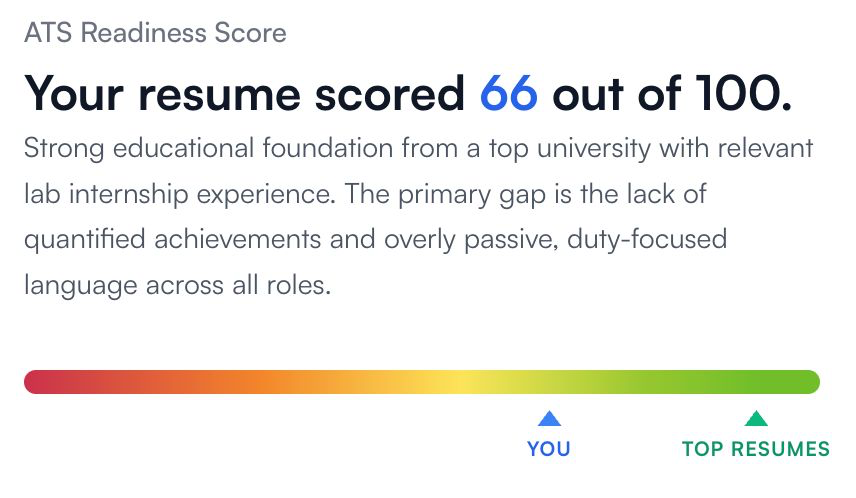
One graduate recently shared her CV. She had graduated from METU Biology, a solid educational background. She also had relevant laboratory experience and internship experiences. Out of curiosity, I ran her resume through an ATS evaluation process. The score came back much lower than most people would expect.
- The issue was not intelligence.
- The issue was not competence.
- The issue was not potential.
- The issue was that the CV was written the way many universities implicitly teach students to write about themselves:
General descriptions -> Courses -> Activities -> Responsibilities.
Modern hiring systems often look for something different:
- Relevant keywords
- Clear role alignment
- Structured formatting
- Quantified achievements
- Evidence of impact
The candidate was strong but the document was weak. Those are very different things.
💡 Curious about your own ATS score? You can test your CV for free using useresume.ai or use the ATS Resume Scorer prompt described below.
Want to Score Your CV, Receive Feedback and Improve? 📄🤖
After sharing ATS feedback with several students and graduates, I realized many people have the same question:
“How can I evaluate my CV myself?”
To make the process repeatable, I built an ATS Resume Scorer Meta Prompt that can be used with modern AI tools such as ChatGPT, Claude, Gemini, or similar systems. The prompt performs five major steps automatically:
1. Mode Detection 🎯
The system automatically switches between: Generic Mode (CV only) and JD-Match Mode (CV + Job Description)
When a job description is available, the scoring model increases the weight of keyword matching and skills coverage to better simulate real ATS behavior.
2. CV Parsing 🔍
Before scoring, the system extracts education, skills, work related experience, languages, formatting signals. This prevents scoring before the resume is properly understood.
3. ATS Scoring 📊
The CV is evaluated across nine dimensions; keyword Match, job title alignment, required skills coverage, education match, experience recency & depth, quantified impact, certifications, formatting compatibility, standard section structure.
The output includes a numerical ATS score out of 100. Gap to the next threshold. A detailed breakdown by category and highest-impact improvement opportunity.
4. Improvement Recommendations 🚀
The system produces a ranked list of fixes based on estimated score improvement. Examples include:
- Weak role alignment
- Missing keywords
- Missing quantified achievements
- Certification gaps
- ATS formatting problems
For JD matching, it also highlights missing requirements from the target role.
5. Visual HTML Scorecard 🎨
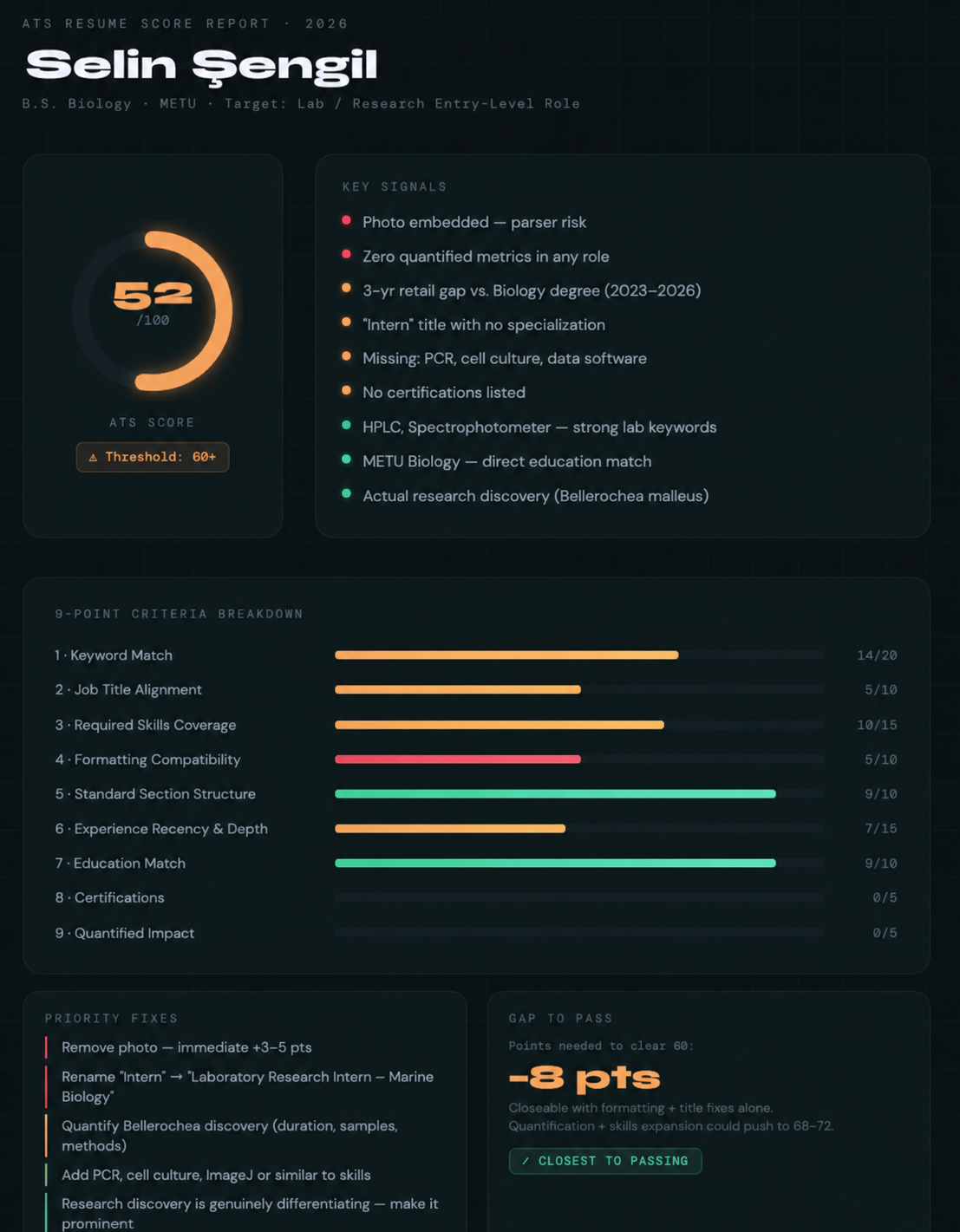
One feature I particularly liked adding is the automatically generated HTML report. This report includes:
- ATS score ring
- Priority fixes
- Visual indicators for strengths and weaknesses
Instead of receiving generic feedback, candidates receive something that resembles a professional recruiting dashboard.
Interested in trying it? Leave a comment or message me and I’ll share the ATS Resume Scorer prompt in .md
Nobody Taught Them The Rules
This is the fascinating part. Universities spend years teaching students how to become Engineers, architects, economists, biologists etc.
Yet very few teach:
- How recruiters screen applications
- How ATS systems rank candidates
- How to write an achievement-focused CV and cover letter.
- How to optimize a LinkedIn profile
- How to prepare for interviews using AI
- How to negotiate compensation
- How to build a professional network
Students spend years preparing for exams. Then they graduate and face a completely different system they have never been trained for.
The transition is surprisingly abrupt.
AI Is Closing The “Career Literacy” Gap
A few years ago, getting high-quality career advice was difficult. You needed a mentor. A recruiter. Maybe a career coach. An experienced manager or simply luck.
Today the situation is changing rapidly, within minutes, AI can help someone:
- Analyze a CV in detail
- Estimate ATS compatibility
- Rewrite bullet points
- Research companies and JD’s
- Identify missing keywords
- Simulate interviews for the role
- Draft cover letters
Knowledge that was previously scarce is becoming abundant. The economics are changing dramatically. A student with access to AI tools can now receive feedback that would have required significant time from experienced professionals only a few years ago.
Much of the discussion around AI focuses on job displacement. That conversation matters.
But I think another trend receives far less attention. AI is becoming a global mentor. It is helping people learn practical skills that traditional education often overlooks.
Not because universities are failing. Universities have different objectives. Their purpose is to teach disciplines, build knowledge, and develop critical thinking.
But career literacy exists in a separate category. And that category has historically been underserved.
AI is starting to fill that gap.
My own career started in a surprisingly similar way. I found my first Industrial Engineering job at the METU Career Fair. Back then, the process looked very different.
There were no ATS systems. No AI career coaches. No resume scoring tools. I attended a group interview organized by Garanti Bank and eventually started my career in Risk Management.
Looking back, I realize how much of that process depended on physical access, timing, and luck.
Today, a student can prepare for the same opportunity with AI-powered CV reviews, interview simulations, company research, and personalized career coaching before ever walking into a career fair.
The playing field is becoming more accessible. At the same time, it is becoming more competitive.
A Course Every University Should Consider
If I could add one elective course to every university curriculum, it would not be another technical subject.
It would be: “How Careers Actually Work 101”
The syllabus would include:
- Personal branding
- LinkedIn optimization
- Networking
- CV writing
- ATS systems
- Interviewing
- Professional communication
- Salary negotiation
The return on investment would be enormous. Because for many graduates, the challenge is not acquiring knowledge.
The challenge is communicating that knowledge effectively.
The good news is that the barrier is falling. The bad news is it’s falling for everyone…
Today, anyone with curiosity and access to AI can learn these skills faster than any previous generation. Perhaps one of AI’s most important contributions will not be replacing work.
It will be teaching people the things that schools never had time to teach.
All the best,
Altan
*Subscribe to stay updated whenever I publish…*
P.s.
🎁 Bonus: I can share the ATS Resume Scorer Master Prompt mentioned in the article.
It can:
✅ Estimate your ATS score
✅ Identify missing keywords
✅ Suggest improvements
✅ Generate a visual scorecard
✅ Match your CV against a specific job description
If you’d like a copy, 👏 clap, ➕ follow, subscribe or 💬 comment “ATS” and I’ll send it over.
메타데이터
- post_id
- 08d0bb04686e
- slug
- universities-teach-degrees-ai-teaches-career-skills-08d0bb04686e
- url
- https://medium.com/@atabarezz/universities-teach-degrees-ai-teaches-career-skills-08d0bb04686e
- canonical_url
- https://medium.com/@atabarezz/universities-teach-degrees-ai-teaches-career-skills-08d0bb04686e
- author_url
- https://medium.com/@atabarezz
- status
- ok
- fetched_at
- 2026-06-24 04:09:36