The Forgotten Genocide
“Who, after all, speaks today of the annihilation of the Armenians?”
The Forgotten Genocide
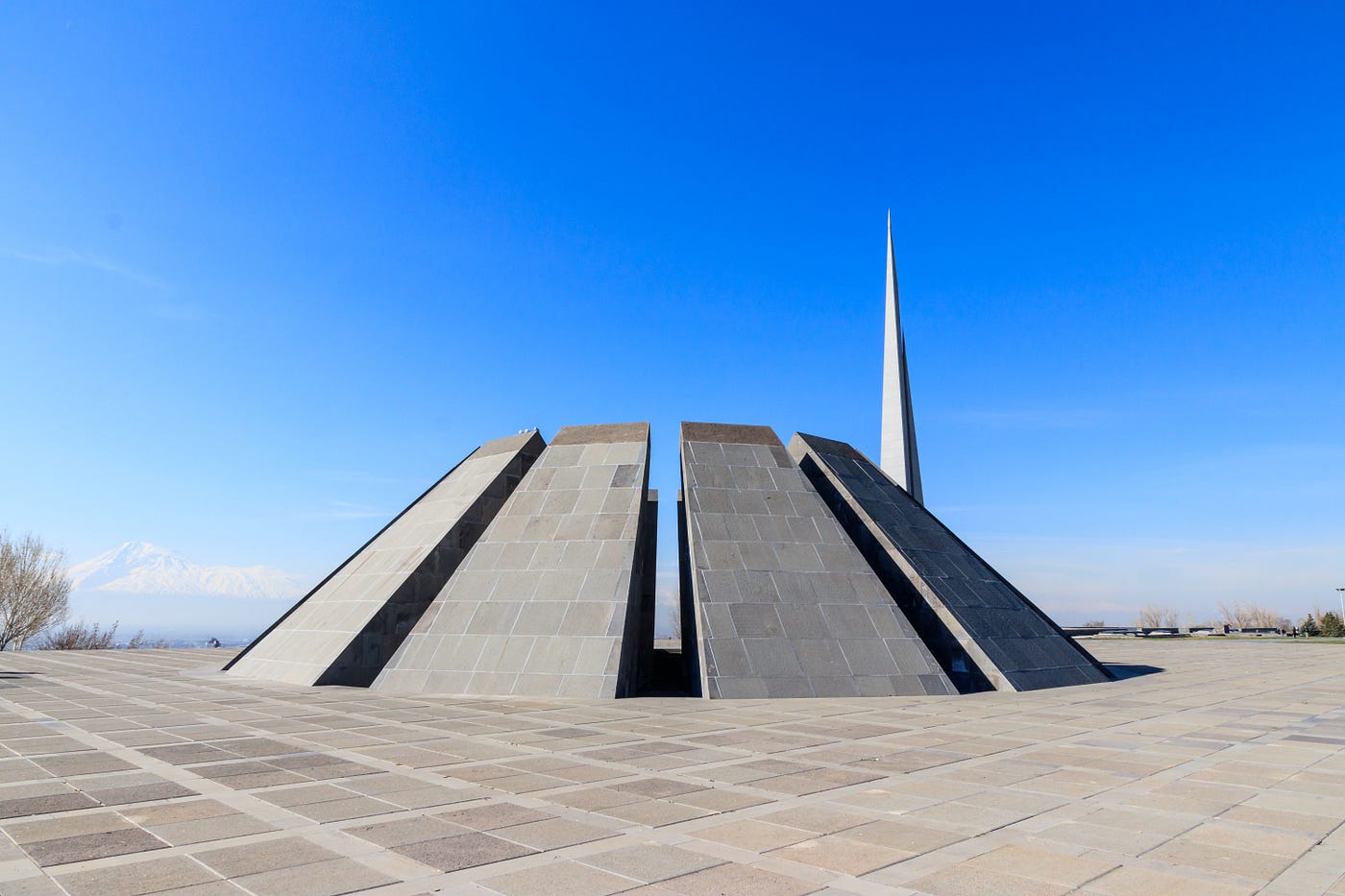
Yerevan Tsitsernakaberd Armenian Genocide Museum Memorial: https://commons.wikimedia.org/wiki/File:Yerevan_Tsitsernakaberd_Armenian_Genocide_Museum_Memorial_msu-2018-3008.jpg
“Who, after all, speaks today of the annihilation of the Armenians?”
Adolf Hitler spoke those words prior to the Invasion of Poland (1939), invoking the view that the Armenian Genocide was a ‘forgotten atrocity.' Within a certain perspective, he was right; the Armenian Genocide isn’t discussed or looked to like the Holocaust, and its horrors have done little to teach the world how to avoid genocides. But to the millions affected and their families, friends, and communities, they haven’t forgotten; they never will. The Armenian Genocide occurred from 1915 to 1923, and depending on the source, the death toll ranges from 600,000 to over 1.5 million deaths.
In present day, Turkey (previously the Ottoman Empire) and, more recently, Azerbaijan have continuously denied the existence of the genocide. They acknowledge that there were a substantial number of Armenian casualties during WW1, but it’s been attributed to various non-genocidal reasons. Fortunately, around 30 countries including the United States, Canada, Uruguay, France, and Germany, have recognized the Armenian Genocide (some have even made denial of it illegal).
Pre-Genocide: 1908 to 1915
During the early 20th century, the Ottoman Empire was ruled by an authoritarian figure, The Sultan, named Abdul Hamid II. Small groups formed with the intention of unseating him. One such was the *Young Turks, a rather diverse group, including Turks, Armenians, Jews, and others. In 1908, the movement to overthrow the Sultan reached its peak, and the Young Turk Revolution began. This revolution was meant to merely oppose the autoritarian leadership, and promote a multi-ethnic, reformist, and liberal learning society, and most importantly, bring back the 1876 Constitution. Unfortunately, over time the Young Turks would be partially radicalized, and those radicals went on to become the architects of the genocide. Within the movement, they formed a radical ultra-nationalist division called the Committee of Union and Progress (CUP). The CUP hijacked the [1908 Young Turk Revolution](https://en.wikipedia.org/wiki/Young_Turks#:~:text=The%20Young%20Turks%20(Ottoman%20Turkish,their%20newspapers%20to%20secret%20subscribers.), and pushed for a radical, nationalist, and exclusionary dictatorship with the goal of the elimination of undesirables. Their plan had two phases, the first was completed in 1908, and the second would occur next, in 1913. In that year, the tri-powers (the Three Pashas/leaders of the CUP) desired to overthrow the current leadership, because they viewed it as the antithesis to the Empire, and a threat to its stability. This coup would be called the [Raid on the Sublime Porte](https://www.britannica.com/event/Sublime-Porte-Incident), and *through this the CUP twisted the Young Turks Revolution, and became the Empire’s new government.
*In April 1909, in the first year following the revolution, Turkish [chauvinists](https://www.merriam-webster.com/dictionary/chauvinism)* (believing in group superiority over others) in Adana, Cilicia, incited locals to attack and brutalize local Armenians; the Turkish army chose to only intervene after a number of days. By then, the damage was done and the message made clear, Armenians weren’t as welcomed as before. The atrocities spread like a virus to other Armenian settlements; some chose self-defence to survive, while many others were slaughtered. Within just a month the massacres had pushed on and taken over 30,000 Armenian lives. What then was the reason for such sudden, brutal, and sickening violence towards an entire group?
Fuelled heavily by paranoia from WW1 regarding; domestic treachery, a common scapegoat for *territorial decline following losses, and an unfortunate mixture of radical and hostile nationalism that considered the Armenians a ‘[fifth column](https://encyclopedia.ushmm.org/content/en/article/world-war-i-and-the-armenian-genocide#:~:text=Under%20pressure,%20Ottoman%20military%20chiefs,deportations%20as%20a%20precautionary%20measure.)’ of society (threats and enemies of the state). The CUP in secret formed a plan for the [destruction and erasure](https://www.armenian-genocide.org/young_turks.html)* of the Armenian people. In 1911, at the Salonika conference, Ottoman leadership chose a full turkification of the empire, and that was the year that the Radicals/CUP finally decided how to officially handle their Armenian 'problem. Secret orders were sent to local authorities within the empire on how to take the necessary steps to begin the extermination.
It was believed this revolution would benefit all, *Greeks, Turks, and Armenians* alike; they were wrong. When all was said and done, many would perish, some would turn on others, and a scar would forever be visible in the hearts and minds of those affected.
The Armenian Genocide: 1915 to 1923
“They can live in the desert but nowhere else”
- Talaat Pasha, Prime Architect and Mastermind behind the Armenian Genocide
The genocide was to take place in order to rid the empire of Armenians, and to achieve this, the state sponsored a policy of death marches (into the Syrian desert), extermination, and starvation conducted in concentration camps.
In 1915, at the onset of the atrocities, on April 24 the genocide would begin formally with ‘Red Sunday’, the day when Ottoman officials arrested hundreds of Armenian intellectuals in the capital. Following this, the deportation of the Armenians would become the first major step, using the questionable justification of the necessity of ‘war.’ Under the CUP, they formed an ‘Executive Committee of Three' to handle the implementation of the genocide, which had the highest level of authorization within the empire to act. They worked out the technical and logistical nightmares of deportation and destruction. They planned the dates for deportation, the routes they’d force them to march, and the camps that would lead to their extermination; they planned everything. Much like the Nazis that would emerge shortly after WW1, the leaders wanted utter extermination and erasure of any and all Armenian culture, and presence. As stated in a secret party session:
“The Armenian nation should be entirely exterminated, so that no Armenian is left in our country and that their name be completely forgotten. Now we are at war and no other such occasion will ever occur. The intervention of the European Powers and the loud protests of the World Press will remain unnoticed, and if they learn about it, they will face a fait accompli and the question will disappear. This time our operations should be directed at total extermination of the Armenians. It is necessary to annihilate them all, till the very last man…I want the Turk and the Turk only to live and impartially rule over this country. Let all the non-Turkish elements go to hell, no matter what nationality or religion they may belong to”
In months following the genocides start, Armenian refugees escaping carnage were abandoned by the withdrawal of Russian troops along *the Caucasus Front. *This act is now generally accepted to have fueled the rapid extermination of Armenians by the Turkish and local Kurdish forces.
Next came the political and military changes: Armenian officials were dismissed, while Armenian Army officers were imprisoned. Regular Armenian military members were stripped of rank/role, disarmed of weapons, and either killed or put into *labour detachments (prison labour). While Armenian soldiers were locked up, violent criminals were being [let out of prisons](https://genocide-museum.am/eng/chronology.php)* and turned towards the Armenians. The imperial leadership understood that removing all Armenian military presence removed a means of resistance for Armenians, as well as the removal of any Armenians in positions of power, and governance.
The rest of 1915 to 1918 would continue along this same path. The first of the mass deportations began in Western Armenia, where the citizens would be sent to the camps or marched to their death. Although Armenian political figures had already been removed, the elite would also be arrested and deported (to their death), including clergymen, writers, parliamentary members, teachers, lawyers, etc. From just April to June of 1915, a mere three months, 800 of these 'elites' were killed either from their deportation (death march) or in the camps themselves. None of what I've found points to these 800 people as more than just Armenians; they weren’t criminals or terrorists or anything dangerous or threatening to the Ottoman Empire. Yet, 800 innocent lives were ended to ‘protect’ the empire.
Barbarism was rampant, according to the *ruler of the city of Kharberd (Eastern Turkey)*, who wrote a letter to the central government of the empire. He further detailed that the roads were covered with the bodies of the slain women and children, and there wasn’t time to bury all of them. What reason did they have for slaying all those women and children? Within just the first year, estimates of casualties were already at 200,000+. Throughout the rest of the genocide, there were more and more deportations and larger and larger numbers of casualties.
The fact that World War 1 raged on from 1914 to 1918, gave a perfect opportunity for the Ottomans to use the conflict to hide their overall atrocities. However, in 1918 the Ottomans were forced to surrender to the allies which ended WW1. In part, the genocide concluded overall but unfortunately, this didn’t end the Armenian genocide in the South Caucasus, with massacres still taking place for a period; although the killings peaked in 1915 and 1916, small massacres continued until 1923 throughout the empire as last ditch attempts.
The Ottoman name was gone but in its place, Turkey was born. By the next year, Turkish Military courts began trials, and convictionsm for the CUP architects responsible for the genocide. In 1921, the *Istanbul Trials* took place, the tri-leadership of the CUP were put to death, while the rest of the leadership were convicted and sent to prison for various lengths. The charges against the leadership were of war crimes, and orchestrating atrocities against Armenians in the Ottoman Empire; yet, Turkey is able to deny that this was a genocide?
Humanity Stepping Up:
For the Armenians, I imagine they felt alone. Overwhelmed by a force that had just one goal, extermination. But in researching, I have found examples of Armenians, Nations and people who helped aid the survivors and victims of the Armenian Genocide.
Armenians themselves attempted to rebel and fight back. Beginning in spring 1915, Turkish troops attacked the Armenian region of Sasun, but the locals when presented with destruction chose to resist, and defend their territory. The Armenians bravely held out until July 1915, but were overwhelmed and unfortunately massacred; other such resistance also occured. For his part in the genocide as an organizer, Talaat was assassinated in 1922 by an armenian student in London, *Soghomon Tehlirian. This was the start of a justice based vigiliate campaign which aimed to eliminate the Young Turk leadership, this was called [Nemesis](https://genocide-museum.am/eng/chronology.php)* (for the Greek Goddess of Revenge). Others like Said Haim would also fall to these Armenian ‘avengers’.
Religious leaders and members from Islam and Christianity; political figures (especially the early and non-radical Young Turks); aid organizations such as the Armenian Red Cross of Constantinople; and neighbouring nations such as those in Russia, Germany, etc., all spoke up or offered some form of aid.
In terms of countries in general, Russia (and later, the Soviet Union) did take in refugees, and after the collapse of the Ottoman Empire, they took control of Armenian territory; unfortunately, the Armenians, while offered humanitarian aid, were also used as a pawn in political matters with Russia. France was another nearby ally that itself had a large Armenian population and provided refuge for those who survived. The United States in 1919 raised over $110 million to provide shelter, sustenance, and clothing for refugees. The US in 1916 under President Wilson also proclaimed October 8 & 9, “Armenian Relief Days”
Countries within the Middle East (Lebanon, Syria, Egypt, and Iraq) provided refuge for survivors as well, with thriving communities still active. Interestingly, these four nations were Islamic, and the Armenians Christian, yet for all the differences, each chose to render aid (proving the Ottomans were not doing this based on religion or even rationality). The Vatican and the Papacy not only recognized the genocide but also referred to it as
“the first genocide of the 20th Century”.
Germany, despite being an Ottoman wartime ally, had missionaries, military personnel, and diplomats, each of whom not only spoke up when witnessing the atrocities but also attempted to provide aid to survivors when possible. The Allied powers felt they couldn’t be indifferent to what was occurring and created the *Triple Entente declaration and therefore chose to send a note, with a [official joint declaration](https://en.wikipedia.org/wiki/May_1915_Triple_Entente_declaration#:~:text=On%2024%20May%201915%2C%20on,law%20after%20World%20War%20II.)* between England, France, and Russia that stated:
“For about a month the Kurd and Turkish populations of Armenia has been massacring Armenians with the connivance and often assistance of Ottoman authorities. Such massacres took place in middle April (new style) at Erzerum, Dertchun, Eguine, Akn, Bitlis, Mush, Sassun, Zeitun, and throughout Cilicia. Inhabitants of about one hundred villages near Van were all murdered. In that city Armenian quarter is besieged by Kurds. At the same time in Constantinople Ottoman Government ill-treats inoffensive Armenian population. In view of those new crimes of Turkey against humanity and civilization, the Allied governments announce publicly to the Sublime Porte that they will hold personally responsible [for] these crimes all members of the Ottoman government and those of their agents who are implicated in such massacres.”
Legacy & Conclusion:
Although great horrors came from the Armenian Genocide, the knowledge of it did remain amongst some. *Henry Morgenthau Jr. The son of the American ambassador to the Ottomans (Henry Morgenthau Sr.) became secretary of the treasury during the FDR administration. His memory of the Armenian Genocide led him to use his position to be an important advocate for the [War Refugee Board,](https://encyclopedia.ushmm.org/content/en/article/war-refugee-board-background-and-establishment)* which acted on behalf of the U.S. to carry out programs helping the Jews and other victims of the Nazis.
From 1915 to 1923, The Ottoman Empire conducted a systematic roundup, deportation, and extermination of their Armenian population. This extermination is still downplayed, and/or denied by Turkey and Azerbajan. However, evidence is abundant in proving that under Ottoman authorization (by the CUP), Armenians were chosen as the target to be deported, starved, and exterminated so that eventually the Ottoman Empire would be ethnically homogenous, populated by Turkic-Muslim people. They were successful in massacring up to 1.5 Million innocent people, destroying culture and heritage, and creating a painful scar in Armenia’s history.
메타데이터
- post_id
- 090a6cfacca5
- slug
- the-forgotten-genocide-090a6cfacca5
- url
- https://medium.com/@JediMasterJF/the-forgotten-genocide-090a6cfacca5
- canonical_url
- https://medium.com/@JediMasterJF/the-forgotten-genocide-090a6cfacca5
- author_url
- https://medium.com/@JediMasterJF
- status
- ok
- fetched_at
- 2026-07-16 17:15:50