The FinOps Tax on AI Engineer Salary Premiums
Part of the ongoing “FinOps for Production AI” series — this one responding to Anubhav’s “AI Engineers Will OWN 2026–2030”
The FinOps Tax on AI Engineer Salary Premiums
Part of the ongoing “FinOps for Production AI” series — this one responding to Anubhav’s “AI Engineers Will OWN 2026–2030”

tax lives where attribution dies
Anubhav’s piece on the AI engineer window is one of the more honest takes on the comp data I’ve read. He nails the shape of it: the 13x growth in AI engineer postings, the 9.2% mid-level comp gain against a 0.8% tech average, and — crucially — the admission that the window is 2026 to 2028, not the full five years his own title promises. He even names the mechanism: once 75% of enterprise engineers are using AI tooling, the label stops meaning anything.
He’s right about all of it. But he’s missing the invoice behind the comp curve. And the invoice, not tool diffusion, is what actually closes the window — and decides who keeps their premium after it closes.
I’ve spent the last several years underneath that invoice. At Roku, I built the cost-attribution pipeline for $10–12M per quarter of AWS spend. At Apple, I work on financial attribution for private cloud infrastructure running internal AI workloads — a fleet of roughly 700,000 servers where misattributed assets were quietly distorting the books by millions until we built the systems to see it. From where I sit, the AI salary premium and the AI cost problem are the same story told from two sides of the ledger.
The premium is a bet on margin nobody has measured
When a company pays the mid-level AI premium Anubhav describes — the $250K–$350K Builder band — it’s making an implicit bet: the AI work will produce margin that justifies the markup.
Sometimes it will.
But here’s what I see from inside the infrastructure: most AI workloads are running at a cost-per-inference that nobody has actually measured, on capacity nobody has actually attributed, against revenue projections nobody has tied to the compute bill.
This isn’t cynicism. It’s an accounting lag, and we’ve run this movie before. In the early cloud era, companies hired “cloud engineers” at a premium, lifted their workloads into AWS, and spent the next five years discovering the bill was 3x what anyone modeled.
That discovery process created FinOps as a discipline. It also quietly repriced the premium: the engineers who kept their markup weren’t the ones who could deploy to the cloud — they were the ones who could deploy to the cloud and explain the bill.
AI is the same movie at higher speed and worse unit economics. GPU capacity is more expensive, more contended, and harder to attribute — a training run that spans three weeks and four teams doesn’t map cleanly to a cost center. Inference is worse: it’s a marginal cost that scales with success. Every product win increases the bill. When your feature takes off, your unit economics get stress-tested, not validated.
So every AI engineer premium eventually faces the same question: when the CFO finally gets clean cost-per-inference numbers, does your work still look like margin? For a lot of AI projects shipped in the last two years, the honest answer is “we don’t know, because we can’t see the costs.” That opacity is currently protecting a lot of salaries. It won’t protect them through 2028.
What attribution did at Roku

Let me make the mechanism concrete. Before the attribution pipeline existed at Roku, cloud spend was a monthly lump. Teams knew their features shipped; nobody could tell you what a feature cost. The engineers who looked most valuable were the ones shipping fastest — which is its own trap.
I’ve written before about the AI productivity paradox: teams generating code faster than they can account for it, then spending the savings on debugging what they generated. Velocity that produces unaccountable systems isn’t leverage; it’s deferred cost. Attribution is what makes the deferral visible.
Once we could attribute spend to teams and services, the picture inverted in specific, uncomfortable ways. Services that looked like wins were running on wildly overprovisioned capacity. A few “boring” infrastructure engineers were quietly saving more money than entire product teams were generating. The prestige hierarchy and the value hierarchy were not the same list — and the gap only became visible when the cost data did.
That’s what’s coming for the AI premium. Right now, AI work is in its pre-attribution phase. The prestige hierarchy — who has “AI” in the title, who touches the models — is standing in for the value hierarchy because the value hierarchy isn’t measurable yet. Every quarter, more companies build the measurement. Every time it lands, some premiums get confirmed and some evaporate. Anubhav dates the window by tool adoption curves. I’d date it by attribution maturity, and attribution is moving faster than Gartner’s adoption numbers suggest — because it’s the CFO, not the CTO, driving it.
The Scaler is the right role — with a missing layer

cost attribution
Anubhav’s taxonomy is genuinely useful: the Prototyper gets commoditized first, the Builder survives because integration is hard, and the Scaler — the person doing evals, observability, and cost-aware routing — has the highest ceiling. His example Scaler writes middleware that routes cheap lookups to Haiku, complex work to Sonnet, agentic reasoning to Opus, and falls back to cache on a 429.
That’s real engineering, and it’s the closest he gets to the actual answer. But notice what the Scaler in his framing is optimizing: provider costs against provider rate limits. That’s cost control. It’s not cost attribution — and attribution is where the durable premium lives, because attribution is what makes your work legible to the people who set the comp bands.
The difference in practice: a Scaler can tell you the routing layer saved 30% on API spend. An engineer who owns attribution can tell you what each feature costs per request, fully loaded, which customer segments are being served at negative margin, and what the P&L impact of the next model upgrade will be. The first is an engineering optimization. The second is a business capability that almost nobody in the org can replicate — because it requires holding the model’s behavior and the money in the same head. Model-side engineers treat cost as someone else’s problem. Finance people can’t read a trace. The intersection is nearly empty, and it’s exactly where the invoices are piling up.
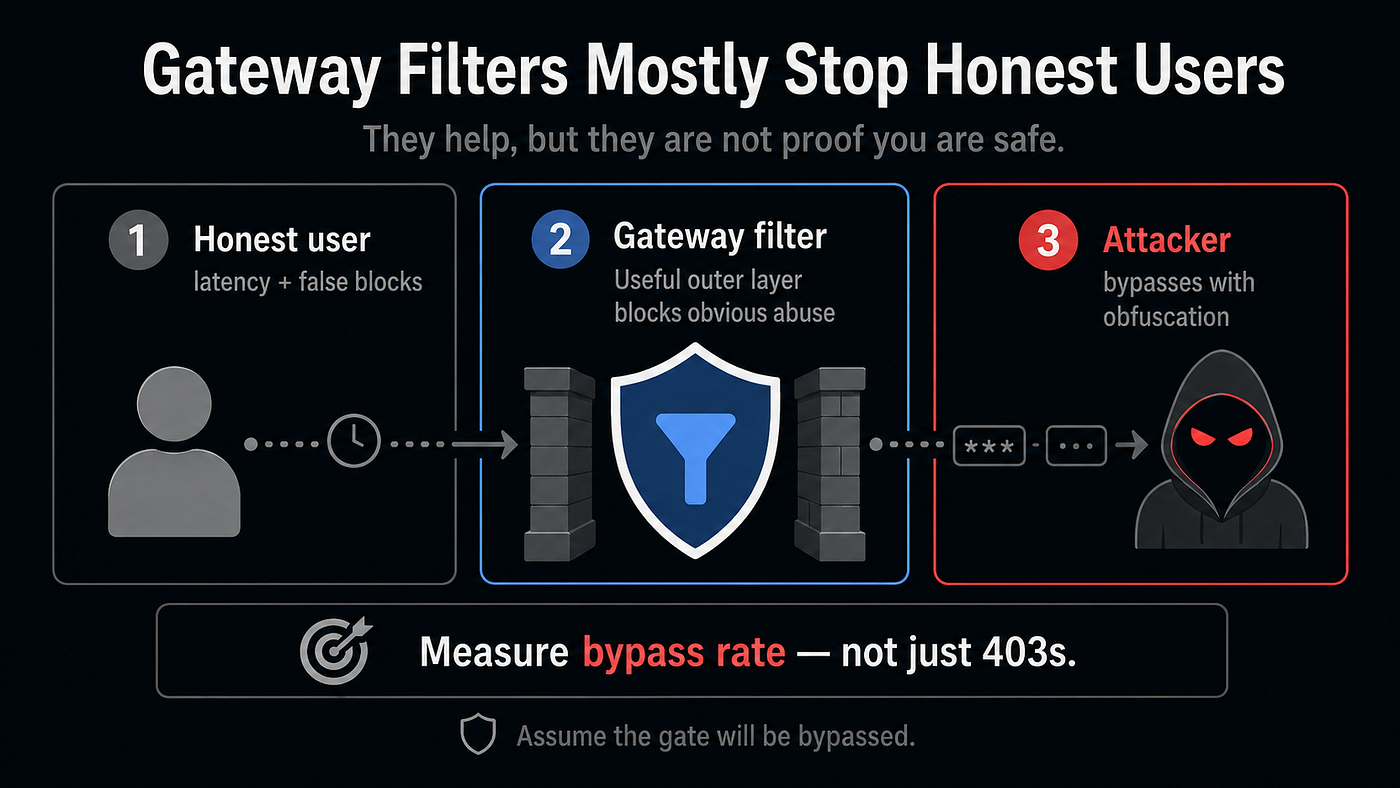
This is the same discipline gap I flagged in my piece on gateway content filters: teams deploy the control (the filter, the router, the rate limiter) and skip the measurement (bypass rate, per-tenant attribution, cost per blocked request). A control you can’t measure is a control you can’t defend in a review — security review or budget review, same failure mode. The Scaler who only builds the routing middleware has shipped the filter without the threat model.
Amending the 12-month artifact

canva made
Anubhav’s concrete advice — build an MCP server against a real backend, ship it with an eval harness that proves 95% reliability over a hundred test cases — is good. I’m shipping MCP in production in my own SaaS right now, and I’ll vouch for the integration work being where the engineering actually lives.
But if you’re building that artifact, add one layer, because it’s cheap now and expensive to retrofit: instrument cost the way you instrument correctness. Per-request, per-tool-call, per-feature. Make your eval harness report not just pass rate but cost-per-successful-outcome. Treat cost regressions like performance regressions — alertable, bisectable, owned. When you demo the artifact, show the unit-economics dashboard next to the eval scores.
That one addition changes what the artifact proves. The eval harness proves you can control a non-deterministic system. The cost layer proves you can control a non-deterministic system and account for it — which is precisely the skill that survived the cloud transition’s window closing, and precisely the one that will survive this one.
The 17.9% is the tell
Anubhav treats the BLS 17.9% software engineering growth baseline as the safe fallback if you miss the AI window. I’d read it differently: that number is the story. General infrastructure engineering is growing at 4.5x the all-occupation average precisely because AI is forcing companies to hire better systems people, not fewer — people who can ship reliable systems under uncertainty and explain what they cost.
His closing advice is to become an AI engineer at a company where AI is the strategic center. Fine. Mine is one step more specific: become the engineer who owns both the model behavior and the cost attribution, wherever you are. The title premium decays on the title’s schedule, and titles commoditize fast. The capability of making AI systems economically legible — reliable in behavior, attributable in cost, defensible in front of a CFO — gets scarcer relative to demand every quarter, because every model release makes the behavior side easier and the economics side bigger. And the economics side keeps moving: techniques like reinforcement-learned teachers are collapsing training costs from one direction while inference volume explodes them from the other. A cost model that was right in Q1 is wrong by Q3. That’s not a problem for the attribution engineer — that’s the job security.
The window is real. But the invoice always arrives. Be the person who can read it.
메타데이터
- post_id
- 093b8bc26ceb
- slug
- the-finops-tax-on-ai-engineer-salary-premiums-093b8bc26ceb
- url
- https://medium.com/devsecops-ai/the-finops-tax-on-ai-engineer-salary-premiums-093b8bc26ceb
- canonical_url
- https://medium.com/devsecops-ai/the-finops-tax-on-ai-engineer-salary-premiums-093b8bc26ceb
- author_url
- https://medium.com/@timothy-urista
- status
- ok
- fetched_at
- 2026-07-11 02:45:20