How to Evaluate a QuickBooks Reconciliation Guide Before Following It
Bank reconciliation is one of the most important accounting tasks for businesses using QuickBooks. It helps ensure that the transactions…
How to Evaluate a QuickBooks Reconciliation Guide Before Following It
Bank reconciliation is one of the most important accounting tasks for businesses using QuickBooks. It helps ensure that the transactions recorded in your books match the transactions reflected in your bank statements. While QuickBooks provides various resources and tutorials, not every reconciliation guide offers the same level of accuracy, clarity, or usefulness.
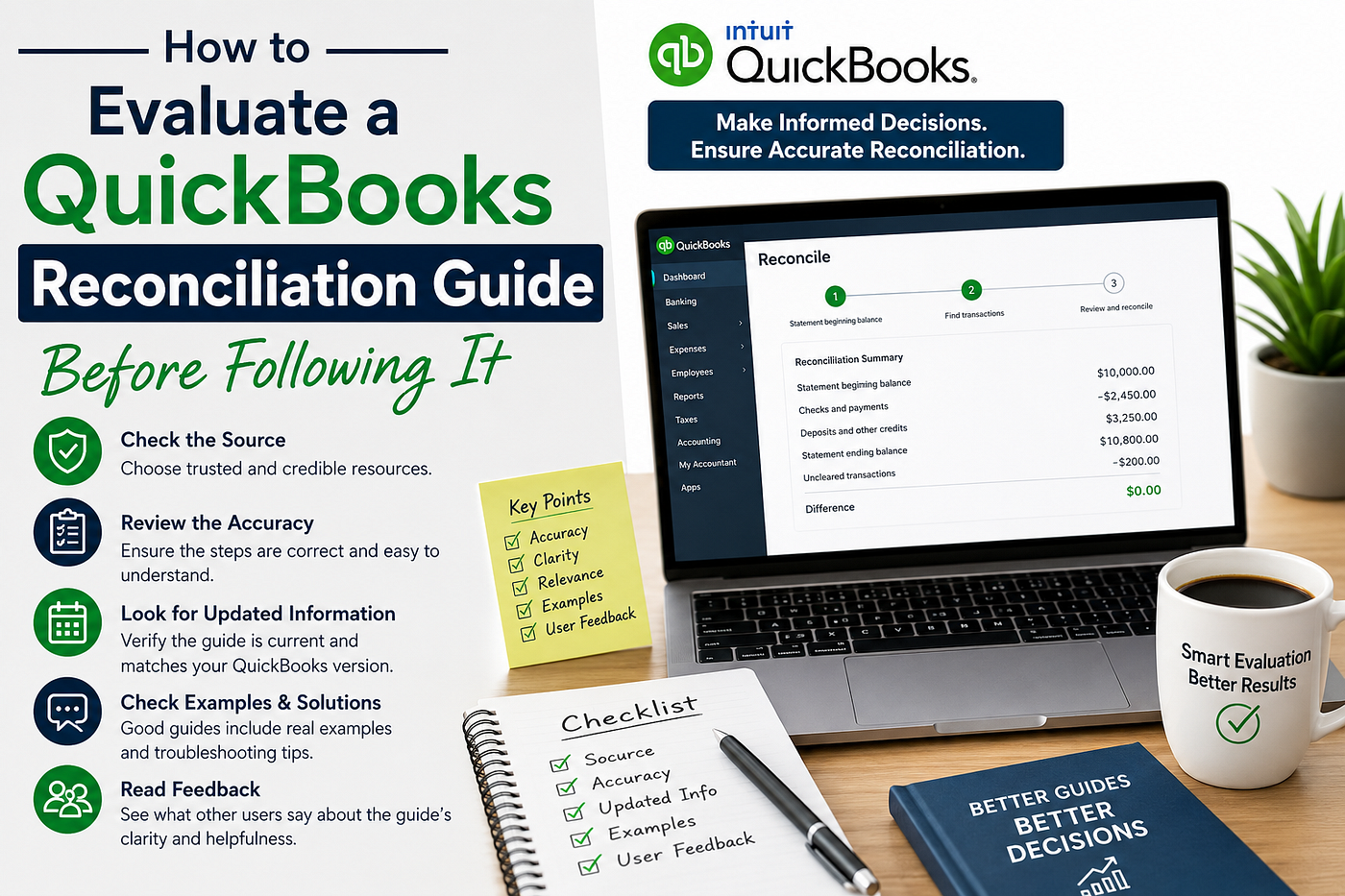
Before following any reconciliation instructions, it is essential to evaluate the quality of the guide. A well-structured guide can save hours of troubleshooting, while a poorly written one may create additional accounting errors. This article explains how to assess a QuickBooks reconciliation guide and determine whether it is worth following.
Why Reconciliation Guides Matter
Reconciliation helps businesses identify missing transactions, duplicate entries, bank errors, and bookkeeping discrepancies. Since reconciliation directly affects financial reporting, relying on inaccurate guidance can lead to serious accounting issues.
Many QuickBooks users search online for tutorials, help center articles, blog posts, and community discussions when they encounter reconciliation challenges. However, not all resources are equally reliable. Evaluating a guide before applying its recommendations can prevent costly mistakes.
Check the Source of the Guide
The first step is to determine who created the content.
Reliable sources often include:
- Official QuickBooks support resources
- Certified QuickBooks ProAdvisors
- Professional accountants and bookkeepers
- Established accounting websites
- Reputable financial software consultants
Be cautious when following advice from anonymous forums or websites that provide limited information about their expertise. Credible sources typically demonstrate accounting knowledge and provide accurate, updated information.
Review the Accuracy of the Instructions
A high-quality reconciliation guide should explain each step clearly and accurately.
Look for guides that:
- Provide step-by-step instructions
- Use correct QuickBooks terminology
- Explain why each action is necessary
- Include examples of common reconciliation scenarios
- Address potential errors and solutions
If a guide skips important steps or provides vague instructions, it may not be suitable for business accounting purposes.
Evaluate the Quickbooks Help Center Reconciliation Guide Review Helpfulness
One useful approach is to assess the overall Quickbooks Help Center Reconciliation Guide Review Helpfulness before relying on its recommendations.
Ask yourself:
- Does the guide answer common user questions?
- Are the instructions easy to understand?
- Does it include screenshots or visual references?
- Are troubleshooting tips provided?
- Is the information current and relevant to recent QuickBooks versions?
A helpful guide should reduce confusion rather than create additional questions.
Look for Updated Information
Accounting software frequently receives updates that can change workflows and interface layouts.
Before following a reconciliation guide, verify:
- Publication date
- Recent updates
- Compatibility with your QuickBooks version
- References to current features
An outdated guide may describe menus or settings that no longer exist, causing unnecessary frustration during reconciliation.
Check for Real-World Examples
The best reconciliation guides go beyond theory and demonstrate practical situations.
Examples may include:
- Missing transactions
- Duplicate entries
- Bank feed discrepancies
- Outstanding checks
- Deposit matching issues
Real-world examples help users understand how reconciliation works in actual business environments rather than just following generic instructions.
Analyze User Feedback and Reviews
User feedback can reveal valuable insights about a guide’s effectiveness.
Look for:
- Reader comments
- Community discussions
- Professional recommendations
- User ratings
- Shared experiences
If many users report success after following the guide, it is generally a positive sign. Conversely, frequent complaints about confusion or inaccuracies may indicate potential issues.
Verify Troubleshooting Coverage
Reconciliation problems rarely follow a perfect path. A quality guide should include troubleshooting sections that address common challenges.
Examples include:
- Reconciliation beginning balance errors
- Missing bank transactions
- Duplicate imported entries
- Incorrect ending balances
- Deleted or modified transactions
Comprehensive troubleshooting information often separates excellent guides from average ones.
Assess Clarity and Readability
Technical accounting topics can become overwhelming if explained poorly.
A useful reconciliation guide should:
- Use simple language
- Break steps into manageable sections
- Include headings and bullet points
- Avoid unnecessary jargon
- Provide logical progression from start to finish
Clear communication improves user understanding and reduces the likelihood of mistakes.
Compare Multiple Sources
Never rely solely on one guide when dealing with important accounting records.
Compare information from:
- QuickBooks support resources
- Accounting professionals
- Industry blogs
- Educational videos
- Community forums
Cross-referencing multiple sources can help confirm whether the guidance is accurate and widely accepted.
Contact for Quickbooks Help Center Reconciliation Guide Review Helpfulness: +18663849053
Signs of a High-Quality Reconciliation Guide
Before following any instructions, ensure the guide demonstrates these characteristics:
✓ Clear step-by-step directions
✓ Updated QuickBooks information
✓ Practical examples
✓ Error resolution guidance
✓ Professional credibility
✓ Easy-to-follow formatting
✓ Positive user feedback
✓ Comprehensive explanations
When these elements are present, users can feel more confident implementing the recommended reconciliation procedures.
Conclusion
Choosing the right reconciliation guide is essential for maintaining accurate financial records in QuickBooks. Not every online resource provides reliable or up-to-date information, making evaluation an important part of the process.
By reviewing the source, checking for accuracy, assessing the Quickbooks Help Center Reconciliation Guide Review Helpfulness, and comparing multiple resources, businesses can identify trustworthy guidance and avoid common reconciliation mistakes. Taking a few extra minutes to evaluate a guide before following it can save significant time, improve accounting accuracy, and support better financial management.
메타데이터
- post_id
- 093f79ee434d
- slug
- how-to-evaluate-a-quickbooks-reconciliation-guide-before-following-it-093f79ee434d
- url
- https://medium.com/@surequickbooks/how-to-evaluate-a-quickbooks-reconciliation-guide-before-following-it-093f79ee434d
- canonical_url
- https://medium.com/@surequickbooks/how-to-evaluate-a-quickbooks-reconciliation-guide-before-following-it-093f79ee434d
- author_url
- https://medium.com/@surequickbooks
- status
- ok
- fetched_at
- 2026-07-13 07:26:45