Why the Universe Is Mostly Empty
When we look at the night sky, we see signs arranged with wisdom and balance. Modern astronomy maps those signs and finds a striking…
Why the Universe Is Mostly Empty
When we look at the night sky, we see signs arranged with wisdom and balance. Modern astronomy maps those signs and finds a striking pattern: most of the cosmos is quiet, thin, and seemingly empty, threaded by a delicate web of galaxies and clusters. Science can describe how this spaciousness arises; ultimate knowledge belongs to Allah, and our understanding remains humble and provisional.
How the emptiness appears
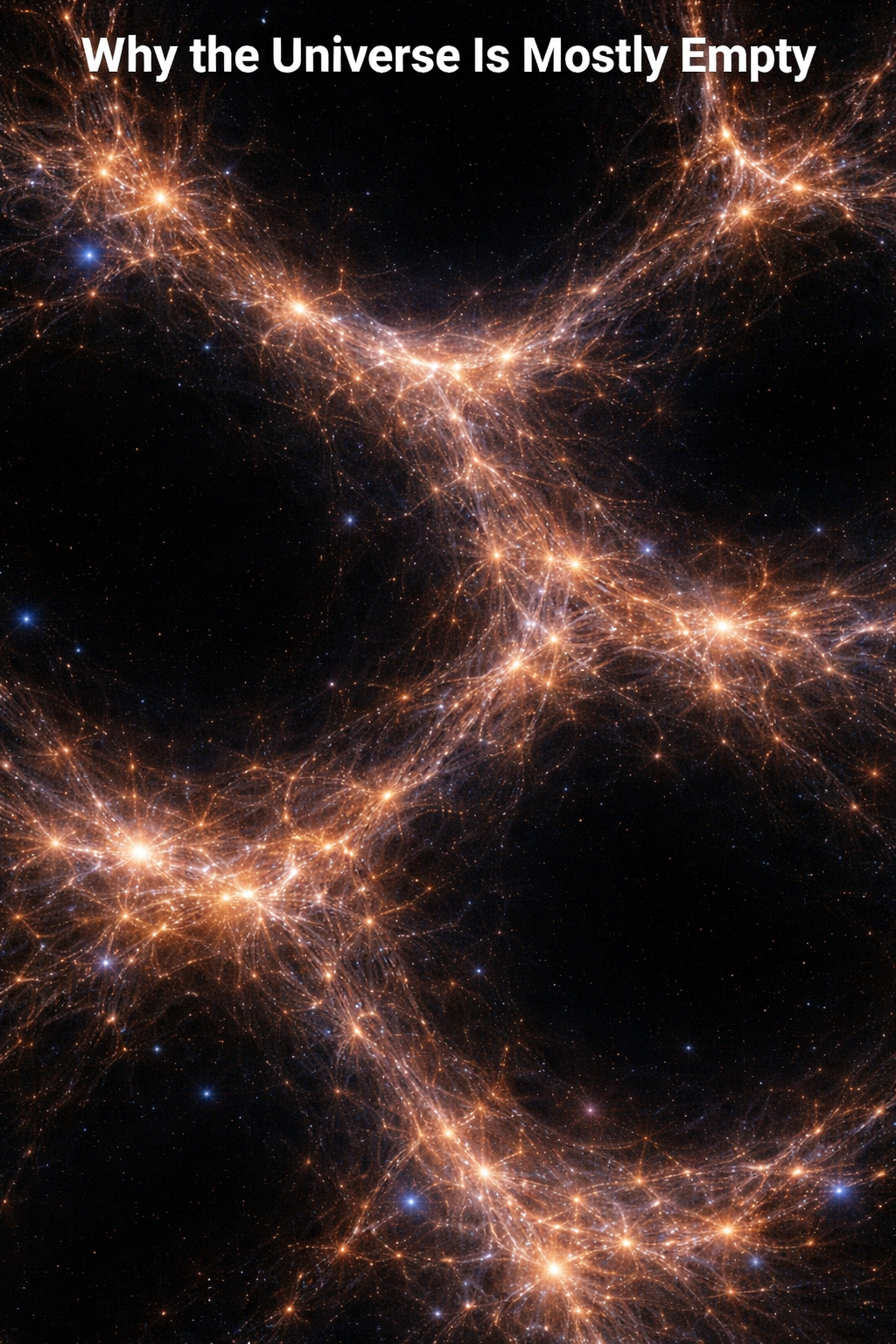
The cosmic web Galaxies gather in filaments and clusters. Between them lie vast regions cosmic voids where matter is sparse. Gravity amplifies tiny early ripples in density: slightly denser patches draw in more material and grow bright, while slightly emptier regions give up matter to their surroundings and become calmer and wider. Over time, small voids merge into larger basins, producing a foam‑like structure across creation. Expansion widens the gaps: Space itself is stretching. On the largest scales, this gentle widening increases the distance between unbound structures, making the low‑density regions even more spacious. Locally, gravity holds systems together planets, stars, galaxies so the expansion shows up only across immense distances. Matter is diffuse by design: Even where matter exists, it is spread out. Dark matter forms broad halos; ordinary gas thins as it fills those halos; galaxies themselves are little islands within a vast sea. In daily life, matter feels solid, yet atoms are mostly space electrons occupy roomy orbits around tiny, dense nuclei. That openness makes chemistry and transparency possible.
Why emptiness is necessary
Room for structure: If the universe were tightly packed, gas would not cool and settle into stars and disks. The wide spaces allow clouds to collapse under gravity, form stars, and then recycle their material through gentle flows. Long‑lived light Starlight crosses great distances because intergalactic space is clear. This clarity lets us read the signs in creation the afterglow of the early universe, the colors of distant galaxies, the subtle bending of light by gravity. Stability and safety: Spaciousness reduces destructive collisions between galaxies and allows solar systems to remain undisturbed for long spans. In this balance (mizan) life can take root in sheltered corners. Orderly growth: Calm voids and active filaments together regulate how galaxies form. Feedback from stars and central black holes can breathe in and out without choking the whole environment keeping star formation in a healthy range rather than a runaway. How we study the quiet Astronomers chart emptiness by measuring where galaxies are scarce and by weighing the thin matter through weak gravitational lensing. Subtle shifts in the cosmic microwave background as it crosses voids, and the way light spreads through these regions, help refine our picture of expansion and gravity. New surveys Euclid, the Vera C. Rubin Observatory, DESI, and NASA’s Roman Space Telescope are mapping both the crowded filaments and the serene spaces between, turning the whole sky into a precise classroom.
Reflections for the heart
Humility: A mostly empty universe reminds us of our smallness and the mercy of being given a home perfectly suited for life. Gratitude grows when we see how finely balanced our world is. Seeking knowledge (’ilm): Studying creation’s spacious design is a way of reading the signs set before us. Honest inquiry, pursued with humility, strengthens our appreciation of order and purpose. Stewardship (amanah): The vastness beyond does not lessen our duty here. Caring for Earth air, water, land, and the vulnerable is part of honoring the balance entrusted to us. Unity: Under one expansive sky, humanity shares a single classroom. Cooperation in science and service becomes a natural response to a creation that embraces us all. A gentle conclusion The universe’s “emptiness” is not a flaw; it is part of a wise arrangement space for light to travel, stars to form, and worlds to be sustained. As we learn to map both what shines and what seems silent, may our knowledge deepen our humility and our care, and may we remember that all understanding is by Allah’s permission.
If you enjoyed this article, you can support me via crypto tips: 0xa67c656cdff6c636ea3c533fdd7c8e9bcd70afde
메타데이터
- post_id
- 0949e15a3ec5
- slug
- why-the-universe-is-mostly-empty-0949e15a3ec5
- url
- https://medium.com/@khurram002/why-the-universe-is-mostly-empty-0949e15a3ec5
- canonical_url
- https://medium.com/@khurram002/why-the-universe-is-mostly-empty-0949e15a3ec5
- author_url
- https://medium.com/@khurram002
- status
- ok
- fetched_at
- 2026-06-26 03:39:16