GLP-1 Weight Loss: What It Supports and What It Does NOT Do
Let me tell you something that will annoy some people.
GLP-1 Weight Loss: What It Supports and What It Does NOT Do
Let me tell you something that will annoy some people.
GLP-1 is not magic.
I know that is not what many people want to hear.
Because when something becomes popular, people start treating it like a miracle.
They talk about it like this one medication will enter their body and immediately fix everything they have been struggling with for 10, 15, or 20 years.
Weight.
Cravings.
Emotional eating.
Late-night snacking.
Sugar addiction.
Poor meal planning.
No exercise.
No sleep.
No structure.
No discipline.
No water.
No protein.
No patience.
Everything.
They want one injection to do all the work.
And because some people really do lose weight on GLP-1 medications, the hype becomes even louder.
“Just take it.”
“You won’t be hungry again.”
“The weight will fall off.”
“You don’t need to do anything.”
“This is the cheat code.”
“This is the future.”
Well…
Calm down.
Because that kind of thinking is where trouble starts.
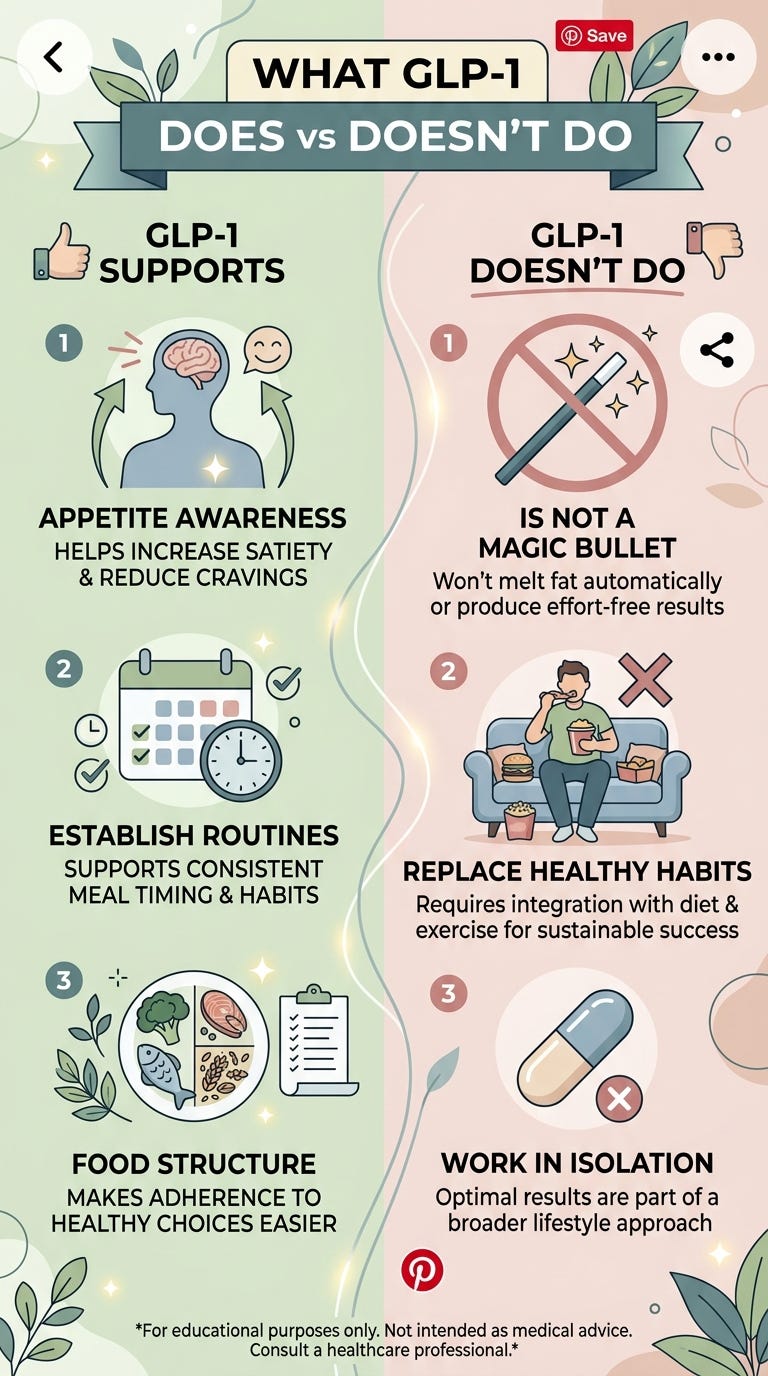
GLP-1 medications may support weight loss.
They may support appetite control.
They may support better food awareness.
They may help some people finally create the space they need to make better choices.
But they do not replace wisdom.
They do not replace food quality.
They do not replace hydration.
They do not replace strength.
They do not replace doctor supervision.
They do not replace long-term habits.
They do not replace personal responsibility.
And if you don’t understand this early, you may become one of those people who lose weight but still end up confused, weak, frustrated, scared, or unprepared for maintenance.
So, today, let’s talk about the real issue.
What does GLP-1 weight loss actually support?
And what does it NOT do?
I will explain.
First, The Problem With How People Talk About Weight Loss
For years, people have been told that weight loss is just about willpower.
“Eat less.”
“Move more.”
“Stop being lazy.”
“Close your mouth.”
“Just go to the gym.”
“Just stop eating junk.”
It sounds simple.
But if it was that simple, millions of people would not still be struggling.
The truth is that weight loss is not only about information.
Most people already know the basics.
They know vegetables are good.
They know protein matters.
They know walking helps.
They know soda is not better than water.
They know eating until they are stuffed every night is not helping.
The problem is not always knowledge.
Sometimes the problem is appetite.
Sometimes the problem is food noise.
Sometimes the problem is stress.
Sometimes the problem is hormones.
Sometimes the problem is medication.
Sometimes the problem is sleep.
Sometimes the problem is insulin resistance.
Sometimes the problem is years of dieting that messed up their relationship with food.
Sometimes the problem is a lifestyle built around convenience, pressure, exhaustion, and emotional survival.
So when GLP-1 medications entered the conversation, many people felt seen for the first time.
Because suddenly, they were not just being told to “try harder.”
Some of them were experiencing a different relationship with hunger.
They could stop eating earlier.
They were not thinking about food all day.
They could pass by snacks without feeling like something was pulling them.
They could eat a smaller plate and feel okay.
For someone who has fought food noise for years, that can feel like freedom.
But freedom is not the same thing as automatic success.
A door can open.
But you still have to walk through it.
What GLP-1 May Support
Let’s start with what GLP-1 medications may actually support.
1. GLP-1 May Support Appetite Control
This is the big one.
Many people on GLP-1 medications say their appetite changes.
They may feel full faster.
They may feel full longer.
They may not crave as strongly.
They may not snack as often.
They may find it easier to stop eating.
This can make weight loss easier because eating less becomes less of a war.
Before GLP-1, some people spend the whole day fighting their appetite.
They wake up thinking about food.
They finish breakfast and start thinking about lunch.
They eat lunch and start thinking about snacks.
They eat dinner and still want something sweet.
Then at night, the kitchen starts calling their name.
That kind of life is exhausting.
So if a medication reduces that noise, it can be helpful.
But listen carefully.
Reduced appetite is not the same thing as proper nutrition.
Just because you are eating less does not mean you are eating well.
You can eat less and still eat badly.
You can eat less and still miss protein.
You can eat less and still become dehydrated.
You can eat less and still ignore fiber.
You can eat less and still lose strength.
You can eat less and still fail to build the habits that will help you later.
This is where many people make the mistake.
They think:
“I’m not hungry, so everything is fine.”
No.
Everything is not automatically fine.
Your body still needs support.
2. GLP-1 May Support Portion Control
Before GLP-1, a person may eat a full plate, go back for seconds, then wonder why they still want dessert.
On GLP-1, that same person may suddenly realize they cannot eat like that anymore.
Half the plate may feel like enough.
A few bites may feel satisfying.
A normal restaurant portion may now feel like two or three meals.
That can be useful.
Because let’s be honest:
Modern portions are wild.
Some restaurant meals look like they were prepared for a small village.
And many people have trained themselves to finish whatever is in front of them.
Not because they are hungry.
But because it is there.
Because they paid for it.
Because they don’t want to waste it.
Because that is how they grew up.
Because eating fast has become normal.
GLP-1 may interrupt that pattern.
It may make you more aware of fullness.
But again…
It does not automatically teach you how to build a balanced plate.
You still need to learn portion structure.
You still need to learn what protein looks like.
You still need to learn how to take leftovers home without feeling guilty.
You still need to learn how to eat slowly.
You still need to learn how to stop before discomfort.
The medication may support the signal.
But you must build the behavior.
3. GLP-1 May Support Better Blood Sugar Management
Some GLP-1 medications are used in diabetes care because they can help the body manage blood sugar.
This is one reason these medications became important medically before they became social media celebrities.
But please don’t misunderstand this.
If you have diabetes, prediabetes, insulin resistance, or any blood sugar concern, you should not be using internet content as your treatment plan.
This is not the place to play “guess and try.”
You need proper medical guidance.
You need a licensed clinician.
You need monitoring.
You need to understand how your medication interacts with your health history.
You need to ask questions.
You need to report symptoms.
This is not fear.
This is wisdom.
GLP-1 can be a serious medical tool.
Treat it like one.
4. GLP-1 May Support Consistency
This is one of the underrated benefits.
For many people, the hardest part of weight loss is not starting.
It is staying consistent.
They can do well for two days.
Then cravings hit.
Then stress hits.
Then work gets busy.
Then they travel.
Then they attend a party.
Then they feel tired.
Then they say, “I’ll restart on Monday.”
Then Monday becomes next month.
Then next month becomes next year.
But when appetite becomes easier to manage, consistency may become less painful.
A person may find it easier to follow a meal plan.
Easier to avoid random snacking.
Easier to say no.
Easier to build a routine.
This is why GLP-1 can be powerful when combined with structure.
Not chaos.
Structure.
Because if the medication gives you a quieter appetite, that is the perfect time to build systems.
Meal systems.
Grocery systems.
Hydration systems.
Movement systems.
Tracking systems.
Doctor-question systems.
Maintenance systems.
Use the quiet season wisely.
Don’t waste it.
5. GLP-1 May Support Momentum
Momentum matters.
When someone has struggled for years and finally sees the scale move, something happens mentally.
Hope comes back.
Confidence comes back.
They start to believe change is possible.
They may begin walking.
They may begin cooking.
They may start reading labels.
They may finally book that doctor appointment.
They may start caring again.
This is not a small thing.
Hope can move people.
But hope must be protected with truth.
Because if you build hope on hype, it will crash.
If you build hope on a system, it can grow.
So yes, GLP-1 may support momentum.
But momentum needs direction.
Otherwise, you are just moving without a plan.
What GLP-1 Does NOT Do
Now let’s talk about the part many people don’t like.
What does GLP-1 NOT do?
1. GLP-1 Does Not Automatically Make You Healthy
This is very important.
Weight loss and health are connected for many people, but they are not exactly the same thing.
A person can lose weight and still be undernourished.
A person can lose weight and still be dehydrated.
A person can lose weight and still have poor sleep.
A person can lose weight and still be weak.
A person can lose weight and still have a terrible relationship with food.
A person can lose weight and still avoid movement.
A person can lose weight and still have unmanaged stress.
A person can lose weight and still be mentally miserable.
So don’t worship the scale.
The scale is one signal.
It is not the whole story.
If the number is going down but your energy is terrible, your digestion is bad, your mood is unstable, and you can barely eat a proper meal, you need to pay attention.
This is why tracking matters.
Not obsessive tracking.
Helpful tracking.
What did you eat?
How much water did you drink?
How much protein did you get?
How was your digestion?
How was your sleep?
Did you move your body?
Did you feel strong or weak?
Did you ask your doctor about the symptoms you keep ignoring?
These things matter.
2. GLP-1 Does Not Replace Protein
Let me be blunt.
If you are using a GLP-1 and your eating pattern becomes “coffee, two crackers, and vibes,” you are playing with your body.
Protein matters.
Especially during weight loss.
You need protein to support muscle.
You need protein to support satiety.
You need protein to support daily function.
Now, I am not saying you should start eating like a professional bodybuilder.
Relax.
But you need to be intentional.
Because when appetite goes down, your protein intake can also go down.
And if you are eating smaller meals, the quality of those meals becomes more important.
This is why a GLP-1 plate should usually begin with the question:
“Where is the protein?”
Not:
“What random thing can I tolerate today?”
Of course, if you are dealing with nausea or strong side effects, talk to your healthcare provider.
But as a general support habit, don’t treat protein like decoration.
Protein should be part of the plan.
3. GLP-1 Does Not Replace Water
Water is boring until your body starts complaining.
Some people on GLP-1s eat less and drink less without realizing it.
Then digestion slows.
Then constipation arrives.
Then headaches arrive.
Then fatigue arrives.
Then they start wondering what is happening.
Again, not every symptom is solved by water.
But poor hydration does not help you.
If your appetite is low, if your digestion feels slower, if your routine has changed, you need to be more intentional with fluid.
Put water where you can see it.
Drink earlier in the day.
Sip.
Use a bottle.
Track it if necessary.
Don’t wait until you feel awful.
Many people want advanced strategies while ignoring simple basics.
Water is basic.
But basic does not mean useless.
4. GLP-1 Does Not Replace Fiber
Fiber is not glamorous.
Nobody becomes famous on Instagram by saying, “Please eat enough fiber.”
But your digestive system cares.
Your gut cares.
Your bathroom routine cares.
Fiber helps support digestion and fullness.
But there is a right way to think about it.
Do not suddenly jump from almost no fiber to a mountain of beans, vegetables, seeds, and bran in one day.
Your stomach may protest.
Increase gradually.
Drink enough water.
Pay attention to your body.
And ask your clinician or dietitian what makes sense for you, especially if you have digestive issues.
Fiber is not punishment.
It is support.
5. GLP-1 Does Not Replace Movement
Some people hear “weight loss medication” and quietly remove movement from the plan.
Wrong move.
Movement still matters.
Walking matters.
Strength training matters.
Mobility matters.
Daily activity matters.
Not because you must punish yourself.
Not because you need to “earn” your food.
Not because you must become a gym influencer.
But because your body was designed to move.
And during weight loss, strength becomes even more important.
You don’t want to just become smaller.
You want to become stronger, more capable, more energetic, and more stable.
So start simple.
Walk.
Do light resistance training.
Use your bodyweight.
Use bands.
Do what you can.
But don’t do nothing.
A smaller weak body is not the dream.
6. GLP-1 Does Not Fix Emotional Eating Automatically
This one is big.
Some people eat because they are hungry.
Some eat because they are sad.
Some eat because they are angry.
Some eat because they are lonely.
Some eat because they are bored.
Some eat because they are tired.
Some eat because food is the only comfort they know.
GLP-1 may reduce appetite.
It may reduce some food noise.
But it does not automatically teach emotional regulation.
It does not heal your childhood.
It does not fix your marriage.
It does not reduce your workload.
It does not remove loneliness.
It does not give you coping skills.
So if emotional eating has been a major issue for you, do not ignore it simply because your appetite is quieter.
Use this season to learn.
Journal.
Get support.
Talk to a therapist if needed.
Build non-food comfort habits.
Learn your triggers.
Create a plan.
Because if food has been your emotional escape for years, the work is not only physical.
It is also emotional.
7. GLP-1 Does Not Teach Maintenance
This may be the most important point.
Losing weight is one phase.
Maintaining weight is another.
And many people are so focused on losing that they never prepare for maintaining.
That is dangerous.
Because what happens after the exciting first phase?
What happens when the scale slows down?
What happens when appetite changes?
What happens if you stop the medication?
What happens if insurance stops covering it?
What happens if your doctor changes your plan?
What happens during holidays?
What happens during stress?
What happens when compliments stop?
What happens when discipline gets boring?
What happens when old habits start knocking again?
If you don’t build maintenance habits while losing, you may struggle later.
Maintenance is not something you suddenly invent at the end.
You build it during the journey.
That means you learn:
How to eat consistently.
How to get enough protein.
How to hydrate.
How to move.
How to handle restaurants.
How to travel.
How to manage cravings.
How to track without obsession.
How to review your habits monthly.
How to ask for help.
How to avoid all-or-nothing thinking.
That is real support.
The Dangerous GLP-1 Mindset
There is a mindset I want you to avoid.
It sounds like this:
“I’m on the medication now, so I don’t need to think about anything else.”
That mindset is lazy.
And it can hurt you.
A better mindset is:
“This medication may support me, so I will use this opportunity to build better habits.”
That is wisdom.
Because tools work better in the hands of prepared people.
Give a sharp knife to a chef and you get a beautiful meal.
Give that same knife to a careless person and you may get an injury.
The tool is not the only issue.
The user matters.
So if you are using GLP-1s, become a smart user.
Not a panicked user.
Not a careless user.
Not an arrogant user.
Not a social-media-led user.
A smart user.
The Smart GLP-1 Support Framework
Let me give you a simple framework.
You can call it the 5-part GLP-1 support system.
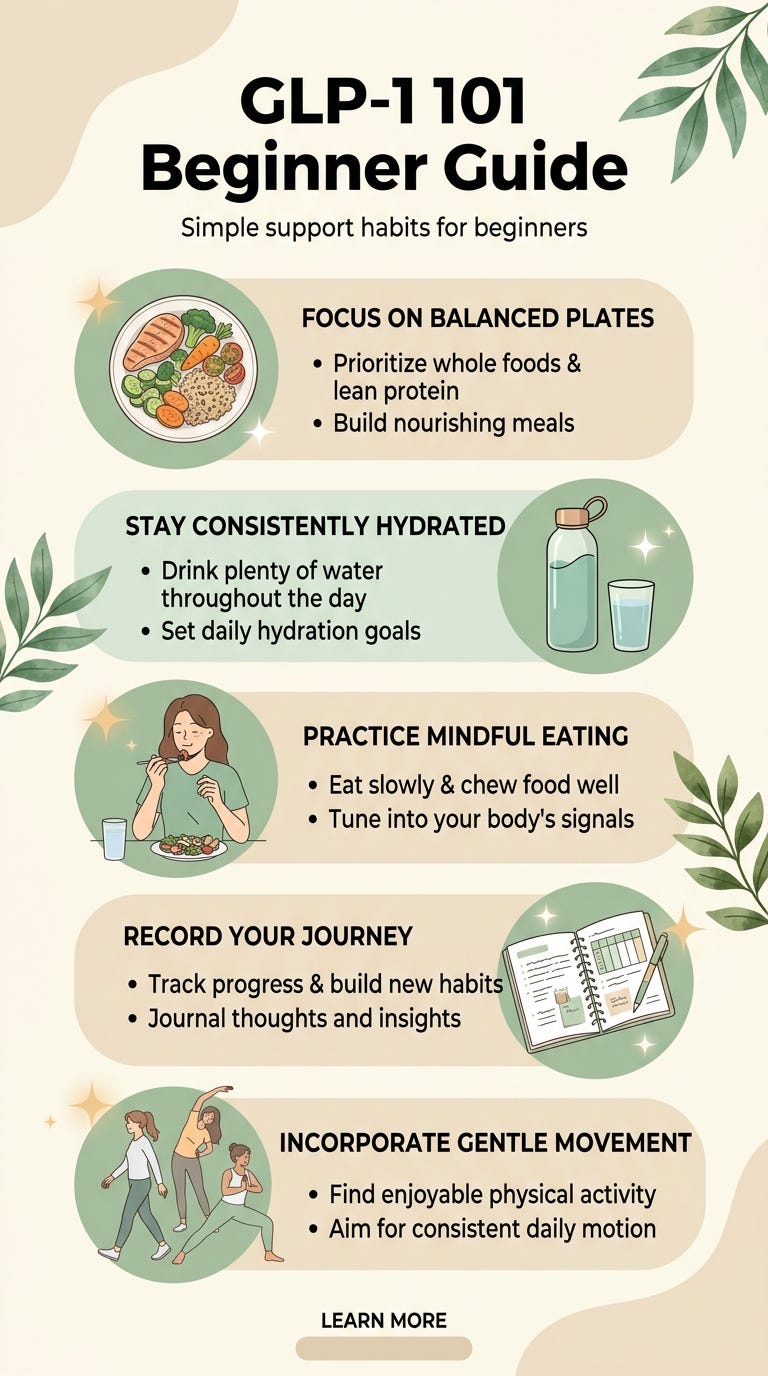
1. Food Structure
Do not just “eat less.”
Eat with intention.
Build meals around protein.
Add fiber where appropriate.
Keep portions comfortable.
Avoid forcing large meals if your body is not tolerating them.
Keep simple foods available.
Plan for low-appetite days.
2. Hydration Structure
Have a daily water plan.
Don’t guess.
Don’t wait until evening to realize you barely drank anything.
If needed, use a water bottle with measurements.
Make hydration visible.
3. Movement Structure
Start with walking.
Add simple strength work when appropriate.
Keep it realistic.
If you hate your exercise plan, you probably won’t continue.
Make movement boring enough to repeat.
That is not an insult.
Boring routines often work because they are sustainable.
4. Tracking Structure
Track the basics.
Meals.
Water.
Protein.
Symptoms.
Energy.
Digestion.
Weight if appropriate.
Doctor questions.
This is not to punish yourself.
It is to notice patterns.
Patterns create better decisions.
5. Medical Communication
Tell your healthcare provider what is happening.
Don’t hide symptoms.
Don’t change dose based on online advice.
Don’t stop or restart medication casually.
Don’t mix random supplements, compounds, or internet products without asking.
Your doctor cannot help with what you refuse to say.
How to Know If You Are Using GLP-1 Support Wisely
Here are some signs you are thinking properly:
You are not chasing extreme speed.
You are eating enough protein.
You are drinking water.
You are paying attention to digestion.
You are asking your doctor questions.
You are not buying suspicious products online.
You are not copying someone else’s dose.
You are not starving yourself.
You are not using nausea as proof that “it is working.”
You are building habits.
You are thinking about maintenance.
You are tracking patterns.
You are respecting your body.
That is how serious people behave.
How to Know If You Are Being Careless
Here are warning signs:
You are barely eating and calling it success.
You are ignoring constant vomiting or severe discomfort.
You are scared to tell your doctor what is happening.
You are buying GLP-1 products from random online sellers.
You are taking advice from comment sections.
You are copying another person’s schedule.
You are celebrating weight loss even though you feel weak and miserable.
You are not drinking water.
You are constipated but doing nothing.
You are eating almost no protein.
You believe the medication will fix everything.
You are not planning for long-term maintenance.
If you recognize yourself in any of these, don’t feel attacked.
Feel awakened.
There is still time to adjust.
The Truth About “Cheating”
Some people say using GLP-1 for weight loss is cheating.
I understand why people say it.
But I don’t think the conversation is that simple.
If a person has struggled with obesity, appetite, diabetes, metabolic health, or years of failed attempts, and a licensed clinician believes medication may help, calling that person a cheat is not helpful.
But there is another side.
Some people using GLP-1s also need to stop acting like medication removes their responsibility.
So here is the balanced truth:
Using medical support is not automatically cheating.
But refusing to build habits because you have medical support is foolish.
There is a difference.
A person wearing glasses is not cheating because they can now see better.
But if they use glasses and still walk into traffic without looking, that is foolish.
A person using medication support is not automatically lazy.
But if they use it as an excuse to avoid every basic health habit, that is careless.
Let us be adults.
A Simple Daily GLP-1 Checklist
Here is a simple checklist you can use today.
Did I eat protein today?
Did I drink enough water today?
Did I include some fiber today?
Did I move my body today, even a little?
Did I notice any symptoms today?
Did I write down any question for my doctor?
Did I eat slowly?
Did I stop before discomfort?
Did I avoid comparing my journey to strangers online?
Did I do one thing that supports maintenance?
That is enough to begin.
Not perfect.
Just consistent.
What I Want You to Remember
GLP-1 may help reduce appetite.
GLP-1 may help with portion control.
GLP-1 may support weight loss.
GLP-1 may create room for better choices.
But GLP-1 will not build your life for you.
It will not plan your meals.
It will not pour water into your mouth.
It will not lift weights for you.
It will not buy groceries.
It will not track your symptoms.
It will not call your doctor.
It will not heal emotional eating by itself.
It will not create a maintenance plan.
That part is on you.
And that is not bad news.
It is good news.
Because it means you are not powerless.
You have work to do, yes.
But you also have control over many support habits.
Start with the basics.
Do them daily.
Repeat them until they become normal.
Then build from there.
Final Word
If you are considering GLP-1 medication, talk to a qualified healthcare professional.
If you are already using one, take the support habits seriously.
If you are struggling, don’t suffer quietly.
If you are seeing results, don’t become careless.
And if you are still confused, start with this simple truth:
GLP-1 can support the journey.
It cannot become the journey.
You still need wisdom.
You still need structure.
You still need patience.
You still need food.
You still need water.
You still need movement.
You still need honesty.
You still need medical guidance.
And above all, you still need to become the kind of person who can maintain the result you are praying for.
That is the real work.
And that is where the real transformation begins.
Your Action Step Today
Take out a notebook or open your phone notes.
Write these five headings:
Food.
Water.
Movement.
Symptoms.
Doctor questions.
Under each heading, write one thing you will track today.
Not next week.
Not when you feel motivated.
Today.
Because the person who tracks patterns makes better decisions.
And the person who makes better decisions has a better chance of getting lasting results.
Start there.
메타데이터
- post_id
- 09566f2fe231
- slug
- glp-1-weight-loss-what-it-supports-and-what-it-does-not-do-09566f2fe231
- url
- https://medium.com/@marydaneil02/glp-1-weight-loss-what-it-supports-and-what-it-does-not-do-09566f2fe231
- canonical_url
- https://medium.com/@marydaneil02/glp-1-weight-loss-what-it-supports-and-what-it-does-not-do-09566f2fe231
- author_url
- https://medium.com/@marydaneil02
- status
- ok
- fetched_at
- 2026-06-17 08:20:12