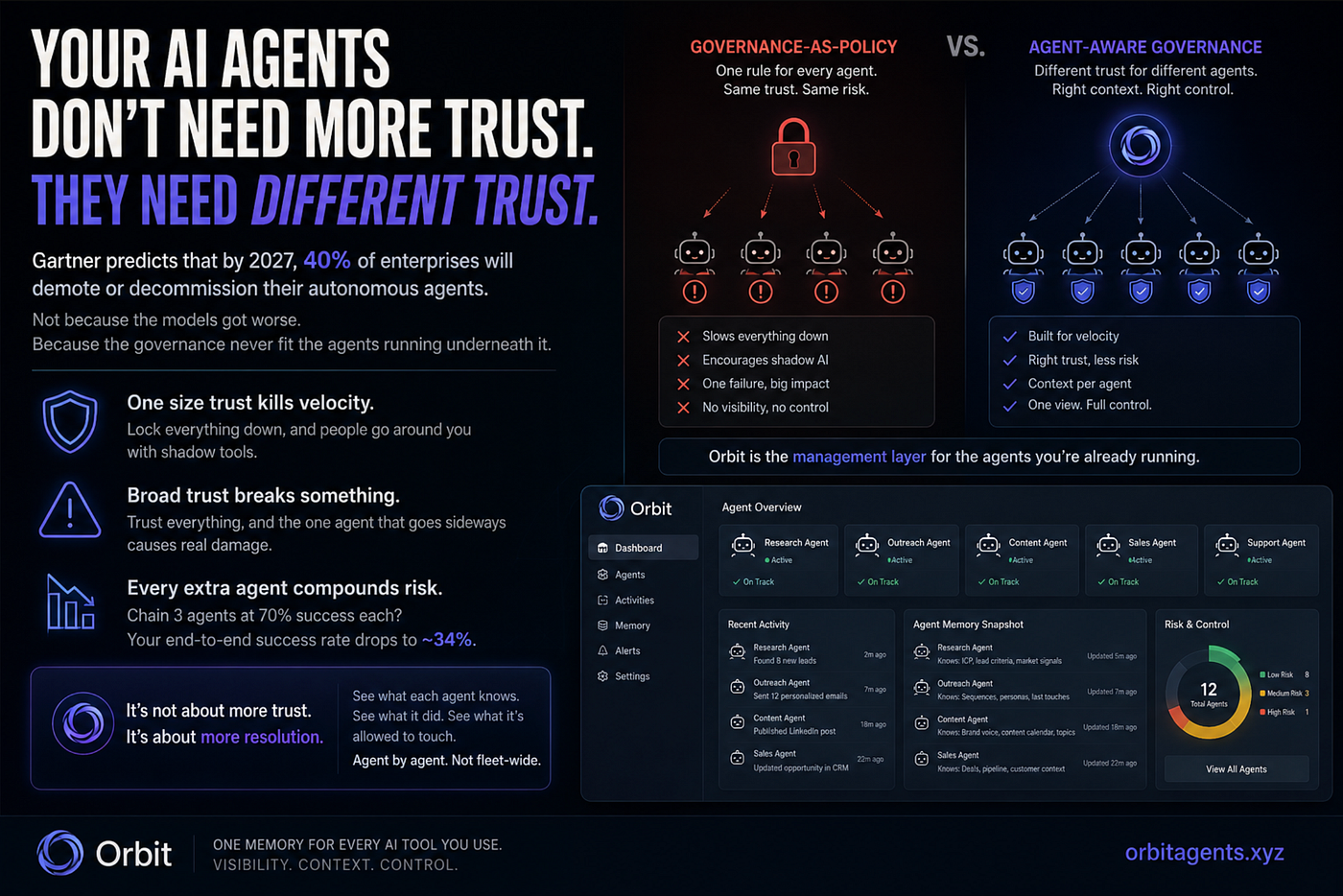
Everyone is creating agents. Nobody knows how to manage them.
Here’s the thing nobody tells you when you start building a company out of AI agents.
Everyone is creating agents. Nobody knows how to manage them.

Here’s the thing nobody tells you when you start building a company out of AI agents.
The agent that crashes is the easy case. It throws an error, the run stops, you see red, you fix it. Loud failure is easy to fix; the expensive failure is the quiet one.
This is the actual state of agents in 2026. The numbers are brutal once you look: somewhere around 86–89% of enterprise agent pilots never reach durable production value. Not because the models can’t do the work. The frontier models are extraordinary. They fail because the moment you have more than one agent doing more than one thing, nobody is watching whether the work is actually right.
And if it’s you, you’re left hand-holding a system built incorrectly to begin with.
Your agents are producing more status checks than any human can read. Traces, logs, run histories, green checkmarks. It all says “fine.” And somewhere inside that wall of “fine” is the agent that pulled a stale number, or contradicted a decision you made last Tuesday, or sent the client something you’d never have approved. The signal is there. You just can’t see it, because seeing it would be a full-time job.
But it’s not only about visitability. It’s about architecture and data. The agent needs access to the right data in order to create good outputs. So here’s where it gets interesting. The big platforms figured this out at the same time you did.
Look at the last two weeks, Salesforce shipped multi-agent orchestration as the headline of its summer release. IBM put out an entire “AI operating model” blueprint. The whole enterprise world quietly pivoted from “which model is smartest” to “who governs the agents.”
It tells you something: orchestration and data are now the bottleneck, not capability. The buying decision moved from the model to the management layer on top of it.
But notice who those tools are built for. Platform teams. Engineering orgs. Procurement committees. A 200-person company with an agent governance initiative.
That’s not you.
You’re one person running a real business through a fleet of agents that cost you a few hundred dollars a month and replaced functions that used to cost six figures. You don’t have a platform team. You are the platform team. And the orchestration problem hits you harder, not softer, because every agent’s mistake routes straight to your name with no layer of humans in between to catch it.
This is the part of the AI-workforce story that got skipped.
We spent two years on “you can create agents now.” True. Incredible. But creating was never the hard part of running an AI Agent company. Managing was.
Anyone who’s ever run a team knows the work isn’t finding people who can do tasks, it’s keeping ten of them pointed at the same goal, not contradicting each other, not losing the thread from last week, not quietly drifting off-spec while everything looks fine on the surface.
We rebuilt the entire concept of an employee and forgot to rebuild the concept of a manager.
So what does managing a fleet of agents actually require? Strip it down, and it’s three things, and none of them are “more logs.”
- You need to see what they’re doing in human terms. Not raw traces. Not 200s. A readable account of what each agent actually did and decided, the kind of update you’d want from a person, not a server. If you have to debug to find out whether your workforce did good work, you don’t have a workforce. You have a side project.
- You need them to share one memory. Right now, your context is scattered across seven tools that don’t talk to each other. Claude figured something out. ChatGPT forgot it. Your coding agent shipped a patch nobody else knows about. Every new chat starts from zero. A company where no two employees remember the same things isn’t a company. It’s chaos with good branding. Shared memory isn’t a feature; it’s the thing that makes a group of agents into an organization instead of a pile of tools.
- You need contradictions to surface, not silently resolve. When one agent’s conclusion overwrites another’s, or an agent acts against a decision you already made, that should raise a red flag. The dangerous version of agent fleets isn’t the one that argues. It’s the one that quietly overwrites your judgment and never tells you.
Here’s the reframe I keep coming back to: the leverage in a one-person AI company was never creating agents. Agents are getting commoditized by the week. The leverage is whether you can actually run them, see them, trust them, correct them, and keep them building on each other instead of stepping on each other. The founders who win the next two years won’t be the ones with the most agents. They’ll be the ones who can manage the most agents without losing the thread.
The market is about to learn this the hard way, one quiet failure at a time. I’d rather learn it now. That’s exactly why I built Orbit.
Introducing Orbitagents
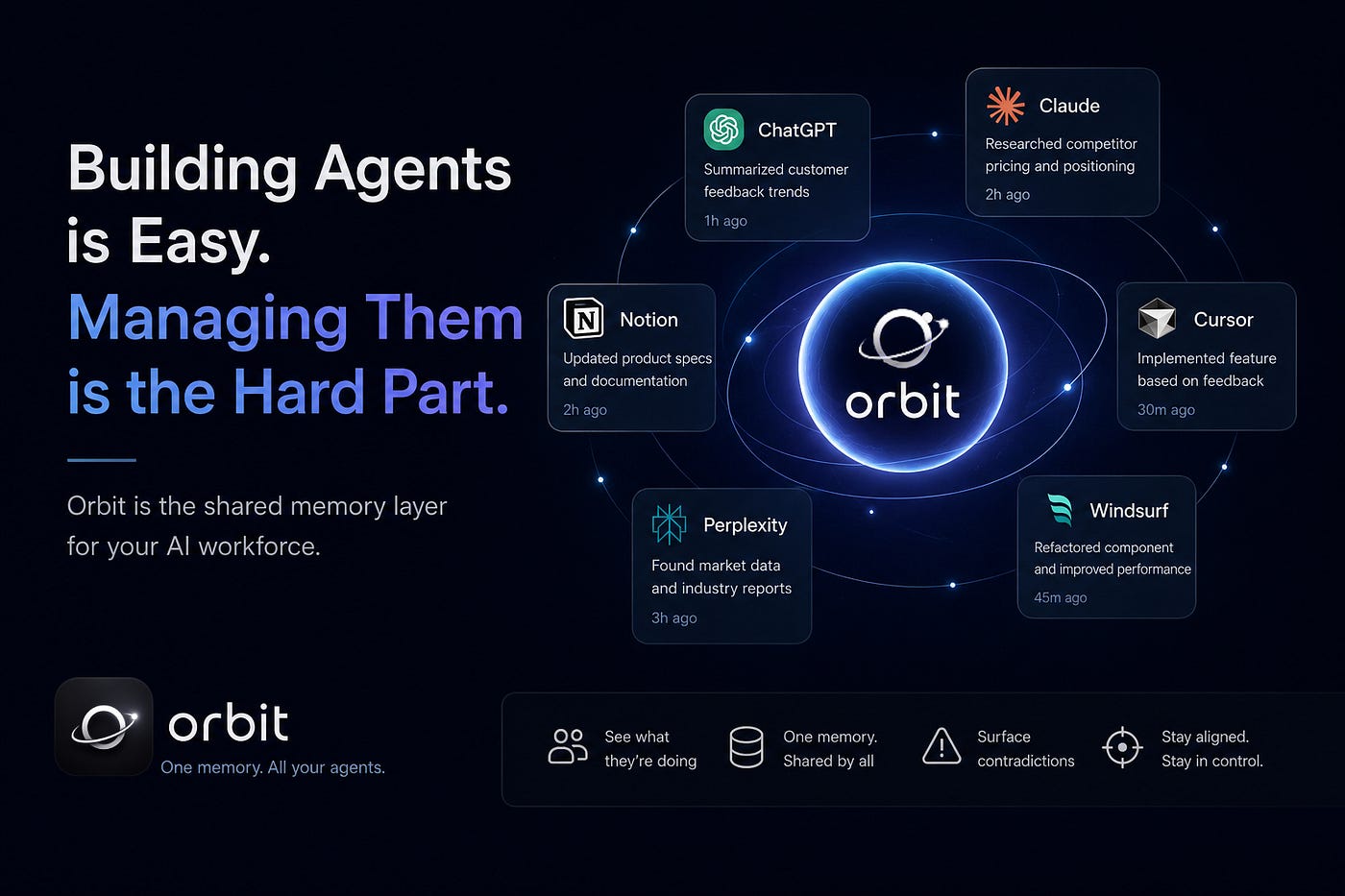
Orbit is the shared memory layer for your AI workforce. It sits between your AI tools and coding agents, giving them one persistent source of truth instead of fragmented conversations and isolated context windows.
Every decision, project, preference, and piece of knowledge becomes available across your entire agent stack, so Claude, ChatGPT, Cursor, Windsurf, and every other tool can build on the same foundation instead of starting from zero.
As AI agents become cheaper and more capable, the competitive advantage won’t come from having more of them. It will come from whether they can operate as a coherent organization rather than a collection of disconnected tools. That’s the infrastructure Orbit is built to provide.
Shared Memory and Management OS for your AI Agents across Claude, Codex, and beyond
The point is not to create more agents, but to make running them actually possible.
Orbit gives every AI tool and coding agent a shared memory, so they stop starting from zero, stop contradicting each other, and stop losing the context your business depends on.
Instead of jumping between isolated chats, logs, and workspaces, you get a single layer where your entire AI workforce can remember, collaborate, and stay aligned. On top of that, we connect to where YOU already work, we’re building the layer that closes the gap.
As we move from an era of building agents to managing them, I think the shared memory layer and making UI/UX good will become just as fundamental as the models themselves. The companies that understand that first will not just have more agents, they’ll have agents that compound.
Get started with orbitagents today.
메타데이터
- post_id
- 095b525c8dfd
- slug
- everyone-is-creating-agents-nobody-knows-how-to-manage-them-095b525c8dfd
- url
- https://medium.com/@CryptoBlooom/everyone-is-creating-agents-nobody-knows-how-to-manage-them-095b525c8dfd
- canonical_url
- https://medium.com/@CryptoBlooom/everyone-is-creating-agents-nobody-knows-how-to-manage-them-095b525c8dfd
- author_url
- https://medium.com/@CryptoBlooom
- status
- ok
- fetched_at
- 2026-07-09 23:37:22