Gemma 4 12 b: Google Released The Model Without Encoder And That was My WTF Moment
Gemma 4 12B is an open, encoder-free multimodal model that runs on a 16GB laptop. Here is what that actually means, and why it matters.
Gemma 4 12 b: Google Released The Model Without Encoder And That was My WTF Moment
Gemma 4 12B is an open, encoder-free multimodal model that runs on a 16GB laptop. Here is what that actually means, and why it matters.
When I saw the post about Google’s Gemma 4 12B, I assumed it was the usual launch-day noise: a 12-billion-parameter open model that runs on a laptop, handles several kinds of input, and does tool calling, with bullet points that read like every other release this year.
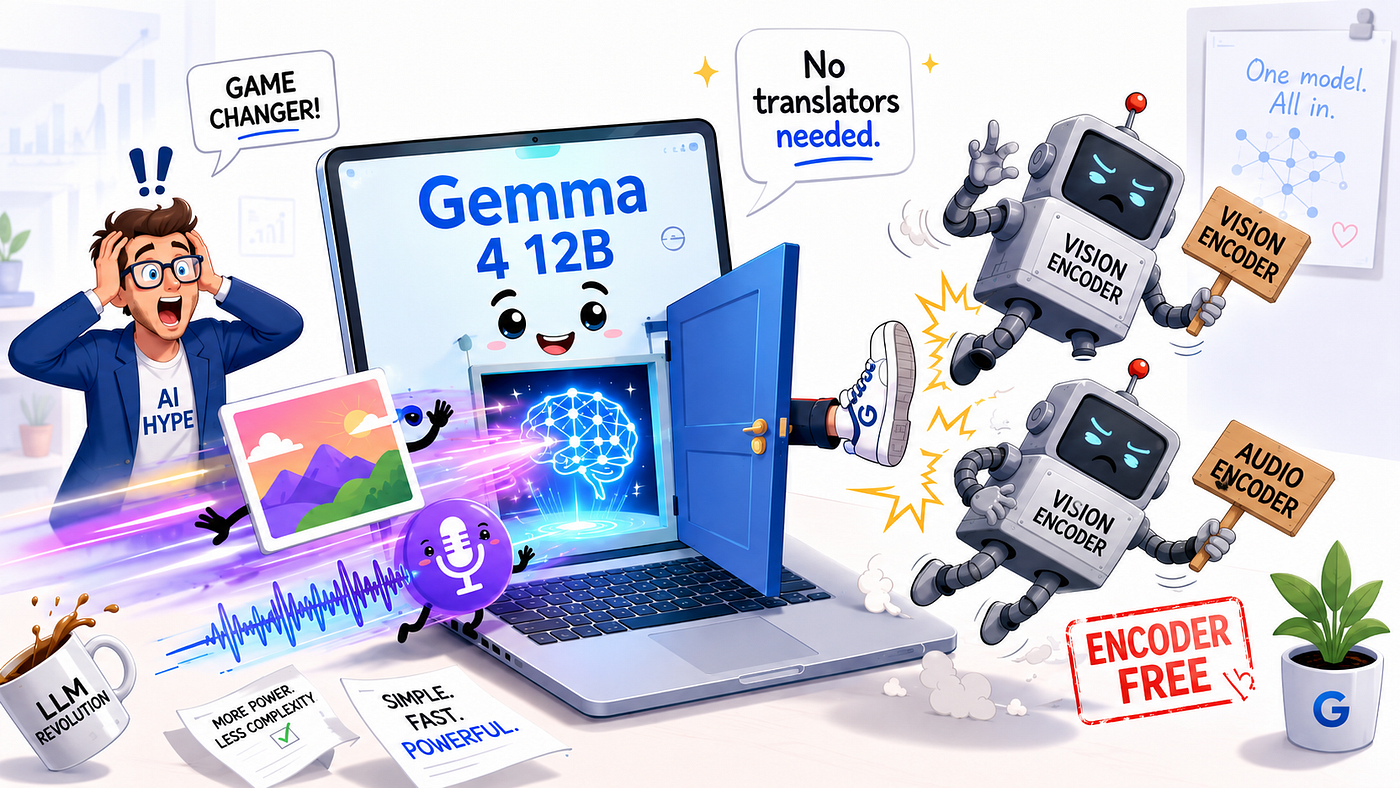
If you can’t read the article furhter because than please click here.
Then I got to one line: “audio + image go straight into model, no encoder.” That one stopped me, because if it is true, Google quietly removed a piece of the standard multimodal recipe that almost everyone treats as mandatory. I opened the post expecting marketing and closed it thinking this is one of the more interesting architecture decisions of the year, with a couple of asterisks worth knowing about.
The problem nobody talks about
First some grounding, amultimodal model is one that takes more than just text. You can hand it an image, or audio, or video, and it understands them alongside your words. ChatGPT and Gemini both do this, and the Gemma family, Google’s open-weights cousins to Gemini, has done it for a while too.
Here is the part that usually stays hidden. Most multimodal models do not feed your image straight into the brain. They run it through a separate model first, called an encoder. The vision encoder looks at your picture and converts it into a numerical summary the language model can digest. There is often a second encoder just for audio.
Think of it like hiring two translators. You want to talk to someone who only speaks one language. So before your photo or your voice reaches them, a vision translator and an audio translator each convert your input into that one language. It works. But translators cost time and money, and something always gets lost in the handoff.
In model terms, those translators are big. Google’s own numbers tell the story. The medium-sized Gemma 4 models carry a vision encoder weighing 550 million parameters. The smaller edge models add a 300-million-parameter audio encoder built from twelve specialized layers. All of that has to run and finish before the language model even starts thinking. That is latency you pay on every single image and every single clip of audio. Gemma 4 12B throws the translators out.
The core idea, in plain words
Instead of converting your image into “language-model language” with a heavy encoder, Gemma 4 12B feeds the raw pixels almost directly into the model itself. Same for audio. The language model learns to read the raw stuff on its own.
That is the whole pitch: one model, no separate encoders, multimodal data goes straight in. Google calls it a unified, encoder-free architecture. The benefit is speed and simplicity, and there is a bonus I will get to that surprised me more than the speed did.
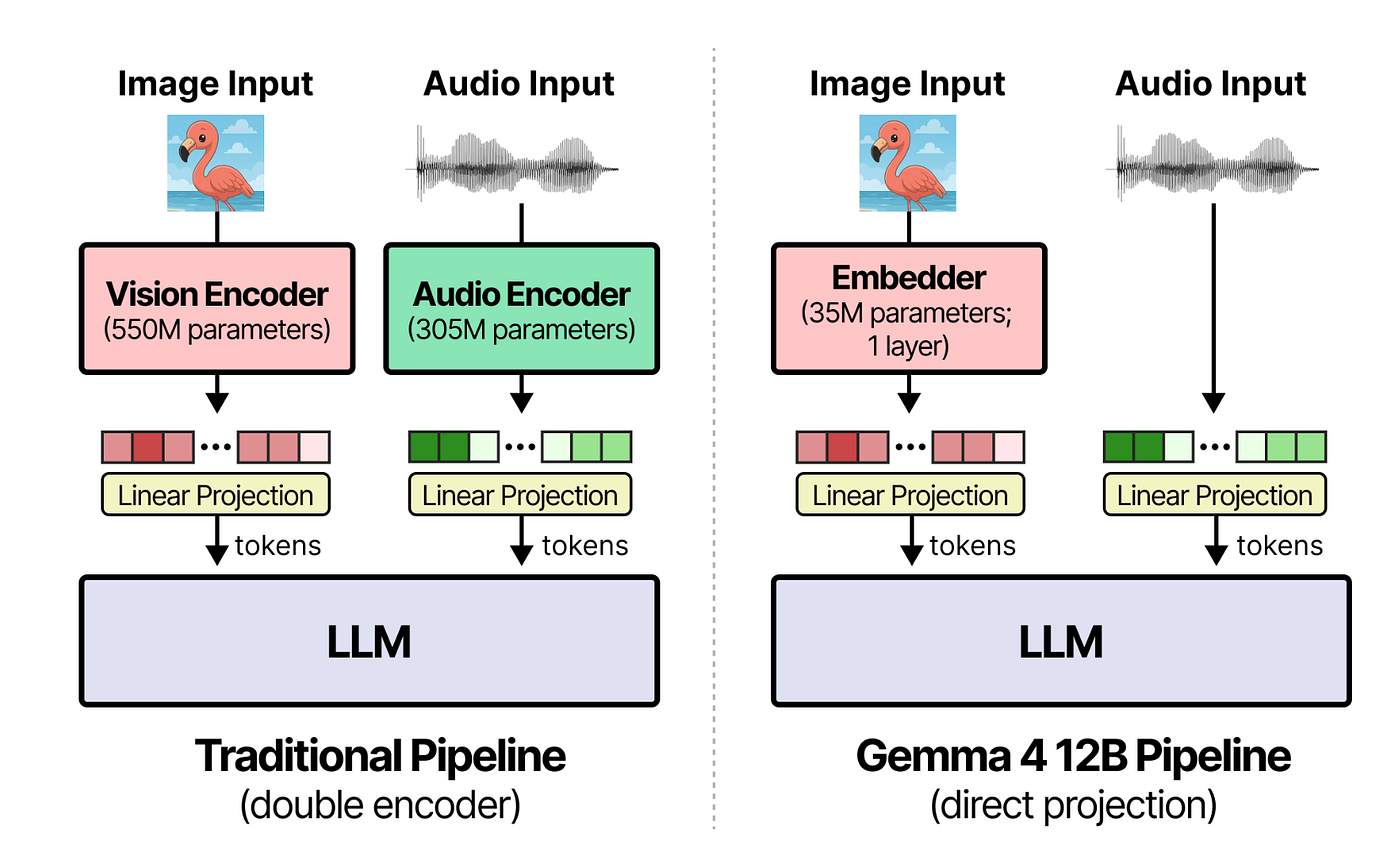
Model architecture Gemma 4 12b
Here is how thin the new pipeline actually is: for images, the model chops your picture into small 48-by-48 pixel squares. Each square gets turned into numbers by a single multiplication step, no attention, no stack of layers. To remember where each square sat in the original picture, the model looks up two small learned values, one for its row and one for its column, and adds them in. That is the entire vision system. Google shrank it from 550 million parameters down to 35 million. The image-handling part of the model got roughly fifteen times smaller.
For audio, it is even more direct. Raw sound at 16 kHz gets sliced into tiny 40-millisecond chunks of 640 numbers each, and those numbers get projected straight into the same space the model uses for words. No feature extraction, no conformer layers, none of the usual audio plumbing. The model treats a slice of sound a lot like it treats a word, and its existing sense of sequence order keeps everything lined up in time.
Old way vs new way
A quick side-by-side, since this is the heart of it.
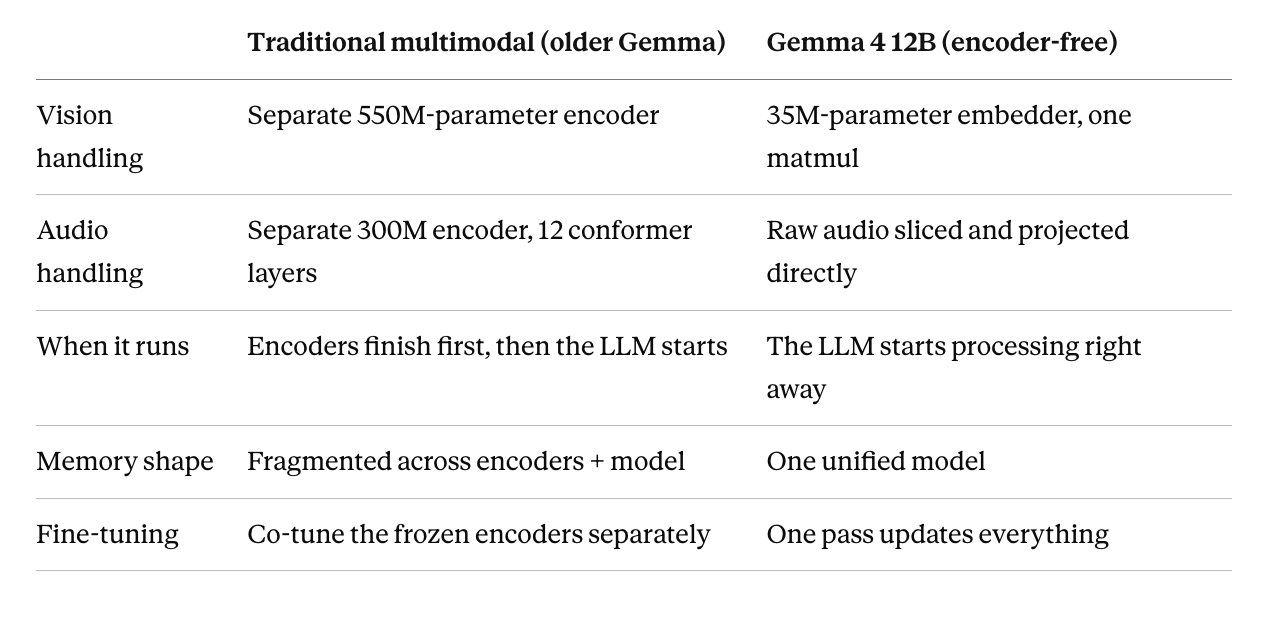
That last row is the bonus I mentioned, and it is the part I think people will underrate.
The fine-tuning trick that comes for free
When you have separate encoders, customizing the model for your own data is fiddly. The encoders are usually frozen, meaning you cannot easily adjust them, and you end up tuning the pieces in awkward isolation. Anyone who has tried to fine-tune a vision-language model on a niche dataset knows this pain.
With Gemma 4 12B, vision, audio, and text all share the exact same weights. There is no separate frozen encoder to work around. So when you fine-tune, whether with a lightweight method like LoRA or a full retrain, a single pass updates how the model handles all three at once. Hugging Face and Unsloth already support this out of the box. If you build products on open models, that is a real quality-of-life upgrade, not a footnote.
What you actually get
Stepping back from the architecture, here is the spec sheet for the thing itself. Gemma 4 12B is a dense 12-billion-parameter model, which in plain terms means all its weights are active on every token, as opposed to the sparse “mixture-of-experts” designs that only switch on parts of themselves. It handles text, images, video, and audio as input, and writes text as output. It has a 256K-token context window, which is large enough to hold a small book in working memory at once, and it supports over 140 languages.
It is the first medium-sized Gemma that can take audio natively. Earlier on, audio was limited to the tiny edge models. Now a model in the useful middle of the size range can transcribe speech, tell speakers apart, and reason over a soundtrack without a separate speech pipeline bolted on.
It ships under the Apache 2.0 license. That is the “A2.0” in the original post, and it matters more than it looks. Apache 2.0 is a genuinely permissive open-source license. You can use the weights commercially, modify them, and ship your own version, without the usage restrictions that came attached to earlier Gemma releases. Google made this an open release in the fuller sense of the word.
And the headline practical fact: it runs locally on a laptop with 16GB of VRAM or unified memory. That covers a lot of gaming laptops and most recent Apple Silicon Macs. You do not need a data center or a cloud subscription to run a capable multimodal model anymore. That is the shift the whole launch is built around.
The speed part: multi-token prediction
The post mentions “assistants for MTP (faster!)” with a lightning bolt, which sounds like jargon but points at something concrete. Normally a language model writes one token at a time. Predict a token, add it, predict the next, repeat. MTP, short for multi-token prediction, ships a small helper model alongside the main one.
The helper drafts several likely next tokens in a quick guess, and the big model verifies them in a batch instead of grinding them out one by one. When the guesses are good, you get several tokens for the price of roughly one step. On local hardware, where you do not have a rack of GPUs to brute-force speed, that drafting trick is a meaningful boost.
Does it actually perform?
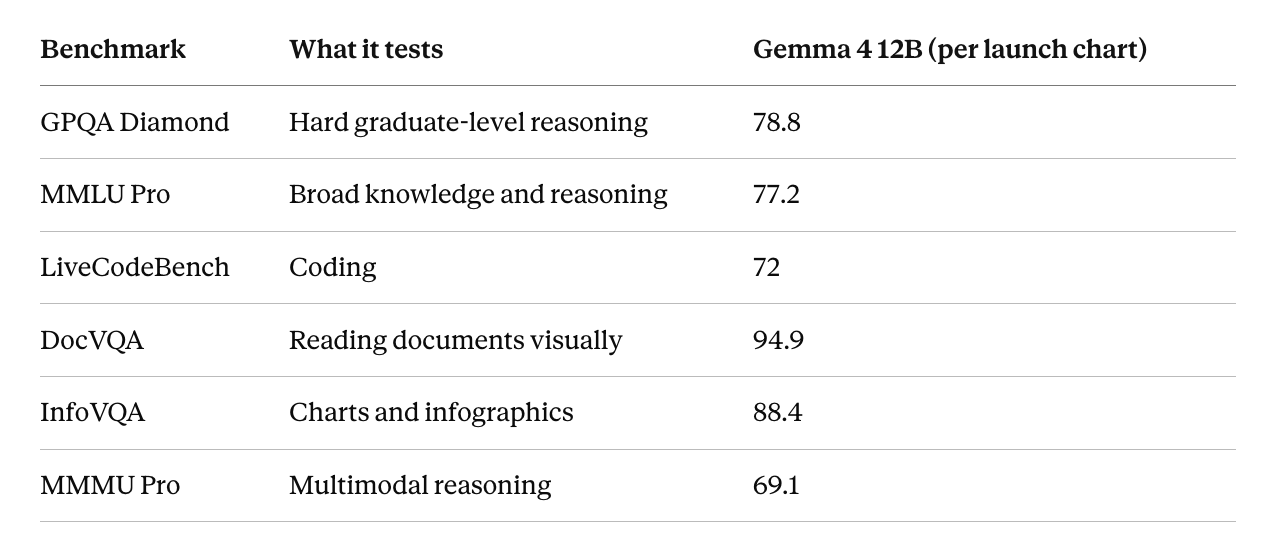
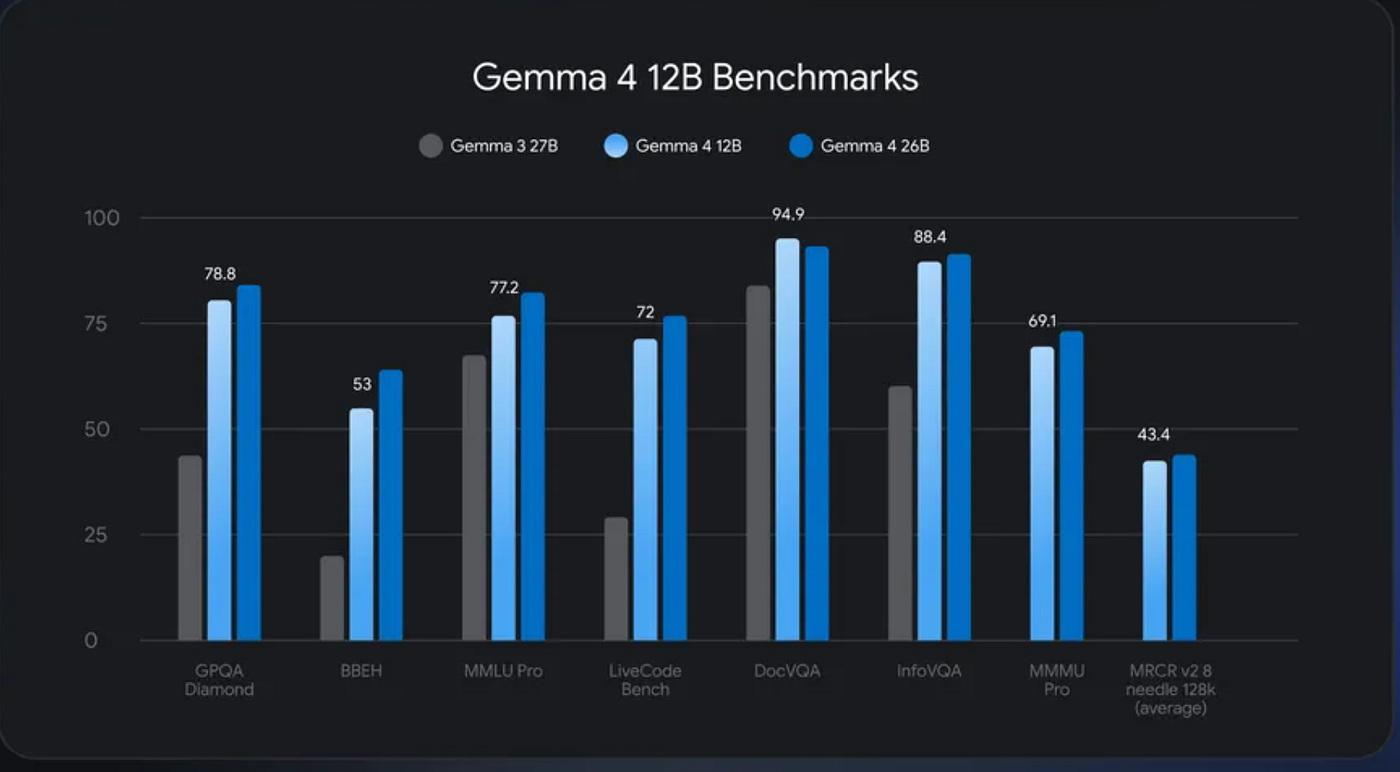
Here is where I have to be honest, because this is the soft spot in the launch. The original post includes a benchmark chart, and the numbers on it look strong. Going by that chart, Gemma 4 12B posts results like 78.8 on GPQA Diamond, 77.2 on MMLU Pro, 72 on LiveCodeBench, and 94.9 on DocVQA, sitting close to the larger Gemma 4 26B and clearly ahead of the older Gemma 3 27B across the board.
Now the asterisk: as of launch, Google had not published a full, formal benchmark table in its core release materials. Its written claim is more measured: the 12B performs near the larger 26B mixture-of-experts model while using less than half the memory. The chart circulating in posts may well be accurate, but treat single-number comparisons from a launch graphic with a little caution until independent third-party evaluations land. The honest summary is that Google is claiming near-26B quality at half the footprint, and the early numbers support that story without yet confirming it in detail.
One real-world data point does exist. In Google’s own on-device dictation app, switching to Gemma 4 12B produced what the company reports as a 60%-plus jump in overall quality, with better instruction following. That is a vendor measurement, so weigh it accordingly, but it is at least a concrete before-and-after rather than a leaderboard score.
How it stacks up against the best
This is the question everyone actually wants answered: is it better than the other open models you could run? The honest answer is that it depends entirely on what you mean by “better,” because Gemma 4 12B is not trying to win the raw-intelligence race.
If you only care about pure smarts on text, it is not the top pick. As of mid-2026, the strongest open models you can run on consumer hardware are bigger. Qwen 3.6 27B is the common “best overall” recommendation, scoring around 77% on the SWE-bench coding test and edging out Gemma on most text reasoning. Frontier-class open models like Kimi K2.6 and DeepSeek V4 are stronger still, but they are large mixture-of-experts systems that want serious hardware, not a 16GB laptop.
So on a pure leaderboard, Gemma 4 12B loses to the heavyweights, which is exactly what you would expect from a model half their size or less.
Where it gets interesting is the specific combination it offers. Look at the four things together: native audio and video input, an encoder-free design, a 16GB memory footprint, and an Apache 2.0 license. Almost no other model checks all four boxes at once.
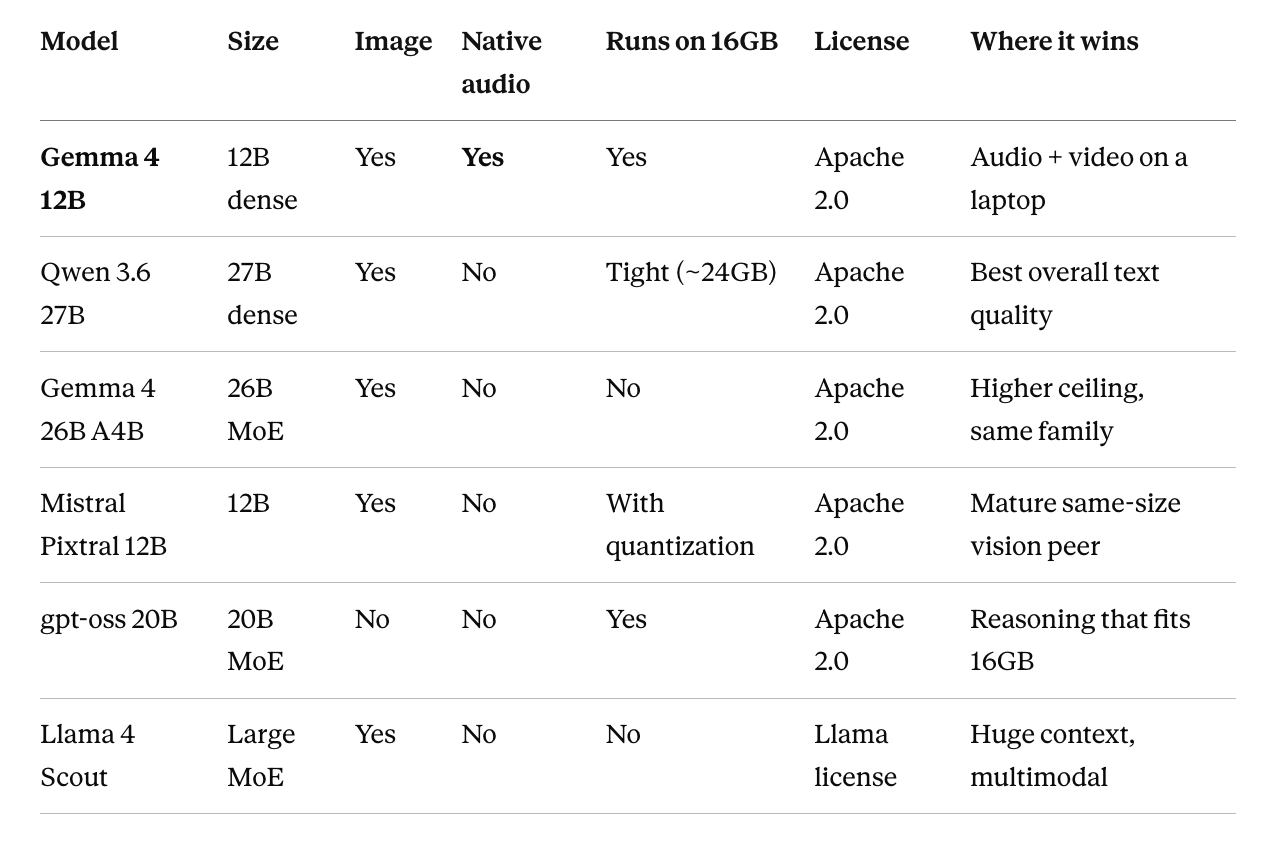
The standout column is native audio. Most open multimodal models, including Pixtral, Qwen, and Llama 4, handle images and sometimes video, but they do not take raw audio. They need a separate speech pipeline bolted on. Gemma 4 12B transcribes and reasons over sound directly. Even its own larger sibling, the Gemma 4 26B, does not do this; in the Gemma family, native audio lives only in the edge models and now this 12B.
Every model, by the numbers
Capabilities are one thing. Here are the actual scores across the lineup, on the two benchmarks that most of these models report in a roughly comparable way: GPQA Diamond for hard reasoning, and MMLU Pro for broad knowledge. Higher is better. I have sorted by GPQA.
Now the plain reading: scores track size, which is the least surprising result in AI. Qwen 3.6 27B and the two larger Gemmas sit at the top. Gemma 4 12B lands in the upper middle, which is exactly where a 12B model should land. The quiet win is that it clears Llama 4 Scout on both benchmarks despite Scout carrying 109 billion total parameters, though Scout’s numbers come from its April 2025 launch on older benchmark versions, so some of that gap is age, not just architecture.
Coding is missing from the table on purpose, because the models do not report it the same way. Gemma uses LiveCodeBench, Qwen leans on SWE-bench, and even LiveCodeBench comes in different versions. Inside the Gemma family on the same LiveCodeBench v6, the 31B scores 80.0 and the 26B reaches 77.1, with the 12B a step below on its own chart. An independent reviewer who ran the larger Gemma against Qwen 3.6 on identical settings found Gemma slightly ahead on code. So relative to its size, Gemma is strong on coding, not weak.
On multimodal reasoning, the bigger models lead, with Qwen around 75.8 and Gemma 31B around 76.9 on the vision version of MMMU Pro, and the 12B at 69.1. But not one of the other models in this table can take audio. Pixtral 12B, the closest same-size vision model, posts respectable image scores but is a 2024-era model that does not report these reasoning benchmarks in a comparable form, and it is deaf too. So the moment your task involves sound, most of this table drops out entirely.
One caveat that applies to every row: these numbers come from each model’s own card or launch post, measured on different dates, under different setups, sometimes on different benchmark versions. Read the table as a rough map of the landscape, not a referee’s scorecard. The one reliable takeaway is that bigger models score a little higher on text, the gaps are modest rather than dramatic, and Gemma 4 12B punches above its weight while carrying a sense the others lack.
So the fair verdict is narrow but real. If you want the smartest open model and have the hardware, look at Qwen 3.6 or a frontier MoE. If you want one model that sees, hears, and reads, runs offline on a normal laptop, and is fully open for commercial use, Gemma 4 12B is close to alone in its lane.
How you can run it today
This is not a “coming soon” launch, which is part of why the post had momentum. It went out day-zero across the tools people already use. The “day-0 in transformers, llama.cpp & MLX” line in the post checks out, and the list is actually longer.
You can pull the weights from Hugging Face or Kaggle. The instruction-tuned version is named google/gemma-4-12B-it. For running it locally, the easy on-ramps are LM Studio and Ollama if you want a click-and-go experience, or llama.cpp and MLX if you are comfortable closer to the metal. Developers can wire it into pipelines with Hugging Face Transformers, vLLM, or SGLang, and fine-tune efficiently with Unsloth.
Google also did something new here: it released downloadable macOS desktop apps so you can talk to the model out loud, fully offline, on Apple Silicon. And there is a litert-lm serve command that spins up a local server speaking the same API format as OpenAI's, so existing tools that expect a cloud endpoint can point at your laptop instead. That is a quietly big deal for anyone trying to cut a cloud dependency.
The honest limitations
This is a 12B model built to be the strong, practical middle option you can actually run yourself, rather than a frontier system that tops the biggest cloud models on the hardest tasks. Google’s own framing puts it near the 26B rather than ahead of everything.
The full benchmarks are not out yet. The early numbers look good, and the architecture story is genuinely novel, but the rigorous independent comparisons that tell you how it holds up across edge cases are still landing, so give it a few weeks.
The encoder-free approach is new, which cuts both ways. Stripping out battle-tested vision and audio encoders is a bold bet, and bold architecture bets sometimes have rough edges that only show up at scale or on unusual inputs. The latency and memory wins are real and easy to verify. Whether raw-pixel and raw-audio ingestion matches dedicated encoders on the trickiest visual or acoustic tasks is the open question worth watching.
And “runs on a laptop” still means a fairly good laptop. Sixteen gigabytes of VRAM or unified memory is common now but not universal, and older or budget machines will struggle. None of that undercuts the core point. Google took a part of the multimodal recipe that everyone treats as required, removed it, made the model smaller and faster, and got a fine-tuning bonus on top. I came in expecting another launch-day “beast” post. I left convinced the encoder-free idea is the thing to actually pay attention to, and the rest of the field will be looking hard at whether they need their translators either.
References
- Susano Pinto, A., Steiner, A., Misiunas, K., Roth, K., Tschannen, M., & Sanseviero, O. “Gemma 4 12B: The Developer Guide.” Google Developers Blog, June 3, 2026.
- “google/gemma-4–12B.” Hugging Face model card, Google DeepMind, June 2026.
- Razzaq, A. “Google DeepMind Releases Gemma 4 12B: An Encoder-Free Multimodal Model with Native Audio that Runs on a 16 GB Laptop.” MarkTechPost, June 3, 2026.
- “Gemma (language model).” Wikipedia, accessed June 2026.
- “Google Launches Gemma 4 12B: This Powerful AI Model From Google Can Run on Your Laptop.” WION, June 2026.
- “Qwen3.6–27B.” Hugging Face model card and Qwen blog, Alibaba, April 2026 (benchmark scores).
- “Qwen3.6 27B vs Qwen3.5 27B vs Gemma 4 31B: Accuracy, Latency, Memory, and Token Efficiency Tested.” The Kaitchup, May 2026 (independent head-to-head).
- “Llama 4.” Meta official model page, 2025 (Scout and Maverick benchmark scores).
- “Google Gemma 4: A Technical Overview.” Labellerr, April 2026 (Gemma 4 26B and 31B scores).
Disclosure: I used AI tools to help with spellcheck and editing (Grammarly), and image generation (ChatGPT Image 2). The ideas, final writing, fact-checking, and publishing decisions are my own.
메타데이터
- post_id
- 096595686bf9
- slug
- gemma-4-12-b-google-released-the-model-without-encoder-and-that-was-my-wtf-moment-096595686bf9
- url
- https://www.towardsdeeplearning.com/gemma-4-12-b-google-released-the-model-without-encoder-and-that-was-my-wtf-moment-096595686bf9
- canonical_url
- https://www.towardsdeeplearning.com/gemma-4-12-b-google-released-the-model-without-encoder-and-that-was-my-wtf-moment-096595686bf9
- author_url
- https://medium.com/@sumit.ai
- status
- ok
- fetched_at
- 2026-06-15 20:49:13