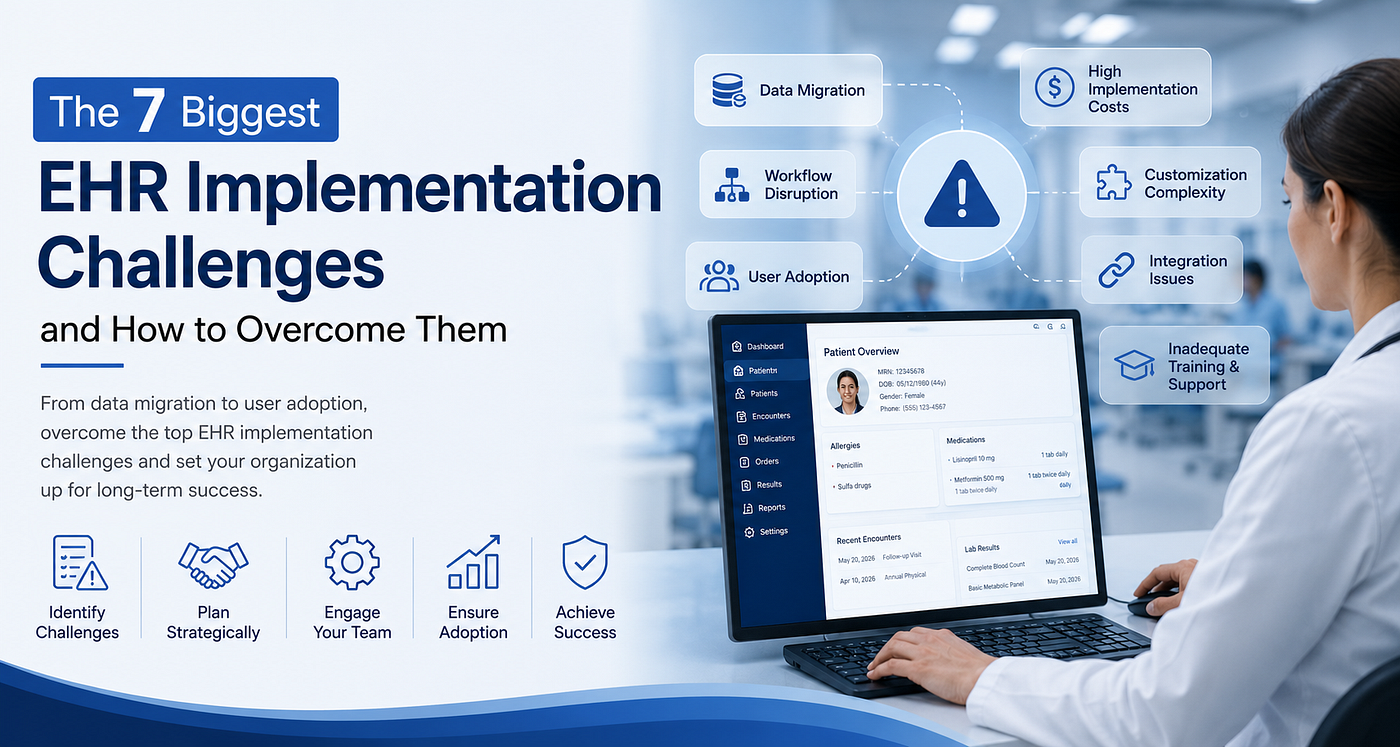
The 7 Biggest EHR Implementation Challenges and How to Overcome Them
Introduction
The 7 Biggest EHR Implementation Challenges and How to Overcome Them
Introduction
Most EHR implementations do not fail because of the technology. They fail because the complexity of the project is underestimated until it is too late to course-correct. The data migration takes twice as long as planned. A legacy system does not connect the way the vendor promised. Nursing staff are resistant, and go-live is three weeks away.
These are not edge cases. They are the standard experience for a significant portion of healthcare organizations that go through EHR implementation. The seven challenges covered in this blog show up consistently, regardless of organization size, budget, or which platform is being implemented. More importantly, they are all preventable with the right preparation.
The 7 Biggest EHR Implementation Challenges and How to Overcome Them
1. Starting Without a Clear Plan
This might seem obvious, but it is the root cause of more EHR failures than any technical issue. Organizations rush into implementation because a contract has been signed, a deadline has been set, or a competitor has already moved. The planning phase gets compressed, and the gaps show up later when they are much more expensive to fix.
A weak plan typically looks like this:
- No defined success metrics beyond “system goes live on time”
- Workflows mapped on paper but never validated with frontline staff
- Decision ownership that is unclear across departments
- Stakeholder alignment that exists in a kickoff meeting but disappears in execution
The result is a system configured around assumptions rather than actual clinical workflows. Clinicians get a tool that works differently from how they work. Workarounds appear within days of go-live and become permanent within weeks.
How to overcome it:
Before any configuration begins, map your current workflows in detail. Not how they are supposed to work on paper, but how they actually work on the floor. Involve department heads, clinical leads, and frontline staff in that process. Define what success looks like in measurable terms: first-pass claim rate, time to documentation completion, patient throughput. Assign clear ownership for every workstream. A plan that nobody owns is not a plan.
2. Data Migration Errors
Moving patient records from a legacy system to a new EHR is one of the most technically demanding parts of the entire process, and one of the most common EHR implementation challenges organizations face. Data comes from multiple sources, often in different formats, with different naming conventions, duplicate entries, and fields that do not map cleanly from one system to another.
A mid-sized hospital going through migration will often discover that a significant percentage of patient records have some form of data quality issue:
- Duplicate patient IDs across legacy systems
- Incomplete demographic records with missing or conflicting fields
- Lab results stored under inconsistent identifiers
- Medication histories in formats the new system cannot parse
- Partial records split across multiple profiles
If these issues are not caught before migration, they do not disappear. They move into the new system and become the new system’s problems. Clinicians encounter incomplete patient histories. Lab results get attached to the wrong record. Trust in the new system erodes quickly when the data inside it cannot be relied upon.
How to overcome it:
- Run a full data audit before migration begins, not during
- Standardize formats, deduplicate records, and resolve mapping conflicts in advance
- Migrate in phases, validating each batch before moving to the next
- Involve clinicians in reviewing critical data fields
- Run post-migration validation across departments before go-live
3. Interoperability Failures
On paper, most EHR systems support FHIR and HL7. In practice, connecting a new EHR to your existing lab information system, imaging platform, pharmacy, telehealth tools, and billing software is rarely as straightforward as the vendor’s integration checklist suggests. Interoperability failures rank among the top EHR implementation challenges because they are often discovered at go-live, not before.
The most common issues include:
- HL7 version mismatches that prevent data from flowing correctly between systems
- Patient matching failures that create duplicate profiles or misroute results
- API performance problems that work in testing but break under peak clinical load
- Undocumented custom logic in legacy systems that silently stops working after migration
How to overcome it:
- Conduct a full interface inventory before implementation starts
- Map data fields at a detailed level, not just at the standard version level
- Run stress tests under simulated peak patient volume
- Assign a dedicated monitoring team during and after go-live
- Include API performance requirements and interoperability SLAs in vendor contracts before signing
4. Staff Resistance and Low Adoption
A technically successful EHR implementation can still fail operationally if the people using it every day do not actually use it the way it was designed. Clinical staff resist new systems for understandable reasons. They are already busy. The old system, however imperfect, is familiar. Learning something new under the pressure of a full patient schedule is genuinely difficult.
When adoption breaks down, it tends to show up as:
- Staff reverting to paper-based documentation in parallel with the new system
- Clinicians skipping steps in the workflow to save time
- Workarounds that spread department to department and become unofficial standard practice
- Low confidence in the data the system produces
According to research cited in multiple healthcare implementation studies, 37% of employees resist workplace change. In healthcare, where the stakes of getting something wrong are clinical rather than just operational, that resistance is amplified significantly.
How to overcome it:
- Involve clinical staff before the system is configured, not just during training
- Communicate specific benefits to daily workflows, not abstract organizational goals
- Identify and train super-users in each department before go-live
- Run role-specific training sessions rather than generic walkthroughs
- Introduce the system in phases where possible to reduce cognitive overload
- Set up a feedback channel so staff can raise issues in real time after launch
5. HIPAA Compliance and Security Gaps
Among the most serious EHR implementation challenges is compliance. EHR systems hold some of the most sensitive data that exists. Patient diagnoses, medication histories, insurance details, lab results, and clinical notes are all protected health information under HIPAA. During implementation, when systems are in transition and configurations are still being finalized, the risk of a compliance gap is higher than at any other point.
Common vulnerabilities during implementation include:
- Misconfigured access controls that give staff visibility into records they should not see
- Incomplete audit trails because logging was not set up correctly from day one
- Weak encryption on data in transit between integrated systems
- Third-party integrations that create security blind spots with no active monitoring
- Staff unfamiliar with HIPAA requirements specific to the new system
According to the HIPAA Journal’s 2026 enforcement data, hospitals and clinics that fail to secure patient data can face fines of up to $2 million per violation per year depending on the level of negligence.
How to overcome it:
- Build role-based access controls into the configuration before go-live, not after
- Set up logging and audit trails from day one so every access and edit is tracked from the start
- Treat every third-party integration as a potential exposure that needs its own security assessment
- Run HIPAA training specific to the new system, not just a general compliance overview
- Use automated monitoring tools to flag unusual access patterns or failed login attempts early
6. Cost Overruns and Hidden Expenses
The budget approved at the start of an EHR implementation rarely reflects what the project actually costs. Not because organizations are careless with estimates, but because the full scope of EHR implementation challenges only becomes visible once the project is underway.
The items that are often underestimated or missed:
- Data migrations and data clean up of longer duration than scoped.
- Development of custom interfaces for systems that have not been designed to integrate with each other natively
- Additional training for departments requiring additional time than was provided for the standard rollout.
- Considerable extra expenditure to support temporary staff or overtime during go live when operations slow down
- Optimizing and providing support in the months following the launch
When companies are faced with the decision of whether to buy an off-the-shelf EHR or build their own, the cost is especially significant. Commercial EHRs come with in-built features that provide quicker go-live and certified compliance, but they have licensing costs and customization options are restricted. Custom EHR development involves a greater initial cost but offers complete control over workflows and integrations, without the need to spend money on features that may not align with the business.
How to overcome it:
Develop a total cost of ownership (TCO) that is greater than the subscription or licensing fee. Add implementation, training, integration, migration, support, and contingency budget. Specify with vendors what they’re charging the implementation fee for and what is extra. If you are considering a custom development path, working with experienced Healthcare IT Consulting partners who understand both the clinical and technical requirements can help you build a budget that reflects reality from the start.
7. Weak Post-Go-Live Support
Go-live is not the finish line. It is the point at which real-world clinical complexity meets a system that was configured in a controlled environment. The first weeks after go-live are when problems surface, when staff have the most questions, and when small issues can compound into larger disruptions if nobody is actively monitoring and responding.
What weak post-go-live support typically looks like:
- Implementation team rolls off immediately after launch
- Internal IT team is stretched thin after months of project work
- Issues that should be resolved in hours take days because escalation paths are unclear
- Workarounds that were meant to be temporary become permanent
- Adoption stalls in departments that never felt fully supported
How to overcome it:
- Keep dedicated support resources available for at least 60 to 90 days after go-live
- Assign department-level super-users who can handle frontline questions without every issue escalating to IT
- Set up a real-time feedback channel, not just a helpdesk ticket queue
- Track adoption metrics by department and address low-adoption areas proactively
- Schedule formal system reviews at 30, 60, and 90 days post-launch to catch problems while they are still small
Conclusion
EHR implementation challenges can feel overwhelming, but they don’t have to throw your entire project off track. Issues like poor planning, messy data migration, interoperability breakdowns, staff pushback, compliance gaps, budget overruns, and weak post-go-live support are common but they’re not inevitable.
What sets successful hospitals apart isn’t a bigger budget or more advanced technology. It’s how they approach the process. The teams that get it right are honest in their planning, involve the right stakeholders early on, and recognize that EHR implementation is as much about people and workflows as it is about software.
If you’re getting ready to implement an EHR or trying to fix a rollout that’s already facing challenges, the choices you make early on matter more than anything else. Strong planning and thoughtful execution can significantly reduce the risks and make the entire transition smoother.
메타데이터
- post_id
- 098ec513ae2c
- slug
- the-7-biggest-ehr-implementation-challenges-and-how-to-overcome-them-098ec513ae2c
- url
- https://medium.com/@emiliaabennett01/the-7-biggest-ehr-implementation-challenges-and-how-to-overcome-them-098ec513ae2c
- canonical_url
- https://medium.com/@emiliaabennett01/the-7-biggest-ehr-implementation-challenges-and-how-to-overcome-them-098ec513ae2c
- author_url
- https://medium.com/@emiliaabennett01
- status
- ok
- fetched_at
- 2026-06-17 18:03:35