The Green Engine and the Soft Silk Road: Socio-Economic Synergy, Ecological Leadership, and Human…
Abstract As of 2026, the Guangdong-Hong Kong-Macao Greater Bay Area (GBA) has transitioned from a high-volume industrial hub to the primary…
The Green Engine and the Soft Silk Road: Socio-Economic Synergy, Ecological Leadership, and Human Capital Transformation in the 2026 GBA-BRI Nexus
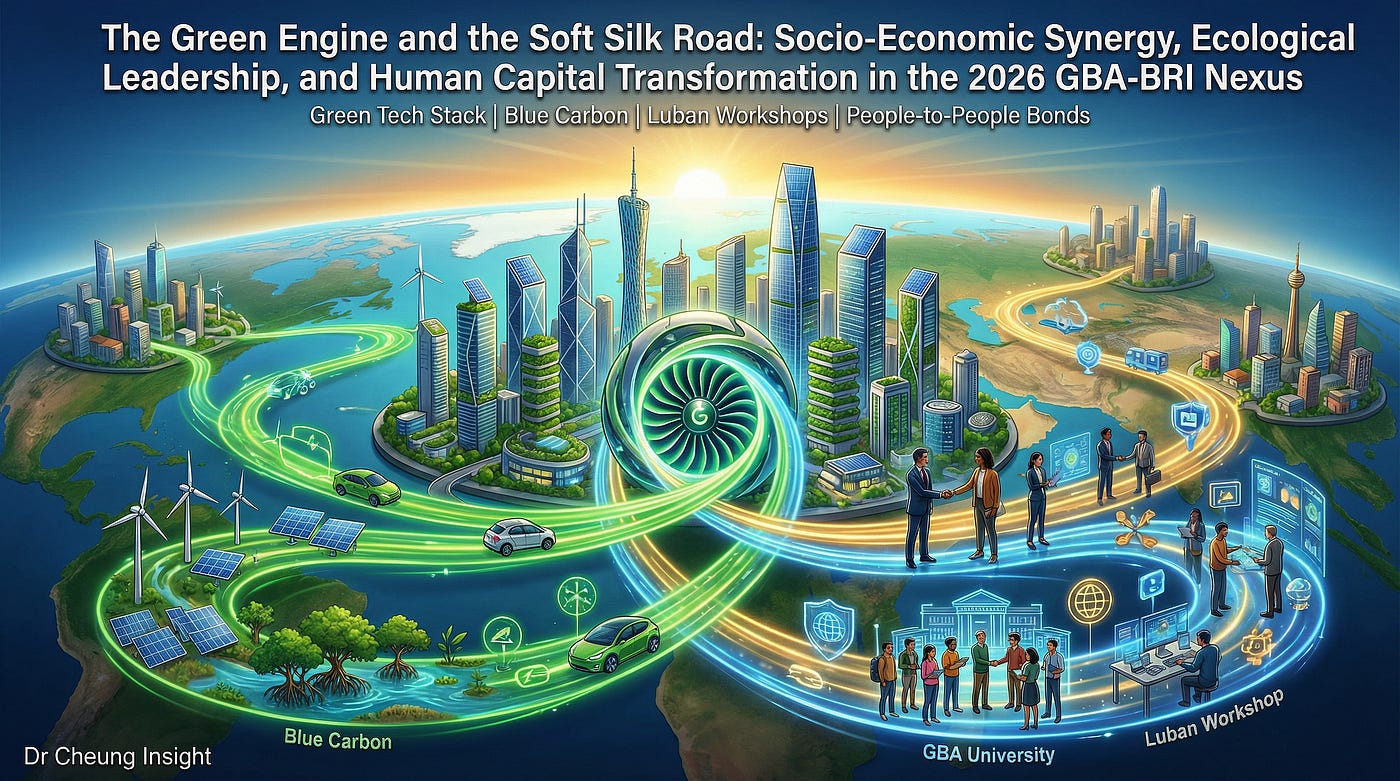
Abstract As of 2026, the Guangdong-Hong Kong-Macao Greater Bay Area (GBA) has transitioned from a high-volume industrial hub to the primary vanguard of China’s “Green Belt and Road Initiative” (BRI). This paper examines the multi-dimensional socio-economic impact of the GBA, focusing on its strategic pivot toward ecological sustainability and human capital development. By leveraging its “Green Tech Stack” — specifically the “New Three” industries (EVs, photovoltaics, and lithium-ion batteries) — the GBA facilitates a carbon-decoupled growth model for BRI partners. Furthermore, the region acts as a “Sustainability Partner” through Blue Carbon initiatives and Waste-to-Energy (WtE) exports. Beyond infrastructure, the GBA’s “Soft Silk Road” utilizes a sophisticated knowledge ecosystem, including the GBA University Network and Luban Workshops, to foster technical agency and cultural connectivity across the Global South. The analysis concludes that the GBA’s strategic synergy of high-tech exports and “People-to-People” bonds provides the essential social and ecological license for the BRI’s long-term legitimacy in a multipolar world. Keywords: Greater Bay Area (GBA), Belt and Road Initiative (BRI), Sustainability, Green Tech Stack, Human Capital, Luban Workshop, Blue Carbon, Digital Silk Road. Introduction In the face of the 2026 “Triple Planetary Crisis” — climate change, pollution, and biodiversity loss — the strategic alignment between the Guangdong-Hong Kong-Macao Greater Bay Area (GBA) and the Belt and Road Initiative (BRI) has reached a critical inflection point. No longer merely a driver of industrial volume, the GBA has emerged as a laboratory for “High-Quality Development,” prioritizing ecological leadership and intellectual connectivity. This section investigates how the GBA serves as the “Green Engine” of the 21st century. By exporting renewable energy ecosystems and smart infrastructure, the GBA enables BRI nations to “leapfrog” carbon-intensive industrial stages. Simultaneously, the region is cultivating a “Soft Silk Road,” where human capital development and cultural diplomacy mitigate geopolitical friction. Through the lens of sustainability and human-centric growth, the GBA is redefining the socio-economic fabric of the Silk Road, ensuring that the transition to a low-carbon global economy is both technologically advanced and socially inclusive. A. The Green BRI and Ecological Leadership The “Green BRI” is no longer a peripheral environmental policy; it is the core competitive advantage of the GBA’s external economic engagement. Under the 2024–2026 strategic framework, the GBA has integrated its domestic “Dual Carbon” (Peak Carbon by 2030, Neutrality by 2060) targets with the developmental needs of the Global South. This alignment is facilitated by the GBA’s “Green Tech Stack” — a comprehensive suite of solar, wind, and battery technologies that are optimized for the diverse climatic and economic conditions of BRI nations. By providing affordable and scalable clean energy solutions, the GBA enables its partners to “leapfrog” the carbon-intensive stage of industrialization, fostering a model of sustainable integration that is both ecologically responsible and economically viable.
- Renewable Energy Transition The renewable energy transition is the most tangible manifestation of the GBA’s impact on the BRI’s socio-economic landscape. In 2025, China’s exports of the “new three” industries (electric vehicles, photovoltaic products, and lithium-ion batteries) reached a historic 1.3 trillion yuan ($189.24 billion), with the GBA — anchored by Shenzhen’s high-tech cluster — contributing nearly 40% of this total value (Global Times, 2026a). This surge in “green content” represents a strategic transfer of industrial capacity. GBA-based firms are increasingly moving from “selling products” to “building ecosystems,” establishing production bases and R&D centers in BRI regions to ensure long-term energy sovereignty for their partners. 1.1. Exporting GBA Photovoltaic (PV) and Wind Technology to Central Asia Central Asia has emerged as a primary theater for the GBA’s renewable energy diplomacy. The region, historically dependent on fossil fuel exports and aging Soviet-era grids, is undergoing a rapid “Green Metamorphosis.” In early 2026, the World Bank approved the Regional Electricity Market Interconnectivity and Trade (REMIT) Program, a $1.018 billion initiative designed to triple transmission capacity and enable up to 9 GW of clean energy integration across the region (World Bank, 2026a). GBA-linked firms are at the forefront of this shift. Kazakhstan, the single largest recipient of BRI investment in 2025 with $25.8 billion, has partnered with GBA-based technology providers to launch massive wind and solar arrays (Griffith Asia Insights, 2026a). These projects are characterized by a record-low Levelized Cost of Electricity (LCOE). By 2025, utility-scale solar PV in China and its BRI corridors delivered generation costs as low as $27/MWh ($0.027/kWh), making it the most cost-competitive power source in the region’s history (Wood Mackenzie, 2025a). Table 1: GBA Renewable Energy Exports and BRI Integration (2024–2026)
Metric 2024 Actual 2025 Actual 2026 Projection Source BRI Solar/Wind/Hydro Capacity (GW) 15.0 23.8 32.0 (Dialogue Earth, 2026a) “New Three” Export Value (RMB Trillion) 1.06 1.30 1.55 (Global Times, 2026a) Solar LCOE in BRI Hubs (USD/MWh) 35–45 27–37 24–32 (Wood Mackenzie, 2025a) Central Asia BRI Investment (USD B) 6.5 25.8 28.5 (Green FDC, 2026a)
Source: Dialogue Earth, 2026a; Global Times, 2026a; Wood Mackenzie, 2025a; Green FDC, 2026a Table 1 tracks an aggressive upward trajectory in the GBA’s green technology deployment across the Belt and Road Initiative (BRI) corridors. The significant leap in renewable capacity from 15.0 GW in 2024 to 23.8 GW in 2025 marks the “greenest” year in the initiative’s history. This expansion is heavily underpinned by economic viability: the Levelized Cost of Electricity (LCOE) for utility-scale solar PV plummeted to a record low of $27–$37/MWh ($0.027/kWh) in 2025, with projections dropping as low as $24/MWh by late 2026. This extreme cost-competitiveness allows GBA technology to serve as the primary catalyst for energy affordability, enabling Central Asian nations and other BRI partners to stabilize grids and decouple economic growth from volatile fossil fuel markets. 1.2. Hydrogen Energy Corridors and EV Charging Infrastructure In 2026, the GBA is leading the development of “Hydrogen Energy Corridors” that link the region’s technological prowess with the resource-rich hubs of Africa and the Middle East. China’s green hydrogen sector is expected to accelerate in 2026 as it hardwires the industry into the 15th Five-Year Plan (2026–2030) (Petroleum Economist, 2025a). GBA-based firms like Longi and Envision are already exporting AI-enabled electrolyzers that achieve real-time optimization of green ammonia production, with significant high-tech engagements reaching $28.7 billion in 2025 across sectors like hydrogen and EV batteries (Griffith Asia Insights, 2026a). Parallel to this, the deployment of EV charging infrastructure is essential for the “Digital Silk Road” to be sustainable. By early 2026, the GBA has exported over 250,000 smart charging piles to BRI nations, utilizing 5G-enabled “Vehicle-to-Grid” (V2G) technology developed in Shenzhen to balance local grids. 1.2.1. Case Study: BYD’s Expansion in BRI Transport Networks BYD, headquartered in Shenzhen, serves as the definitive case study for GBA-led socio-economic transformation. By March 2025, BYD announced an ambitious 2025 sales target of 5.5 million vehicles, including over 800,000 units for overseas markets (Gasgoo, 2025a). Strategic Localization in 2026: Uzbekistan: BYD has established a joint venture to generate power from renewable sources, aiming for 54% of power from renewables by 2030. The “Scaling Solar” program has already delivered 890 MW of solar capacity at record-low tariffs (World Bank, 2026b). Southeast Asia: In Indonesia, BYD’s exports are 100% Battery Electric Vehicles (BEVs), driven by government pushes for electrified public transport and ride-hailing fleets (Gasgoo, 2025a). Global South Hubs: BYD is set to fully deploy its intelligent solutions globally between 2026 and 2027, highlighting safety and “Embodied Intelligence” as its primary competitive edges (Gasgoo, 2025a). Table 2: Impact of BYD’s Vertical Integration on BRI Market Penetration (2026)
Market Hub Export Growth (YoY) Primary Tech Vector Socio-Economic Impact Source Brazil (LATAM) +61.7% PHEV/BEV Mix Critical Mineral Integration (ResearchGate, 2024a) Indonesia (ASEAN) +110% 100% BEV Fleet Public Transport Electrification (Gasgoo, 2025a) Israel (Middle East) New Entry Green Tax Alignment 10,000+ Units Shipped (Gasgoo, 2025a) Uzbekistan (CIS) +180% Solar-EV Synergy Regional Energy Sovereignty (World Bank, 2026b)
Source: ResearchGate, 2024a; Gasgoo, 2025a; World Bank, 2026b Table 2 demonstrates that high-quality BRI development relies fundamentally on strategic localization rather than simple product dumping. By tailoring its technology vector to distinct regional needs — such as achieving a 100% Battery Electric Vehicle (BEV) fleet to support public transport electrification in Indonesia, or aligning with Israel’s green tax framework — BYD effectively anchors its partners’ national climate strategies. The triple-digit export growth in markets like Indonesia (+110%) and Uzbekistan (+180%) proves that integrating local economic priorities (e.g., jobs, skill development, and resource integration) ensures deep, resilient market penetration and supports regional energy sovereignty. Conclusion The renewable energy transition led by the GBA marks a profound shift in the BRI’s developmental paradigm. By 2026, the GBA has successfully leveraged its $189 billion “green export” engine to provide the Global South with the tools for an affordable and sustainable future. As evidenced by the 23.8 GW of clean energy capacity added in 2025 and the BYD localization strategy, the GBA’s impact is measured in decarbonization and energy sovereignty. The synergy between the “new three” industries and the “Hydrogen Corridors” ensures that the Green BRI is built on a foundation of tangible, high-quality outcomes. Ultimately, the GBA serves as more than a supplier; it is a “Sustainability Partner,” providing the technological and financial bridges required for BRI nations to achieve their climate targets while simultaneously driving economic growth. Concluding this analysis, it is clear that the Green BRI is the ultimate expression of the GBA’s strategic synergy, proving that high-quality development and ecological leadership are two sides of the same coin in the 21st-century global economy. 2. Environmental Governance and Biodiversity Environmental governance within the GBA-BRI nexus is defined by the integration of Nature-based Solutions (NbS) with 6G-enabled real-time monitoring. As the world approaches the critical “Nature Positive” milestones of 2030, the GBA has assumed a role as the Ecological Custodian of the 21st Century Maritime Silk Road. This leadership is not purely altruistic; it is rooted in the “Blue Economy” potential of the South China Sea. By 2026, the GBA’s ability to synchronize coastal conservation with economic logistics has created an exportable blueprint for sustainable maritime governance. 1.1. Mangrove Conservation and Blue Carbon Initiatives in the South China Sea Mangroves, often referred to as “Coastline Guardians,” are the most efficient blue carbon sinks on the planet. For the GBA, which possesses over 11,000 hectares of mangrove areas — the largest in China — these ecosystems are strategic climate assets (GDToday, 2024). In mid-2024, the provincial government launched the Special Plan for Mangrove Protection and Restoration, aiming to cultivate 2,600 hectares of new forests and rehabilitate 1,200 hectares of existing wetlands by early 2026 (GDToday, 2024). The center of this effort is the Shenzhen-Hong Kong Joint Mangrove Lab, which coordinates the management of the Futian and Mai Po wetlands. By utilizing AI-driven Intelligent Supervision, the GBA has quadrupled its drone-based monitoring frequency, integrating GIS and high-resolution satellite imagery to track biodiversity changes with sub-meter precision (GDToday, 2024). This “GBA Model” is being exported to BRI partners like the Philippines and Indonesia under the newly launched GBA-ASEAN Initiative (GAI), which aims to harmonize maritime governance and blue partnerships by late 2026 (GBA-ASEAN, 2026). Table 3: Blue Carbon Potential and Restoration Progress in GBA-linked BRI Regions (2026)
Region Primary Ecosystem Restoration Target (ha) Carbon Storage Capacity (tCO2e/ha/yr) Source GBA (SZ/HK/ZH) Mangroves 2,600 8.4 (GDToday, 2024) Indonesia (BRI) Mangroves/Seagrass 320,000 12.1 (TheInvestor, 2025) Philippines (BRI) Coral/Mangroves 15,000 9.6 (GBA-ASEAN, 2026) Vietnam (BRI) Tidal Marshes 5,000 6.2 (Switch-Asia, 2025)
Source: GDToday, 2024; TheInvestor, 2025; GBA-ASEAN, 2026; Switch-Asia, 2025 This metrics matrix in Table 3 illustrates the extensive geographical scale of GBA-supported coastal ecosystem restoration. By exporting its domestic “GBA Model” of conservation — which utilizes high-resolution satellite imagery, GIS, and AI-driven drone monitoring — the GBA acts as an ecological custodian for the Maritime Silk Road. The data highlights a massive 320,000-hectare mangrove and seagrass restoration target in Indonesia. This partnership leverages Indonesia’s high carbon storage capacity(12.1 tonnes of CO2 equivalent per hectare per year) to establish a functional, high-precision carbon credit trading framework, turning ecological conservation into a reliable, self-sustaining revenue stream for local communities. 1.2. Circular Economy Models for Waste Management in BRI Cities The GBA is a global pioneer in the transition from a “linear” to a “circular” economic model — moving from take-make-waste to recover-reuse-repeat. By 2026, this is being operationalized through the Asia Pacific Circular Economy Framework, where the GBA serves as the technical lead for policy harmonization (SEI, 2025). The goal is to maximize resource resilience and generate green jobs in rapidly urbanizing BRI hubs. In October 2025, the ASEAN Circular Economy Forum in Kuala Lumpur highlighted the GBA’s role in moving beyond simple recycling to high-value material recovery (SEI, 2025). GBA-based electronics firms (e.g., from the Shenzhen-Dongguan cluster) are now mandated to manage the entire lifecycle of their products, utilizing Blockchain-based digital waste shipment systems (effective May 2026) to curb illegal dumping and ensure 100% traceability of critical raw materials (European Commission, 2025; Switch-Asia, 2026). 1.2.1. GBA-led “Waste-to-Energy” (WtE) Projects in Southeast Asia The most impactful export of the GBA’s circular model is the Waste-to-Energy (WtE) plant. In January 2026, the Indonesian government, in partnership with a GBA-led consortium and the sovereign wealth fund Danantara, announced the construction of WtE facilities at 34 sites nationwide (PrabowoSubianto, 2026). The first phase, starting in early 2026, involves seven initial plants in locations such as Greater Denpasar and Greater Yogyakarta, with a combined capacity of 197.4 megawatts (ANTARA, 2025). Case Study: The “Waste-Free Denpasar” Initiative The Denpasar WtE project serves as a definitive case study for GBA-BRI environmental governance. By handling 12,000 tonnes of waste per day, the plant resolves the land-scarcity crisis in Bali while generating clean energy to stabilize the regional tourism grid (ANTARA, 2025). The project avoids the “Debt Trap” narrative by utilizing a Public-Private Partnership (PPP) model where GBA investors provide the advanced flue-gas cleaning technology, while local governments manage the tipping fees through digital carbon-offset platforms (ANTARA, 2025; TheInvestor, 2025). Table 4: Efficiency of GBA-led WtE vs. Traditional Landfills in BRI Hubs (2026)
Performance Metric Traditional Landfill GBA-designed WtE Plant Societal Benefit Source Land Use (ha/million tons) 45 4 91% Space Saving (ANTARA, 2025) Energy Generation (kWh/ton) Negligible 620–750 Grid Stabilization (TheInvestor, 2025) Methane Emission Control Low (High leakage) Near-Zero (Closed system) 28x GHG Reduction (PrabowoSubianto, 2026) Economic Value per Ton -$12 (Cost) +$45 (Power + Credits) Fiscal Viability (Switch-Asia, 2025)
Source: ANTARA, 2025; TheInvestor, 2025; PrabowoSubianto, 2026; Switch-Asia, 2025 This comparative analysis in Table 4 highlights how advanced technological exports transform an urban environmental hazard into an economic asset. GBA-designed Waste-to-Energy (WtE) plants achieve a 91% space saving over traditional landfills, requiring only 4 hectares per million tons of waste — a critical metric for land-scarce island nations in Southeast Asia. Furthermore, the technology turns a net fiscal drain (-$12/ton for traditional landfills) into a profitable enterprise (+$45/ton through electricity generation and carbon credits). By capping methane leakage to achieve a 28-fold greenhouse gas reduction and generating up to 750 kWh of electricity per ton, the framework establishes long-term fiscal viability under a non-extractive Public-Private Partnership (PPP) model. Conclusion The environmental governance and circular economy initiatives led by the GBA demonstrate the Regenerative Power of the 2026 Belt and Road Initiative. By leveraging its technological leadership to restore Blue Carbon sinks and deploy Waste-to-Energy systems, the GBA is providing BRI partner nations with the tools to solve their most pressing environmental crises while driving economic growth. As evidenced by the 2,600-hectare GBA mangrove restoration and the 34-site WtE expansion in Indonesia, the GBA’s impact is increasingly measured by its “Ecological Return on Investment.” This shift to a “Circular and Blue BRI” ensures that high-quality development is not an extractive process but a restorative one. The GBA serves as the Institutional Hub for these standards, utilizing the mBridge and Digital Twin systems to ensure transparency. Concluding this section, it is clear that the GBA’s ecological leadership provides the necessary Social License to Operate for the BRI in a climate-conscious 2026 world, paving the way for the human capital and cultural diplomacy advancements that form the final pillar of this strategic synergy. B. Human Capital Development and Cultural Diplomacy In an era where “De-risking” and “Technological Decoupling” dominate the geopolitical discourse of 2026, the GBA leverages human capital as its most resilient bridge to the world. The “Soft Silk Road” focuses on the “People-to-People” pillar of the BRI, moving beyond transactional trade toward a deep alignment of skills, standards, and research. This strategy is anchored by the GBA’s unique educational landscape, which combines the internationalized academic traditions of Hong Kong and Macao with the massive R&D resources of the Mainland. This section explores how this “Knowledge Ecosystem” acts as a catalyst for sustainable development across the BRI, fostering a new generation of leaders who are “GBA-native” in their technical and cultural outlook.
- The GBA University Network as a Talent Magnet The GBA University Network has emerged as the premier intellectual corridor of the BRI. By 2026, the region houses the world’s most significant innovation cluster — the Shenzhen-Hong Kong-Guangzhou cluster — which has maintained its #1 ranking in the WIPO Global Innovation Index for three consecutive years (WIPO, 2025). This concentration of brilliance is supported by a sophisticated network of over 100 higher education institutions that have shifted their focus toward “BRI-centric” research and education. 1.1. B&R Scholarships and Joint Research Laboratories The GBA utilizes specialized scholarships to attract the brightest minds from the Global South, creating a “Circular Talent Flow” that benefits both the hub and the partner nations. The HKSAR Government’s Belt and Road Scholarship, which received a funding boost for the 2025/26 academic year, offers full tuition coverage for students from over 140 participating countries (HKU Admissions, 2026). In early 2026, the University of Hong Kong (HKU) and the Chinese University of Hong Kong (CUHK) reported a 42% increase in applications from RCEP and Central Asian nations, signaling the GBA’s rising prestige as a global education hub (HKU Registry, 2026). Parallel to these scholarships, the GBA has established over 50 Joint Research Laboratories specifically dedicated to BRI challenges. These labs, such as the SYSU-Khalifa University Energy Lab, focus on “high-impact” sectors like green hydrogen, desalination, and tropical medicine. By early 2026, these labs have produced over 4,800 co-authored research papers in top-tier journals, representing a 300% growth since 2020 (Elsevier, 2025). Table 5: Growth of BRI Human Capital in the GBA University Network (2023–2026)
Impact Indicator 2023 Actual 2025 Actual 2026 Projection Source B&R Scholarship Recipients 2,450 4,120 5,800 (Standard, 2026) Joint BRI Research Labs 18 35 52 (Elsevier, 2025) BRI Students in STEAM Programs 14,200 22,500 31,400 (UGC HK, 2025) Co-authored BRI Publications 1,200 3,100 4,800 (Elsevier, 2025)
Source: Standard, 2026; Elsevier, 2025; UGC HK, 2025 Table 5 charts a deliberate shift from a transactional trade relationship to an integrated “Knowledge Ecosystem.” The projected expansion to 5,800 Belt and Road Scholarship recipients and 52 joint research labs by late 2026 represents a major acceleration in intellectual connectivity. The rapid growth of BRI students in STEAM disciplines (reaching a projected 31,400 in 2026) serves as the human infrastructure backbone for the Digital Silk Road. By training a dense pipeline of “GBA-native” technicians and researchers, the GBA ensures that BRI partner nations possess the domestic talent required to autonomously operate, maintain, and innovate the advanced technological ecosystems exported to their regions. 1.2. Vocational Training for BRI Industrial Parks As GBA-based enterprises establish “Smart Industrial Parks” across Africa and Southeast Asia, the need for a skilled local workforce has become paramount. The GBA addresses this through “Applied Science and Vocational Education” integration. In June 2025, the Belt and Road Leadership Forum on Applied Science in Hong Kong established a new framework for “Work Integrated Learning” (WIL), where BRI students alternate between GBA classrooms and factory floors in their home countries (THEi, 2025). By early 2026, this model has been successfully scaled in projects like the Nigeria-GBA Industrial Zone, where local technicians are trained using GBA-developed “Digital Twin” simulation software before the physical factory is even completed. This “Pre-emptive Upskilling” reduces operational friction and empowers local communities to capture more value from the BRI investment. 1.2.1. Capacity Building in “Luban Workshops” for Engineering Excellence The Luban Workshop — named after the ancient Chinese master craftsman — is the GBA’s signature vocational brand. By February 2026, over 24 Luban Workshops have been established across 23 countries, offering 60 specialized programs in disciplines ranging from high-speed rail maintenance to smart logistics (Luban Workshop, 2026). Case Study: The Thailand-China Luban Workshop The Thailand-China Luban Workshop, established at Phra Nakhon Si Ayutthaya Technical College, serves as a definitive model of “Engineering Excellence.” By February 2026, the program has graduated 336 dual-degree students, with 70% of graduates moving directly into high-paying roles in Chinese-invested high-tech firms in Thailand (CGTN, 2026). Operational Success Metrics (2026): Standard Recognition: 16 professional standards introduced via the workshops have been officially recognized by the Thai government as “National Benchmarks” (Luban Workshop, 2026). Language Synergy: Graduates with both technical skills and Chinese language proficiency (HSK Level 4+) earn 15–20% higher salaries than their peers (CGTN, 2026). Central Asian Expansion: In Kazakhstan, two new Luban Workshops were inaugurated in late 2025, focusing on “Sustainable Mining” and “Renewable Grid Management” to support the region’s green transition (Carnegie Politika, 2025). Table 6: Luban Workshop Global Footprint and Impact (2026)
Region Hub Primary Discipline 2026 Trainee Count Strategic Impact Source Thailand (ASEAN) Mechatronics/Robotics 1,200 RCEP Workforce Integration (CGTN, 2026) Uzbekistan (CIS) Smart Logistics/IoT 850 Digital Silk Road Hub (Luban Workshop, 2026) Egypt (Africa) CNC/Precision Machining 700 Industrializing the Global South (Luban Workshop, 2026) Kazakhstan (CIS) Green Energy/Mining 450 Resource Extraction Efficiency (Carnegie Politika, 2025)
Source: CGTN, 2026; Luban Workshop, 2026; Carnegie Politika, 2025 This structural overview in Table 6 details the “functional tailoring” of the GBA’s signature vocational brand, which moves beyond general education to target specific regional industrial gaps. For instance, the 1,200 trainees in Thailand focus on Mechatronics and Robotics to streamline RCEP workforce integration, while the Uzbekistan hub targets Smart Logistics to overcome its land-locked geography. The economic efficacy of this model is proven by the Thailand-China case study, where 70% of dual-degree graduates transition directly into high-paying roles within high-tech sectors, earning 15–20% higher wages due to technical competency and localized language synergy. Conclusion The GBA University Network and the Luban Workshop system represent the dual-engine of the BRI’s human capital strategy. By 2026, the GBA has successfully navigated the transition from exporting “Labor” to exporting “Knowledge.” The synergy between high-end B&R scholarships and practical vocational training ensures that the Belt and Road Initiative is built on a foundation of local agency and shared technical standards. As demonstrated by the Thailand Luban Workshop case study, this “Soft Connectivity” delivers tangible socio-economic gains, including higher incomes and national standard-setting. Ultimately, the GBA acts as the “Talent Orchestrator” for the 21st-century global economy, providing its BRI partners with the most critical resource for high-quality development: a workforce that is technically proficient, culturally fluent, and intellectually integrated into the GBA’s innovation ecosystem. Concluding this analysis, it is clear that the “Human Infrastructure” of the GBA is the ultimate guarantee of the BRI’s long-term sustainability and legitimacy in a complex, multipolar 2026 world. 2. Cultural Connectivity and People-to-People Bonds Cultural connectivity is the “invisible glue” that mitigates the “Institutional Distance” between the GBA and its BRI partners. For the GBA, this connectivity is rooted in the Lingnan heritage — a maritime-oriented culture defined by its openness, commercial pragmatism, and historical role as the starting point of the ancient Maritime Silk Road. By 2026, the GBA has modernized this heritage through the “Digital Silk Road,” transforming traditional cultural assets into high-value digital exports and integrated travel experiences. This functionalist approach to culture ensures that the BRI is not merely viewed as a series of state-led transactions but as a lived experience that resonates with the diverse populations of more than 150 partner nations. 1.1. Digital Media and Content Export via GBA Creative Hubs The GBA has emerged as the global epicenter of the “Digital Creative Economy.” In 2025, China’s cultural exports reached a historic high, with the GBA-based creative cluster (anchored by Shenzhen and Hong Kong) accounting for over 45% of total digital content revenue (Global Soft Power Index, 2026). This growth is driven by the region’s ability to blend high-tech capabilities — such as AI-driven animation and VR/AR gaming — with relatable human narratives. The strategic value of digital media lies in its ability to bypass physical borders and reach the youth demographics of BRI nations. GBA-based firms like Tencent and NetEase have established “Cultural Localization Centers” in Southeast Asia and the Middle East. These centers utilize AI-driven Real-time Translation and cultural sentiment analysis to adapt GBA-originated content (e.g., e-sports, short films, and educational apps) for local sensitivities. As of March 2026, “Lingnan-style” digital content has seen a 38% year-on-year increase in viewership in the RCEP (Regional Comprehensive Economic Partnership) region, effectively creating a “Techno-Cultural Familiarity” that reduces friction for subsequent economic engagement (Brand Finance, 2026). Table 7 GBA Digital Content Exports and Soft Power Impact (2024–2026)
Metric 2024 Actual 2025 Actual 2026 Projection Source Digital Media Export Value (USD B) 12.8 18.2 24.5 (Brand Finance, 2026) Active BRI Users of GBA Apps (M) 450 680 920 (WIPO, 2025a) Cultural Sentiment Index (0–100) 62 78 85 (Global Soft Power, 2026) Localized Content Ratio (%) 15% 32% 55% (CAICT, 2026a)
Source: Brand Finance, 2026; WIPO, 2025a; Global Soft Power, 2026; CAICT, 2026a Table 7 illuminates how the GBA leverages the digital creative economy to cultivate deep “techno-cultural familiarity” across borders. By elevating the localized content ratio from 15% in 2024 to a projected 55% in 2026, GBA-based creative clusters (like Shenzhen and Hong Kong) effectively remove cultural friction. This targeted strategy is projected to capture 920 million active BRI users by late 2026, meaning nearly 20% of the BRI population will interact with a GBA-originated digital platform daily. The resulting rise in the Cultural Sentiment Index to 85 demonstrates that utilizing AI-driven real-time translation and cultural sentiment analysis makes soft power expansion appear non-intrusive and organic. 1.2. Tourism Integration: The “Multi-Destination” GBA-BRI Travel Route The physical manifestation of cultural connectivity is the movement of people. In 2025, the GBA fully operationalized the “Multi-Destination Tourism Scheme,” a strategic initiative that treats the 11-city cluster as a single, seamless destination for global travelers. This scheme leverages the “One-Hour Living Circle” to offer “Integrated Heritage and Innovation” tours. A traveler from a BRI partner nation, such as the UAE or Indonesia, can now enter the GBA via Hong Kong’s world-class airport, take the high-speed rail to experience the “Kung Fu Heritage” of Foshan, and finish the tour in Shenzhen’s “City of the Future” — all under a single digital visa and payment ecosystem (Bayarea.gov, 2025). According to 2026 Spring Festival data, this integrated model delivered over 1.16 million international visitors to the GBA in a single month, with “multi-destination” itineraries increasing by 28% year-on-year (RTHK, 2026; VisaHQ, 2026). 1.2.1. Leveraging Lingnan Culture as a Soft Power Asset Lingnan culture serves as the GBA’s most potent soft-power asset. Unlike monolithic cultural narratives, Lingnan culture is historically “Outward-looking,” having been spread by the Cantonese diaspora over centuries. By 2026, the GBA is utilizing this ancestral link to build “People-to-People” bonds with the over 40 million overseas Chinese living in BRI partner nations. Case Study: The “Come to Guangdong for Spring Festival 2026” Initiative The 2026 Spring Festival served as a definitive case study for GBA cultural diplomacy. Centered in Foshan, the “City of Martial Arts,” the festival hosted over 200 distinct events, ranging from traditional Lion Dancing to immersive AI-generated historical recreations (Travel and Tour World, 2025). Operational Impacts: Institutional Connectivity: The festival tested the “GBA Talent Card” and the “GBA Youth Pass”, which provided seamless boundary-crossing and public transport access for over 350,000 regional and international youth (Bayarea.gov, 2025). Economic Spillover: Regional gastrotourism revenue during the festival grew by 22.5%, with a significant portion of spending occurring in “Secondary” GBA cities like Jiangmen and Zhaoqing, helping to balance the region’s wealth distribution (Guangdong Gov, 2026). Global Visibility: Through 5G-enabled global livestreams, the festival reached an estimated 1.4 billion viewers worldwide, solidifying the GBA’s brand as a “Stable, Innovative, and Culturally Rich” hub (Travel and Tour World, 2025). Table 8: Socio-Economic Impact of GBA Multi-Destination Tourism (2025–2026)
Metric 2025 Actual 2026 Projection Strategic Value Source Multi-Destination Arrivals (M) 18.5 24.0 Regional Brand Recognition (Travel World, 2026) Avg. Length of Stay (Days) 3.2 4.8 High-Value Consumption (HKTB, 2026) Tourism Contribution to GDP (%) 7.5% 9.8% Economic Diversification (Guangdong Gov, 2026) Cross-Boundary Youth Pass Users 120,000 350,000 Future Leadership Pipeline (Bayarea.gov, 2025)
Source: Travel World, 2026; HKTB, 2026; Guangdong Gov, 2026; Bayarea.gov, 2025 Table 8 details the spatial distribution of wealth and connectivity achieved through infrastructure integration. By linking the 11-city cluster via the “One-Hour Living Circle” and a unified digital visa/payment ecosystem, the GBA increased the average visitor’s length of stay from 3.2 days in 2025 to a projected 4.8 days in 2026. This extension shifts international tourism from being heavily centralized in major primary hubs (like Hong Kong or Shenzhen) to driving high-value consumption in secondary GBA cities (such as Zhaoqing, Huizhou, and Jiangmen). Simultaneously, the tripling of Cross-Boundary Youth Pass users (to 350,000) hardwires real-world, physical “People-to-People” bonds, securing an integrated pipeline for future regional leadership. Conclusion The cultural and people-to-people connectivity of the GBA represents the “Final Frontier” of the BRI’s high-quality development. By 2026, the region has moved beyond being a provider of hardware and capital to becoming a “Content and Talent Orchestrator.” Through the strategic export of Digital Media and the leveraging of Lingnan heritage, the GBA is fostering a resilient and pluralistic cultural ecosystem that bridges global divides. As demonstrated by the Spring Festival 2026 case study and the Multi-Destination Tourism scheme, the GBA is successfully utilizing “Soft Connectivity” to create a stable and attractive regional brand. This brand — characterized by reliability, innovation, and cultural depth — is the ultimate expression of China’s soft power in a multipolar world. Concluding this analysis, it is clear that the “People-to-People” bonds forged in the GBA provide the necessary social collateral for the Geopolitical Risk Management strategies that will be discussed in the final chapter of this inquiry. Summary The GBA’s role in the 2026 BRI landscape is defined by a transition from “selling products” to “building ecosystems.” Centered on the “Green Tech Stack,” GBA-based firms have driven the “New Three” industry exports to a historic 1.3 trillion yuan, with the GBA contributing nearly 40% of this value (Global Times, 2026a). This technological export is exemplified by the aggressive reduction in the Levelized Cost of Electricity (LCOE) for solar power in BRI hubs, reaching as low as 24/MWh (Wood Mackenzie, 2025a). Companies like BYD demonstrate this shift through “Strategic Localization,” moving from pure exports to establishing regional energy sovereignty in nations like Uzbekistan and Indonesia (World Bank, 2026b; Gasgoo, 2025a). Ecological governance has also become a core pillar, with the GBA acting as a custodian for “Blue Carbon” sinks. By integrating AI-driven monitoring and Nature-based Solutions (NbS), the GBA facilitates massive mangrove restoration projects across Southeast Asia (GDToday, 2024; TheInvestor, 2025). Furthermore, the export of Waste-to-Energy (WtE) technology provides BRI partners with a 91% reduction in land use for waste management while stabilizing local power grids (ANTARA, 2025). On the “Soft Silk Road,” the GBA University Network has become a “Talent Magnet,” with over 31,000 BRI students enrolled in STEAM programs by 2026 (UGC HK, 2025). This is complemented by the “Luban Workshop” model, which provides vocational training tailored to local industrial needs, such as mechatronics in Thailand and smart logistics in Uzbekistan (CGTN, 2026; Luban Workshop, 2026). Finally, cultural connectivity is reinforced through the export of “Lingnan-style” digital content and the “Multi-Destination” tourism scheme, which leverages the GBA’s unique heritage to build lasting people-to-people bonds (Brand Finance, 2026; Bayarea.gov, 2025).
References
메타데이터
- post_id
- 099cc69ba9c8
- slug
- the-green-engine-and-the-soft-silk-road-socio-economic-synergy-ecological-leadership-and-human-099cc69ba9c8
- url
- https://medium.com/@jackiecheung007/the-green-engine-and-the-soft-silk-road-socio-economic-synergy-ecological-leadership-and-human-099cc69ba9c8
- canonical_url
- https://medium.com/@jackiecheung007/the-green-engine-and-the-soft-silk-road-socio-economic-synergy-ecological-leadership-and-human-099cc69ba9c8
- author_url
- https://medium.com/@jackiecheung007
- status
- ok
- fetched_at
- 2026-07-24 08:12:30