Aldous Huxley’s Perennial Philosophy
Bridging philosophy, mysticism and quantum reality
Aldous Huxley’s Perennial Philosophy
Bridging philosophy, mysticism and quantum reality
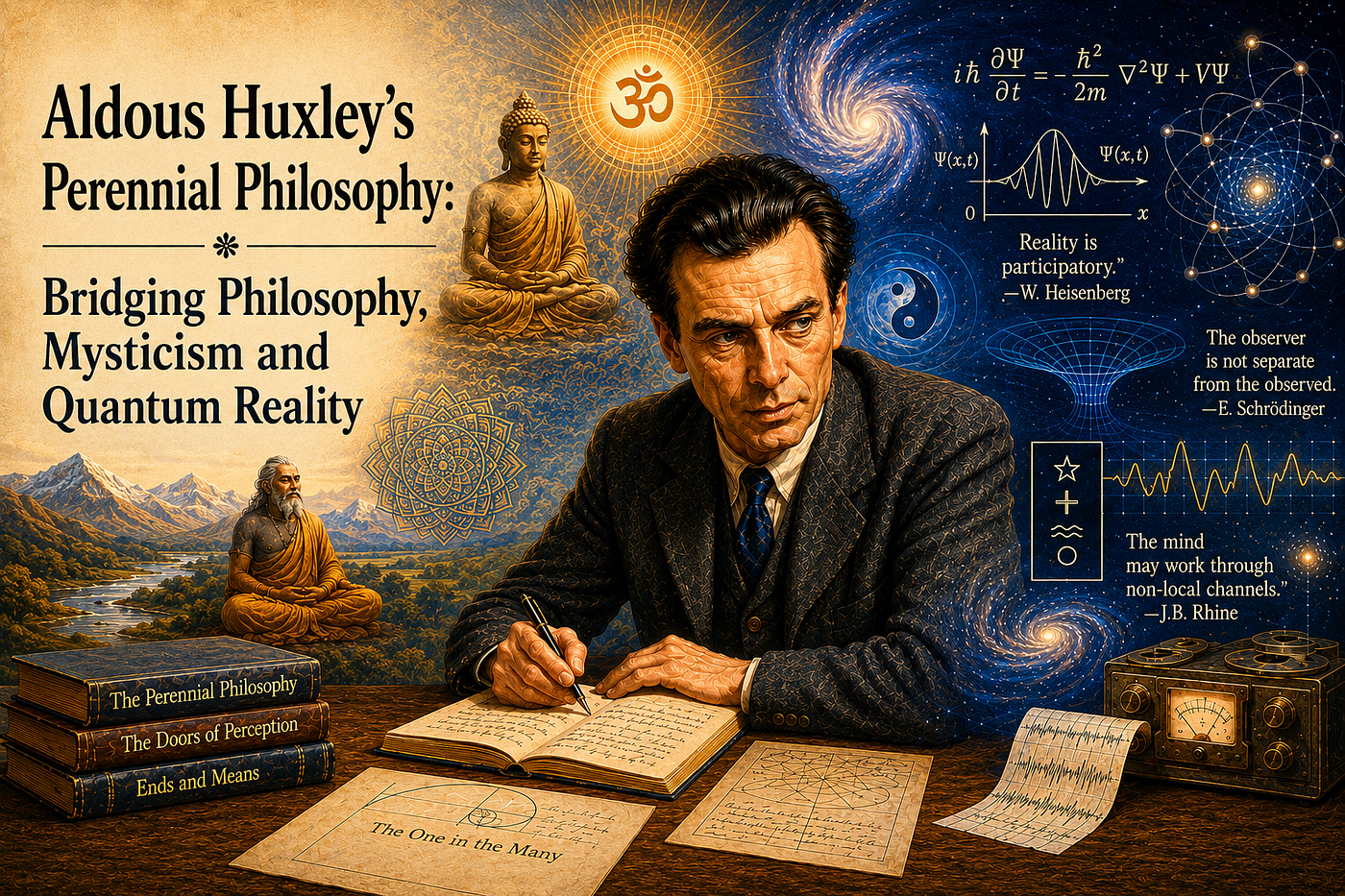
Portrait of Aldous Huxley, generated by ChatGPT and released under public domain
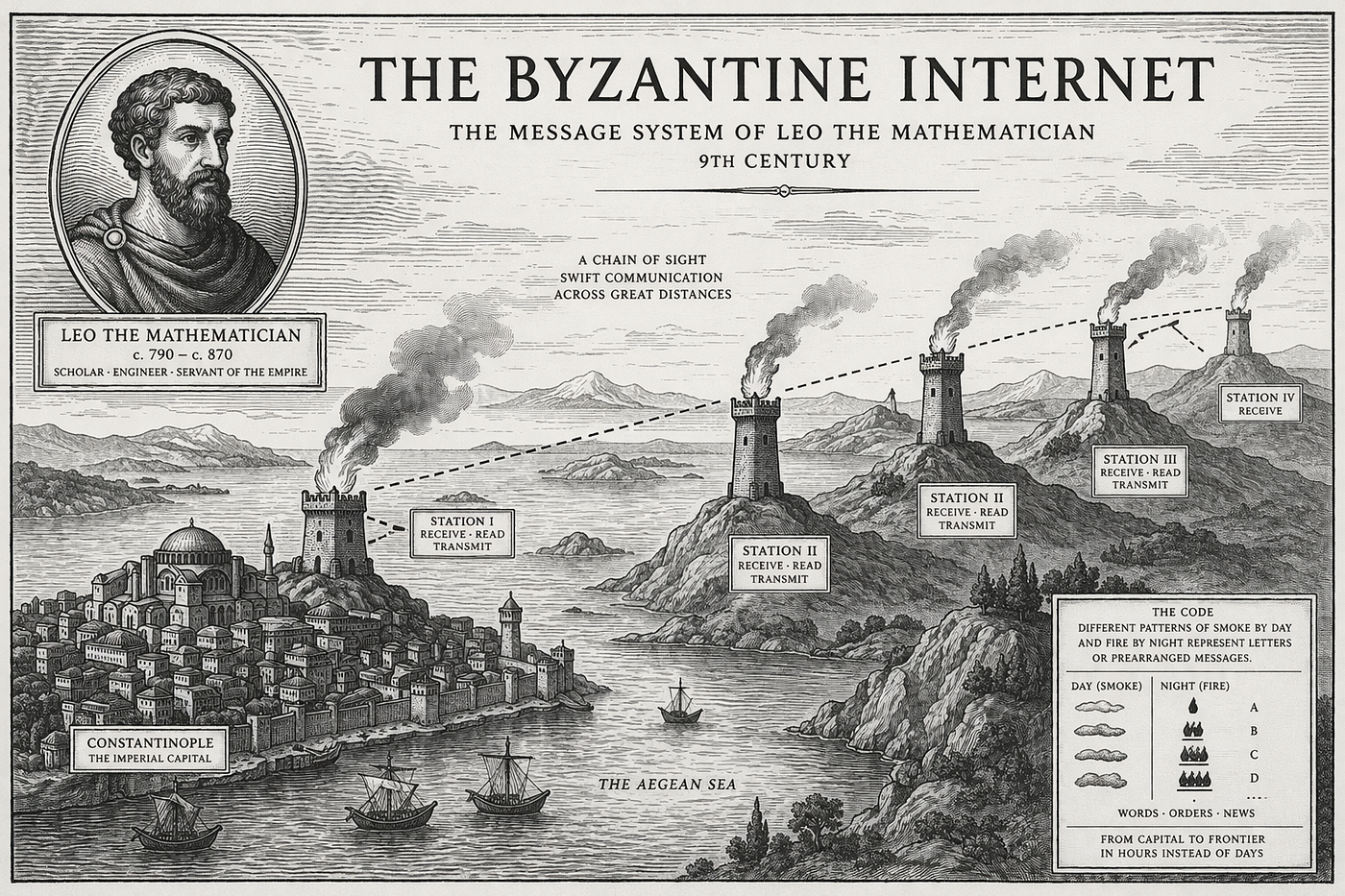
With the fall of Constantinople in 1453, Greek scholars fled to Italy, carrying ancient manuscripts never before seen in Western Europe. Impressed by these texts, Cosimo de’ Medici, the ruler of Florence, established the Platonic Academy and appointed a young priest and scholar, Marsilio Ficino, to translate them into Latin. Ficino translated Plato’s works and the Corpus Hermeticum, attributed to the Egyptian sage Hermes Trismegistus. His protégé Pico della Mirandola, a prodigy fluent in five languages, added the Jewish Kabbalah, Arabic philosophy, and Aristotle into the project.
Studying these scrolls, Ficino and Pico reached a remarkable conclusion. They believed that God had disclosed the ultimate truth about reality to humanity’s earliest sages, a wisdom that was transmitted through generations, from Moses and Hermes down to the Greeks. This idea, that a single, universal truth is the foundation of all the world’s religions and philosophical traditions, resurfaced repeatedly in later centuries.
Philosopher and mathematician Gottfried Leibniz used the term philosophia perennis in a 1714 letter, referring to a common truth present in ancient Greek and Christian thought, enriched by the science of mechanics. In 1841, philosopher Ralph Waldo Emerson, in his essay The Over-Soul, argued that within each person lives a unique spiritual essence that unites all individual minds, and is the source of all wisdom and virtue. Individual thoughts are just segments of this larger, shared soul.
In the autumn of 1945, as the world emerged reeling from World War II, English novelist and essayist Aldous Huxley published his most ambitious work, The Perennial Philosophy, a collection of writings from religious scholars, together with his own commentary. The book brought ancient mysticism to a 20th-century audience, offering a spiritual antidote to the madness of World War II and a bridge between Eastern and Western thought.
Huxley argued that beneath all religious dogmas lies a single, universal reality, which he called the ‘Ground of all being.’ He identified a set of insights and practices that all major religions share, essential to reach this reality, which he named the ‘Highest Common Factor.’ The ultimate purpose of human existence, he wrote, is to experience this reality directly, by moving beyond the ego.
Aldous Leonard Huxley (1894–1963) was born in Surrey, England, to writer and schoolmaster Leonard Huxley and Julia Arnold. In 1913, Huxley enrolled at Balliol College, Oxford, where he studied English literature, earning a Bachelor of Arts. Huxley began writing in his twenties, publishing a series of novels and essays. In 1932 he published Brave New World, describing a dystopian future society where consumer pleasure, genetic conditioning, and the use of a recreative drug become the norm.
In the winter of 1937, Huxley arrived in Los Angeles with his wife Maria and his son, Mathew. He had left England because the Californian light was easier for his failing eyes than the London fog, but mainly because Europe was slowly sliding towards war.
Over the next decades, Huxley changed from a successful novelist into an explorer of human consciousness, dedicating himself to bridging the gap between science and mystical experience. Coming from one of Britain’s most famous scientific families, grandson of zoologist Thomas Henry Huxley, a fervent admirer of Darwin, and brother to noted biologist Julian Huxley, Aldous was trained for scientific rigor and sharp analysis. In Perennial Philosophy, he used his considerable analytical skills to approach the world’s sacred texts as a large dataset of human experience.
It was this extensive analysis that allowed him to detect in the writings of religious mystics a single, unique reality. He claimed that this reality is independent of subjectivity, beyond concepts and cultures, and can only be experienced through mystical experience. Huxley distinguished between the universal, mystic core of all religions, and their dogmas, which he considered local, cultural, and divisive.
Huxley and the Philosophers
Alan Watts
When English-born philosopher Alan Watts moved to the United States in 1938 and settled on the West Coast, he met Huxley. Although Alan Watts had already written The Spirit of Zen by age 21, Huxley showed him how to approach Eastern philosophies in a systematic way. Huxley appreciated Watts’s ability to translate abstract Eastern ideas into modern language.
Huxley’s hallucinogen experience, described in his book The Doors of Perception (1954), made him claim that psychedelics could momentarily dissolve the ego and expand consciousness. He argued that a supervised, ritual use of these substances could become a legitimate spiritual tool. Watts was more cautious. Although he had used hallucinogens, he insisted that a psychedelic experience was, at best, a reference. In Watts’s view, enlightenment could not be scheduled; it was a continuous effort, not an experience you can get from a chemical substance.
Jiddu Krishnamurti
Huxley’s relationship with Indian philosopher Jiddu Krishnamurti was more complicated. Although Huxley embraced Krishnamurti’s philosophy and wrote the foreword to his book The First and Last Freedom, Krishnamurti’s insistence that all religions and all meditative techniques were obstacles to true insight created friction with Huxley’s approach. As Huxley became interested in the use of hallucinogens to expand consciousness, the tension sharpened. Krishnamurti was highly critical of psychedelics, warning that the use of chemical substances to expand consciousness was just another form of conditioning.
Huxley and J. B. Rhine
Huxley was deeply interested in parapsychology. J. B. Rhine was a botanist who became the founder of modern parapsychology, establishing the first university-based laboratory for its study at Duke University in the 1930s. He used scientific methods to test for telepathy, clairvoyance, and Extra-Sensory Perception (ESP). In 1954, Huxley published an article in Life Magazine titled A Case for ESP, PK and Psi, based on Rhine’s book New World of the Mind.
Rhine’s focus was on conducting laboratory experiments and collecting data to prove the existence of ESP. Huxley was more interested in the philosophical implications of psychic phenomena, seeing them as evidence that human consciousness is more interconnected than it appears.
The Physicists and Huxley’s ‘Mind At Large’
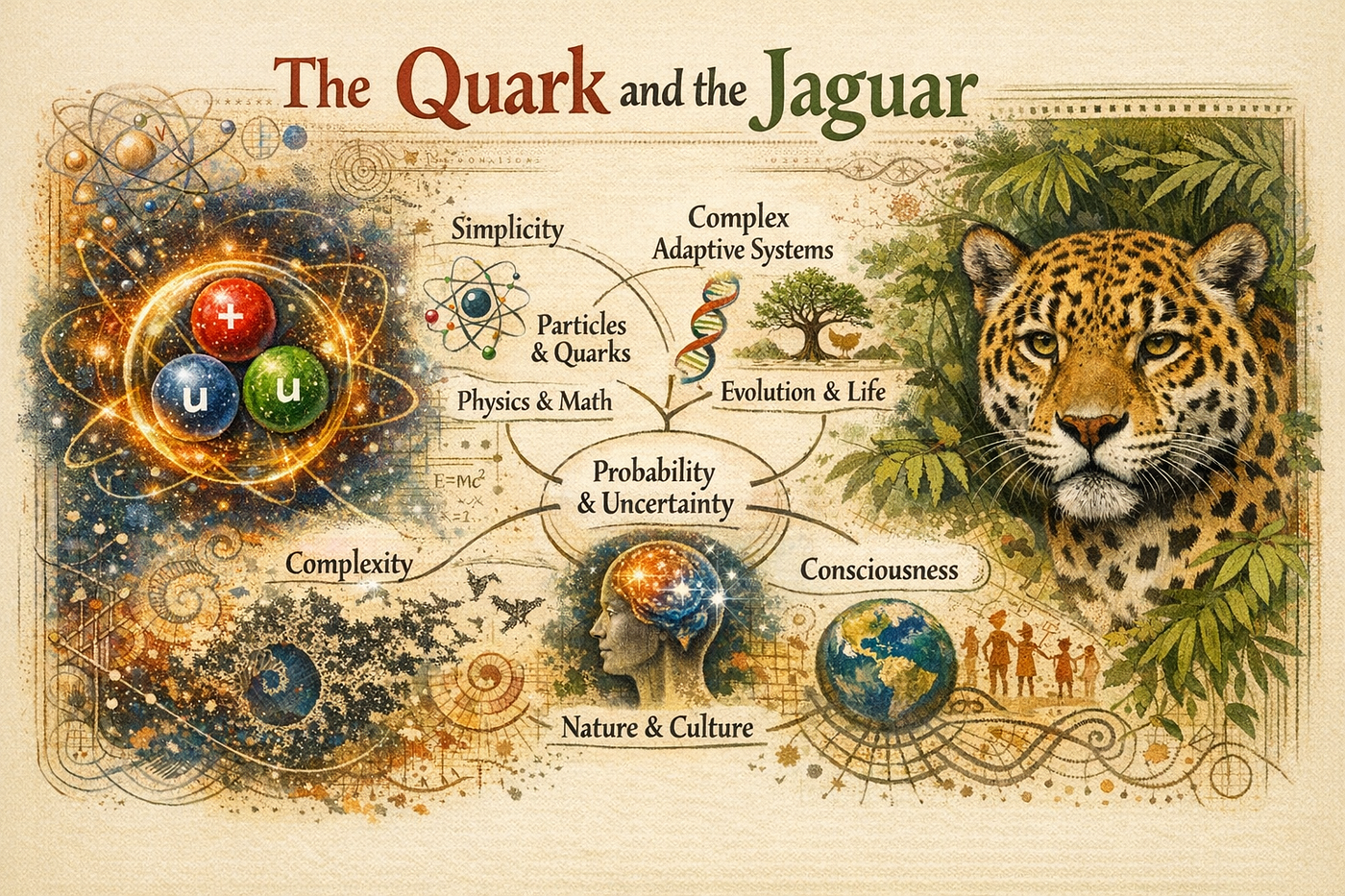
While writing the Perennial Philosophy, Huxley studied the works of physicists who tried to go beyond classical physics. Subjects such as the probability of a particle’s location and the interdependence of observer and observed seemed to him to confirm the existence of a deeper reality.
In his 1954 book The Doors of Perception, Huxley introduced the concept of the ‘Mind at Large.’ He described the brain as a ‘reducing valve’ that filters out consciousness, only letting through a small part necessary for survival. Huxley believed that under the influence of hallucinogens, the valve opens, giving temporary access to this expanded consciousness he called Mind at Large.
Erwin Schrödinger
In 1946, Huxley sent Erwin Schrödinger a copy of the Perennial Philosophy. Schrödinger replied positively, and a correspondence began. Schrödinger, who had studied the Vedanta (a Hindu philosophy), believed it fitted the implications of quantum theory. Huxley saw a parallel between Schrödinger’s theory that individual consciousness is not separate or unique to each person and his own concept of the Mind at Large.
Werner Heisenberg
In a visit to Germany, Werner Heisenberg met Indian writer and philosopher Rabindranath Tagore, and expressed interest in the Vedanta. Heisenberg, in his work, offered mathematical and theoretical proof that an observer is not separate from his environment, and that what we perceive is a limited version of a deeper reality. Huxley, who admired Tagore’s synthesis of science and mysticism, recognized in Heisenberg’s theories a similarity with the Mind at Large.
Esalen Institute
In 1963, Michael Murphy and Dick Price, two Stanford graduates disillusioned with academia, leased the Murphy family property at Slate’s Hot Springs in Big Sur, California, and founded the Esalen Institute. Set on 120 acres of coastal land with natural hot springs, it was the ideal setting for Price and Murphy to host workshops and lectures in philosophy, religion, and psychology. Huxley was invited as a founding advisor, and his seminar, titled ‘The Human Potentiality’, set the tone for what Esalen would become.
The interaction of Eastern philosophies, new psychological theories, and Zen Buddhism and Taoism created a climate of experimentation and openness. Gradually, however, Esalen began attracting an unexpected kind of visitor: theoretical physicists, who came to seminars out of personal curiosity. Esalen’s hot springs became a meeting place where these physicists, down from Stanford or UC Berkeley for the weekend, would listen, then slowly join in lectures by psychologists and philosophers.
A few years earlier, David Bohm and Jiddu Krishnamurti had already bridged quantum physics and Eastern philosophy through their dialogues. Both had given talks in Esalen, and participated in the ongoing debates. However, the landmark event in the evolution of Esalen’s quantum-spirituality conversation was the publication of Fritjof Capra’s The Tao of Physics (1975). Capra, a regular at Esalen, took Huxley’s work further by providing a detailed scientific foundation for his philosophical worldview.
Conclusion
Aldous Huxley’s Perennial Philosophy was never just an abstract concept; it was a passionate attempt to bridge science, spirituality, and philosophy. Through his work, his dialogues with other thinkers, and his influence at Esalen, Huxley helped set the stage for a new kind of thinking, where science does not fear mysticism, and spirituality is studied seriously as empirical data. Huxley’s true legacy may not be his answers, but his way of asking questions that invited scientists, philosophers, and scholars to see the whole rather than just the parts.
메타데이터
- post_id
- 09a4f8307470
- slug
- aldous-huxleys-perennial-philosophy-09a4f8307470
- url
- https://medium.com/brain-labs/aldous-huxleys-perennial-philosophy-09a4f8307470
- canonical_url
- https://medium.com/brain-labs/aldous-huxleys-perennial-philosophy-09a4f8307470
- author_url
- https://medium.com/@PeterManthos
- status
- ok
- fetched_at
- 2026-06-17 08:20:12