Infrastructure First. Coordination Early. Adoption Later.
Infrastructure isn’t adopted early. It’s adopted when not having it becomes unacceptable. RWAs require coordination before demand.
Most tokenomics pages start with numbers.
Supply. Emissions. Incentives.
That framing assumes the token is the product.
In infrastructure systems — especially those that intersect with real-world assets — that assumption is wrong.
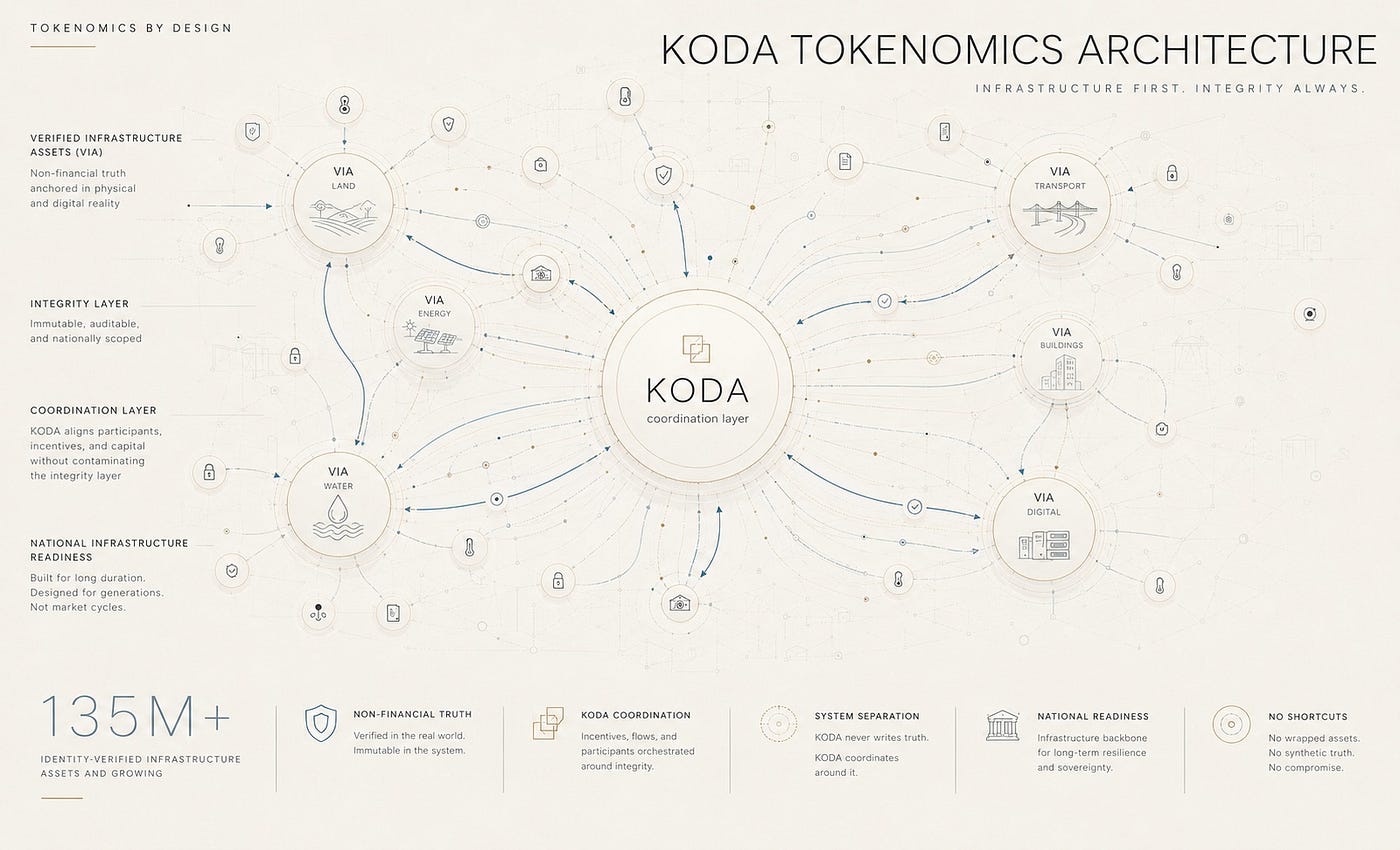
KODA exists because verified infrastructure must precede markets, not the other way around. This article explains how Verified Infrastructure Assets (VIA) establish non-financial truth, how KODA coordinates around that integrity layer without contaminating it, and how the system is structured for long-duration national infrastructure readiness.
Why Traditional Tokenomics Break Down in Infrastructure
Crypto token models evolved in environments that are:
• Fully digital • Voluntary to join and exit • Liquidity-first • Financially incentivized
Residential infrastructure behaves differently.
Homes do not churn. Infrastructure does not exit. Verification cannot be transferred without losing meaning.
Once physical systems are involved, the economic unit is no longer the token. It is the verified state of the system itself.
Infrastructure truth cannot be engineered like liquidity.
Why We Do Not Call This “Staking”
In digital networks, staking typically means:
• Locking tokens • Securing a network • Earning yield
That construct collapses when applied to property infrastructure.
A home does not stake. Verification cannot be unstaked. Truth cannot be liquidated.
So we do not use that term.
Instead, we define a different primitive.
Verified Infrastructure Assets (VIA)
A Verified Infrastructure Asset (VIA) represents a verified, non-fungible, infrastructure-bound state of truth.
VIA is:
• Non-transferable • Non-speculative • Non-financial
It does not generate yield. It is not designed to trade.
Its sole function is to anchor point-in-time digital infrastructure metadata to a real-world system without surveillance, credential custody, or financialization.
Staking locks tokens. VIA anchors infrastructure.
Why VIA Never Trades
This is not a limitation. It is the foundation.
If verification were transferable:
Accuracy would become arbitrage. Trust would become extractable. Infrastructure truth would collapse into markets.
Verification retains value only when it remains attached to what was verified.
VIA therefore remains fixed by design — similar to:
SSL certificates DNS records Building permits
Invisible. Essential. Non-financial.
From RWAs to VIA (Why Tokens Come Later)
Most discussions of Real-World Assets begin with tokenization.
That skips a critical step.
Before an asset can exist safely on-chain, its underlying real-world state must be:
• Verified • Bounded • Privacy-preserving • Neutral at the moment of transition
VIA defines that prerequisite layer.
It does not represent ownership, yield, or financial exposure. It represents verified infrastructure truth.
Only after truth is anchored does coordination become meaningful.
That coordination role is what KODA enables — without ever touching the integrity layer.
This separation ensures:
Verification remains non-financial. Privacy boundaries remain intact. Markets do not contaminate truth.
Market Convergence (2026 Context)
CleanSL8® was founded before tokenization entered its current institutional phase. Early narratives centered on liquidity and asset issuance.
In 2026, institutional commentary increasingly frames tokenization as market infrastructure — issuance rails, settlement layers, compliance continuity — rather than speculative novelty.
This convergence does not alter the architecture. It confirms the premise: infrastructure truth must exist before coordination or liquidity can safely emerge.
VIA defines truth. KODA coordinates around it.
Keeper of Digital Assets (KODA)
If VIA protects integrity, KODA enables coordination.
KODA exists to:
• Capitalize infrastructure readiness before adoption • Coordinate participation without touching verification • Fund development, tooling, and long-term stewardship • Provide a liquid coordination rail outside the integrity layer
KODA is not the infrastructure. It is the coordination system surrounding infrastructure.
The separation is intentional.
Infrastructure Inevitability and National Scale
Smart device fixtures are not speculative. They are a function of ordinary human behavior — investments in safety, comfort, energy efficiency, and convenience.
In the United States, there are over 145 million residential properties. The housing base expands at approximately 1% annually.
Devices accumulate incrementally. They persist across ownership changes. Their digital transfer is rarely documented.
MyHOME™ ID vaults are instantiated in advance of engagement, creating a deterministic identifier layer across the national housing stock.
These vaults:
• Do not assume adoption • Do not require engagement • Do not monitor behavior
They exist in a ready state, capable of receiving verified records when interaction occurs.
Capital participation does not underwrite adoption. It underwrites readiness.
The Tortoise and the Hare
The ecosystem grows across two independent tracks.
The Tortoise — Infrastructure Correctness
• Verification primitives are built early • Privacy boundaries are enforced • Documentation standards are proven • Adoption is not assumed
This path is deliberately slow.
The Hare — Capital Readiness
• Liquidity exists before coordination is demanded • Markets form ahead of regulatory pressure • Capital positions in advance of inevitability
Presale participation underwrites readiness — not usage.
The two tracks remain structurally independent.
Why a Secondary Market Exists
If verification does not trade, why does KODA?
Because infrastructure must exist before it is demanded.
Liquidity operates outside the integrity layer. It does not monetize verification and does not confer ownership of infrastructure truth.
Markets form around infrastructure — not inside it.
Tokenomics Architecture
Supply Overview
Maximum supply: 5,000,000,000,000 KODA.
Supply is divided into structurally independent domains:
- Infrastructure Allocation
- Operational Stewardship
- Enterprise Activation
- Market Liquidity
These domains do not overlap programmatically.
1. Infrastructure Allocation Commitment (3 Trillion KODA)
3,000,000,000,000 KODA have been permanently committed via an irreversible on-chain transaction to the MYHID instantiation architecture.
Each MYHID address — representing a residential property — is programmatically associated with a baseline allocation of 10,000 KODA.
This allocation:
• Does not circulate • Does not trade • Does not recycle • Is independent of price and market volume
It establishes national coordination capacity directly tied to the residential property base.
2. Demographic Indexing (Non-Compounding)
To maintain proportional coverage as the U.S. housing base expands, allocation parameters are indexed at approximately 1% annually — consistent with long-term residential growth trends.
Indexing is:
• Linear (non-compounding) • Independent of token markets • Independent of enterprise onboarding • Independent of liquidity conditions
Because total supply is fixed, indexed allocation gradually reduces unassigned infrastructure capacity over time.
Under current demographic assumptions, this model supports multi-decade national coverage.
This is infrastructure alignment — not scarcity engineering.
3. Operational Stewardship (14%)
14% of supply supports:
• System security • Compliance functions • Infrastructure tooling • Patent development and defense • Long-term protocol maintenance
These allocations are governed and do not automatically enter circulation.
4. Enterprise Network Activation (15%)
15% of supply functions as onboarding credits for enterprise participants.
These credits:
• Reduce integration friction • Support early API usage • Deplete through operational consumption • Do not replenish automatically
This mechanism encourages integration without forcing immediate budget allocation.
5. Circulating Supply (Up to 1.5 Billion)
Up to 1.5 billion KODA circulate on secondary markets.
Circulating supply operates independently from infrastructure allocation and enterprise reserves.
Market activity does not influence allocation indexing.
6. Secondary Market Supply Discipline
A defined portion of transaction fees (capped between 1–5%) may be directed toward token retirement mechanisms affecting circulating supply only.
These mechanisms:
• Apply exclusively to circulating float • Do not affect infrastructure allocation • Do not alter demographic indexing • Do not modify enterprise credits
Infrastructure capacity and market liquidity remain structurally separated.
Pricing Disclosure
Presale pricing progresses through defined phases reflecting access to early capital allocation.
Pricing supports operational sustainability and infrastructure readiness.
It does not represent:
• A promise of appreciation • A guarantee of liquidity • A projection of market performance
Regulatory Posture
Participation is structured under:
• Regulation S (Non-U.S.) • Regulation D, Rule 506(c) (Accredited U.S.)
All participants undergo KYC/AML verification.
KODA does not represent:
• Equity • Real estate ownership • Revenue share • Yield • Staking rights • Monitoring privileges
It represents participation in an infrastructure coordination layer only.
The Long View
Infrastructure is rarely adopted early.
It becomes essential when the cost of absence exceeds the cost of implementation — often after regulatory shifts, litigation, or systemic friction.
VIA establishes truth. KODA establishes readiness.
When digital transfer clarity becomes expected rather than optional, the coordination layer will already exist.
That is the design.
Intellectual Property & Trademark Notice
CleanSL8® is a registered trademark of CleanSL8, Inc. (Wyoming). MyHOME ID™, SL8 Audit™, SL8 Wipe™, and SL8 Signature™ are proprietary trademarks and service marks of CleanSL8®.
The definitions and frameworks for Verified Infrastructure Assets (VIA) and KODA Metadata Certificates (KMC) are proprietary schemas. MyHOME ID™ is a persistent, property-bound digital identity activated and populated through SL8 Signature™, binding verified, point-in-time infrastructure metadata to a home. Use of these marks, schemas, or the KODA coordination layer without explicit authorization from CleanSL8® is strictly prohibited.
메타데이터
- post_id
- 09bd515ea532
- slug
- infrastructure-first-coordination-early-adoption-later-09bd515ea532
- url
- https://medium.com/@christian_86421/infrastructure-first-coordination-early-adoption-later-09bd515ea532
- canonical_url
- https://medium.com/@christian_86421/infrastructure-first-coordination-early-adoption-later-09bd515ea532
- author_url
- https://medium.com/@christian_86421
- status
- ok
- fetched_at
- 2026-07-24 09:12:50


