🛰️ Weekly WASM Watch: The Top 5 You Shouldn’t Miss This Week
Fresh projects, releases, and signals from the WASM world — WASM Radar, October 16, 2025
🛰️ Weekly WASM Watch: The Top 5 You Shouldn’t Miss This Week
Fresh projects, releases, and signals from the WASM world — WASM Radar, October 16, 2025

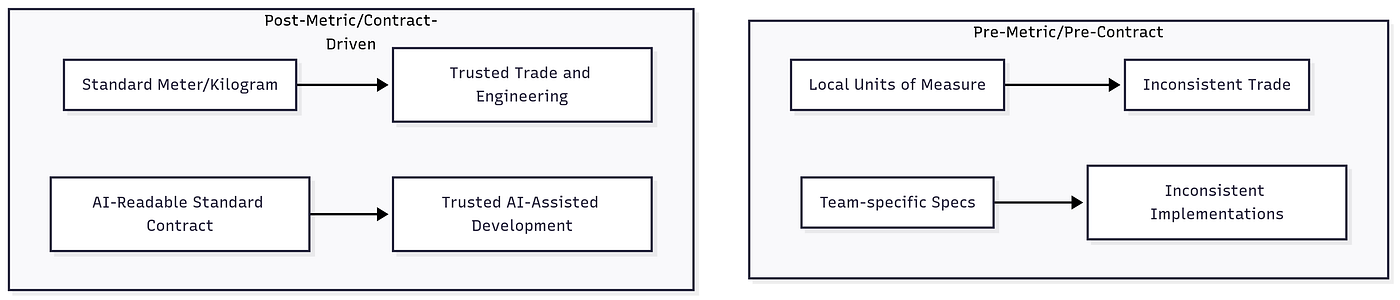
For years, I've pursued the same idea that drew me into architecture: what if software could truly run anywhere, not just in theory but in reality? Not using containers that pretend to be portable or APIs that hide the complexity, but through a genuine universal layer where behavior, identity, and capability stay consistent regardless of the device, runtime, or platform. This vision eventually laid the foundation for **Universal Microservices Architecture (UMA)**, the design philosophy I've been refining through white papers, proofs of concept, and now the book I am writing. UMA was born from the simple belief that portability shouldn't sacrifice trust, and that modern systems must be both distributed and capable of introspection. It’s not just about running code across browsers, edge, and cloud; it's about ensuring that the same contract guides every execution path.
When I began sketching UMA years ago, WebAssembly was still a niche experiment. It ran in browsers, but there was no standard way to access the file system, network, or GPU. However, what was once a dream is now becoming reality. The evolution of WASM, driven by WASI, the Component Model, and emerging cross-runtime standards like MCP, is finally aligning with the principles on which UMA was built. The five topics in this research capture what I have always envisioned the UMA world to be: GPU acceleration that achieves performance parity across runtimes, telemetry that makes AI agents observable and accountable, identity systems that operate without central authorities, components that replace containers with composable trust, and most importantly, sandboxes that constrain not only what code does but also how AI thinks.
It took years of prototypes, papers, and late-night writing to bring this ecosystem to life. Now, the architecture I once sketched on whiteboards as an impossible loop of code, data, and intelligence moving smoothly between environments is finally becoming real. UMA is more than just a framework; it's turning into a reality driven by the evolution of WebAssembly.
TL;DR
WebAssembly is rapidly maturing beyond its browser roots, reshaping how AI and distributed systems run across devices. Five key trends define this transformation.
1. WASI WebGPU brings native GPU acceleration to WebAssembly, breaking years of CPU-only limitations. Developers can now write one GPU kernel and run it anywhere, browser, edge, or cloud, with near-native speed and full portability.
2. AI Observability Inside the Sandbox introduces structured telemetry for WASM-based agents. Modules can now emit metrics, traces, and model-level insights safely within the sandbox, turning black-box inference into an auditable, observable process.
3. Secure Identity for Distributed AI merges the Model Context Protocol with Decentralized Identifiers (DIDs). It gives every agent a cryptographically verifiable identity, enabling cross-organization authentication without centralized providers.
4. From Containers to Components marks the shift from OS-level virtualization to behavior-level modularity. The WASM Component Model, integrated with OCI registries, replaces heavy containers with lightweight, composable, language-agnostic components.
5. Cognitive Sandboxing extends WASM’s isolation model from code to reasoning itself. It validates AI decisions at runtime, ensuring that even autonomous agents operate within safe, explainable, and reversible boundaries.
Together, these developments signal that WebAssembly is no longer a web technology. It’s becoming the universal runtime for secure, portable, and intelligent computation from browsers to edge nodes, from reasoning models to GPU clusters.
WASI WebGPU: GPU Acceleration Comes to WebAssembly
WebAssembly has been CPU-bound for years, but that is rapidly changing. The WASI WebGPU interface now enables WASM modules to run GPU-accelerated AI inference natively, delivering near-CUDA performance in browsers, edge nodes, and even embedded runtimes.
What changed
Until recently, WebAssembly’s sandboxed execution environment limited AI workloads to CPU-bound tasks, leaving GPUs out of reach. With the emergence of WASI WebGPU, developers can now write GPU kernels once and deploy them anywhere WebGPU is supported without vendor lock-in. Early benchmarks show two to five times speedups for in-browser AI inference and up to twenty times improvements in graphics-heavy or matrix compute scenarios. The most significant impact is that WebGPU is now accessible through the WASI API, not just browsers. This means headless servers, edge devices, and even IoT boards can tap into GPU acceleration through a common, portable interface.
How it works
WASI WebGPU provides a standardized GPU abstraction layer that mimics WebGPU’s design in browsers. It enables runtimes like Wasmtime, WasmEdge, and wasmCloud to allocate GPU buffers, compile shaders, and run compute workloads securely within the sandbox.
At a high level, it works like this:
- The host runtime implements the
wasi:webgpuinterface. - A WASM module imports this interface and uses GPU commands such as
create_bufferordispatch_compute. - The runtime maps those commands to native GPU APIs like Metal, Vulkan, or DirectX on the host.
- The results are returned to the module as structured data.
Here is a minimal example of initializing a compute pipeline with WASI WebGPU:
// host: Wasmtime or WasmEdge with wasi webgpu enabled
use wasi_webgpu::*;
fn main() {
    let adapter = request_adapter().unwrap();
    let device = adapter.request_device().unwrap();
    let shader = device.create_shader_module("
        @compute @workgroup_size(1)
        fn main(@builtin(global_invocation_id) gid : vec3<u32>) {
            // Simple multiply
        }
    ");
    let pipeline = device.create_compute_pipeline(shader);
    device.dispatch_workgroups(64, 1, 1);
}
This program compiles to WASM and runs on GPU-enabled hosts without any changes, whether in the browser or on an edge node using Vulkan.
Why it matters
This marks a major milestone for AI inference portability. With WASI WebGPU, developers can deploy the same GPU-accelerated model across browsers, edge devices, or servers using identical binaries. It fills a vital gap in the WebAssembly ecosystem, offering hardware-accelerated AI without sacrificing security or portability. For enterprises, this means running privacy-preserving inference on a device without relying on native CUDA stacks. For researchers, it enables reproducible GPU workloads in WASM sandboxes. And for web developers, it provides real AI acceleration in the browser without plugins or custom builds.
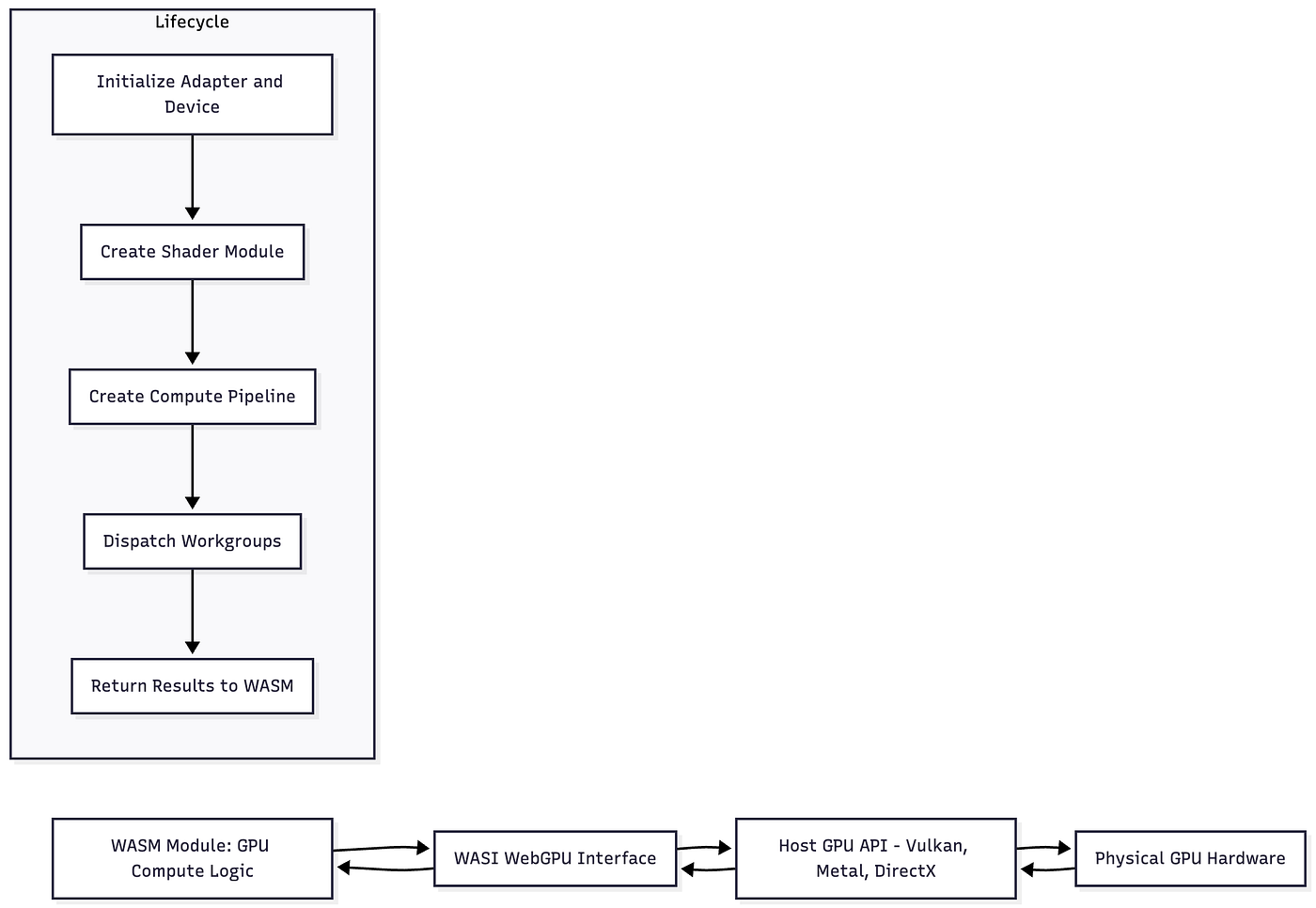
Diagram: WASM modules now invoke GPU compute through WASI WebGPU, enabling cross-platform AI acceleration.
Documentation
- WASI WebGPU specification preview: github.com/WebAssembly/wasi-webgpu
- WasmEdge GPU runtime: wasmedge.org
- Example GPU inference: dev.to/vaib/unleashing-edge-ai-with-webassembly
AI Observability Inside the Sandbox: Telemetry Models for WASM-Based Agents
As AI workloads shift to WebAssembly, observability has become a blind spot. Once code is compiled into a WASM module and runs inside a secure sandbox, developers lose visibility into how models behave, how resources are used, and why an agent acts a certain way. A new wave of telemetry models is emerging to address this issue without compromising the isolation guarantees that make WASM so attractive.
What changed
Traditional observability tools rely on direct access to system logs, process metrics, and network traces. Inside a WASM runtime, none of these are accessible by default. The sandbox conceals everything from the host for security reasons. As AI systems develop into multi-agent ecosystems operating on WASM runtimes like WasmEdge or wasmCloud, this lack of introspection makes it hard to debug, audit, or improve performance. Recent proposals propose structured telemetry interfaces for WASM, enabling modules to send metrics, traces, and state snapshots through a controlled channel. These telemetry streams can include model-level data such as inference time, prompt size, memory usage, or even reasoning traces in a compressed, anonymized format. With this change, observability becomes part of the WASM runtime’s capability agreement rather than a security issue.
How it works
Telemetry for WASM-based AI agents builds on the concept of capability-based instrumentation. Instead of letting a module write to stdout or open system logs, the host provides a wasi:telemetry interface with a few core primitives:
record_metric(key, value)record a scalar or histogram metric.emit_trace(event)append structured logs to a bounded trace buffer.snapshot_state()capture memory or model state summaries for debugging.
A WASM module can import these interfaces and call them safely. The runtime enforces quotas and sanitization before sending the telemetry to an external collector or MCP tool.
Here is a simplified Rust example of how a WASM agent could expose its own telemetry hooks:
use wasi_telemetry::*;

fn infer(prompt: &str) -> String {
    record_metric("prompt_length", prompt.len() as f64);
    let start = now();
    let result = run_inference(prompt);
    emit_trace(format!("inference_complete in {} ms", now() - start));
    record_metric("inference_time_ms", (now() - start) as f64);
    result
}
This agent can now be monitored in real time without breaking sandbox isolation. The telemetry feed can be streamed to a local dashboard, a cloud observability platform, or an MCP server that aggregates and correlates data across agents.
Why it matters
WASM made AI portable and secure, but it also made it opaque. Telemetry restores visibility in a controlled way, transforming WASM from a black box into an auditable AI runtime. For developers, this enables faster debugging and detailed performance tuning. For enterprises, it guarantees that autonomous agents can be monitored, traced, and explained without compromising security. More importantly, telemetry within WASM aligns with the increasing demand for trustworthy AI. Logs, metrics, and traces generated by sandboxed agents create a verifiable record of reasoning and execution. This bridges the gap between AI accountability and software observability.

Diagram: Structured telemetry inside the WASM sandbox provides safe visibility into AI agent behavior and performance.
Documentation
- WASI Telemetry proposal draft: github.com/WebAssembly/wasi-observe
- WasmEdge observability API: wasmedge.org/docs/telemetry
- MCP logging integration concept: modelcontextprotocol.io
Secure Identity in Distributed AI: MCP Authentication Meets Decentralized Identifiers (DID)
As AI systems grow across organizations and devices, identity becomes the weakest link. Each agent, model, and server now interacts through networks that span cloud, edge, and browser runtimes. The Model Context Protocol (MCP) standardizes communication, but authentication still relies on traditional OAuth flows and static tokens. By integrating MCP with Decentralized Identifiers (DID) and Verifiable Credentials (VCs), a new kind of portable, cryptographically verifiable agent identity is emerging, one that works across all runtimes, including WebAssembly.
What changed
Today’s AI infrastructure relies on centralized identity providers to issue access tokens and verify credentials. This causes friction when agents operate offline, across different domains, or on user-owned devices. The result is fragmented trust models that cannot scale to distributed AI ecosystems.
DID and VC standards, originally created under the W3C, enable identities to be issued, owned, and verified without a central authority. A DID signifies a cryptographically verifiable identifier, while Verifiable Credentials serve as signed attestations about an entity’s capabilities, such as “can access dataset X” or “runs verified model Y.” When used in MCP, these credentials form a trust network for distributed AI agents. An MCP server can now verify not only the identity of an agent but also what actions it is authorized to perform, without depending on cloud-based OAuth flows. This allows for secure, authenticated interactions across WASM runtimes, edge nodes, and private environments.
How it works
MCP authentication with DIDs integrates at the protocol handshake level. The steps are simple but powerful:
- Each agent and server possesses a DID document describing its public keys and service endpoints.
- When initiating an MCP connection, the agent presents a Verifiable Credential, signed with its DID key, declaring its permissions or role.
- The MCP server verifies the credential signature using the DID document, checks policy compliance, and grants or denies access accordingly.
- The entire exchange happens over mutual TLS, preserving the existing security model while removing dependency on central identity systems.
Here’s a conceptual snippet of how a WASM-based MCP client could register with a DID identity:
use mcp_identity::*;
use didkit::generate_credential;

fn authenticate(agent_id: &str) {
    let credential = generate_credential(agent_id, "access:dataset:telemetry");
    let signed = sign_credential(credential);
    mcp_handshake_with_did(signed);
}
This method enables each agent, whether running in a browser, a WASM runtime like WasmEdge, or a remote data center, to authenticate using the same decentralized system. The trust model becomes portable, extensible, and cryptographically verifiable.
Why it matters
Identity is essential for secure AI. Without it, even the most advanced agent orchestration becomes a security vulnerability. Integrating MCP with DIDs introduces self-sovereign identity to distributed AI systems, allowing agents to validate their origin, capabilities, and compliance without centralized authority. For enterprises, this removes vendor lock-in and lowers risk by enabling each organization to issue and verify its own credentials. For developers, it simplifies authentication across various environments, from cloud to edge. For researchers, it facilitates secure experimentation in decentralized, cross-organizational AI systems.
This convergence of MCP and DID paves the way for trust at the protocol level, establishing the identity layer that autonomous software has always lacked.

Diagram: MCP authentication enhanced with DIDs enables decentralized, verifiable trust across AI agents and runtimes.
Documentation
- W3C Decentralized Identifiers (DID) specification: www.w3.org/TR/did-core
- Model Context Protocol overview: modelcontextprotocol.io
- Verifiable Credentials Data Model: www.w3.org/TR/vc-data-model
From Containers to Components: Comparing WASM Component Model vs OCI
WebAssembly has long aimed to be the “universal runtime,” but until now, it lacked a standard unit for distribution. Developers used Docker containers for everything else, while WASM modules were small, fast, and portable but isolated and difficult to assemble. The WASM Component Model changes that. It introduces a standard for describing, linking, and packaging reusable components that can work together seamlessly. When combined with the Open Container Initiative (OCI) format, it redefines deployment in a world moving beyond traditional containers.
What changed
Over the past decade, containers have been the main method for software deployment. Each Docker image included its OS layer, dependencies, and application code, ensuring consistent runtime environments across different machines. However, containers are bulky, tied to specific architectures, and need constant updates. The WASM Component Model, now nearing full standardization, offers a lighter, more modular alternative. Components are self-contained units that specify their imports, exports, and types using the WebAssembly Interface Types (WIT) format. Instead of encapsulating an entire OS, a WASM component only includes the logic and metadata necessary for execution. By adhering to the OCI registry standard, these components can be published, versioned, and shared just like Docker images. For instance, Microsoft’s Wassette and Fermyon’s Spin runtimes already support pulling components directly from OCI registries like GHCR or Docker Hub. The result is a hybrid ecosystem where the familiar container infrastructure distributes portable WASM components instead of large system images.
How it works
The WASM Component Model defines a clear composition and linking system that mirrors the structure of modern microservices. Here’s how it functions in practice:
- A component is compiled from source (Rust, C, Go, etc.) into a
.wasmbinary annotated with a WIT file that describes its interface. - The runtime uses the WIT metadata to automatically generate adapters, resolving dependencies between components without manual glue code.
- The component is packaged into an OCI-compliant artifact (e.g.,
component:1.0.0) and pushed to a registry. - Another runtime, such as wasmCloud, Spin, or Wasmer, can then pull and execute it directly.
Here’s a conceptual example of defining and linking two components — a text analyzer and a summarizer — using WIT:
package analytics:core

interface text_analyzer {
  analyze: func(input: string) -> map<string, u32>
}
interface summarizer {
  summarize: func(input: string) -> string
}
world analytics {
  import text_analyzer
  export summarizer
}
This simple WIT schema enables runtimes to connect these components automatically. They can be stored as individual OCI artifacts and combined dynamically at runtime without needing rebuilds or container orchestration.
Why it matters
The shift from containers to components is not only about speed but also about granularity and composability. Containers isolate environments, but WASM components define behavior. This results in smaller applications that are quicker to deploy and naturally more secure. For platform architects, it means services can be assembled on demand from verified components instead of rebuilding from scratch. For developers, it simplifies modular design by allowing each component to explicitly declare its capabilities, while runtimes automatically manage compatibility. For enterprises, it enables true cross-platform execution, where a single artifact can run in the browser, on edge nodes, or in the cloud with consistent semantics. The WASM Component Model, integrated with OCI, may not replace containers immediately, but it sets the blueprint for what comes after them.

Documentation
- WASM Component Model specification: github.com/WebAssembly/component-model
- WebAssembly Interface Types (WIT): github.com/WebAssembly/interface-typ
Cognitive Sandboxing: AI Safety Patterns for Running Reasoning Models in WASM
As AI systems become more autonomous, the question is no longer just about what code runs safely but also about what reasoning runs safely. Large Language Models and agentic frameworks can generate, plan, and execute actions dynamically, sometimes in unpredictable ways. Cognitive Sandboxing applies the principles of WebAssembly isolation not only to code execution but also to reasoning itself, creating boundaries for how AI thinks, decides, and interacts with its environment.
What changed
Traditional sandboxes secure software by isolating binaries, preventing a program from reading or writing outside its designated memory space. However, AI models blur these boundaries. A model can output shell commands, request sensitive data, or call external APIs through tool interfaces like the Model Context Protocol (MCP). This means that the most critical vulnerabilities now arise not in compiled code but in the emergent reasoning of the model’s ability to generate unsafe or unintended behavior. Recent advancements in AI infrastructure have begun to extend WASM’s sandboxing logic to encompass cognitive control. Runtimes like Wassette and wasmCloud now allow MCP tools or reasoning chains to run within WASM modules, ensuring that even if an agent attempts a risky action, it must first pass through an explicit capability contract specified by the host. This shifts the safety boundary from “what can the code access” to “what can the model decide to do.”
How it works
Cognitive Sandboxing builds on three safety layers inside a WASM runtime:
- Capability Gatekeeping: Each reasoning or action step runs as a WASM component with a limited capability scope. For example, a “file read” component can access only a specific virtual directory, enforced by the runtime’s capability contract.
- Decision Interception The model’s reasoning output (e.g., “download file X” or “delete record Y”) is parsed and validated before execution. A policy engine checks intent against allowed actions.
- State Checkpointing Before an action executes, the model’s state snapshot is serialized, hashed, and logged to enable rollback or forensic analysis in case of unsafe behavior.
Here’s a conceptual example showing how a reasoning step could be sandboxed in Rust-like pseudocode:
use wasi_policy::*;

fn plan_action(command: &str) {
    if validate_intent(command).is_ok() {
        execute_in_wasm(command);
    } else {
        emit_trace("Blocked unsafe reasoning output");
    }
}
Each reasoning step undergoes an explicit validation phase within the sandbox, enabling developers to monitor and control autonomous behavior without providing the model with direct access to system calls.
Why it matters
Cognitive Sandboxing represents the next frontier in AI safety. It treats reasoning as an executable process with explicit permissions, auditability, and rollback capabilities. This transforms AI alignment from an abstract ethical goal into a runtime-enforced architectural feature. For security engineers, it means AI models can be deployed on local or edge devices without the risk of arbitrary code execution. For enterprises, it allows each decision to be logged, verified, and replayed for compliance. For researchers, it provides a reproducible environment to study how reasoning chains evolve under controlled constraints. By applying WASM’s isolation principles to the logic that drives AI behavior, Cognitive Sandboxing bridges the gap between trust and autonomy. It ensures that even when AI reasons freely, it acts responsibly.

Diagram: Cognitive Sandboxing applies WASM’s isolation model to reasoning itself, validating AI decisions before execution.
Documentation
- Wassette runtime overview: opensource.microsoft.com/blog/2025/08/06/introducing-wassette-webassembly-based-tools-for-ai-agents
- Model Context Protocol policy framework: modelcontextprotocol.io wasmCloud security and capability model: wasmcloud.dev
🧠 Found this helpful?
If this post gave you fresh ideas or something to share with your team, a clap goes a long way. It also helps others find the series.
🛰️ Following the signal? This article is part of the ongoing series:
Each post examines what’s new in WebAssembly, from performance improvements to platform advancements, so that you can stay ahead of the curve.
메타데이터
- post_id
- 09d21bb15f69
- slug
- ️-weekly-wasm-watch-the-top-5-you-shouldnt-miss-this-week-09d21bb15f69
- url
- https://medium.com/wasm-radar/%EF%B8%8F-weekly-wasm-watch-the-top-5-you-shouldnt-miss-this-week-09d21bb15f69
- canonical_url
- https://medium.com/wasm-radar/%EF%B8%8F-weekly-wasm-watch-the-top-5-you-shouldnt-miss-this-week-09d21bb15f69
- author_url
- https://medium.com/@enricopiovesan
- status
- ok
- fetched_at
- 2026-06-11 05:11:55