The Singapore Law Firm That Now Analyses 200-Page M&A Contracts in 12 Minutes (A Tech DD…
A law firm compressed four days of contract review to 12 minutes. The technology worked. The more interesting question is what this implies…
The Singapore Law Firm That Now Analyses 200-Page M&A Contracts in 12 Minutes (A Tech DD Perspective)
A law firm compressed four days of contract review to 12 minutes. The technology worked. The more interesting question is what this implies for every other due diligence process still running on four to six week timelines.
Let’s start with the number.
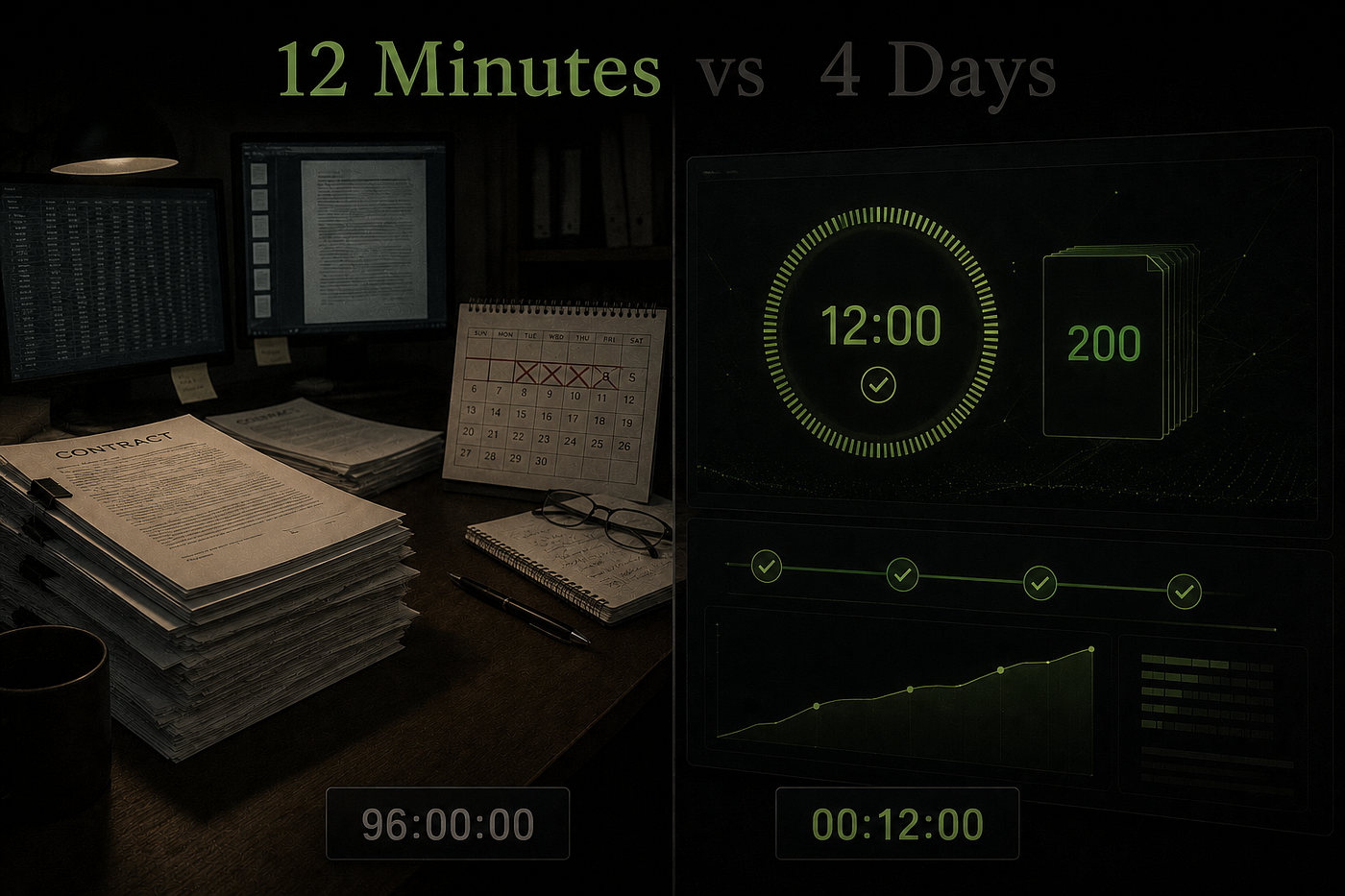
Twelve minutes. That’s how long it takes a Singapore M&A law firm to complete the initial analysis and pass on a 200-page transaction document set, share purchase agreement, disclosure schedule, ancillary agreements and regulatory filings, across three legal jurisdictions: Singapore, the United Kingdom and the United States.
Before the AI contract review agent was deployed, the same first-pass analysis was taking three to four days of senior associate time. Not the complete legal work, that still requires experienced lawyers making judgment calls about materiality, risk tolerance and negotiating position. The mechanical extraction work: identifying defined terms, flagging risk provisions, noting jurisdiction-specific clause variations and surfacing cross-document inconsistencies that would otherwise require manual comparison across hundreds of pages.
Three to four days compressed to twelve minutes. On a multi-jurisdiction, multi-document transaction package that is typical of the M&A work this firm handles regularly.
I want to talk about what this means, not just for M&A legal work, but for how we should be thinking about every due diligence process in the deal ecosystem. Because if contract review can be compressed this dramatically, the four to six week timelines that technical due diligence firms are still running need to be interrogated.
What the Contract Review Agent Actually Does
Before drawing broader conclusions, precision about the agent’s scope matters.

The firm handles cross-border transactions that regularly span Singapore, UK and US law in three jurisdictions with different regulatory frameworks, different standard clause interpretations and different market practice norms. A representation about material adverse change, for example, has different standard interpretations under English law than under US GAAP-influenced deal practice. A limitation of liability clause that is standard market practice in Singapore may be unusual in a UK context.
The contract review agent ingests the complete document set, typically 150–250 pages across the principal agreements and supporting documents and runs a structured analysis that covers five categories of extraction.
Defined term identification and cross-referencing, ensuring that terms defined in the principal agreement are used consistently across ancillary documents and flagging any inconsistencies that could create interpretive disputes.
Key commercial provision extraction, payment terms, closing conditions, representations and warranties, indemnification structures, restriction periods, earnout mechanics, with jurisdiction-specific commentary on whether each provision is within standard market range or represents a deviation that warrants negotiation.
Risk-flagged clause identification, provisions that are standard in one jurisdiction but non-standard or potentially problematic in another, provisions with unusual carve-outs and provisions where the drafting creates ambiguity that could produce disputed interpretations.
Cross-document consistency checking, verifying that obligations, representations and defined terms are used consistently across the SPA, disclosure schedules and ancillary agreements.
Preliminary analysis output, a structured document that a senior lawyer can use as the starting point for their substantive review, with all mechanical extraction complete and all jurisdiction-specific issues flagged for focused attention.
The twelve minutes is not the complete legal work. It is the extraction and preliminary analysis that previously consumed the first three to four days of a senior associate’s time on every transaction. What happens after twelve minutes, the substantive legal judgment, the negotiation advice, the risk assessment for the specific client’s situation, still requires experienced lawyers working at human speed.
The full **AI contract review case study** covers the architecture and implementation approach for law firms and deal teams evaluating similar deployments.
The Implication That Nobody Is Saying Loudly Enough
Here is the question about the law firm’s deployment forces on the adjacent due diligence ecosystem: if the mechanical extraction work in contract review can be compressed from four days to twelve minutes, what other due diligence work is running on unnecessarily long timelines because the mechanical extraction stages haven’t been automated?

Technical due diligence is the most obvious candidate.
A standard tech DD engagement for a mid-size software acquisition currently runs four to six weeks at most firms. The explanation for this timeline involves the depth of assessment required, code architecture analysis, security assessment, key person interviews, vendor contract review, IP chain investigation, infrastructure evaluation. And some of that work genuinely requires time: experienced assessors need to read and understand code, conduct interviews and form considered views about architectural risk.
But a meaningful portion of the four to six week timeline is occupied by work that is structurally similar to what the Singapore law firm just automated. Initial codebase scanning, running static analysis tools, generating complexity metrics, mapping dependency trees, identifying test coverage by module, can be significantly compressed with AI-assisted tooling. First-pass vendor contract review, identifying change-of-control clauses, data ownership provisions and acquisition-relevant terms across the vendor contract portfolio, is exactly the kind of structured extraction work the contract review agent handles.
The combination of these two observations, that contract review can be compressed to minutes and that comparable extraction work exists in tech DD, suggests that the four to six week standard timeline reflects historical process design rather than the irreducible minimum time required for rigorous assessment.
What Faster DD Actually Requires
The twelve-minute number for contract review is real, but it requires some context to be useful for thinking about tech DD timelines.

The compression happened because the extraction work was well-defined enough to be systematised. The agent knows what it’s looking for, the categories of provisions, the jurisdiction-specific variations, the consistency checks, because the law firm had done the work of defining the extraction criteria precisely enough to encode them.
The same precondition applies to accelerating tech DD. AI-assisted codebase analysis can compress the initial scanning and metric generation significantly. Automated vendor contract review can compress the first-pass identification of change-of-control clauses. Systematic IP chain investigation can be structured as an extraction workflow rather than a manual research exercise.
What can’t be compressed without sacrificing quality is the interpretive work. Understanding what the codebase metrics mean for the specific acquisition thesis. Assessing whether identified dependencies are manageable or material in the context of the integration plan. Evaluating architectural risk in light of the growth assumptions in the financial model. This is the work that requires experienced assessors making judgment calls and that work still takes time.
The opportunity is to compress the extraction stages so that the assessors’ time is concentrated on the interpretation stages. The Singapore law firm didn’t eliminate its lawyers. It gave its lawyers twelve minutes of preparation instead of four days, which means the lawyers’ time is spent on the work that actually requires them.
The Deal Team Implication
NCLT proceedings in India, competitive auction processes in the US, accelerated deal timelines across every geography, the trend in M&A is toward compressed timelines, not expanded ones. A four to six week tech DD engagement is increasingly incompatible with the deal processes where tech DD matters most.
The historical response to timeline pressure has been to compress or skip tech DD rather than to accelerate it. This is an expensive response. Every post-close discovery that could have been caught in a proper assessment is evidence of what timeline pressure without process improvement costs.
The better response, which is what the Singapore law firm demonstrated in contract review, is to build assessment processes that use AI-assisted tooling for the extraction stages while preserving human expertise for the interpretation stages. The result is faster assessments that don’t sacrifice the depth that makes the assessment worth doing.
The gap between the teams who have made this shift and the teams still running fully manual assessment processes is widening every quarter. The deal teams using AI for contract analysis already have a timeline advantage in competitive processes. The ones combining AI-assisted contract review with accelerated tech DD are de-risking at a level and speed that the market hasn’t fully caught up with yet.
That’s the advantage that compounds. The **tech due diligence services** page covers how we approach this, faster assessment timelines without compromising the depth that changes deal decisions.
The Broader Point About AI in Due Diligence
The Singapore law firm’s twelve-minute number will age, the timelines will compress further, the accuracy will improve and the scope of what can be automated will expand. That trajectory is predictable.

What’s less predictable is which firms in the due diligence ecosystem will have built the capability to take advantage of that trajectory and which ones will be defending manual processes that are increasingly difficult to justify.
The deal teams already using AI for contract analysis are a step ahead. The ones combining that with proper tech DD that uses the same AI-assisted efficiency for the extraction stages are de-risking at a level the market hasn’t caught up with yet. That leads compounds over every deal they do while competitors are still running on four-day first passes and four-week tech DD timelines.
Published by Dextra Labs | AI Consulting & Technical Due Diligence
메타데이터
- post_id
- 09d29bec9077
- slug
- the-singapore-law-firm-that-now-analyses-200-page-m-a-contracts-in-12-minutes-a-tech-dd-09d29bec9077
- url
- https://medium.com/@dextra_labs/the-singapore-law-firm-that-now-analyses-200-page-m-a-contracts-in-12-minutes-a-tech-dd-09d29bec9077
- canonical_url
- https://medium.com/@dextra_labs/the-singapore-law-firm-that-now-analyses-200-page-m-a-contracts-in-12-minutes-a-tech-dd-09d29bec9077
- author_url
- https://medium.com/@dextra_labs
- status
- ok
- fetched_at
- 2026-06-09 15:37:30




