Why Do Stupid People Think They’re Geniuses?
The Guy Who Robbed Banks with Lemon Juice and the Truth of Not Knowing What You Don’t Know
Why Do Stupid People Think They’re Geniuses?
The Guy Who Robbed Banks with Lemon Juice and the Truth of Not Knowing What You Don’t Know
Not knowing that you don’t know… That’s exactly what the Dunning-Kruger effect is all about.
One of the strangest things in life is this: The people who know the least usually talk the most. The ones who actually know a lot tend to stay quiet in the background. At first you think it’s just an confidence issue, but it’s not. It’s directly related to how our brains work.
[embed]
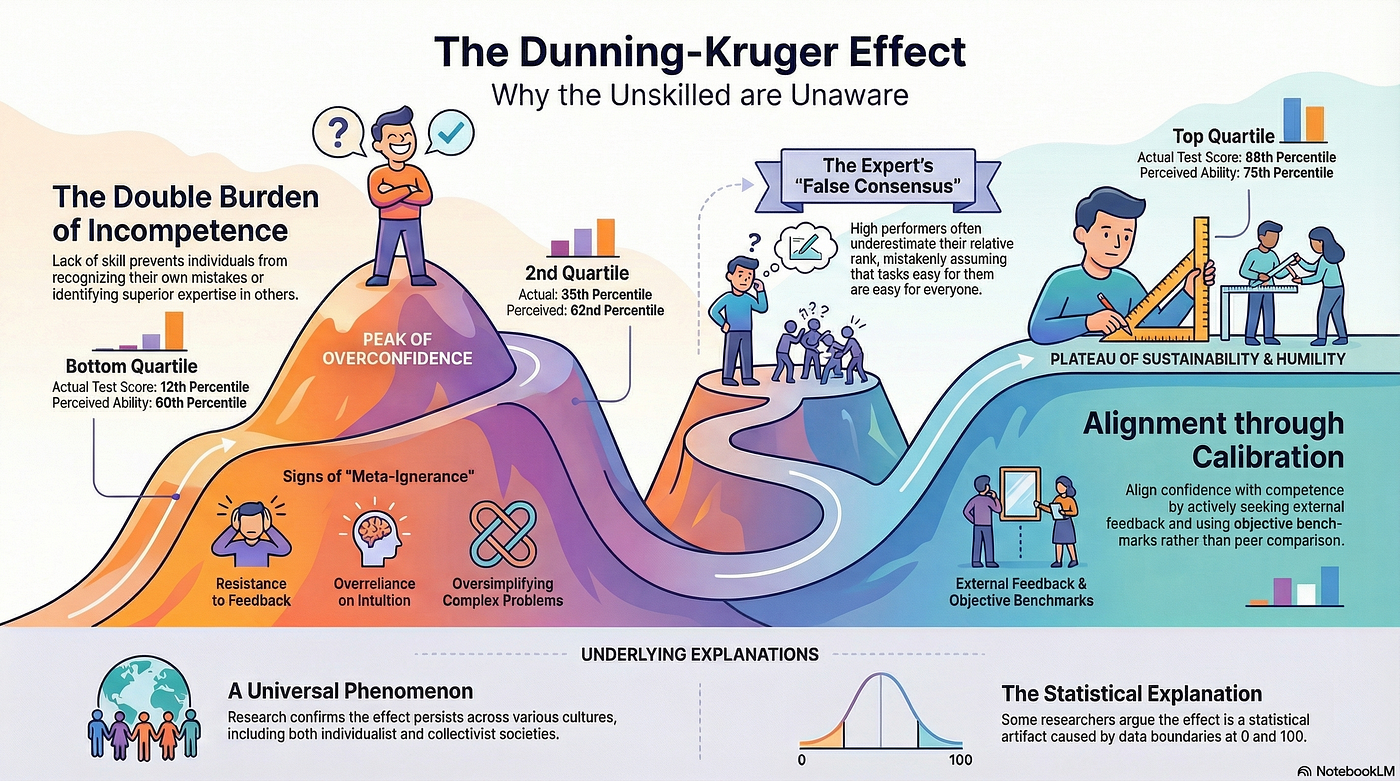
The Dunning-Kruger effect says: If you’re incompetent in something, you don’t just make mistakes — you also lack the ability to realize you’re making them. The real problem isn’t just the lack of knowledge; it’s not even being aware of that lack. That’s the truly dangerous part.
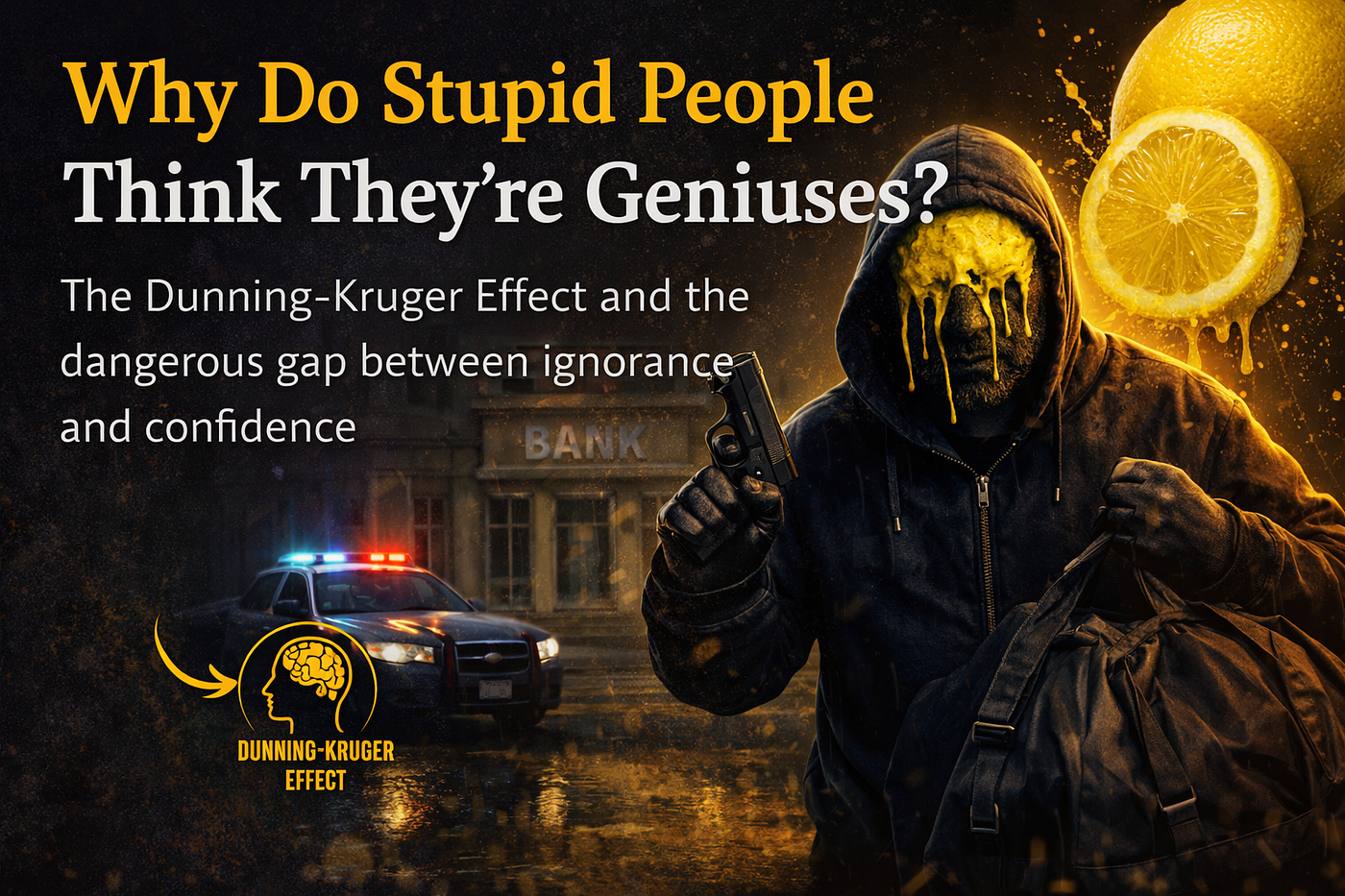
The best example is still that legendary lemon juice story. In 1995, a guy named McArthur Wheeler robbed two banks. No mask, no disguise, nothing. Why? Because in his mind, he had become invisible. How? He had rubbed lemon juice all over his face. His logic was simple: “If lemon juice can be used as invisible ink, then if I put it on my face, the cameras won’t see me.”
And yes, he actually tried it.
When the police caught him, his response was priceless: “But I wore the lemon juice.”
The guy’s problem wasn’t just that he had a stupid idea — it was that he couldn’t even recognize how stupid it was. This is where Dunning-Kruger hits hard.
David Dunning and Justin Kruger from Cornell got inspired by this case and did their research. They gave people various tests, then asked them, “How well do you think you did?”
The results were shocking: The people who performed the worst thought they were way above average. The ones who actually did well underestimated themselves.
Why? Because knowledgeable people realize how deep the subject really is. They see all the things they still don’t know, so they can’t be overly confident. But someone with little knowledge only sees the surface and thinks, “I’ve got this all figured out.”
This doesn’t stay in the lab either. In companies, nearly half the employees think they’re in the top 5%. Mathematically impossible, yet everyone puts themselves there. On the road, about 80% of drivers believe they’re better than average.
In health, politics, everyday arguments… it’s no coincidence that the people who know the least often have the strongest opinions. Because even doubting yourself requires a certain level of knowledge first.
Interestingly, some researchers argue that this effect isn’t purely psychological — part of it might be a statistical illusion related to “regression to the mean.” But Dunning’s side says that as education and experience increase, people’s self-assessment becomes more realistic. So it’s not just math; it’s genuinely a mental blind spot.
Can we completely escape it? Not really. It’s like the brain’s default setting. But we can reduce its impact.
The things that actually make a difference are usually simple but hard:
- Staying open to continuous learning
- Being able to genuinely doubt your own opinions
- Not being afraid to get honest feedback from others
And the most critical point is this: The moment you feel 100% sure about something, you’re actually at the most dangerous point.
As Darwin put it: “Ignorance more frequently begets confidence than does knowledge.”
So next time, especially when you feel very certain, ask yourself: “Am I really knowing this… or am I just unaware that I don’t know?”
That question can save you a lot.
메타데이터
- post_id
- 09d4e7b262b7
- slug
- why-do-stupid-people-think-theyre-geniuses-09d4e7b262b7
- url
- https://medium.com/@diabolikss/why-do-stupid-people-think-theyre-geniuses-09d4e7b262b7
- canonical_url
- https://medium.com/@diabolikss/why-do-stupid-people-think-theyre-geniuses-09d4e7b262b7
- author_url
- https://medium.com/@diabolikss
- status
- ok
- fetched_at
- 2026-07-13 15:35:31