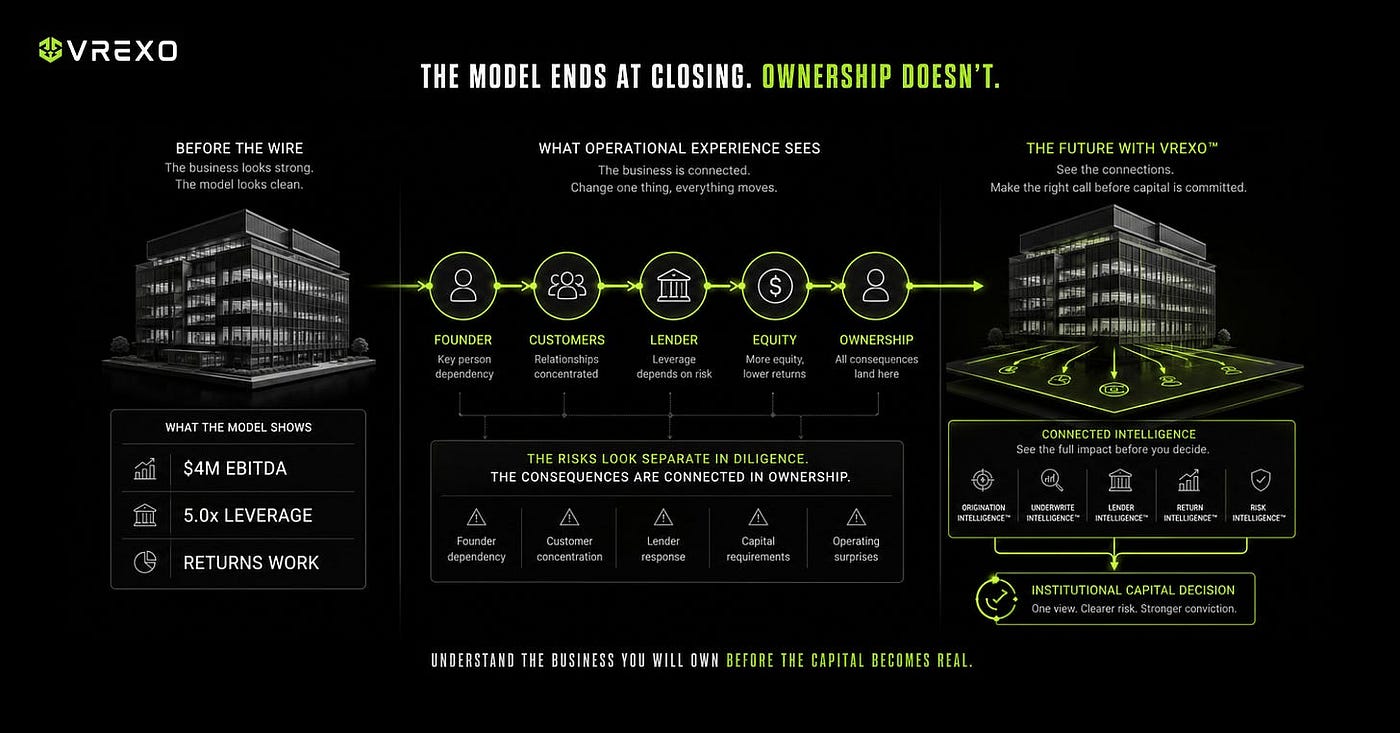
The Future of Acquisitions Won’t Be Decided by Valuation Alone.
Every acquisition process eventually reaches a moment where months of sourcing, underwriting, negotiations and due diligence converge into…
The Future of Acquisitions Won’t Be Decided by Valuation Alone. It Will Be Decided by Pricing Discipline.
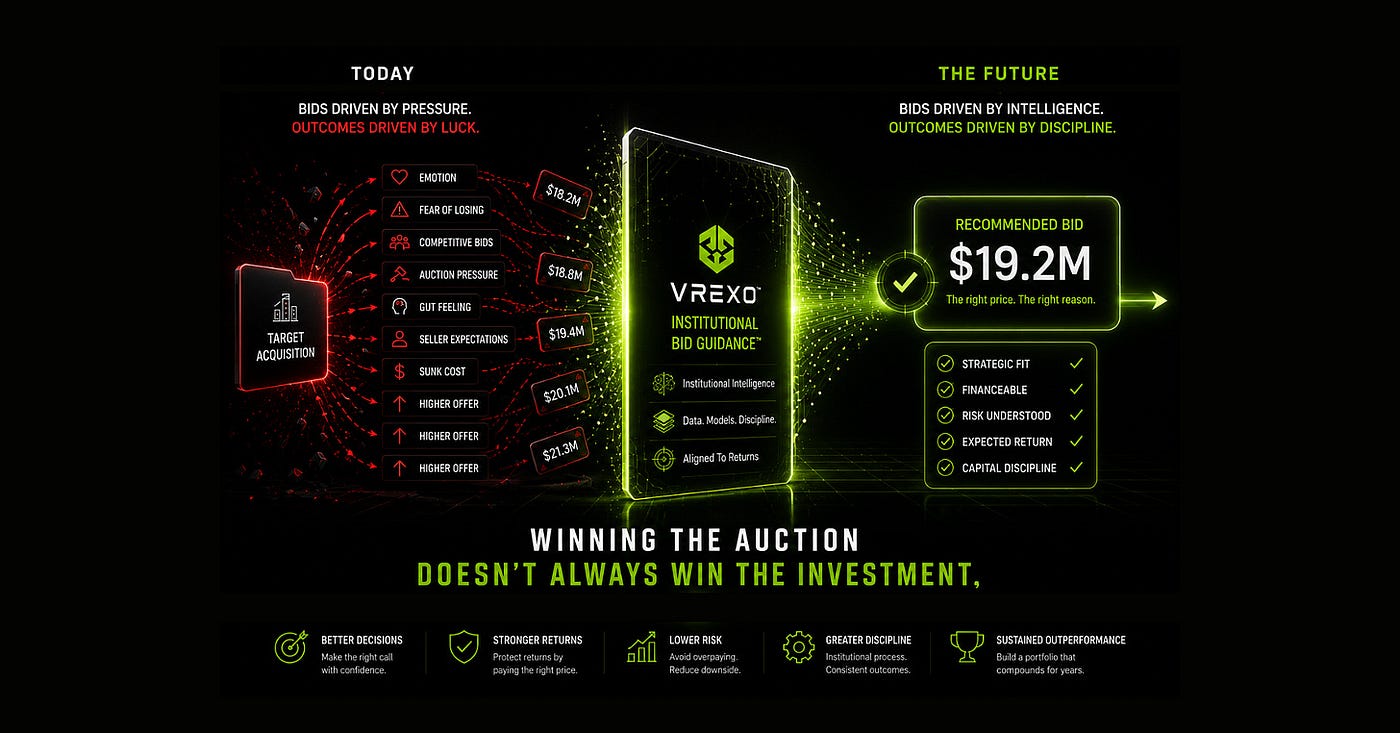
The goal isn’t winning every acquisition. It’s paying the right price. Here’s why Institutional Bid Guidance™ is the future.
Every acquisition process eventually reaches a moment where months of sourcing, underwriting, negotiations and due diligence converge into a single decision.
How much should we bid?
It sounds like a straightforward financial question, but in reality, it may be the most important capital allocation decision an investor will make throughout the entire acquisition lifecycle. The bid determines not only whether an acquisition closes, but also whether it ultimately creates value or quietly erodes it.
For years, private equity firms, family offices, independent sponsors, search funds and commercial real estate investors have invested heavily in improving origination, underwriting and due diligence. Entire industries have emerged around financial modelling, market research, lender relationships and valuation analysis.
Yet one critical area has received remarkably little attention.
The discipline behind determining what an investor should actually pay.
As acquisition markets continue becoming faster, more transparent and increasingly competitive, VREXO™ believes the next competitive advantage will not come from finding better opportunities. It will come from making better pricing decisions.
That belief is the foundation behind the launch of Institutional Bid Guidance™, the latest expansion of VREXO™’s Institutional Intelligence platform for private markets.
Acquisition Markets Have Changed
Only a decade ago, access to opportunities created competitive advantage.
Business owners had fewer channels to reach buyers. Commercial real estate opportunities circulated through relatively limited broker networks. Off-market transactions were genuinely difficult to discover. Investors who developed stronger relationships often gained access to opportunities before competitors even knew they existed.
That environment has fundamentally changed.
Today, business acquisitions and commercial real estate transactions move through increasingly connected markets. Brokers distribute opportunities across sophisticated buyer networks almost instantly. Online marketplaces, investment banking firms, lender referrals and digital deal platforms have dramatically increased market transparency.
Private equity firms, family offices, independent sponsors, strategic buyers and search funds frequently review the very same acquisition opportunities at nearly the same time.
Information is no longer scarce.
Competition is.
As more qualified buyers pursue fewer high-quality opportunities, pricing pressure naturally increases.
The acquisition challenge is no longer identifying businesses worth buying.
It is maintaining disciplined capital allocation once everyone else identifies those opportunities too.
The Hidden Cost Nobody Talks About
Most investors understand the risk of buying a poor-quality business.
Far fewer appreciate the long-term consequences of paying slightly too much for a great one.
During a competitive acquisition process, increasing a bid by two or three percent often feels insignificant. Negotiations are moving quickly. Competing offers are arriving. Seller expectations continue rising. Months of due diligence have already been completed. Walking away feels expensive.
This is where psychology quietly begins influencing capital allocation.
The desire to complete a transaction slowly starts competing with the objective of generating superior returns.
Every additional increase appears manageable in isolation.
Across an acquisition portfolio, however, those seemingly minor pricing decisions compound.
Paying more than disciplined capital deserves to pay reduces future returns, limits financing flexibility, compresses equity performance and increases downside exposure if market conditions change.
Winning the auction may feel like success.
Generating exceptional long-term returns is something entirely different.
The Difference Between Valuation and Bid Guidance
One of the biggest misconceptions in acquisitions is assuming valuation and bidding are the same exercise.
They are not.
Valuation estimates what an asset may be worth based on financial performance, market conditions and projected cash flows.
Bid guidance determines what that asset deserves within the context of your own investment strategy.
Those are fundamentally different questions.
Two investors reviewing the same acquisition may produce nearly identical valuations while arriving at completely different bid decisions.
Why?
Because every investor operates under different financing structures, return expectations, lender relationships, portfolio concentrations, strategic priorities and risk tolerances.
Institutional investors have understood this distinction for decades.
Their objective has never been simply determining asset value.
Their objective has always been determining whether paying a particular price creates an attractive investment opportunity within the context of their broader capital allocation strategy.
That difference is subtle.
Its financial impact can be enormous.
Why Institutional Investors Think Differently
Large institutional investors rarely evaluate acquisitions in isolation.
Every bid competes against every other opportunity available to their capital.
Should this acquisition receive funding?
Would another opportunity generate stronger returns?
Does this transaction improve portfolio diversification?
How will lenders view the financing structure?
Does the expected upside justify the additional pricing?
What happens if market conditions weaken?
Every acquisition competes for institutional attention long before it competes for capital.
That disciplined decision-making framework is one of the reasons institutional investors have historically outperformed many smaller acquisition teams.
The objective has never been winning the most transactions.
The objective has always been allocating capital where it creates the greatest long-term value.
The Rise of Institutional Bid Guidance™
VREXO™ believes private markets are entering a new era where pricing decisions become increasingly intelligence-driven.
Artificial intelligence will continue improving financial analysis.
Market intelligence will become more accessible.
Valuation models will become increasingly sophisticated.
Information itself will continue becoming a commodity.
Judgment, however, will remain a competitive advantage.
Institutional Bid Guidance™ was created around that belief.
Rather than functioning as another pricing calculator, it extends VREXO™’s broader Institutional Intelligence framework into one of the most consequential decisions in every acquisition.
Instead of asking,
“What can we afford to pay?”
Institutional Bid Guidance™ asks,
“What should disciplined capital pay?”
That question changes everything.
The answer cannot come from valuation alone.
It requires understanding strategic fit, financing capacity, underwriting conclusions, lender behaviour, market intelligence, transaction risk, expected returns and portfolio objectives simultaneously.
Only when those variables are connected can pricing become a true capital allocation decision.
Building Institutional Intelligence Across the Entire Acquisition Lifecycle
The launch of Institutional Bid Guidance™ represents another step in VREXO™’s long-term vision of creating a connected operating system for private markets.
Historically, acquisition technology has focused on isolated stages of the transaction process.
Some platforms organize deal flow.
Others manage due diligence.
Some focus on underwriting.
Others assist with document management or portfolio reporting.
Very few connect every major investment decision into a single institutional framework.
VREXO™ is building something different.
Its Institutional Intelligence platform connects Origination Intelligence™, institutional underwriting, lender intelligence, Institutional Bid Guidance™, investment committee workflows, market intelligence, portfolio surveillance and transaction execution into one connected decision infrastructure.
The objective is not simply to organize information.
It is to improve judgment before capital is committed.
Because better decisions ultimately create better investments.
The Next Competitive Advantage
The future of acquisitions will not be won by investors reviewing the greatest number of opportunities.
Nor will it belong exclusively to those capable of producing the most sophisticated valuation models.
Competitive advantage is shifting.
As markets become increasingly efficient, access becomes less valuable.
Information becomes more widely available.
Technology automates more financial analysis.
What remains difficult to replicate is disciplined judgment.
Knowing which opportunities deserve attention.
Knowing which deserve underwriting.
Knowing where capital should be allocated.
And increasingly, knowing where bidding should stop.
That is where VREXO™ believes the next generation of acquisition technology is heading.
Not toward replacing investors.
Toward helping investors make institutional-quality decisions with greater confidence, consistency and discipline.
Looking Ahead
Private markets are entering one of the most significant periods of transformation in decades. Artificial intelligence, institutional data, connected underwriting, lender intelligence and structured decision frameworks are reshaping how acquisitions are evaluated from the very beginning of the investment lifecycle.
The launch of Institutional Bid Guidance™ reflects more than a new capability.
It represents a broader shift in how successful investors will think about pricing itself.
Because in tomorrow’s acquisition markets, the firms that consistently outperform will not necessarily be those willing to submit the highest offer.
They will be the firms that know precisely where disciplined capital should stop bidding.
That is the future VREXO™ is building.
If you don’t understand the risk, don’t bid.
Website: vrexo.ai
Media Contact
Jessica Paul Media & Marketing Manager, VREXO™ jessica@vrexo.ai (888) 831–2313 401 Bay Street Toronto, Ontario M5H 2Y4 Canada
메타데이터
- post_id
- 09e4007f45d0
- slug
- the-future-of-acquisitions-wont-be-decided-by-valuation-alone-09e4007f45d0
- url
- https://medium.com/@vrexo_ai/the-future-of-acquisitions-wont-be-decided-by-valuation-alone-09e4007f45d0
- canonical_url
- https://medium.com/@vrexo_ai/the-future-of-acquisitions-wont-be-decided-by-valuation-alone-09e4007f45d0
- author_url
- https://medium.com/@vrexo_ai
- status
- ok
- fetched_at
- 2026-07-10 21:29:00