How Can Signals in the Air Become Energy? A Story About AI, Cities, and a More Resilient Future
From disaster scenarios to future technology — how AI helps turn invisible signals into usable energy.
How Can Signals in the Air Become Energy? A Story About AI, Cities, and a More Resilient Future
From disaster scenarios to future technology — how AI helps turn invisible signals into usable energy.
⏱️ Estimated reading time: 5–6 minutes
When a City Loses Power
Imagine this happening in your city.
One night, the electricity suddenly goes out. Not just your home — the entire city goes dark.
Streetlights stop working. Internet disappears. Communication networks collapse.
Within minutes, a modern city — once fast and connected — turns fragile, revealing how dependent urban life is on a single invisible system: energy. 🎯
Modern cities are designed for efficiency — but not always for survival. 🎯
In moments like this, one simple question emerges:
What if energy could still exist — even when everything else fails?
The Energy We’ve Been Ignoring
We usually think of energy as something visible — power plants, cables, or solar panels on rooftops.
But there’s another kind of energy surrounding us all the time.
Invisible. Silent. Constantly moving.
The WiFi you’re using right now. Radio waves from broadcast stations. Cellular signals from nearby towers.
These are all forms of electromagnetic energy.
We’ve always used them for communication. But what if they could do more?
What if we could turn those signals into electricity?
Turning Air Into Energy
This idea is known as wireless energy harvesting — capturing energy directly from the environment without wires.
At the center of this concept is a device called a rectenna.
Think of it as a solar panel — but instead of sunlight, it captures radio signals.
Here’s a simple way to understand it:
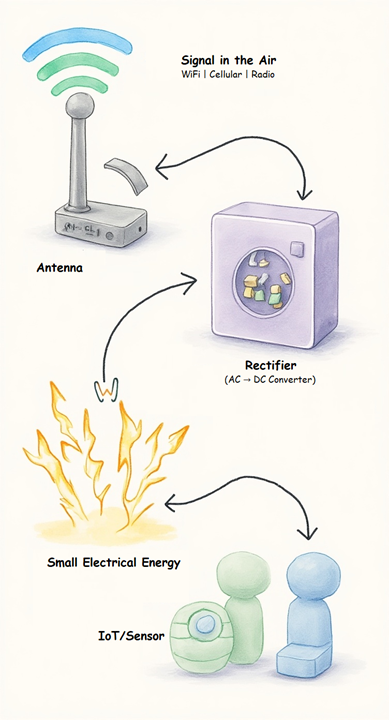
Simple illustration of how ambient signals can be converted into usable electrical energy (Souce: AI
It sounds simple.
But in reality, it’s not.
The Invisible Challenge
Unlike sunlight, which is relatively stable, signals in the air are highly unpredictable.
Sometimes strong. Sometimes weak. Sometimes barely there.
As a result, the energy produced is:
- Very small
- Unstable
- difficult to rely on
And this is where many technologies struggle.
Not because the idea is impossible — but because it’s hard to optimize.
When Technology Starts Learning
This is where Artificial Intelligence (AI) changes everything.
Instead of relying on fixed systems, AI allows devices to adapt.
Imagine a system that:
- Observes signal conditions in real time
- Learns from patterns
- Automatically adjusts itself
Like a smart brain, AI continuously searches for the best way to extract energy — even when conditions keep changing.
In urban environments, where conditions change rapidly, this kind of adaptability isn’t just useful — it’s essential. 🎯

AI helps systems adapt to changing signal conditions, improving energy efficiency (Source: AI)
Here’s a thought: “What if the WiFi around you could quietly power small devices without you even noticing?”
Why This Matters for Future Cities
Now, let’s go back to that dark city.
Cities of the future won’t be defined only by how smart they are — but by how well they can withstand disruption. 🎯
In normal situations, this technology might feel like an interesting innovation.
But during a crisis?
It could make a critical difference.
When communication systems stay alive during a blackout, emergency responses become faster, coordination improves, and communities recover more quickly. 🎯
This isn’t just about energy — it’s about keeping cities functioning when they are pushed beyond their limits.
Imagine if:
- urban sensors stay active during blackouts
- emergency communication systems continue working
- IoT devices don’t depend on batteries
Not powered by large generators. Not dependent on fragile grids.
But powered by something we’ve always overlooked:
signals in the air.

This technology could support more resilient urban systems in line with sustainable city goals (Source: AI)
This is how technology quietly shapes resilience — not in ideal conditions, but in the moments when cities are pushed to their limits. 🎯
This vision closely aligns with global efforts to build more resilient and sustainable cities, as emphasized in frameworks like the United Nations Sustainable Development Goals. 🎯
From Research to Reality
Today, this technology is still evolving.
Most developments are happening in laboratories and simulations. Researchers are continuously working to improve efficiency and scalability.
But the direction is clear.
In the future, we may see:
- battery-free IoT devices
- self-powered sensors
- smarter and more adaptive urban systems
Not replacing traditional energy — but complementing it.
What Makes a City Truly Resilient?
A resilient city is not one that never fails — but one that can recover, adapt, and continue operating when failure happens. 🎯
A Future You Can’t See — But Can Rely On
We’ve always associated energy with something large and visible.
But the future may look different.
Energy doesn’t always have to be seen. It doesn’t always have to come from one big source.
Sometimes, it’s already around us — hidden in plain sight.
And with the help of AI, we’re finally learning how to use it.
“The future of energy isn’t just about producing more it’s about making better use of what already exists.”
A Question for the Future
This technology may not power entire cities anytime soon.
But it changes how we think about energy.
Not just as something we generate — but something we can harvest, adapt, and optimize.
Because in an uncertain world, the cities that endure won’t just be the strongest — they’ll be the ones designed to adapt, recover, and keep going when everything else stops. 🎯
they’ll be the most adaptive.
💬 What do you think — will energy from the air remain a niche innovation, or become part of our everyday lives?
🎯[SDGs 11]: fragility, resilience vs efficiency
메타데이터
- post_id
- 09e87b9562c0
- slug
- how-can-signals-in-the-air-become-energy-a-story-about-ai-cities-and-a-more-resilient-future-09e87b9562c0
- url
- https://medium.com/@betajambul/how-can-signals-in-the-air-become-energy-a-story-about-ai-cities-and-a-more-resilient-future-09e87b9562c0
- canonical_url
- https://medium.com/@betajambul/how-can-signals-in-the-air-become-energy-a-story-about-ai-cities-and-a-more-resilient-future-09e87b9562c0
- author_url
- https://medium.com/@betajambul
- status
- ok
- fetched_at
- 2026-06-09 15:37:30