A Comparative Study of the Syntactic and Grammatical Structures of English and Pashto
Exploring the similarities and differences between English and Pashto language sentence structures
A Comparative Study of the Syntactic and Grammatical Structures of English and Pashto

Introduction: This project studies the basic structure of human language and explains how words are organized to create meaningful communication. Human beings do not speak by placing words randomly; instead, every language follows a system of rules that helps speakers understand one another. These rules are studied in syntax, which is one of the most important branches of linguistics.
In this project, English is compared with Pashto, which is my mother tongue. Both languages communicate ideas effectively, but they organize words differently. English mainly follows the SVO (Subject–Verb–Object) order, while Pashto usually follows the SOV (Subject–Object–Verb) order. Because of this difference, Pashto provides an excellent comparison with English. By studying both languages side by side, we can understand how different grammatical systems work and how languages use different structures to express similar meanings. This comparison also helps us understand the universal principles shared by all human languages.
1. Syntax: The Architecture of Language Syntax is the branch of linguistics that studies the rules used to combine words into phrases, clauses, and sentences. It explains how words are arranged and why some combinations sound correct while others do not.
For example, the words: “The child opened the door.” form a correct English sentence because the words are arranged according to English syntactic rules.
But if we say: “Door the opened child the.” the sentence becomes ungrammatical because the word order violates English syntax.
Syntax is therefore the system that gives structure to language and allows speakers to communicate ideas clearly.
Misconceptions About Syntax: Many people believe syntax only means “correct grammar” taught in schools. However, linguistics studies syntax descriptively rather than prescriptively. Prescriptive grammar tells people how they should speak. Descriptive grammar studies how people naturally use language in real life. For example, linguists are interested in understanding why native speakers say something naturally, even if it differs from formal school grammar.
Why Languages Have Syntax: Without syntax, language would become confusing because listeners would not know who performs an action and who receives it.
For example: “The farmer helped the traveler.” “The traveler helped the farmer.” Both sentences contain the same words, but the meaning changes because of syntax and word order. Syntax therefore helps humans organize thoughts logically and communicate accurately.
How Linguistic Examples Are Read Linguists often use glossing to explain sentence structure word by word.
Pashto Example: زه چای څښم۔ (Za chai skham.)
Literal Meaning: I tea drink.
English Translation: “I am drinking tea.”
Gloss: Za = I chai = tea skham = /am drinking This type of glossing helps linguists compare languages more easily.
2. Structure of Phrases: A phrase is a group of words that acts as one unit inside a sentence. Every phrase has a central word called the head, which determines the type of phrase.
Different kinds of phrases exist in language. 1. Noun Phrase (NP): A Noun Phrase is built around a noun and may include articles, adjectives, or modifiers.
English Example: “The tall building” Here, “building” is the head noun.
Pashto Example: لوړ غر (Lowar ghar) Meaning: “Tall mountain” In this phrase, “غر” (mountain) is the head noun.
2. Verb Phrase (VP): A Verb Phrase contains the main verb and related elements.
English Example: “Was speaking politely” The main verb is “speaking.”
Pashto Example: ارام سره خبرې کوي (Aram sra khabare kawi) Meaning: “Speaks calmly” The verb “کوي” is the head of the phrase.
3. Adjective Phrase (AP): An Adjective Phrase describes a noun.
English Example: “Very difficult”
Pashto Example: ډېر آسان (Der asan) Meaning: “Very easy”
4. Adverb Phrase (AdvP): An Adverb Phrase modifies a verb, adjective, or another adverb.
English Example: “Quite softly”
Pashto Example: ډېر ورو (Der wro) Meaning: “Very slowly”
5. Prepositional Phrase (PP): English usually uses prepositions before nouns, while Pashto often uses postpositions after nouns.
English Example: “Behind the wall”
Pashto Example: دېوال شاته (Dewal shata) Meaning: “Behind the wall” This difference shows an important contrast between English and Pashto structure.
3. The Clause: A clause is a grammatical unit that usually contains a subject and a predicate. The predicate includes the verb and information related to the action or state. Clauses are considered the basic building blocks of sentences because every sentence must contain at least one clause.
Some sentences contain only one clause, while others contain several clauses joined together. Clause vs Sentence:
A clause contains a subject and a verb.
A sentence is a complete grammatical idea that can stand alone.
A sentence may contain: One clause Two clauses Several clauses
Simple Sentence (One Clause): A simple sentence contains only one clause.
English Example: “The baby cried.”
Pashto Example: ماشوم وخندل۔ (Mashoom وخندل.) Meaning: “The child laughed.” Both examples contain one subject and one verb.
Complex Sentence (Multiple Clauses): A complex sentence contains one main clause and one or more subordinate clauses.
English Example: “She stayed inside because the weather was cold.”
Pashto Example: زه بازار ته لاړ نه شوم ځکه چې باران کېده۔ (Za bazar ta lar na shum zaka che baran kedo.) Meaning: “I did not go to the market because it was raining.”
Main Clause (Independent Clause): A main clause can stand alone as a complete sentence.
English Example: “The students completed the assignment.”
Pashto Example: هلک لوبه وګټله۔ (Halak loba wogatla.) Meaning: “The boy won the game.” Both clauses express complete thoughts independently.
Subordinate Clause (Dependent Clause): A subordinate clause cannot stand alone because its meaning depends on another clause.
English Example: “Although they were tired” This clause feels incomplete by itself.
Pashto Example: کله چې لمر راوخت (Kala che lamar rawakhat) Meaning: “When the sun rose” This clause also depends on another clause for complete meaning.
Clause Markers in Pashto: Pashto often uses subordinating words such as: چې (che) = that/when ځکه چې (zaka che) = because که (ka) = if ترڅو چې (tar tso che) = until These markers help connect clauses together.
Combined Clause Example: کله چې استاد خبرې شروع کړې، ټول زده کوونکي چوپ شول۔ (Kala che ustad khabare shoro kray, tool zda kowunki chop shwal.)
Meaning: “When the teacher started speaking, all the students became quiet.”
Types of Clauses: 1. Finite Clause: A finite clause contains a verb showing tense. Example “They watched television.”
2. Non-Finite Clause: A non-finite clause contains infinitives or participles. Example “To finish the work on time is important.”
3. Relative Clause: A relative clause gives extra information about a noun.
Pashto Example: هغه سړی چې پرون راغلی و زما استاد دی۔ (Hagha sari che paron raghle wo zama ustad day.) Meaning: “The man who came yesterday is my teacher.”
4. Adverbial Clause: An adverbial clause shows time, reason, condition, or purpose. Example: “If you practice daily, you will improve.”
Importance of Understanding Clauses: Understanding clauses is important because it helps in:
- Building complex sentences
- Improving writing skills
- Understanding punctuation
- Translating accurately between languages
- Analyzing formal and literary texts
English usually depends more on fixed word order, while Pashto often depends on verb forms and clause markers like “چې”. Even though the two languages differ structurally, both combine clauses to create detailed and meaningful communication.
- Grammatical Functions: Grammatical Functions refer to the specific roles that words or phrases perform inside a sentence. In syntax, it is important to understand not only what kind of phrase something is, but also what job it performs in the sentence.
For example, a Noun Phrase (NP) can function as a subject, object, complement, or modifier depending on its position and role.
In simple words: Form = what a word or phrase is Function = what work it does in the sentence Understanding grammatical functions is very important because it helps us understand how meaning is organized in language.
Major Grammatical Functions: 1. Subject: The subject usually performs the action of the sentence or tells us what the sentence is about. In many languages, the subject agrees with the verb in number and person.
English Example: “The driver stopped the bus.” Here, “the driver” is the subject because it performs the action.
Pashto Example: احمد دروازه خلاصه کړه۔ (Ahmad darwaza khalasa kra.) Meaning: “Ahmad opened the door.” In this sentence, “احمد” (Ahmad) is the subject because he performs the action.
2. Direct Object: The direct object receives the action of the verb. It answers the questions “what?” or “whom?”.
English Example: “The girl painted a picture.” The phrase “a picture” is the direct object because it receives the action of painting.
Pashto Example: زلمي موټر ومينځه۔ (Zalmay motor wominzha.) Meaning: “Zalmay washed the car.” Here, “موټر” (motor/car) is the direct object because it is affected by the action.
3. Indirect Object: The indirect object shows the person who receives something or benefits from the action. It usually answers the questions: To whom? For whom?
English Example: “The teacher gave the students homework.” The phrase “the students” is the indirect object.
Pashto Example: پلار ماشوم ته کتاب ورکړ۔ (Plar mashoom ta kitab warkro.) Meaning: “The father gave the child a book.” In this sentence: “ماشوم ته” (to the child) is the indirect object. “کتاب” (book) is the direct object.
4. Complement: A complement completes the meaning of the subject or object. Some verbs require complements to make complete sense. Complements usually come after linking verbs such as: become seem appear remain
English Example: “She became a scientist.” The phrase “a scientist” is a complement because it completes the meaning of “became.”
Pashto Example: هغه خوشحال شو۔ (Hagha khushhal sho.) Meaning: “He became happy.” The word “خوشحال” (happy) works as a complement because it describes the subject after the linking verb.
5. Modifier: A modifier adds extra information to another word or phrase. Modifiers are optional because the sentence usually remains grammatically correct without them.
Modifiers may describe: nouns verbs adjectives whole clauses
English Example: “The young boy solved the difficult problem quickly.” “young” modifies “boy” “difficult” modifies “problem” “quickly” modifies the verb
Pashto Example: فريد ډېر تېز منډه وهي۔ (Fareed der taiz manda wahi.) Meaning: “Fareed runs very fast.” Here: “ډېر” modifies “تیز” “تیز” modifies the action of running
Form vs Function: One of the most important ideas in syntax is the difference between grammatical form and grammatical function.
Form: Form refers to the grammatical category of a word or phrase, such as: Noun Phrase (NP) Verb Phrase (VP) Adjective Phrase (AP) Function: Function refers to the role performed by that form inside the sentence. The same form can perform different functions in different sentences.
English vs Pashto in Grammatical Functions: English mainly depends on word order to show grammatical functions. For example: “Sara helped Hamid.” “Hamid helped Sara.” Changing word order changes the meaning.
Pashto, however, often uses: postpositions verb endings case markers Because of this, Pashto allows more flexibility in word order than English.
Why Grammatical Functions Are Important: Understanding grammatical functions helps in: learning sentence structure improving writing and speaking understanding complex grammar translating between English and Pashto analyzing language scientifically Grammatical functions show how all parts of a sentence work together to create meaning. Every subject, object, complement, and modifier has a specific role that contributes to communication. By studying grammatical functions, language learners gain a deeper understanding of how English and Pashto organize information differently while still following systematic grammatical rules.
5. Head, Complements, and Modifiers: In syntax, every phrase has a central word called the Head. The head is the most important element because it determines the type and grammatical behavior of the phrase. For example: In the phrase “the beautiful garden,” the word “garden” is the head because the whole phrase is a noun. In the phrase “very slowly,” the word “slowly” is the head because the phrase functions as an adverb phrase. The head gives identity to the phrase, while the other words depend on it.
These dependent elements are usually divided into:
Dependent Complements Modifiers Dependents: Dependents are words or phrases connected to the head. They help complete or expand the meaning of the head word.
For example: In “read a newspaper,” the phrase “a newspaper” depends on the verb “read.” In “extremely cold weather,” the adjective “cold” depends on the noun “weather.”
Complements: Complements are necessary elements required by the head to complete its meaning. Without complements, the sentence may sound incomplete or ungrammatical.
English Example: “They built a house.” The phrase “a house” is a complement because the verb “built” needs an object to complete its meaning. If we only say: “They built…” the listener expects more information.
Pashto Example: هغوی کور جوړ کړ۔ (Haghwi kor jor kro.) Meaning: “They built a house.” Here, “کور” (house) functions as the complement of the verb.
Modifiers: Modifiers add extra information to a sentence, but they are not required for grammatical completeness.
A modifier may describe: time place manner quality quantity Removing a modifier usually does not damage the grammatical structure.
English Example: “They built a house last year.” The phrase “last year” is a modifier because it gives extra information about time. The sentence remains correct without it: “They built a house.”
Pashto Example: هغوی پرون کور جوړ کړ۔ (Haghwi پرون kor jor kro.) Meaning: “They built a house yesterday.” The word “پرون” (yesterday) is an optional modifier.
Head Direction in English and Pashto Languages differ in the position of the head inside phrases.
Some languages are: Head-initial Head-final This difference explains major structural contrasts between English and Pashto.
English as a Head-Initial Language: English is mostly head-initial, meaning the head often appears before its complement.
Structural Rules S → NP + VP VP → V + NP The verb usually appears before the object.
English Example: “The chef cooked food.” Structure: Subject = The chef Verb = cooked Object = food The head verb comes before the complement.
Pashto as a Head-Final Language: Pashto is mostly head-final, meaning the head often appears at the end of the phrase.
Structural Rules S → NP + VP VP → NP + V The object usually comes before the verb.
Pashto Example: اشرف ډوډۍ پخه کړه۔ (Ashraf dodai pakha kra.) Meaning: “Ashraf cooked food.” Structure: Subject = Ashraf Object = food Verb = cooked The verb appears at the end of the sentence.
Importance of Heads, Complements, and Modifiers: Understanding these concepts helps in: analyzing phrase structure building grammatical sentences translating accurately understanding English and Pashto syntax studying linguistic theory These concepts also show that language is hierarchical rather than random. Words are organized into meaningful relationships centered around heads. Although English and Pashto differ in surface word order, both languages follow systematic structural rules based on the relationship between heads and dependents.
This understanding is very useful for linguists, translators, teachers, and language learners working between English and Pashto.
6. Constituents and Tree Diagrams: Constituents are one of the most important concepts in syntax. A constituent is a group of words that functions together as a single unit inside a sentence. Instead of viewing a sentence as only a straight line of words, syntax studies how words combine into larger units called constituents.
For example, in the sentence: “The clever student answered the question.” The words “the clever student” work together as one unit. Similarly, “answered the question” also functions as one unit. These groups are called constituents. Constituents show that language has hierarchical structure. Words combine into phrases, phrases combine into larger phrases, and finally complete sentences are formed.
Why Constituents Are Important: Understanding constituents helps linguists: analyze sentence structure explain movement in sentences understand phrase organization study grammatical relationships create tree diagrams Constituency also explains why some groups of words can move together while others cannot.
Tests for Constituency: Linguists use several tests to determine whether a group of words forms a constituent.
1. Substitution Test: A group of words is a constituent if it can be replaced by a single word without making the sentence incorrect.
English Example: “The young teacher” → “She”
Original sentence: “The young teacher entered the classroom.”
After substitution: “She entered the classroom.” Because the replacement works, “the young teacher” is a constituent.
Pashto Example: “هوښیار هلک” → “هغه” (Hoshyar halak → Hagha)
Original sentence: هوښیار هلک منډه وهي۔ (Hoshyar halak manda wahi.) Meaning: “The intelligent boy is running.”
After substitution: هغه منډه وهي۔ (Hagha manda wahi.) Meaning: “He is running.” This proves that “هوښیار هلک” is a constituent.
2. Movement Test: A group of words is also considered a constituent if it can move together inside the sentence.
English Example: Original sentence: “The manager approved the report.”
Moved structure: “It was the report that the manager approved.” The phrase “the report” moves together as one unit.
Pashto Example: Original sentence: فريد کتاب واخيست۔ (Fareed kitab wakhist.) Meaning: “Fareed bought a book.”
Moved structure for emphasis: کتاب فريد واخيست۔ (Kitab Fareed wakhist.) Meaning: “It was the book that Fareed bought.” The word group remains meaningful after movement.
Other Constituency Tests: Other common tests include: Coordination Question formation Cleft sentences Ellipsis These tests help prove that language is built hierarchically rather than randomly.
Hierarchical Structure: Syntax does not treat sentences as flat strings of words. Instead, words combine step by step into larger structures.
For example: Words → Phrases Phrases → Clauses Clauses → Sentences This layered organization is called hierarchical structure. For example, in: “The little girl opened the window.” The phrase “opened the window” functions together as a Verb Phrase (VP), while “the little girl” forms a Noun Phrase (NP).
Tree Diagrams: Tree diagrams are visual representations of sentence structure. They show how constituents combine to form larger grammatical units.
Tree diagrams help students understand: phrase structure hierarchy grammatical relationships head positions sentence organization Each branch of the tree represents a constituent.
English Tree Structure Example:
Sentence: “The boy carried the bag.” Plain text
S / \ NP VP / / \ The boy V NP | | carried the bag
Explanation: The sentence (S) is divided into: NP (Noun Phrase) VP (Verb Phrase)
The VP contains: Verb (V) Object NP
This reflects the English SVO structure: Subject → Verb → Object
Pashto Tree Structure Example: Sentence: حميد قلم اخلي۔ (Hameed qalam اخلي.) Meaning: “Hameed buys a pen”.
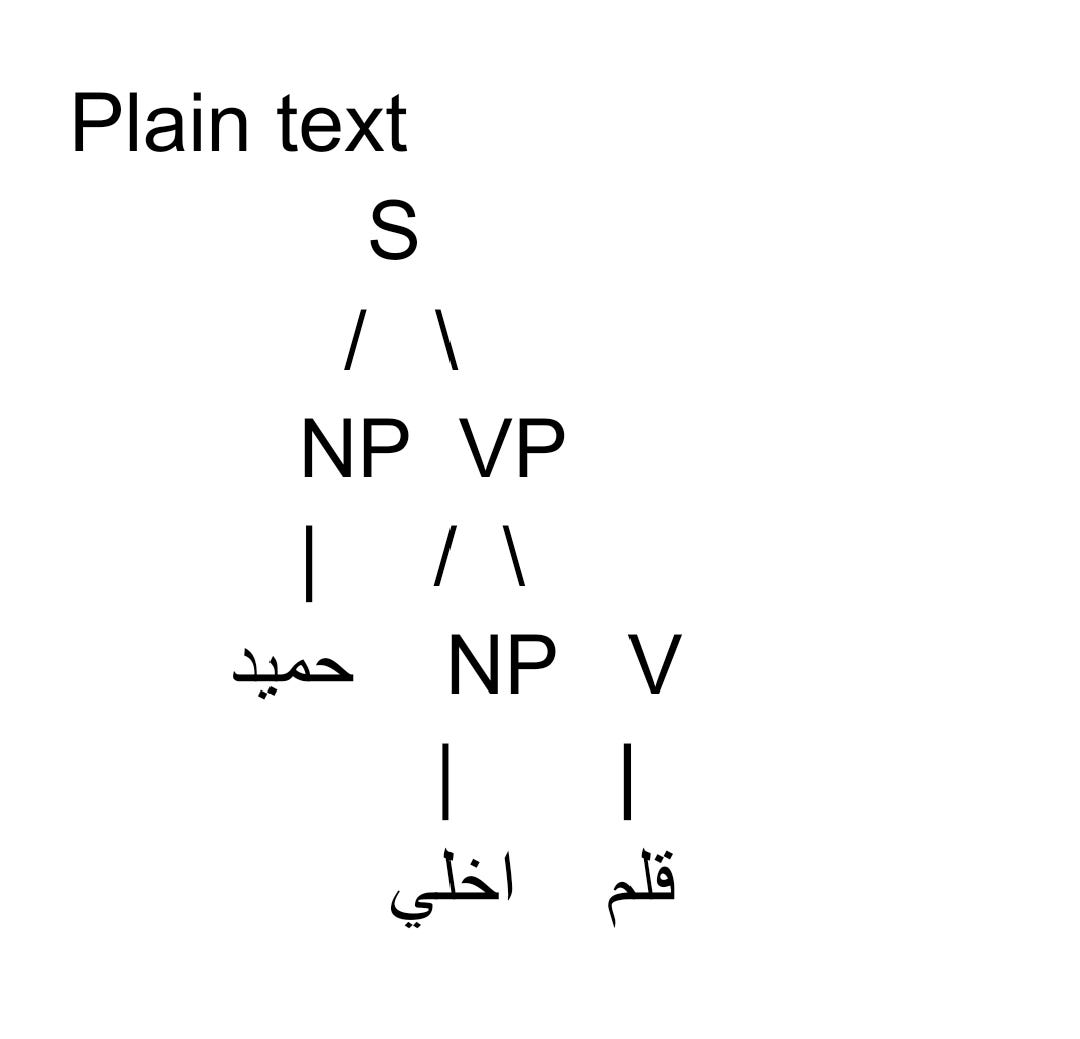
Explanation: The sentence begins with the subject NP. The object NP comes before the verb. The verb appears at the end.
This reflects the Pashto SOV structure: Subject → Object → Verb
Constituents in English and Pashto: Both English and Pashto organize sentences into constituents, but they differ in word order.
English: English depends heavily on fixed word order. Example: “The doctor treated the patient.” Changing word order changes meaning.
Pashto: Pashto allows somewhat greater flexibility because grammatical roles are also shown through: postpositions verb endings context However, constituents still function as organized units.
Importance of Tree Diagrams: Tree diagrams are very useful because they: simplify complex structures show grammatical hierarchy help language learners improve translation analysis support linguistic research They visually demonstrate that sentences are carefully organized systems rather than random collections of words. Tree diagrams also help compare languages like English and Pashto by showing their similarities and differences in phrase structure.
Phrase Structure Grammar (PSG): Phrase Structure Grammar (PSG) is a theory that explains how sentences are formed using grammatical rules called rewrite rules. PSG describes how small units combine step by step to create larger structures. It helps linguists explain how an unlimited number of grammatical sentences can be produced from a limited number of rules. The theory focuses mainly on constituent structure and hierarchical organization.
Basic Idea of PSG: Phrase Structure Grammar uses rules such as: S → NP + VP This rule means: A sentence (S) consists of: a Noun Phrase (NP) followed by a Verb Phrase (VP) The rules continue breaking phrases into smaller parts until individual words are reached.
English Phrase Structure Rule: Rule S → NP + VP VP → V + NP
English Example: “The girl washed the clothes.”
Structure: NP = The girl VP = washed the clothes Inside the VP: V = washed NP = the clothes This reflects the normal English SVO order.
Pashto Phrase Structure Rule: Rule S → NP + NP + V This structure reflects the common Pashto SOV pattern.
Pashto Example: سعيد مېوه خوري۔ (Saeed mewa khwari.) Meaning: “Saeed eats fruit.”
Structure: Subject NP = سعيد Object NP = مېوه Verb = خوري The verb appears at the end of the sentence.
Importance of PSG: Phrase Structure Grammar is important because it: explains sentence formation shows hierarchical structure identifies phrase relationships distinguishes grammatical from ungrammatical sentences and helps compare languages structurally PSG demonstrates that language is rule-governed rather than random.
Transformational Generative Grammar (TGG): Transformational Generative Grammar (TGG) was developed by Noam Chomsky during the 1950s. This theory explains how human beings can produce and understand an unlimited number of sentences using a limited set of grammatical rules. TGG studies the relationship between meaning and sentence structure. According to this theory, humans possess an internal linguistic system that allows them to generate language creatively.
Main Concepts of TGG: 1. Deep Structure: Deep structure refers to the basic underlying meaning of a sentence before transformations occur. It represents the core semantic relationship between sentence elements.
2. Surface Structure: Surface structure is the final spoken or written form of the sentence. This is the actual sentence people hear or read.
3. Transformational Rules: Transformational rules change deep structures into different surface forms such as: questions passive sentences negatives relative clauses These transformations explain how one meaning can appear in several different forms.
English Example of Transformation: Deep Structure: “The officer checked the documents.”
Question Transformation “Did the officer check the documents?” The meaning remains similar, but the structure changes.
Pashto Example of Transformation: Deep Structure: استاد سبق بيان کړ۔ (Ustad sabaq bayan kro.) Meaning: “The teacher explained the lesson.”
Surface Structure (Question Form) ايا استاد سبق بيان کړ؟ (Aya ustad sabaq bayan kro?) Meaning: “Did the teacher explain the lesson?”
Importance of TGG: Transformational Generative Grammar is important because it explains: language creativity sentence transformation universal grammatical principles the relationship between meaning and structure TGG also supports the idea that all human languages share certain universal features despite surface differences.
PSG and TGG Together: Phrase Structure Grammar explains how sentences are built structurally, while Transformational Generative Grammar explains how those structures can change into different forms. Together, they provide powerful tools for studying syntax in both English and Pashto. PSG focuses on phrase organization, whereas TGG focuses on transformation and language creativity. Both theories help linguists understand the systematic nature of human language.
9. Systemic Functional Linguistics (SFL): Systemic Functional Linguistics (SFL) is a theory of language developed by M. A. K. Halliday. It is different from other grammatical theories because it does not only study structure. Instead, it focuses on how language is used in real life to make meaning in society.
In simple words: SFL studies what we do with language, not just how language is built. Language as a Meaning System: According to SFL, language is not just grammar rules. It is a system of choices. For example, when we speak, we choose: formal or informal language polite or direct language short or long sentences These choices depend on the situation.
Three Main Functions of Language (Metafunctions): SFL says every sentence has three meanings at the same time:
1. Ideational Function (Experience): This function shows what is happening in the world.
English Example: “The engineer fixed the machine.”
Pashto Example: انجینر ماشین جوړ کړ۔ (Engineer machine jor kro.) Meaning: An engineer repaired the machine.
2. Interpersonal Function (Relationship): This shows how people interact with each other.
English Example: “Please close the door.”
Pashto Example: مهرباني وکړئ دروازه بنده کړئ۔ (Meharbani kawai darwaza banda kay.) This shows politeness and request.
3. Textual Function (Organization): This shows how information is arranged in a sentence or text.
English Example: “Yesterday, I visited my uncle.”
Pashto Example: پرون زه خپل تره ته لاړم۔ (Paron za khpal tarah ta larum.) The time word “yesterday/پرون” organizes the sentence.
Register in SFL: Register means language changes according to the situation.
It has three parts: Field = topic Tenor = relationship Mode = spoken/written form.
Example of Register Change: Situation 1 (Formal): A teacher explaining a lesson English: “Students must complete the assignment.”
Pashto: زده کوونکي باید کار مکمل کړي۔
Situation 2 (Informal): Friend talking
English: “Finish your homework.”
Pashto: کورنۍ کار ختم کړه۔ Same idea, different register.
Genre in SFL: Genre means different types of texts used for different purposes.
Common genres include: Story (narrative) Argument (debate) Instruction (procedure) Explanation (expository)
Example: Instruction Genre:
English: “First open the book, then read page one.”
Pashto: اول کتاب خلاص کړه، بیا اول مخ ولوله۔
SFL shows that language depends on purpose and situation, not just grammar rules.
Conclusion of SFL: SFL proves that
Language is a social tool. m
Meaning is more important than structure Grammar depends on context It helps us understand how English and Pashto are used in real communication situations.
CONCLUSION: Understanding syntax helps us see the “basic structure” or “hidden system” of human communication. It shows that every sentence we speak or write is not random. Instead, human beings follow a clear and organized system to arrange words into meaningful sentences. Syntax helps us understand how language works behind the scenes when we speak or understand others.
When we compare English and Pashto, we can clearly see differences in sentence patterns. English usually follows the SVO (Subject–Verb–Object) order, while Pashto mainly follows the SOV (Subject–Object–Verb) order and often uses postpositions instead of prepositions. Even though both languages look different in their word order and structure, they still follow the same basic principles of grammar. Both languages depend on phrases, heads, constituents, and hierarchical structures to build meaning.
This means that whether it is English or Pashto, languages use smaller units like words and phrases and combine them step by step to form larger and more meaningful sentences. English depends more on fixed word order to show grammatical roles, while Pashto uses a more flexible structure where meaning is also supported by verb placement and postpositions. Still, both languages follow a logical and systematic pattern to express ideas clearly.
Different linguistic theories help us understand these structures more deeply. Phrase Structure Grammar (PSG) explains how sentences are formed step by step using rules. Transformational Generative Grammar (TGG) shows how a single basic idea in the mind (deep structure) can be expressed in different forms (surface structure), such as statements or questions. On the other hand, Systemic Functional Linguistics (SFL) explains that language is not only about structure but also about function. It shows how people use language in real-life situations to communicate, express feelings, share information, and manage social relationships according to context, register, and genre.
By studying English and Pashto together, we gain a better understanding of how human language works in general. It helps us see both the differences and similarities between languages. This also supports the idea of Universal Grammar proposed by Noam Chomsky, which suggests that all human languages share some basic mental principles. At the same time, it supports Halliday’s idea that language is a social tool used for communication in different situations.
Learning syntax is not only useful for linguists, but also for students, translators, teachers, and anyone who wants to understand language more deeply. It improves our ability to think about language, translate between languages, and communicate more effectively. In a world where many languages exist side by side, this knowledge also helps people respect different languages and cultures. In the end, syntax is much more than just grammar rules. It is the invisible system that controls how we form thoughts into words. It is like the “structure of thinking” that shapes how we express ideas and connect with other people. By comparing English and Pashto syntax, we can appreciate both the common patterns shared by all human languages and the unique features that make each language special and beautiful.
References: 1.Chomsky, Noam. Syntactic Structures. Mouton de Gruyter.
2.Radford, Andrew. Syntax: A Minimalist Introduction. Cambridge University Press.
3.Fromkin, Victoria, Robert Rodman, and Nina Hyams. An Introduction to Language. Cengage Learning, latest edition.
4.Halliday, M.A.K., and Christian M.I.M. Matthiessen. An Introduction to Functional Grammar. Routledge.
5.Carnie, Andrew. Syntax: A Generative Introduction. Wiley-Blackwell.
메타데이터
- post_id
- 09e8aabaf5fc
- slug
- a-comparative-study-of-the-syntactic-and-grammatical-structures-of-english-and-pashto-09e8aabaf5fc
- url
- https://medium.com/@arshadzada689/a-comparative-study-of-the-syntactic-and-grammatical-structures-of-english-and-pashto-09e8aabaf5fc
- canonical_url
- https://medium.com/@arshadzada689/a-comparative-study-of-the-syntactic-and-grammatical-structures-of-english-and-pashto-09e8aabaf5fc
- author_url
- https://medium.com/@arshadzada689
- status
- ok
- fetched_at
- 2026-06-09 15:37:30