How AI Creates Real Business Value in Healthcare Claims and RWD Analytics
Payers and life sciences teams have spent years building large, well-governed repositories of administrative claims and real-world data…
How AI Creates Real Business Value in Healthcare Claims and RWD Analytics
Payers and life sciences teams have spent years building large, well-governed repositories of administrative claims and real-world data. The data is rich, but the work of turning it into reliable answers is still slow, manual, and inconsistent across teams. Artificial intelligence is now mature enough to change that — not as a moonshot, but as a practical layer that reduces cycle time, improves data quality, and helps analysts focus on the questions that actually drive decisions. This post outlines where the value is, what large language models add when clinical context matters, and how to get started without overcommitting.
The Pain Points Slowing Claims and RWD Teams Today
Most claims and RWD organizations share a familiar set of frictions. Cohort definitions take weeks because every therapeutic area requires a fresh negotiation between coders, clinicians, and analysts about which ICD, CPT, HCPCS, and NDC combinations best represent a condition or line of therapy. Data engineering teams spend disproportionate time on harmonization across sources, mapping vocabularies, reconciling provider identifiers, and patching gaps where coding practices shift over time. Analysts then re-create similar cohorts for each new study because past work is buried in notebooks and decks rather than in a reusable layer.
On the payer side, prior authorization, claims adjudication, and fraud, waste, and abuse review still depend heavily on rule libraries that age quickly and on reviewers who must read through unstructured attachments. On the life sciences side, HEOR and market access teams face long timelines to produce burden-of-illness, treatment-pattern, and real-world outcomes evidence, often under tight launch or payer-negotiation deadlines. The common thread is that analysts are the bottleneck for tasks that are repetitive but require judgment — exactly the kind of work modern AI handles well as an assistant rather than a replacement.
High-ROI AI Use Cases Across Claims Operations and RWD/HEOR
A few use cases consistently produce returns that are easy to measure and defend.
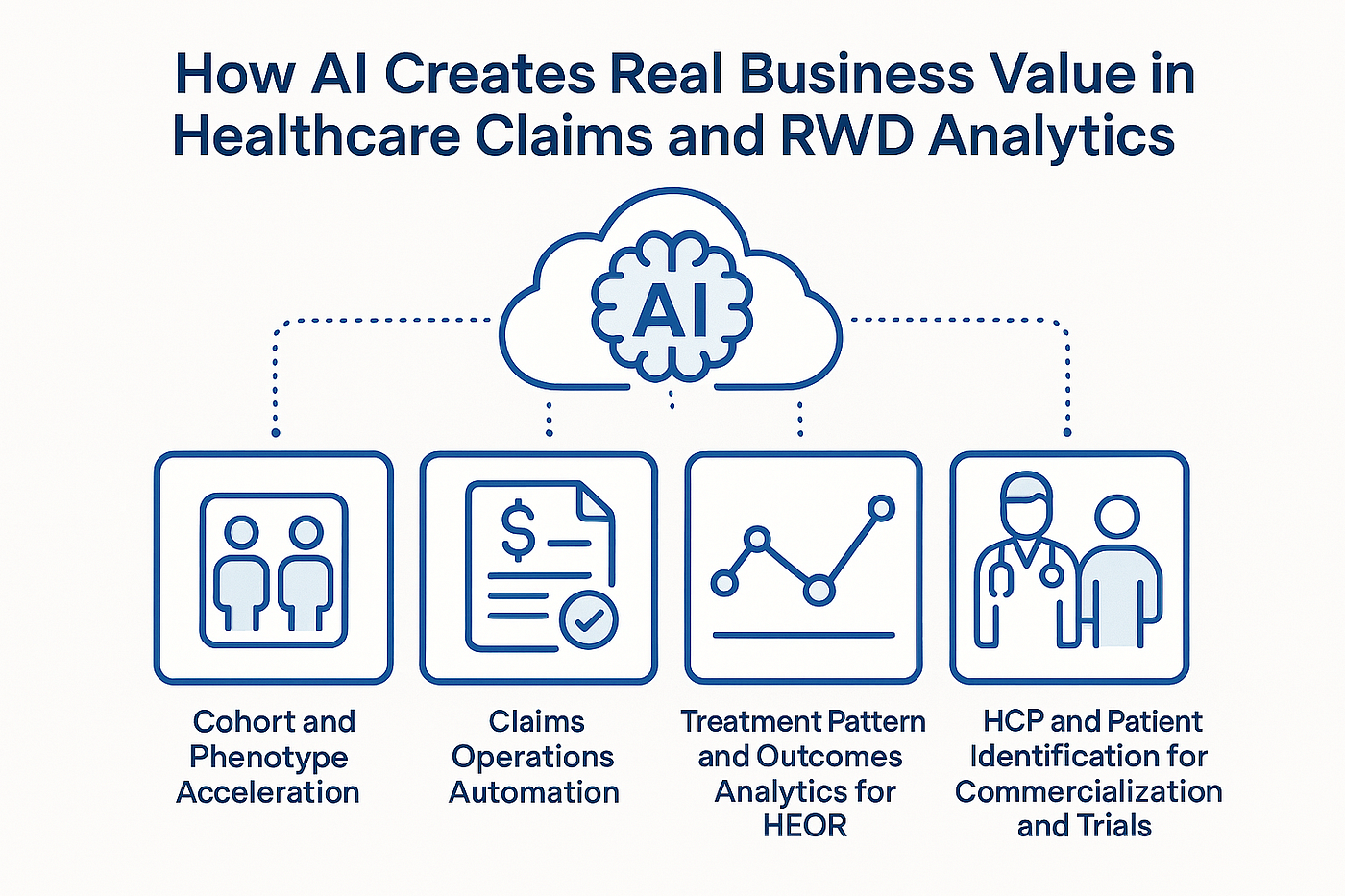
Cohort and phenotype acceleration :
AI assistants can draft cohort logic from a plain-language description of a condition or treatment pattern, suggest candidate code sets, flag likely false positives, and explain why a given patient was included. Analysts still review and approve, but the first draft arrives in minutes instead of days, and the reasoning is captured for audit.
Claims operations automation
For payers, AI models can pre-screen prior authorization requests, route claims to the right adjudication path, and surface anomalies that suggest waste or abuse. The goal is not to auto-deny — it is to let human reviewers spend their time on the small share of cases that genuinely need judgment.
Treatment pattern and outcomes analytics for HEOR
AI can standardize lines of therapy, infer regimens, identify switches and discontinuations, and assemble the longitudinal patient journeys that HEOR studies depend on. This shortens the path from raw claims to a defensible evidence package for payer dossiers, label expansion, or launch planning.
HCP and patient identification for commercialization and trials
AI can rank providers and sites by the likelihood of seeing eligible patients, taking into account diagnosis mix, procedure volume, and referral patterns, which makes targeting and recruitment more efficient.
Where Large Language Models Help: Unstructured Clinical Context
Claims data tells you what was billed, not always what happened. The richest clinical signal — severity, symptoms, biomarker values, prior therapies, reasons for switching — usually sits in notes, pathology reports, prior-authorization attachments, and discharge summaries. This is where large language models add something genuinely new.
LLMs can read unstructured clinical text and extract structured fields that link cleanly back to a claims record: stage, performance status, mutation status, ejection fraction, pain scores, or the specific reason a therapy was stopped. They can also reconcile conflicts between coded and narrative information, flag missing documentation, and summarize a patient’s history for a reviewer in seconds. When tokens, embeddings, and extracted fields are stored alongside the claims spine, downstream analytics inherit a far more complete clinical picture without forcing analysts to read documents one by one. The same capability supports payer use cases such as medical-necessity review and appeals handling, where the underlying question is almost always buried in free text.
Practical Steps to Get Started
Teams that succeed with AI in this space tend to follow a similar path.
Start with one high-friction workflow
Pick a process where the current cycle time, rework rate, or backlog is well understood — cohort building, prior authorization triage, or line-of-therapy derivation are good candidates — so value is easy to measure.
Treat governance as a first-class deliverable
Define how AI outputs will be reviewed, logged, and overridden, and make sure privacy, security, and clinical sign-off are built into the workflow rather than added later.
Build a reusable evidence layer
Invest in shared cohort definitions, code sets, and extracted clinical features so each new study compounds prior work instead of starting from scratch.
Keep humans in the loop and measure honestly
Track time saved, agreement with expert review, and decision quality, not just model accuracy. The goal is a faster, more consistent analyst — not an autonomous one.
Done this way, AI becomes a quiet productivity layer across claims and RWD work: less time spent assembling data, more time spent answering the questions that move coverage, access, and patient outcomes forward.
메타데이터
- post_id
- 09ec89dd601e
- slug
- how-ai-creates-real-business-value-in-healthcare-claims-and-rwd-analytics-09ec89dd601e
- url
- https://medium.com/@raghavvgoyall/how-ai-creates-real-business-value-in-healthcare-claims-and-rwd-analytics-09ec89dd601e
- canonical_url
- https://medium.com/@raghavvgoyall/how-ai-creates-real-business-value-in-healthcare-claims-and-rwd-analytics-09ec89dd601e
- author_url
- https://medium.com/@raghavvgoyall
- status
- ok
- fetched_at
- 2026-06-09 15:37:30






