Building Fault-Tolerant Microservices with Circuit Breaker using Spring Boot & Resilience4j
In a microservices architecture, services often depend on each other. But what happens when one service goes down?
Building Fault-Tolerant Microservices with Circuit Breaker using Spring Boot & Resilience4j
In a microservices architecture, services often depend on each other. But what happens when one service goes down?
we’ll explore:
- What is Circuit Breaker?
- Why it is needed
- How it works
- Implementation using Spring Boot & Resilience4j
- Real-time example
If you’re not a Medium subscriber, you can read the full interview-focused article using this friend’s link: [👉 Read the full article here](https://sanjaysingh-dev.medium.com/building-fault-tolerant-microservices-with-circuit-breaker-using-spring-boot-resilience4j-0a18a5daf7c1?sk=30de20792f6f7b5ade12f6d56d86dd9a)
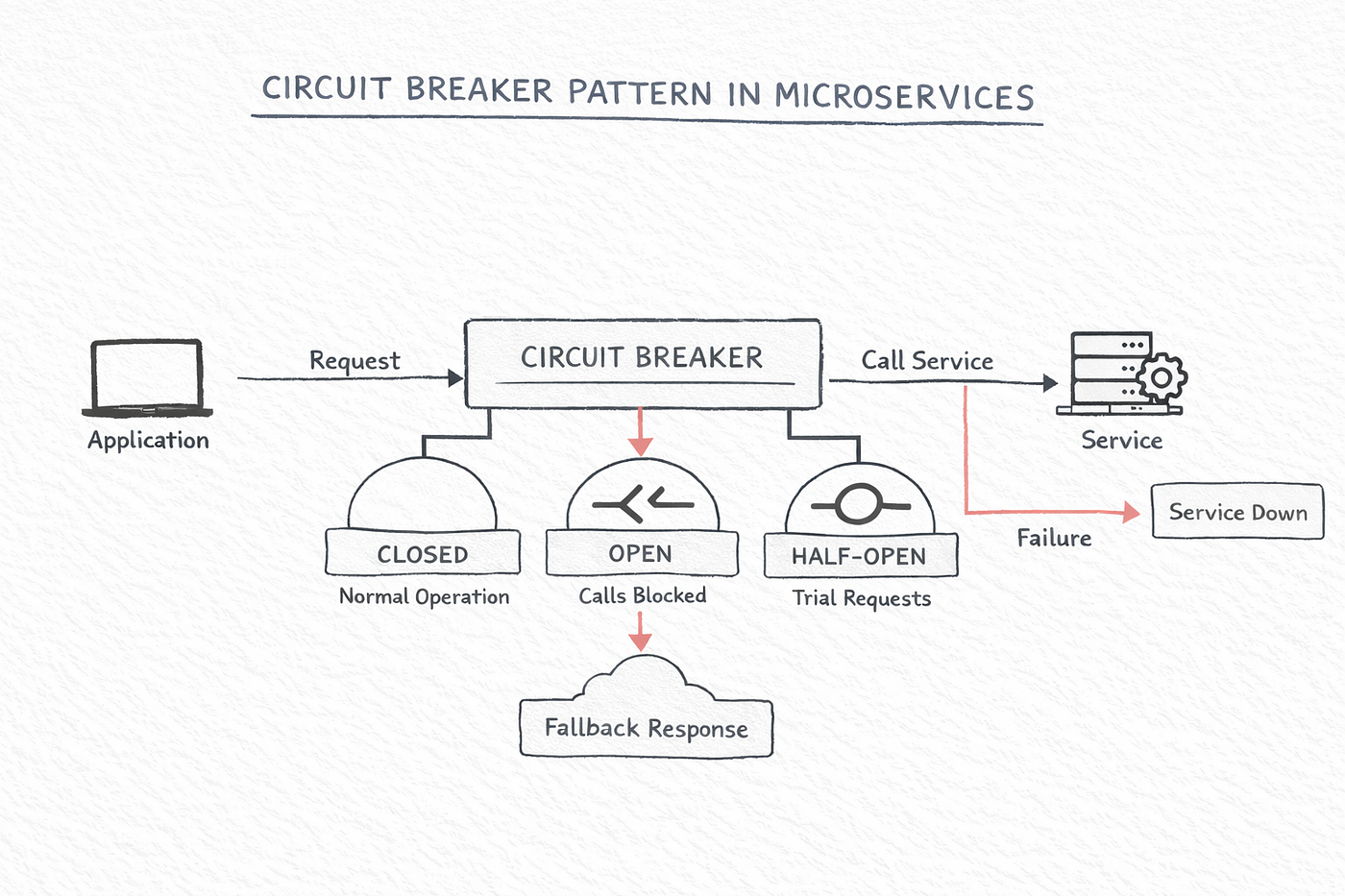
Circuit Breaker Pattern in Microservices
Let’s stay connected!
If you found this helpful, follow me for more deep dives into Java, Spring Boot, and System Design.
What is Circuit Breaker Pattern?
The Circuit Breaker Pattern prevents a system from making repeated requests to a failing service.
Think of it like an electrical circuit breaker:
- If everything is fine → current flows
- If failure happens → circuit trips (stops calls)
- After some time → tries again

What is Circuit Breaker Pattern?
Why Do We Need It?
Without Circuit Breaker:
- Continuous retries → system overload
- Cascading failures
- Poor user experience
With Circuit Breaker:
- Fail fast
- Provide fallback response
- Improve system stability
Circuit Breaker States
Circuit Breaker States

1. Closed
Requests are allowed
Failures are monitored

2. Open

Requests are blocked immediately
Fallback logic is executed

3. Half-Open

Limited requests are allowed
If successful → moves to Closed
If failures continue → moves back to Open
Internal Working (Flow)

Request → Circuit Breaker
        → If Closed → Call Service
        → If Open → Fallback Method
        → If Half-Open → Trial Request
Why Resilience4j?
Resilience4j is a lightweight, modern fault-tolerance library designed for Java 8+ and Spring Boot.
Key Advantages
- Lightweight (no heavy dependencies like Hystrix)
- Functional programming style
- Native Spring Boot integration
- Supports: ***- Circuit Breaker
- Retry
- Rate Limiter
- Bulkhead
- Time Limiter***
Note: Netflix Hystrix is now deprecated, and Resilience4j is the recommended alternative.
Setting Up Spring Boot with Resilience4j
1. Add Dependencies
<dependency>
    <groupId>io.github.resilience4j</groupId>
    <artifactId>resilience4j-spring-boot3</artifactId>
</dependency>
<dependency>
    <groupId>org.springframework.boot</groupId>
    <artifactId>spring-boot-starter-aop</artifactId>
</dependency>
Configuring Circuit Breaker
Add the following configuration in application.yml:
resilience4j:
  circuitbreaker:
    instances:
      orderServiceCB:
        slidingWindowSize: 10
        failureRateThreshold: 50
        waitDurationInOpenState: 10s
        permittedNumberOfCallsInHalfOpenState: 3
        minimumNumberOfCalls: 5
        automaticTransitionFromOpenToHalfOpenEnabled: true
Configuration Explained
slidingWindowSize: Number of calls to evaluatefailureRateThreshold: Percentage of failures to open the circuitwaitDurationInOpenState: Time before moving to Half-OpenpermittedNumberOfCallsInHalfOpenState: Test calls allowedminimumNumberOfCalls: Minimum calls before evaluation
Implementing Circuit Breaker in Service Layer
Let’s assume our service calls an external Order Service.
Service Class
@Service
public class PaymentService {
@CircuitBreaker(name = "orderServiceCB", fallbackMethod = "orderFallback")
    public String processPayment(String orderId) {
        // Simulating remote service call
        if (Math.random() > 0.5) {
            throw new RuntimeException("Order service is down");
        }
        return "Payment processed for order " + orderId;
    }
    public String orderFallback(String orderId, Throwable ex) {
        return "Order service unavailable. Please try again later.";
    }
}
How Fallback Works
When:
- Failure threshold is exceeded
- Circuit is open
The fallback method is executed instead of calling the failing service.
Benefits of Fallback
- Graceful degradation
- Meaningful error messages
- System stability
Monitoring Circuit Breaker Events
Resilience4j exposes actuator endpoints.
Enable Actuator
<dependency>
    <groupId>org.springframework.boot</groupId>
    <artifactId>spring-boot-starter-actuator</artifactId>
</dependency>
application.yml
management:
  endpoints:
    web:
      exposure:
        include: health,metrics,circuitbreakers
You can now monitor:
- Circuit breaker state
- Failure rate
- Number of calls
Best Use Case
- Use circuit breakers for remote calls only
- Combine with timeouts and retries
- Define meaningful fallback responses
- Monitor circuit breaker metrics
- Avoid over-using circuit breakers on internal method calls

cheet summery
Let’s stay connected!
If you found this helpful, follow me for more deep dives into Java, Spring Boot, and System Design.
메타데이터
- post_id
- 0a18a5daf7c1
- slug
- building-fault-tolerant-microservices-with-circuit-breaker-using-spring-boot-resilience4j-0a18a5daf7c1
- url
- https://medium.com/@sanjaysingh-dev/building-fault-tolerant-microservices-with-circuit-breaker-using-spring-boot-resilience4j-0a18a5daf7c1
- canonical_url
- https://medium.com/@sanjaysingh-dev/building-fault-tolerant-microservices-with-circuit-breaker-using-spring-boot-resilience4j-0a18a5daf7c1
- author_url
- https://medium.com/@sanjaysingh-dev
- status
- ok
- fetched_at
- 2026-06-27 18:20:27