How to Develop a Token on Arbitrum in 2026: Future-Ready Step-by-Step Guide
As blockchain adoption accelerates across finance, gaming, healthcare, and supply chain industries, tokenization has become one of the…
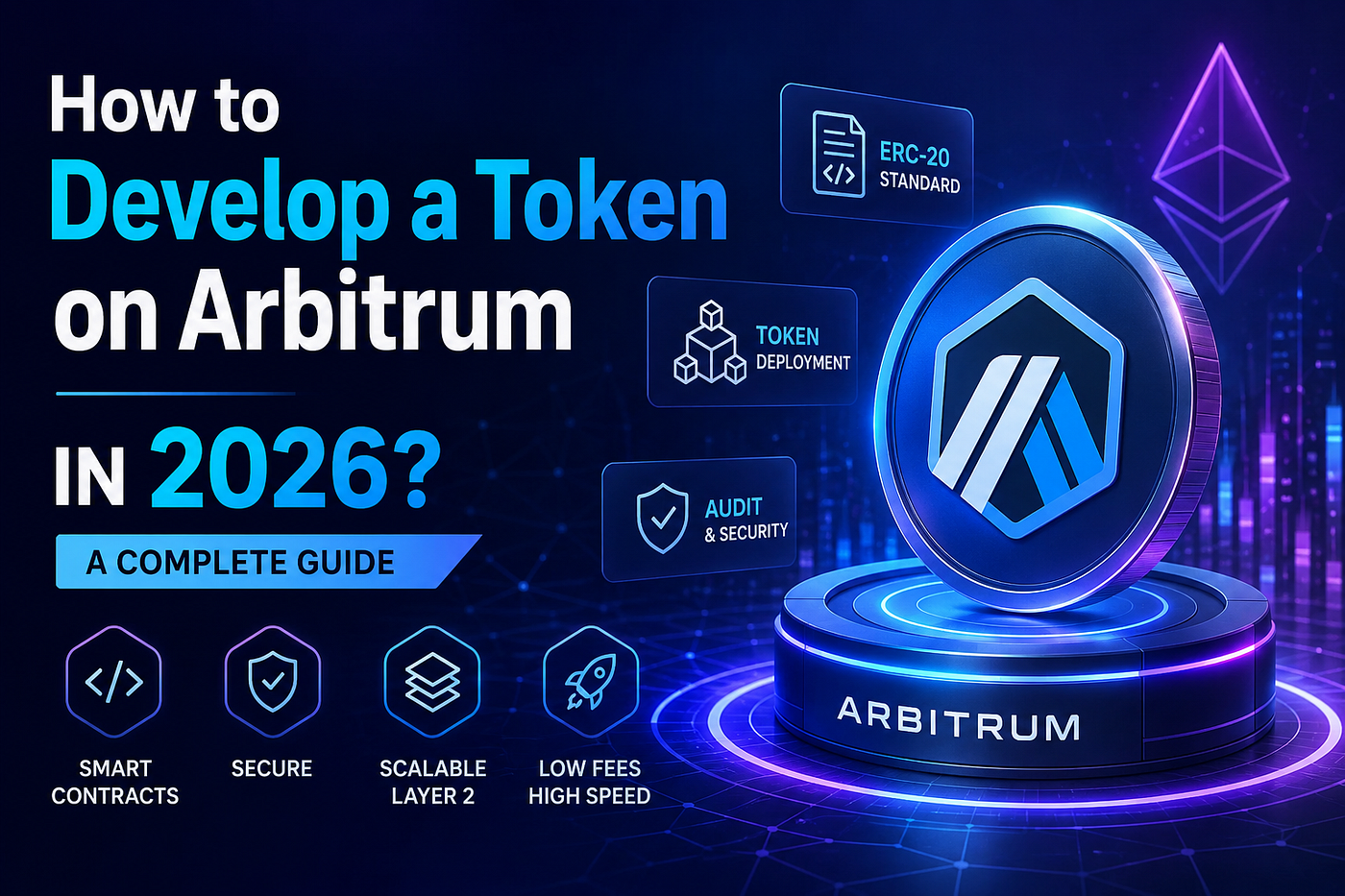
Learn how to develop a token on Arbitrum in 2026 with this complete guide covering tokenization development, secure smart contracts, tokenomics, deployment, security, and scalable blockchain solutions.
How to Develop a Token on Arbitrum in 2026: Future-Ready Step-by-Step Guide
As blockchain adoption accelerates across finance, gaming, healthcare, and supply chain industries, tokenization has become one of the fastest-growing technology trends in 2026. Businesses are moving beyond traditional blockchain networks to scalable ecosystems that offer lower costs and faster transactions. Arbitrum has emerged as one of the leading environments for token development, enabling startups and enterprises to launch secure, scalable, and cost-efficient digital assets. Whether you’re creating a utility token, governance token, stablecoin, or tokenized real-world asset, understanding the complete development process is essential for long-term success.
In this guide, we’ll explore every stage of tokenization development on Arbitrum, the latest innovations shaping the ecosystem, and best practices for building a future-ready token project.
Why Arbitrum Is the Preferred Choice for Token Development in 2026
The blockchain ecosystem has evolved rapidly, making scalability one of the most important factors in tokenization development. Arbitrum delivers high throughput while maintaining Ethereum-level security, making it attractive for businesses launching modern token ecosystems.
Some major advantages include:
- Extremely low transaction fees
- High transaction processing speed
- Strong developer ecosystem
- Ethereum-compatible infrastructure
- Better user experience
- Excellent scalability for growing token projects
These advantages make token development significantly more practical for startups and enterprises planning large-scale adoption.
What Makes Tokenization Development Different in 2026?
Today’s token development focuses on much more than creating a digital asset.
Modern tokenization includes:
- AI-driven compliance monitoring
- Automated governance systems
- Cross-chain interoperability
- Institutional-grade security
- Real-world asset integration
- Programmable ownership rights
- Dynamic token economics
Organizations now build intelligent digital ecosystems instead of standalone cryptocurrencies.
Step 1: Define Your Token Utility
Every successful tokenization project starts with a clear business objective.
Common token models include:
Utility Tokens
Provide access to products or platform services.
Governance Tokens
Allow community voting and decentralized decision-making.
Reward Tokens
Encourage customer engagement and ecosystem growth.
Security Tokens
Represent regulated investment opportunities.
Real-World Asset Tokens
Digitize ownership of physical or financial assets through tokenization.
A clearly defined utility improves adoption and long-term sustainability.
Step 2: Design the Tokenomics
Strong tokenomics directly impacts the success of any token development project.
Important considerations include:
- Total token supply
- Circulating supply
- Distribution strategy
- Vesting schedule
- Burn mechanisms
- Treasury allocation
- Community incentives
- Liquidity planning
Balanced tokenomics helps maintain ecosystem stability while encouraging participation.
Step 3: Select the Right Token Standard
The majority of token projects continue using the ERC-20 standard because of its compatibility with wallets, exchanges, and blockchain infrastructure. Selecting the appropriate standard early simplifies token development while ensuring maximum ecosystem support.
Step 4: Build Secure Smart Contracts
At this stage, developers begin smart contract development that governs every aspect of the token lifecycle, including transfers, minting, burning, governance, and permission management.
Modern contracts often include:
- Upgradeability
- Access control
- Emergency pause functions
- Treasury automation
- Governance modules
- Cross-chain functionality
Security-first architecture is essential because deployed contracts cannot easily be modified.
Step 5: Integrate Advanced Blockchain Intelligence
The newest trend in tokenization development involves integrating AI-powered blockchain technologies that automatically detect suspicious transactions, optimize network performance, improve governance, and provide predictive analytics for token ecosystems.
This intelligent automation significantly reduces operational risks while improving scalability.
Step 6: Build Cross-Platform Compatibility
Modern token projects rarely exist on a single blockchain.
Today’s businesses integrate with multiple Layer 2 blockchains to improve scalability, reduce costs, and expand market accessibility without sacrificing security.
Cross-chain interoperability has become a major competitive advantage.
Step 7: Connect with the Ethereum Ecosystem
Since Arbitrum extends Ethereum development capabilities, developers can leverage familiar tools, libraries, wallets, and infrastructure while enjoying significantly improved transaction efficiency.
This compatibility reduces development complexity and speeds up project deployment.
Step 8: Focus on Security Before Launch
Security remains the highest priority during token development.
A complete security strategy should include:
- Code audits
- Vulnerability testing
- Penetration testing
- Gas optimization
- Load testing
- Wallet compatibility testing
- Multi-signature treasury setup
Preventing vulnerabilities before launch protects both users and investors.
Step 9: Enable Ecosystem Integrations
Successful tokenization depends on accessibility.
Modern token projects integrate with:
- Wallet providers
- Payment gateways
- Identity verification
- Analytics platforms
- Staking systems
- Governance portals
Many also connect with DeFi protocols to provide lending, staking, liquidity pools, and decentralized financial services that increase token utility.
Step 10: Expand Through Enterprise Adoption
Businesses increasingly use enterprise blockchain infrastructure to launch secure token ecosystems for supply chains, finance, healthcare, logistics, manufacturing, and digital identity management.
Enterprise-grade tokenization emphasizes compliance, transparency, automation, and operational efficiency.
Step 11: Build User Applications
A token alone rarely creates long-term value.
Successful projects develop decentralized applications (dApps) that allow users to interact with the ecosystem through staking, governance, payments, rewards, marketplaces, and digital identity solutions.
Applications create continuous demand for token usage.
Step 12: Explore Real-World Asset Opportunities
One of the fastest-growing sectors in 2026 is asset tokenization, enabling organizations to digitally represent ownership of real estate, commodities, invoices, intellectual property, infrastructure projects, and private equity.
This significantly increases liquidity while reducing settlement times and administrative costs.
Latest Trends Shaping Token Development in 2026
The tokenization industry is rapidly evolving with several emerging innovations:
- Autonomous AI governance
- Modular blockchain architecture
- Zero-knowledge privacy solutions
- Cross-chain asset movement
- Digital identity integration
- Tokenized carbon credits
- Embedded compliance automation
- Programmable financial products
- Institutional custody solutions
- Machine-driven fraud prevention
These technologies are transforming how digital assets are created, managed, and scaled.
Common Mistakes to Avoid
Many projects struggle because they overlook critical development steps.
Avoid these common mistakes:
- Weak token utility
- Poor tokenomics planning
- Inadequate security audits
- Ignoring regulatory requirements
- Limited scalability planning
- Poor documentation
- Insufficient testing
- Weak governance design
- Lack of community incentives
- Incomplete ecosystem integration
Addressing these issues early greatly improves project success.
Why Professional Expertise Matters
Launching a successful blockchain project requires expertise across architecture, security, compliance, infrastructure, and long-term ecosystem planning.
Professional Token development services help organizations accelerate deployment while reducing technical risks, improving security, and ensuring scalable tokenization solutions aligned with business objectives.
Conclusion
Arbitrum has established itself as one of the most efficient platforms for tokenization development in 2026, combining Ethereum security with exceptional scalability and low transaction costs. Businesses that invest in strategic token development, intelligent automation, strong security, and scalable ecosystem design are well-positioned to lead the next wave of blockchain innovation.
Whether you’re building a utility token, governance ecosystem, or enterprise tokenization platform, focusing on sustainable tokenomics, advanced security, seamless integrations, and future-ready architecture will maximize long-term success. As tokenization continues reshaping digital ownership across industries, organizations that adopt modern token development strategies today will gain a significant competitive advantage in tomorrow’s decentralized economy.
메타데이터
- post_id
- 0a3cc89b511a
- slug
- how-to-develop-a-token-on-arbitrum-in-2026-future-ready-step-by-step-guide-0a3cc89b511a
- url
- https://blog.blockmagnates.com/how-to-develop-a-token-on-arbitrum-in-2026-future-ready-step-by-step-guide-0a3cc89b511a
- canonical_url
- https://blog.blockmagnates.com/how-to-develop-a-token-on-arbitrum-in-2026-future-ready-step-by-step-guide-0a3cc89b511a
- author_url
- https://medium.com/@david.wilson.digital
- status
- ok
- fetched_at
- 2026-07-11 10:04:19