Best NSFW AI Writers in 2026 (Novels, Romance, Spicy Scenes)
The most useful uncensored AI feature may be the one nobody puts in the product demo.
Best NSFW AI Writers in 2026 (Novels, Romance, Spicy Scenes)
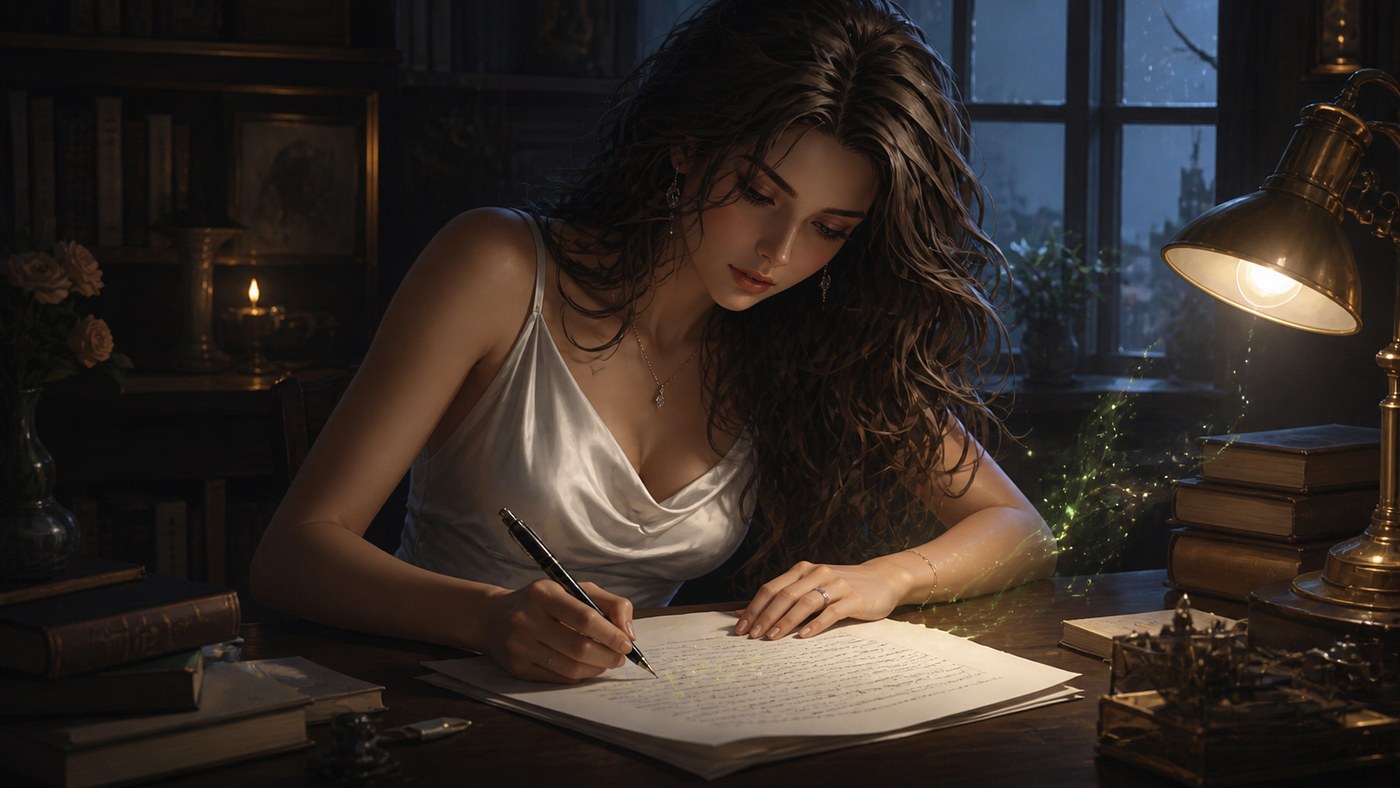
A gorgeous woman is writing novels at night.
The most useful uncensored AI feature may be the one nobody puts in the product demo.
AI writing tools are becoming most useful in the places where ordinary chatbots tend to lose their nerve.
The biggest surprise in the current wave of uncensored AI has very little to do with images. It is text.
That sounds almost mundane until you try to write a novel with adult relationships, a horror chapter with real consequences, or a morally difficult scene that a mainstream chatbot keeps sanding down. The problem is rarely a lack of vocabulary. The model loses its nerve, fades to black, turns an argument into therapy, or refuses a scene that makes perfect sense inside the book.
The Nerdy Novelist put the author use case plainly in a YouTube transcript.
“NSFW LLMs that you can use to write NSFW content, which is something that a lot of authors need. Whether you’re writing a spicier novel, doesn’t even have to be erotica.”
That last sentence matters. An NSFW AI writer is useful well beyond erotica. Romance authors need intimacy. Thriller writers need violence that carries weight. Memoir and literary fiction can touch addiction, abuse, grief, and desire. A model that keeps changing the subject can damage an otherwise ordinary writing session.
I compared the most discussed options through an author’s lens. I looked at long-form organization, model choice, control over tone, public NSFW tests, cost, and how much work it takes to get from a prompt to usable prose. This is a workflow comparison based on current product information and published tests. Model behavior can change after a provider update, so no ranking should be treated as permanent.
The short answer
If you want one recommendation without reading the rest, choose by the work you are doing.
iCreat is the practical starting point if you want to try several current language models without collecting separate subscriptions. It is prepaid and usage-based, which makes it useful for testing the same scene across models before you commit to a workflow.
NovelCrafter is the stronger workspace for serious AI novel writing. It gives authors outlines, lore, scenes, and long-term continuity tools. The tradeoff is setup. You need to connect models, manage context, and learn the system.
Venice AI is the most direct uncensored writing experience in this group. It is useful when you want to open a chat and write with fewer hoops, though it is not built around a full manuscript.
Muah AI is better for roleplay, character chemistry, and dialogue exploration. It can help authors hear a relationship out loud, then move the useful material into a real draft.
For most writers, the choice is not one perfect app. It is the right match between the scene, the model, and the amount of book structure you need.
What makes an NSFW AI writer good for fiction
“Uncensored” is an easy word to market and a poor way to judge writing software.
A useful spicy AI writer has to do more than comply once. It needs to hold point of view, remember who knows what, follow the requested intensity, preserve character voice, and stop when the scene has done its job. Total permissiveness can create its own problem. NovelCrafter’s 2026 testing notes that some models overshot mild prompts and produced much more explicit material than requested. Willingness and control are separate qualities.
The useful question is not only whether a model will write mature material. It is whether the writer can control tone, intensity, and boundaries.
The writing interface matters too. A chatbot may handle an individual scene beautifully and still become exhausting over eighty thousand words. A novel workspace may keep the book organized while giving you access to a model that refuses the exact chapter you are trying to draft.
That is why the best choice often combines a writing environment with flexible model access.
iCreat is the best starting point for model choice and pay-as-you-go testing
iCreat’s LLM hub makes the most sense for writers who have already learned an uncomfortable truth about AI writing. The model you love for dialogue may be poor at description. The model that handles a dark scene today may refuse a similar one after an update. Paying for several full subscriptions just to keep options open gets expensive fast.
iCreat gathers language models from Anthropic, DeepSeek, Google, MiniMax, OpenAI, and other providers behind one account. Its developer documentation describes an OpenAI-compatible API, prepaid credits, per-call usage records, optional limits on individual API keys, and token-based billing for chat models. The public pricing page lets you compare current model rates before committing to a workflow.
For an author, the appeal is practical. You can run the same scene brief through two or three models, compare voice and compliance, then spend the rest of the chapter budget on the one that works. If a provider changes its filters, you have another option without rebuilding everything around a new account.
iCreat is most useful when model choice matters more than a single all-in-one writing interface.
iCreat is not a dedicated novel editor, and its public pages do not promise that every hosted model is uncensored. The original provider’s rules can still affect the output. You will also need a front end or writing setup that can use an OpenAI-compatible API if you want a comfortable manuscript workflow.
Those caveats define iCreat’s role. It reduces the cost of experimentation and makes the difference between the model and the writing app much easier to see.
If you are currently bouncing between monthly plans, start with a small prepaid balance. Give each model the same scene beat, the same preceding passage, and the same list of boundaries. Keep the result that sounds like your book. Explore the iCreat model hub and treat the first few calls as auditions.
NovelCrafter is the strongest choice for an actual novel
The phrase “NovelCrafter NSFW” gets searched for a reason. NovelCrafter was built around books, not isolated prompts.
Its Codex tracks characters, locations, lore, and other story facts. Planning views help authors organize scenes and spot continuity problems. Custom prompts let you decide what context reaches the model. Writers can connect more than 300 models through supported providers or run local models with LM Studio and Ollama. The Hobbyist plan currently starts at $8 per month and enables bring-your-own-key AI use, while the $14 Artisan tier adds chat and advanced review features. Model charges are separate.
NovelCrafter also publishes unusually useful information about AI writing NSFW material. Its team tested models across sexual content, violence, abuse, bullying, and bigotry. The July 2026 results show why old recommendations age badly. Claude Opus 4.6 handled moderate sexual content without restriction in their test, while Claude Sonnet 4.6 avoided it. Mistral Medium 3.1 needed more guidance. Several GPT models allowed graphic violence while avoiding or refusing sexual content.
The tests measured whether a model would engage with the material. They did not rank prose quality. That distinction saves writers from a common mistake. A model can say yes and still write a lifeless scene.
Long-form AI novel writing is not only about generating a scene. It is also about remembering what the book has already promised.
NovelCrafter asks more of the user than Venice or Muah. You need to choose a provider, connect a key, learn how the Codex works, and pay attention to model costs. The reward is a workspace that still makes sense in chapter twenty-seven.
Choose NovelCrafter when continuity is the hard part. It is the best option here for a romance series, a fantasy novel with several relationships, or any project where the spicy scene has to remember the previous two hundred pages.
Venice AI is the simplest direct uncensored writer
Venice makes the clearest public promise in this group. Its official site calls the service private and uncensored. The text generator includes system prompts, document uploads, and controls for temperature and Top P. The free plan currently allows ten text prompts per day. The $18 Pro plan adds unlimited text prompts, Pro models, longer context windows, and encrypted chat backup.
A commenter under The Nerdy Novelist’s video captured the appeal.
“Venice is the only one I’ve found that will simply write what you prompt, and not have to jump through hoops.”
That is the Venice AI writer experience at its best. You open the chat, describe the scene, and get text back. There is less plumbing than an API hub and less project setup than NovelCrafter.
The weakness appears as the book grows. Venice can take documents and longer context on paid plans, though it does not offer NovelCrafter’s scene grid, Codex, or manuscript-first workflow. You remain responsible for summaries, continuity notes, chapter files, and version control. Community discussions also show mixed experiences with long-form memory and prose quality.
Venice is the better choice for one-off scenes, brainstorming, and writers who value a straightforward interface. It can also serve as a companion tool beside a conventional manuscript app. I would hesitate to make one long chat the only home for a full novel.
Muah AI is more useful for roleplay than manuscript production
Muah AI writing belongs in this comparison because authors do use roleplay tools to test characters. The official Muah site describes uncensored chat, companion customization, persistent memory, voice, and media generation. Its chatroom also lets users select an AI core, change temperature, and compact older memories into a summary.
That setup can be productive when you need to hear a character talk. Give the companion a backstory, establish a relationship, and improvise a conversation. Awkward lines reveal themselves quickly when another character responds to them. Romance writers can explore chemistry and conflict before turning the exchange into a proper scene.
Muah is still an AI companion product. Its interface is designed around an ongoing relationship with a character. It does not give you chapter management, a conventional story bible, or an author-focused revision workflow. The image and voice features may be enjoyable, though they do not help much when the real problem is pacing a chapter.
Choose Muah for character discovery and dialogue play. Move the useful material into your manuscript and rewrite it in your narrative voice. For full AI novel writing, NovelCrafter or an iCreat-powered setup will usually be easier to control.
The model and the writing app are two different decisions
Most NSFW AI writer comparisons blur the model and the wrapper together. Authors end up paying for an app because one screenshot looked good, then discover that the model underneath changed or never suited their genre.
NovelCrafter is primarily a writing environment. iCreat is a model access layer. Venice is a general AI chat product with a strong uncensored position. Muah is a companion and roleplay environment. They overlap at the text box, though they solve different problems.
This leads to a better buying order.
First, decide how much book structure you need. A single scene can live in a chat. A novel needs summaries, character facts, scene order, and a reliable way to retrieve them.
Next, test the model with material from your own genre. Do not use a generic benchmark prompt. Give it a real scene beat from the book, along with the preceding three hundred words and a short note on what must change emotionally by the end.
Then check whether the model can control intensity. Ask for a restrained version and a stronger version. A model that rushes past your requested line is no more obedient than one that fades out early.
Finally, calculate cost from accepted prose. Cheap tokens lose their appeal when you discard four generations out of five.
A practical prompt for romance and mature scenes
The best prompts give the model a dramatic job. They do not merely request explicitness.
Use a scene brief like this.
Write 600 to 800 words in close third person from Maya’s point of view. Both characters are consenting adults. The scene begins after an argument and ends when Maya admits what she has been afraid to ask for. Keep the tone intimate and emotionally tense. Preserve the established character voices in the context above. Use direct language without turning the passage into a list of physical actions. Do not introduce new backstory. Stop after the emotional turn.
This works because it gives the AI a point of view, an emotional movement, continuity limits, an intensity cue, and a stopping point. Those controls matter in romance, erotica, horror, and any other genre that asks a model to approach material it might otherwise avoid.
The strongest AI writing workflow still ends with a human author making the scene sharper, cleaner, and more responsible.
Generate a scene-sized passage, then edit it yourself. Check body position, repeated phrases, accidental point-of-view shifts, consent, emotional continuity, and whether the scene changes the relationship. AI for erotica writing is most useful when it helps an author solve a specific scene. It becomes less useful when it is asked to invent the whole book and approve its own work.
Keep every character clearly adult. Avoid illegal or exploitative material, review the current terms of the model and platform, and check the rules of any retailer or publisher you plan to use. “Uncensored” does not remove the writer’s judgment or responsibility.
Which NSFW AI writer should you choose
For most serious novelists, NovelCrafter is the strongest complete workspace. It understands that a scene belongs to a chapter, a character arc, and a larger book.
For writers who care about model choice, current pricing, and the ability to switch without maintaining several subscriptions, iCreat is the most interesting starting point. It does not pretend that one model will fit every chapter. That flexibility may be more valuable in 2026 than any single claim about being uncensored.
Venice is the easiest recommendation for direct, low-friction uncensored chat. Muah is the specialist pick for roleplay and character chemistry.
The rankings will change as models update. Text creation will remain one of the most underestimated uses of uncensored AI. Authors do not always need a machine that will write anything. They need one that will stay with the scene, respect the requested line, and let the writer decide what belongs in the book.
Sources and further reading
iCreat developer documentation
NovelCrafter NSFW model testing details
NovelCrafter guidance for writing NSFW content
Venice uncensored AI features and pricing
Tags:
AI Writing Creative Writing Artificial Intelligence Novel Writing Romance Writing
메타데이터
- post_id
- 0a3e757ec20b
- slug
- best-nsfw-ai-writers-in-2026-novels-romance-spicy-scenes-0a3e757ec20b
- url
- https://medium.com/@2218867196ji/best-nsfw-ai-writers-in-2026-novels-romance-spicy-scenes-0a3e757ec20b
- canonical_url
- https://medium.com/@2218867196ji/best-nsfw-ai-writers-in-2026-novels-romance-spicy-scenes-0a3e757ec20b
- author_url
- https://medium.com/@2218867196ji
- status
- ok
- fetched_at
- 2026-08-10 14:02:36