Chris Nolan Movies as Greek Gods (part 3)
All blog posts written practically, with minimal spellcheck involved.
Chris Nolan Movies as Greek Gods (part 3)
All blog posts written practically, with minimal spellcheck involved.
Check out part 1, or part 2, or part 1, or part 2, or part 1, or part 2, or part 1!
In the lead-up to Christopher Nolan’s version of The Odyssey being released, we here at Midnight Reviews continue our nonsense, linking Nolan-directed movies to the Greek Gods (and there’s a mini bonus at the end!)
Oppenheimer (2023) is Ares

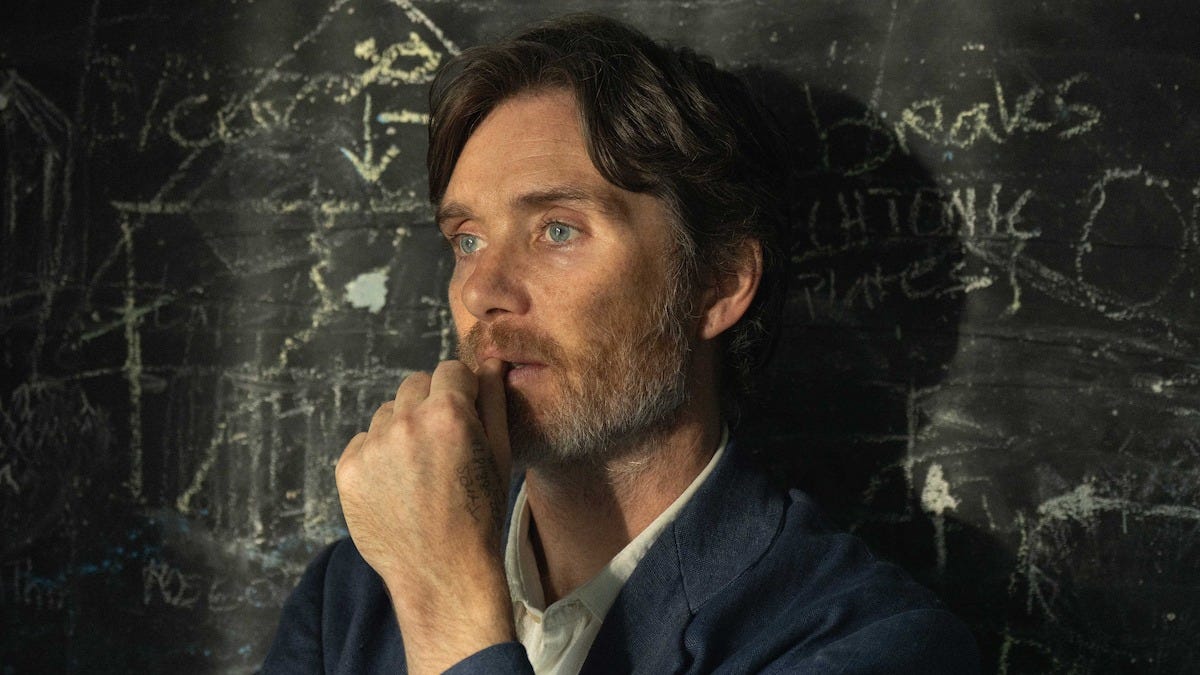
But if she’s a Barbie girl, in a Barbie world, and she leaves that plastic plain of existence… the ramifications of my discovery! Image credit: Universal Pictures
Nolan’s films get bigger as they go. Here, Nolan directs a film featuring people in blank rooms talking to each other, but it happens to be about one of the monumental events, perhaps the monumental even, of the 20th century. It reflects his minimalist direction done on a massive scale. It’s the talky drama that happens to be about, in Nolan’s words, ‘the most important person to ever live.’ It’s here flags are raised with Nolan also talking about Oppenheimer’s story being ‘one of the biggest stories imaginable’, as if size were the only thing that mattered but on landing, Oppenheimer did the business.
Here, Nolan relishes in his love of brutalist set design, somehow sleek, minimalist and modern despite the period setting. We’d seen it before in the mausoleum of Wayne Manor, as well as the ending and post-modern prop design of Tenet. There are also flashes of horror, similar to his previous efforts without Nolan ever actually making a horror movie. It’s been said many times already, but Cillian Murphy is finally given centre stage to deliver these massive moments with an understated performance, reflecting his director’s vision and marking himself as just one of many inversions Nolan’s featured throughout his career.
Ares is a god who is tolerated, despised and renowned in equal measure, by mortals and immortals alike.
It’s also here where we can spot Nolan’s tendencies to try various tricks as sidenotes before perfecting them in a later production. The Prestige featured a plot twist communicated by a character (who is now off-screen) lying to a protagonist; The Dark Knight does this with the Joker lying about Rachel and Harvey.
Interstellar featured a rocket launch’s flames, onscreen for minimal time before we quickly cut to the cold reality of open space. In Oppenheimer, he dives right into the flames as he attempts to film an atomic explosion without CG images. Audiences can feel the heat, and it’s in this heat where the film builds tension as it marks the next step in stopping a terrible war, but at a cost of such scale that it’d be understandable to lock the thing away and forget it ever existed. The film had audiences joking about visual effects being put aside in favour of filming an actual atomic blast. Who’d want to be the AD calling everyone back to first positions for a second take?
But why Ares? Oppenheimer is the tale of someone much meeker than your average protagonist. Stick him in a room with Batman or Odysseus and the man fades into the background. In a similar way, Oppenheimer is undoubtedly a thrilling, morally perplexing movie. But it doesn’t match up to Nolan’s best.
And like Ares, this creator of the ultimate weapon (beyond war, into the realms of pure destruction) is not a rollicking character whose deeds cry excitement to the Heavens. Ares is a god who is tolerated, despised and renowned in equal measure, by mortals and immortals alike. Oppenheimer has its celebrators, but also its detractors. J. Robert Oppenheimer is seen as a pivotal figure in history, bringing about a way to stop the fighting. His solution is brutal; killing hundreds of thousands to potentially save millions. Only Ares could bring about such bloodshed as a way to end a war.
Dunkirk (2017) is Athena

On hearing that Harry Styles is in this, and therefore all anyone will talk about is Harry Styles being in this. Image credit: Warner Bros. Pictures
Fresh off his ‘other’ trilogy (The Prestige, Inception, Interstellar, all with recurring themes and released alternately with his Dark Knight trilogy), what was Christopher Nolan going to make next? Another example of ‘some would say his best work to date.’ Athena isn’t just the Goddess of warfare, she’s the Goddess of handicraft; a feeling Dunkirk evokes in its imagery.
Oppenheimer won the awards and The Dark Knight was the box-office sensation. But Ares showed jealousy towards Athena due to her status, and Zeus was afraid of Athena overthrowing him. Dunkirk, stripped of any thematical requirements and comic book lore, is Nolan’s filmmaking stripped down and unassuming.
Allows its audience to fully immerse itself.
Nolan uses his obsession with time merely as a framing device; each of the three main sections take place over a different amount of time, and Nolan’s construction via jumping back and forth in time is a practise he was well-versed in by 2017. It’s a wonder that frequent Nolan editor Lee Smith is able to cut anything in chronological order anymore (although having the ability to go back in time and not be involved in Argylle might be tempting). It plays more like a series of short stories that happen to be set in the same place. Dunkirk’s pared down nature is its real strength.
Dunkirk is Nolan’s allusion to The Odyssey made most simple. If The Odyssey is boiled down, it is the precursor to any movie where someone is trying to get home. Dunkirk can’t really be boiled down — it really is about people just trying to get home (and in typical Nolan inverting fashion, ‘home came to them’).
But simplicity doesn’t mean lower quality, the same way complexity doesn’t mean a better movie. This simplicity even extends to the jumping back and forth in time, as each section only links to the others in the most perfunctory way. We’re back at Nolan’s strength, seen most prominently in The Prestige, where the when and the why of each vignette is communicated so clearly and allows its audience to fully immerse itself.
The Dark Knight Rises (2012) is Hephaestus

“I was just trying to download the parking app!” Image credit: Warner Bros. Pictures
‘THE FIRE RISES’ was the tagline, capital letters and all, but it’s not only this reference to fire that links The Dark Knight Rises and the metal worker Hephaestus.
Volcanoes (the Roman equation of Hephaestus happens to be Vulcan) work with the build-up of pressure; different mechanisms over time that may seem unrelated, and that are sometimes unpredictable, coming together to create an eruption. In this way The Dark Knight Rises acts as the culmination of Nolan’s Dark Knight trilogy. This is both in the fictional world (we see the return of the league of shadows and the fallout from Batman’s battle with Ra’s al Ghul) as well as real life (Heath Ledger’s untimely death). What would Nolan’s plans have been if The Joker were able to return? Would we have a very different movie? It seems churlish to speculate, as the loss of a character from a movie is hardly comparable to the loss of a human being.
Piles the pressure on Bruce Wayne.
The film can be easily tied to possibly the most interesting God in the Olympic pantheon, a God most well-known for his toil away from Mount Olympus (some stories mention him working inside or under a mountain; the image that comes to mind most often is of him hammering away using the very magma found in the Earth’s centre). Its protagonist, indeed, has a limp much like how Hephaestus is portrayed. In some stories, despite his Godly status, he is unable to walk at all. But that’s too easy. Because, unfortunately for the film, the true link is with how it compares to the rest of the Dark Knight trilogy. It is, despite the craftsmanship on display, the film that falls behind.
It has some good stuff. Nolan’s boldness, after following certain well-established beats religiously in The Dark Knight, is on display as he refuses to even show us the title character for around forty-five minutes. Instead, he piles the pressure on Bruce Wayne to not only return to save the day, but indulge in a habit that’s left him broken. The comparisons to Howard Hughes are obvious. Wayne wanders around his mausoleum of a home with an overgrown beard, never leaving and with seemingly his only link to the rest of humanity (Alfred, played with a frustrated impatience by Michael Caine) being tenuous at best. But he also, despite his relatively quick wits, reminds of an addict, broken down by the thing he allowed to take over his life.
Like Hephaestus, Bruce Wayne uses his hammer and tongs to build machines. Except in The Dark Knight Rises, his tools are called Lucius Fox and Alfred Pennyworth. His automatons are his batpod and, with Nolan’s strict preference that things shouldn’t get too silly, a bat plane that is simply called ‘The Bat.’ His numerous tanks and pieces of personal equipment that are at first a help become a hindrance once Bane’s on the scene. He negates the batarangs and other titbits found in the bat belt, before going on to steal the bigger stuff. Again, Nolan likes his movies big, so it’s a surprise that Bane’s tanks don’t work half as well as a knife between the ribs.
Sometimes too complicated for its own good.
The aforementioned pressure also ties into Hephaestus’ more famous tales. On realising his wife Aphrodite is having an affair with Ares, instead of barging in and running wild with accusations and Godly vengeance, he decides to leave a trap. With cold forethought, he tricks Aphrodite into thinking he’s left their home. When Ares shows up and the two go to bed, the trap is set off and Hephaestus invites other Olympians to come and laugh at the spectacle. In another story, he creates a cursed necklace for the daughter of Aphrodite and Ares, a beautiful piece of jewellery that dooms the wearer to significant suffering and torment. In this myth, Hephaestus’ vengeance builds and builds up until the myth of Oedipus, the unfortunate successor to the necklace.
In this way, Miranda Tate lies in wait for Bruce Wayne to let his guard down before punishing him for murdering her father. A revenge as cold as the snow on the ground.
The action has that sense of escalation that Nolan seems so interested in. Unlike his earlier action in Batman Begins, we can actually comprehend what is happening and aren’t purposefully led away. This isn’t to say Batman Begins didn’t have good action; Nolan’s explanation of how he shot that action to mimic how someone on the streets sees Batman is either an interesting idea, or an annoying copout.
All becomes incredibly muddled.
But like some of Nolan’s work, The Dark Knight Rises is sometimes too complicated for its own good. The reveal that the child in the prison flashbacks isn’t Bane, but Miranda, is another interesting idea but at this point in the movie there are numerous twists and turns all delivered in minutes few (Catwoman’s staying; Batman sets up that he’ll die for Gotham; Miranda stabs Batman; Miranda is the power behind Bane; she knows Bruce Wayne is Batman; the child in the prison wasn’t Bane; Bane actually loves Miranda). It ends up feeling like a beat sheet as opposed to a story being told. And in comparison to The Dark Knight’s implied violence and bloodshed, The Dark Knight Rises is bloodless despite the stakes. Numerous corpses line the streets of Gotham after a terrible gun-battle, but it feels more like people lying down and playing pretend. A solid bet would be that producers had an eye on this opening with a 12A rating, despite the insistence this is a war movie.
And to draw comparisons with The Dark Knight again, the relatively subtle allusions to the war on terror are replaced with a politics that is confusing at best. Nolan introduces Selina Kyle as a character driven by the unfairness of an economic and cultural system. She doesn’t just steal things because she wants them; she hates the rich, and insists their dominance won’t last in the face of rebellion. But when Bane uses that rebellion as a cover to threaten Gotham, all for the crimes that Bruce Wayne committed against the league of shadows, it all becomes incredibly muddled. For all his cloak and dagger when it comes to what he’s saying with his movies, Batman Begins and The Dark Knight had clarity. The Dark Knight Rises sometimes feels it’s set too much up and becomes occupied only with reaching the finishing line.
The pressure was building up and this was the first Nolan movie that didn’t confidently stride through to receive its praise. Instead it limps by, with many interesting trinkets, but without the power to climb back to Mount Olympus.
Bonus: Man of Steel (2013) is Hades
Like the relationship Greeks used to have with the God of the Dead, Man of Steel is the one people don’t talk about. It vies for moral complexity and has some interesting points, but is ultimately by-the-numbers in its bureaucratic destruction. What a waste of Michael Shannon’s raw acting power.
Matthew D. Smith likes to overshare his views on movies and TV shows whenever and wherever he can. Indulge him, and follow him on Twitter or enjoy the podcast he co-hosts with Leslie Wai.
메타데이터
- post_id
- 0a5b7ab92b7e
- slug
- chris-nolan-movies-as-greek-gods-part-3-0a5b7ab92b7e
- url
- https://medium.com/@midnightreviews/chris-nolan-movies-as-greek-gods-part-3-0a5b7ab92b7e
- canonical_url
- https://medium.com/@midnightreviews/chris-nolan-movies-as-greek-gods-part-3-0a5b7ab92b7e
- author_url
- https://medium.com/@midnightreviews
- status
- ok
- fetched_at
- 2026-08-05 16:04:58