HBOT for Hearing Loss, Vision Emergencies, and Post-COVID ENT Problems: Knowing When Treatment…
Many ear and eye conditions develop slowly over time, but not all of them. A person may suddenly lose hearing in one ear during breakfast…
HBOT for Hearing Loss, Vision Emergencies, and Post-COVID ENT Problems: Knowing When Treatment Shouldn’t Wait
Many ear and eye conditions develop slowly over time, but not all of them. A person may suddenly lose hearing in one ear during breakfast, wake up unable to see clearly through one eye, or continue struggling with loss of smell months after recovering from COVID-19. Some people also develop persistent tinnitus or severe dry mouth after radiation therapy, affecting daily comfort and communication.
These problems may have different causes, but several share one important feature: the affected tissues are not getting enough oxygen. Hyperbaric Oxygen Therapy (HBOT) is used with standard medical treatment for selected ENT and ophthalmology conditions to improve tissue oxygenation and support recovery when appropriate.
Conditions Included in the HBOT Referral Guidelines
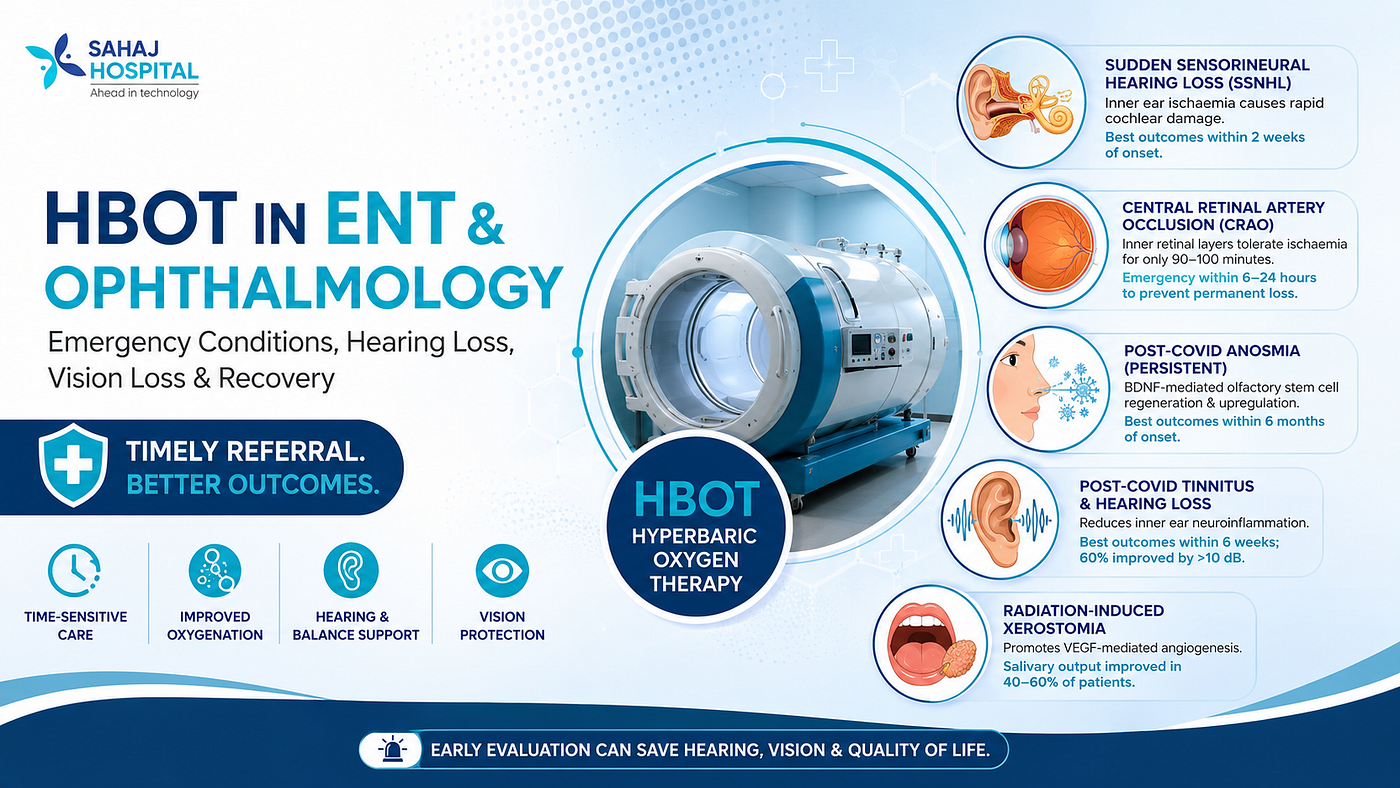
The infographic highlights five conditions where Hyperbaric Oxygen Therapy has established or emerging clinical applications.
Sudden Sensorineural Hearing Loss (SSNHL)
Sudden Sensorineural Hearing Loss (SSNHL) is an ENT emergency that usually appears without warning. Hearing may disappear completely or become severely reduced within hours.
The infographic explains that inner ear ischemia causes rapid injury to the cochlea, which has one of the highest metabolic demands in the body. Without sufficient oxygen, the sensory hair cells inside the cochlea begin to die, and these cells cannot regenerate naturally.
Evidence in the infographic shows that patients experience the best outcomes when treatment begins within two weeks, while recovery becomes less likely after three months.
Central Retinal Artery Occlusion (CRAO)
Central Retinal Artery Occlusion is an ophthalmic emergency caused by an occluded retinal artery.
Once blood flow stops, the retina loses its oxygen supply almost immediately. According to the infographic, the inner retinal layers tolerate ischemia for only 90 to 100 minutes before irreversible damage occurs, making rapid diagnosis and referral essential.
Other Conditions Where HBOT May Be Considered
The infographic also discusses Hyperbaric Oxygen Therapy for:
- Persistent Post-COVID Anosmia
- Post-COVID Tinnitus and Hearing Loss
- Radiation-Induced Xerostomia
Although these conditions usually develop over a longer period, they can significantly reduce quality of life if symptoms continue despite standard treatment.
Why Oxygen Delivery Matters
The ear, retina, olfactory system, and salivary glands all rely on healthy blood circulation to receive oxygen. When circulation is reduced or inflammation disrupts oxygen delivery, these tissues become vulnerable to injury.
In Sudden Sensorineural Hearing Loss, inner ear ischemia deprives the cochlea of oxygen. Since cochlear hair cells cannot repair themselves once destroyed, restoring oxygen early becomes an important treatment goal.
During Central Retinal Artery Occlusion, the blocked artery prevents oxygen from reaching retinal tissue. The infographic explains that Hyperbaric Oxygen Therapy creates vitreous hyperoxia, helping preserve inner retinal oxygenation until circulation improves.
Patients with Persistent Post-COVID Anosmia may experience delayed recovery of smell because of injury to olfactory tissues. The infographic associates improvement with BDNF-mediated olfactory stem cell regeneration and BDNF upregulation, which support tissue repair.
For Post-COVID Tinnitus and Hearing Loss, lingering inflammation may continue to affect the inner ear. The infographic identifies vasculitis and inner ear neuroinflammation as mechanisms that HBOT may help reduce.
In Radiation-Induced Xerostomia, radiation damages blood vessels supplying the salivary glands. Reduced blood flow limits saliva production, causing persistent dry mouth that often interferes with speaking, eating, swallowing, and oral health.
Who Should Not Delay an Evaluation?
The referral guidance in the infographic can be translated into simple patient questions.
- Has your hearing suddenly disappeared or become dramatically worse in one ear?
- Did you suddenly lose vision in one eye?
- Has your sense of smell remained poor for more than three months after COVID-19?
- Are you still experiencing tinnitus or hearing loss after COVID-19 despite treatment?
- Is dry mouth after radiation therapy making it difficult to speak or swallow?
If your symptoms match any of these situations, timely medical assessment is important. Patients can discuss whether Hyperbaric Oxygen Therapy is appropriate with specialists at Sahaj Hospital, where treatment decisions are based on the diagnosis, severity, and referral timing.
How Hyperbaric Oxygen Therapy Supports Healing
Hyperbaric Oxygen Therapy allows patients to breathe pure oxygen inside a pressurised chamber. Under increased atmospheric pressure, much larger amounts of oxygen dissolve into plasma and reach tissues that may not be receiving enough oxygen through normal circulation.
For Sudden Sensorineural Hearing Loss, HBOT increases oxygen diffusion into the injured cochlea. The infographic recommends HBOT simultaneously with steroids, resulting in clinically significant hearing recovery.
The evidence section references the Cochrane Review by Conlin and Nicholas (2006), which found that patients receiving HBOT plus steroids recovered hearing more often than those receiving steroids alone. The infographic reports a Number Needed to Treat (NNT) of 5, particularly when therapy begins within two weeks.
For Central Retinal Artery Occlusion, HBOT produces vitreous hyperoxia, maintaining oxygen delivery to retinal tissue while normal blood circulation is reduced. The infographic reports 40% visual recovery with HBOT compared with 8% using standard care alone.
The infographic also cites the 2022 cohort study by Seiden and colleagues, which demonstrated better olfactory scores in patients with Persistent Post-COVID Anosmia treated with HBOT compared with olfactory training alone.
For Post-COVID Tinnitus and Hearing Loss, HBOT reduces inner ear neuroinflammation. The infographic notes that the best outcomes occur within six weeks of symptom onset, with 60% of patients improving by more than 10 dB.
Patients with Radiation-Induced Xerostomia may also benefit because HBOT promotes VEGF-mediated angiogenesis, encouraging new blood vessel growth in damaged salivary glands. According to the infographic, 40% to 60% of patients experienced significant improvement in salivary output.
When clinically appropriate, Sahaj Hospital provides state-of-the-art hyperbaric oxygen therapy alongside medications and other evidence-based treatments to create an individualised care plan.
Why Timing Is One of the Most Important Factors
The infographic repeatedly emphasises that early referral improves outcomes.
Patients with Sudden Sensorineural Hearing Loss should ideally be referred within 72 hours, while the strongest evidence supports treatment during the first two weeks.
Central Retinal Artery Occlusion should be treated as an emergency. Referral should occur within 24 hours, with HBOT ideally beginning within 6 to 24 hours, before irreversible retinal injury develops.
Patients with Persistent Post-COVID Anosmia should seek specialist evaluation once symptoms continue beyond three months. The infographic indicates the best outcomes occur within six months of onset.
Individuals with Post-COVID Tinnitus that remains unresponsive to standard medical management for more than three months should also discuss further treatment options.
Patients experiencing Radiation-Induced Xerostomia severe enough to interfere with speaking or swallowing should not wait until symptoms become disabling.
If you experience sudden hearing loss, sudden vision loss, persistent loss of smell after COVID-19, continuing tinnitus, or severe dry mouth after radiotherapy, take action today instead of waiting for spontaneous improvement. Contact Sahaj Hospital for an early evaluation, because prompt diagnosis and timely treatment may provide the best chance of preserving hearing, protecting vision, and improving long-term recovery.
👉 Learn more about “**Why Some Wounds Never Heal: The Role of Hyperbaric Oxygen Therapy in Complex Skin and Wound Care**” in our related article.
메타데이터
- post_id
- 0a85ec916cd2
- slug
- hbot-for-hearing-loss-vision-emergencies-and-post-covid-ent-problems-knowing-when-treatment-0a85ec916cd2
- url
- https://medium.com/@sahajprabhakar/hbot-for-hearing-loss-vision-emergencies-and-post-covid-ent-problems-knowing-when-treatment-0a85ec916cd2
- canonical_url
- https://medium.com/@sahajprabhakar/hbot-for-hearing-loss-vision-emergencies-and-post-covid-ent-problems-knowing-when-treatment-0a85ec916cd2
- author_url
- https://medium.com/@sahajprabhakar
- status
- ok
- fetched_at
- 2026-07-10 07:28:19