Distance Is Expensive
Why Getting Somewhere Costs Something
Distance Is Expensive
Why Getting Somewhere Costs Something
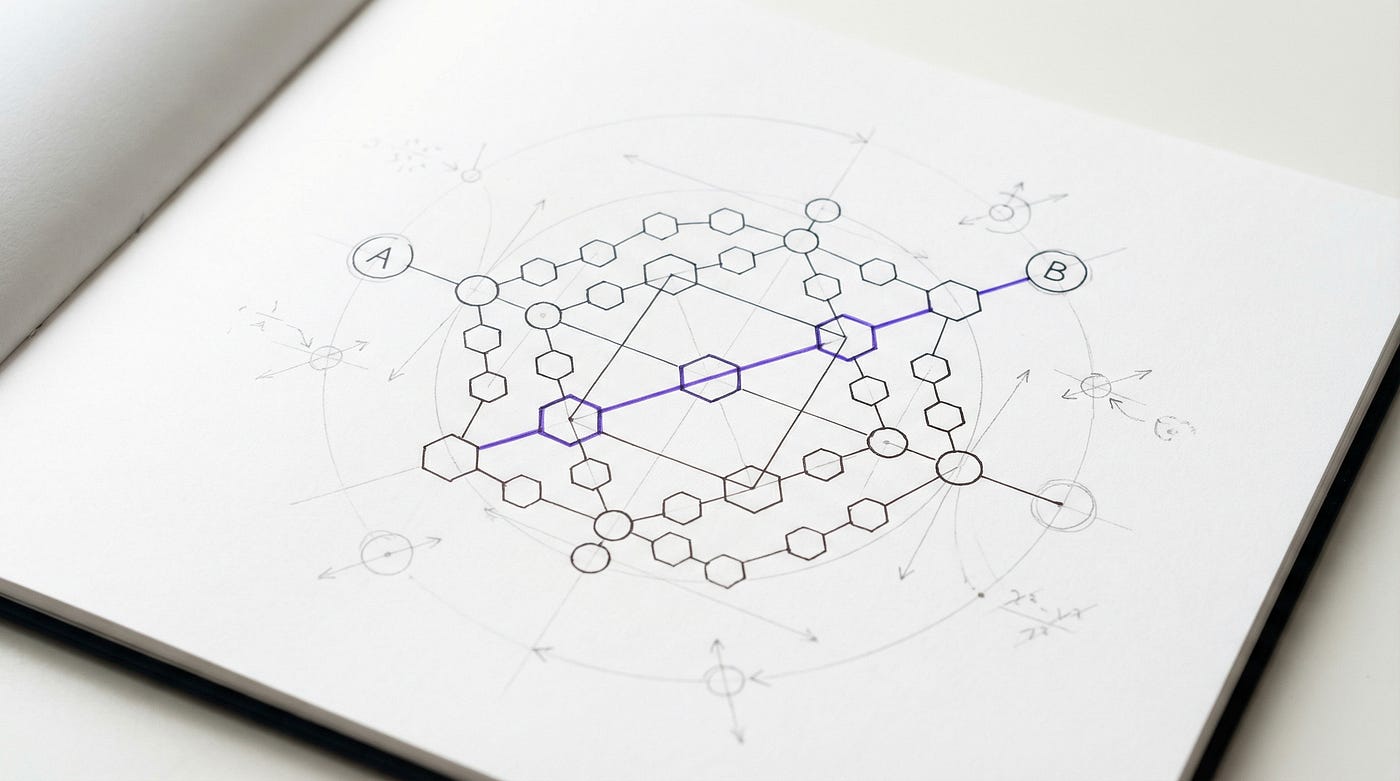
A protocol network sketched in a physicist’s notebook: the cheapest path from A to B traced in violet through a graph of macro states. Distance isn’t a ruler. It’s the ledger of that path.
I took a cab from Syntagma Square to the airport once, at an hour when Athens doesn’t sleep, it just gets weird.
The driver took a route that made no geometric sense. We went through Kifisia. Kifisia is north. The airport is east. I paid twice what I should have.
When I got home I drew the path on a map. The route was longer in kilometers, shorter in minutes, longer in euros. Three different notions of “how far.” All disagreed.
And I thought: which one is distance?
The answer is there is no distance. Not before you choose what you’re counting.
Distance Isn’t Geometry First
Distance isn’t geometry first. It’s accounting first.
I know that sounds like a finance metaphor that got lost and ended up in a geometry textbook. Bear with me.
The usual picture: space exists, points live in it, distance is a ruler. Pull out the ruler. Done.
But that picture is borrowed. You’ve already assumed a container. The container isn’t free.
Real question: if you had to build distance from scratch — from nothing but transitions, costs, and paths — what would it look like?
It would look like a ledger.
A pair of states is near if it’s cheap to move between them. Far if it’s expensive. Not ruler-far. Ledger-far. The cost of getting there is what makes it far.
Assign costs from dynamics this way: cost = negative log likelihood of a transition. Highly probable transition → small cost. Barely-ever-happens transition → enormous cost.
Not a metaphor. The definition.
Protocols: The Cheapest Path Wins
A path from one state to another isn’t a straight line. It’s a protocol: a sequence of moves, each with a cost, adding up.
Distance is the cheapest protocol you can find.
The triangle inequality — the thing your high school teacher made you prove — is just: you can’t save money by going through a detour. Detours add cost. The direct path is at least as cheap as anything through a third point.
The triangle inequality isn’t a geometric axiom. It’s arithmetic on a ledger.
Okay. Wait. Logical detour I cannot resist:
Cab drivers know shorter routes. Cab drivers also know how to make routes expensive. Therefore cab drivers are the embodiment of the gap between geometric distance and protocol cost. Not a formal theorem. But true.
Self-interruption: I got sidetracked. Back to the point.
Distance doesn’t need space to exist. It needs costs, paths, and an optimization.
Points Aren’t Given Either
Before distance, we need to talk about points.
Points aren’t given either.
Look at a city from a plane. You see blocks. Neighborhoods. Not individual apartments. What your interface can distinguish depends on how far away you are.
At street level: every building is a different address. From 35,000 feet: a whole district collapses to a single pixel.
A point is a collapsed pixel.
I realize I just described the entire history of cartography as a data compression problem. I’m sorry. I’m not sorry.
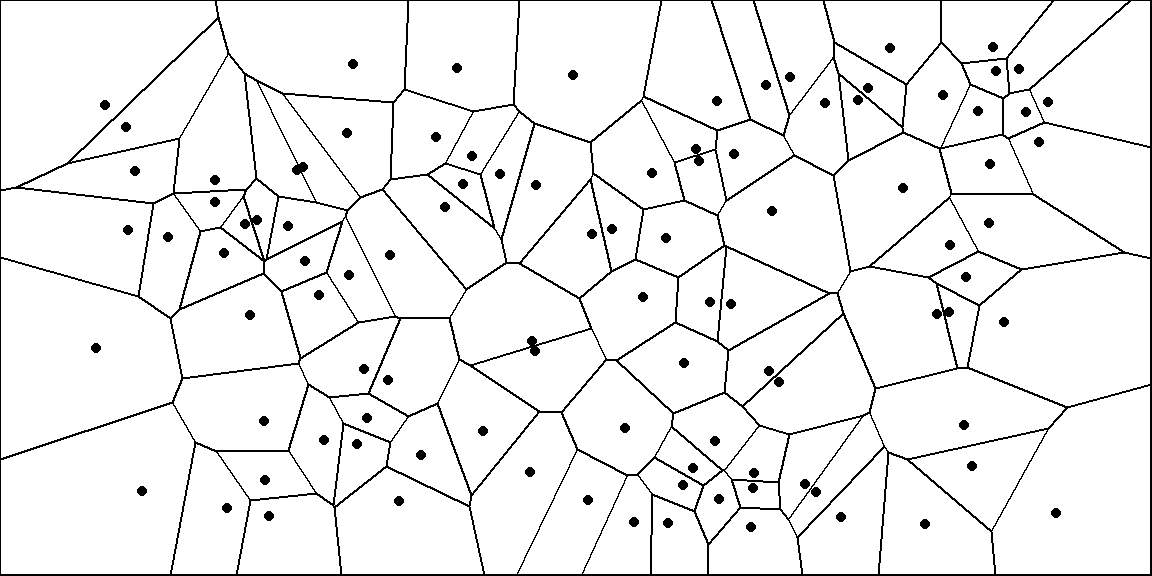
More precisely: a point is an equivalence class of microstates that are indistinguishable at your current resolution. Package them together, give them a label — now they’re “one place.” Not because they’re identical. Because your interface can’t tell the difference.
This is P5 in Six Birds Theory. Packaging. Indistinguishability made into an object.
The Six Birds Behind Distance
All six birds show up in the story of distance.
Six Birds Theory (Emergence Calculus)
P1 Rewrite — change the rule. P2 Gating — restrict what’s allowed. P3 Protocol Holonomy — hidden phase, route mismatch. P4 Sectors — invariants, staging, timescale separation. P5 Packaging — idempotent completion; fixed points are “objects.” P6 Accounting — audits/monotones; what can’t be faked by forgetting.
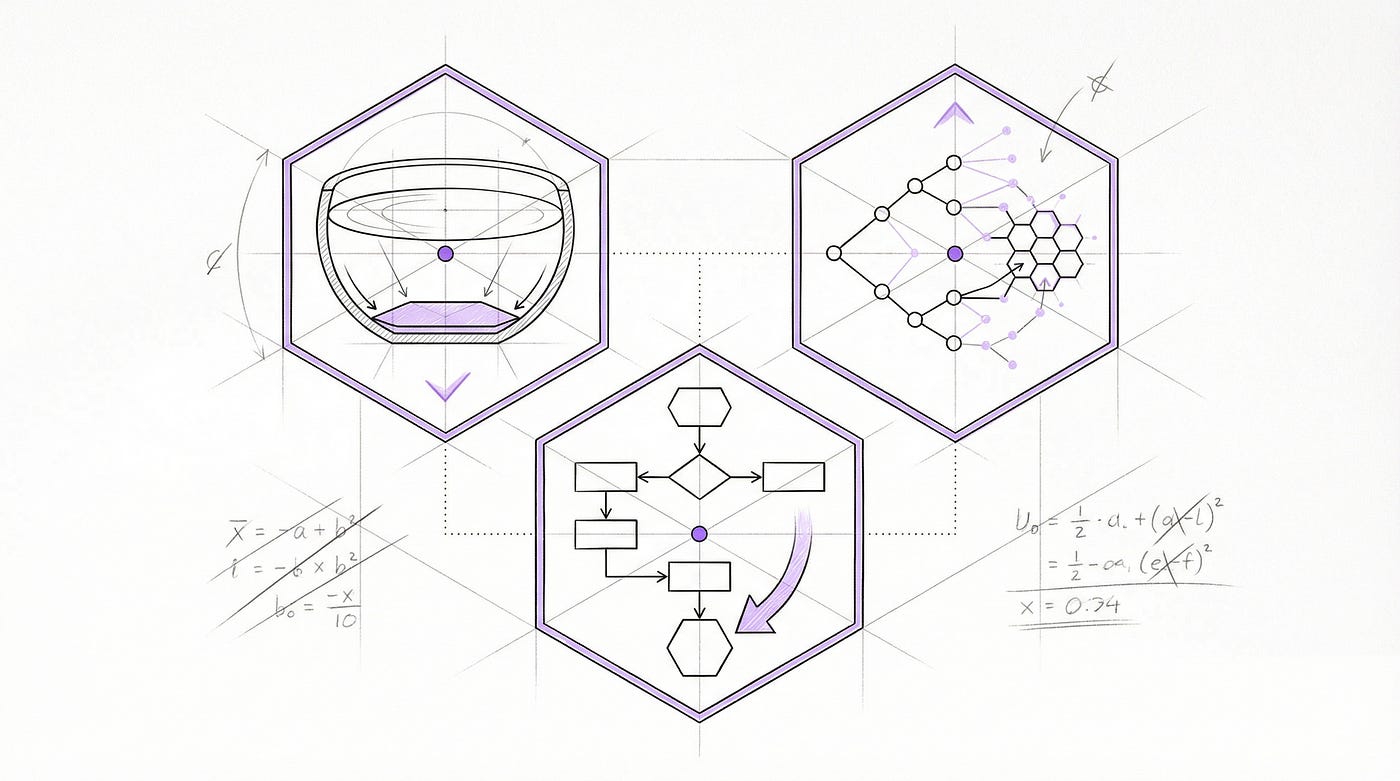
P5 makes points. P6 makes the cost ledger. P3 minimizes cost over protocols to produce distance. P2 decides which moves are even allowed. P4 keeps everything coherent across zoom levels. P1 closes the macro description so it doesn’t have to reopen micro detail every step.
Remove any one and the geometry collapses.
I once thought geometry was the foundation everything else sat on. It isn’t. It’s the most expensive output of the factory.
When Pythagoras Grows Up
Here’s the wildest part.
The Pythagorean theorem — a² + b² = c², the thing every student memorizes — isn’t fundamental. It’s emergent.
Define cost as negative log transition probability under isotropic staged diffusion — a lazy random walk, nothing exotic — and let the staging run long enough. Something happens. The cost surface becomes quadratic. Separable. Level contours become circles.
The Pythagorean residual — how far costs deviate from the quadratic identity — drops from 33.19 at τ = 4 down to 0.0586 at τ = 128.
That’s not a coincidence. That’s a goddamn accounting law asserting itself.
Euclidean distance isn’t fundamental — not in this framework. It falls out of the ledger when conditions are isotropic and flat. Switch to Manhattan costs — just |Δx| + |Δy| instead of −log likelihood — and you get diamond contours. Not circles. No Pythagoras. A different ledger producing a different geometry.
The ruler is not sacred. The ruler is a choice.
When Constraints Bend Space
Look, you’ve been assuming space is neutral. It isn’t. It never was.
Every constraint on what moves are feasible is a constraint on what geometry is possible.
P2 in Six Birds Theory is gating. Restrict feasibility in one direction — the induced metric stretches. Neighborhoods elongate. “Nearby” becomes anisotropic.
Testable. In a controlled experiment, suppressing motion in one direction on a grid substrate produces a macro geometry that is systematically skewed. The shape of distance changes because the shape of protocol feasibility changed.
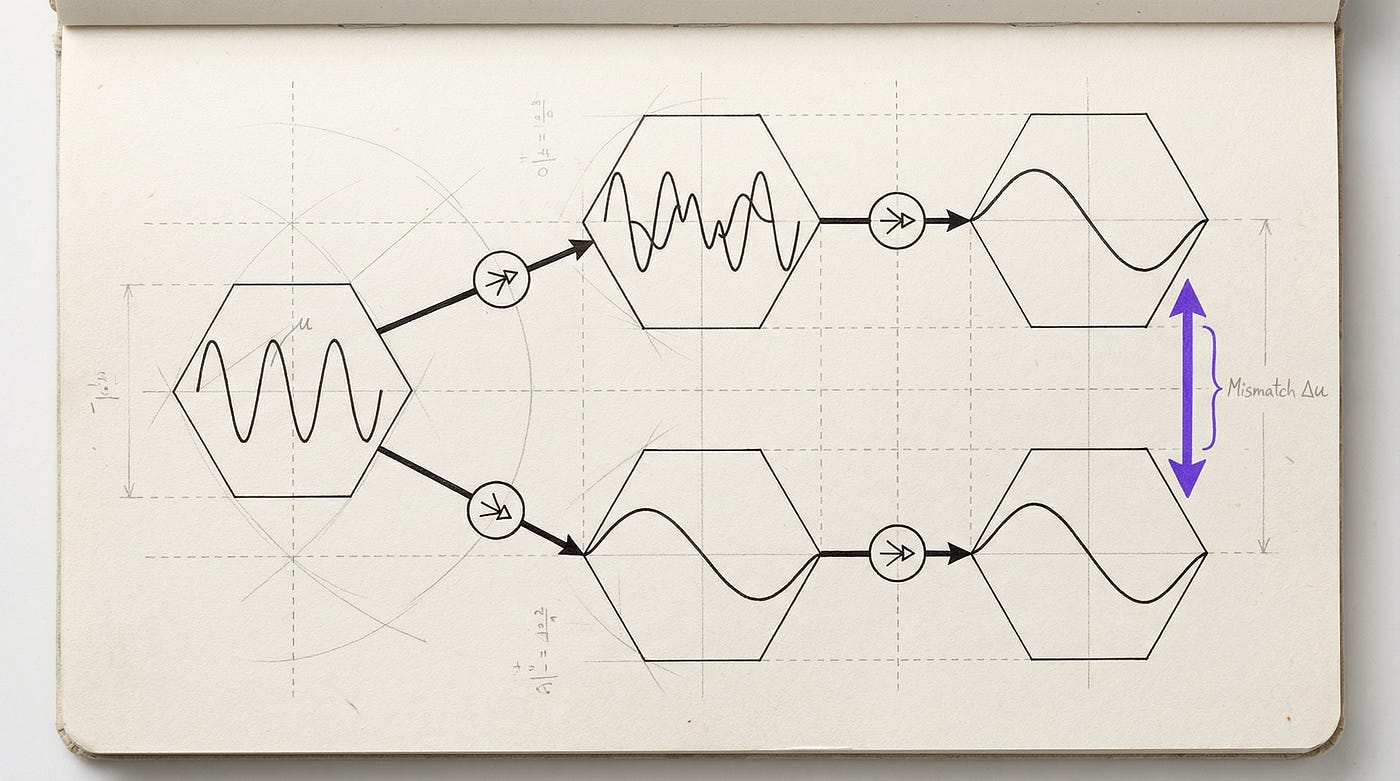
And curvature — the fact that space curves — is the same thing at a higher order. Go around a small loop and fail to come back aligned: that’s protocol noncommutativity surviving packaging. Order of moves matters. That’s P3: Protocol Holonomy.
A sphere-like substrate produces loop residues with median 0.5980. A flat grid: 0.0479. Curvature isn’t a shape drawn in space. It’s an accounting residue of composed protocols.
The Ledger Closes
Remember the cab from Syntagma to the airport?
Three notions of distance. All disagreed. The driver’s route through Kifisia — wrong geometrically, perhaps right in his ledger of time and fuel.
Distance isn’t one thing because the ledger isn’t one thing.
The ledger is whatever you call cost. Negative log likelihood. Minutes. Euros. Ledger varies, geometry varies with it.
Isotropic diffusion, enough staging: Euclidean geometry shows up. Pythagoras is the stable accounting law for flat, symmetric conditions.
Skewed ledger, curved surface: geometry bends.
The ruler is made of arithmetic. It just looks like geometry because arithmetic is cheap enough to be invisible.
메타데이터
- post_id
- 0a8cd71f9dec
- slug
- distance-is-expensive-0a8cd71f9dec
- url
- https://medium.com/@ioannis.tsiokos/distance-is-expensive-0a8cd71f9dec
- canonical_url
- https://medium.com/@ioannis.tsiokos/distance-is-expensive-0a8cd71f9dec
- author_url
- https://medium.com/@ioannis.tsiokos
- status
- ok
- fetched_at
- 2026-07-22 21:40:45