Krishna Janmashtami: Celebrating Divine Birth and Spiritual Teachings
Krishna Janmashtami, often referred to simply as Janmashtami, is one of the most revered festivals in Hinduism. It celebrates the birth of…
Krishna Janmashtami: Celebrating Divine Birth and Spiritual Teachings
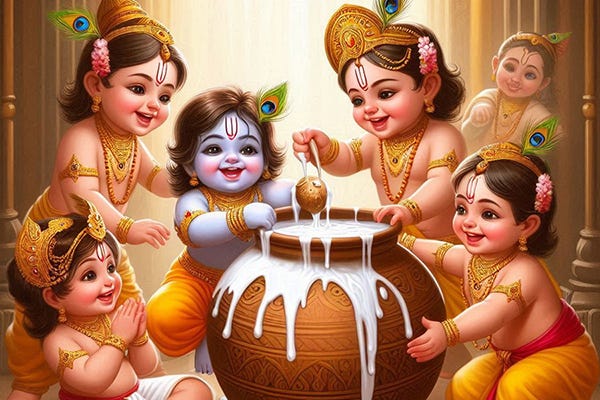
Krishna Janmashtami, often referred to simply as Janmashtami, is one of the most revered festivals in Hinduism. It celebrates the birth of Lord Krishna, the eighth incarnation of Lord Vishnu, who is believed to have been born over 5,000 years ago in the ancient city of Mathura. This joyous occasion falls on the eighth day of the dark fortnight in the month of Bhadrapada (August-September) according to the Hindu lunar calendar.
The significance of Krishna Janmashtami goes beyond merely celebrating the birth of a deity; it is a commemoration of the descent of divinity to Earth to vanquish evil forces and restore righteousness (dharma). Lord Krishna is celebrated for his divine wisdom, miraculous deeds, and his central role in the epic Mahabharata, where he delivered the Bhagavad Gita — one of Hinduism’s most profound philosophical texts.
On Krishna Janmashtami, devotees engage in fasting, singing devotional songs, reenacting scenes from Krishna’s life, and decorating their homes and temples with vibrant displays. The festival is observed with immense enthusiasm across India and around the world, transcending religious boundaries and reflecting its deep spiritual and cultural resonance.
Historical Background of Krishna Janmashtami
The story of Lord Krishna’s birth is filled with miraculous events and deep symbolism. Born to Devaki and Vasudeva in a prison cell in Mathura, Krishna’s life was destined for greatness from the very beginning. According to Hindu mythology, Krishna’s birth was prophesied to end the tyrannical rule of his uncle, King Kansa. Fearing the prophecy, Kansa imprisoned Devaki and Vasudeva and killed their first six children. However, the seventh child, Balarama, was miraculously transferred to another womb, and when Krishna was born, divine forces intervened to protect him.
On the night of Krishna’s birth, the prison doors opened, the guards fell into a deep sleep, and Vasudeva was able to carry the newborn across the Yamuna River to the safety of Gokul, where Krishna was raised by his foster parents, Nanda and Yashoda. These events are commemorated every year during Krishna Janmashtami, serving as a reminder of the divine protection and guidance that Krishna’s life symbolizes.
Krishna’s childhood is rich with tales of his mischievous and miraculous deeds, from lifting the Govardhan Hill to protect villagers from torrential rains to playfully stealing butter from his neighbors. These stories are not only entertaining but also imbued with spiritual teachings. During Krishna Janmashtami, these episodes are reenacted in plays and skits, making the festival a time of both celebration and reflection on the values Krishna’s life imparts.
Beyond his childhood, Krishna’s influence in Hinduism is profound. His role as Arjuna’s charioteer in the Mahabharata, where he delivers the Bhagavad Gita, remains central to Hindu philosophy. The Gita addresses ethical and moral dilemmas faced by humanity and offers a path to righteousness and liberation. Krishna Janmashtami thus becomes not only a celebration but also a time for spiritual introspection, drawing inspiration from Krishna’s timeless teachings.
Cultural and Religious Importance of Krishna Janmashtami
Krishna Janmashtami holds a special place in Hindu culture, not only because of the deity it celebrates but also because of the profound teachings and cultural values it embodies. Lord Krishna is seen as the embodiment of love, compassion, and righteousness (dharma). His life and teachings provide a comprehensive guide to leading a virtuous and fulfilling life.
In Hindu culture, Krishna is more than just a deity; he is a friend, philosopher, and guide. His playful and loving relationship with the Gopis (cowherd girls) of Vrindavan symbolizes the divine love between the soul and God. The Ras Lila, a traditional dance that reenacts Krishna’s playful interactions with the Gopis, is performed in many parts of India during Krishna Janmashtami, symbolizing the joy and devotion Krishna inspires.
The festival also highlights the concept of Bhakti, or devotion. Krishna’s life emphasizes the importance of surrendering to the divine will and living in harmony with one’s dharma. The teachings of the Bhagavad Gita, which are central to Krishna Janmashtami, promote selfless action, devotion, and the pursuit of knowledge — principles that have deeply influenced Indian culture and spirituality.
Krishna Janmashtami is also a celebration of the triumph of good over evil. The stories of Krishna’s victories over various demons represent the eternal struggle between righteousness and unrighteousness and the ultimate victory of the former. This message remains particularly relevant today, as the festival serves as a reminder of the timeless relevance of Krishna’s teachings.
The cultural impact of Krishna Janmashtami extends beyond religious rituals. It has inspired countless works of art, music, and literature in India and beyond. The festival is a time when traditional art forms, such as classical music and dance, come to the forefront, with performances dedicated to Krishna’s life and teachings. Joyous celebrations are accompanied by devotional songs (Bhajans), dances, and dramas that bring to life the stories of Krishna’s divine play (Leela).

Celebrations of Krishna Janmashtami Across India
Krishna Janmashtami is celebrated with great fervor across India, with each region adding its unique flavor to the festivities. In Mathura and Vrindavan, where Krishna is believed to have spent his early years, the celebrations are particularly grand. The entire region comes alive with vibrant processions, devotional singing, and reenactments of Krishna’s childhood. Temples are adorned with flowers and lights, and devotees gather to offer prayers and participate in rituals.
In Maharashtra, Krishna Janmashtami is famous for the Dahi Handi ceremony. This event, inspired by Krishna’s childhood pastime of stealing butter, involves young men forming human pyramids to break a pot filled with curd, suspended high above the ground. The Dahi Handi event has become a popular spectacle, attracting large crowds and promoting camaraderie and teamwork.
In Gujarat, particularly in Dwarka, where Krishna is believed to have ruled as a king, Janmashtami celebrations are marked by elaborate rituals and the recitation of scriptures. The Dwarkadhish Temple becomes the focal point, with midnight rituals and special prayers commemorating Krishna’s birth. Devotees gather in large numbers to witness these sacred events.
South India also celebrates Krishna Janmashtami with devotion and joy, though the rituals may vary. In Tamil Nadu, the festival is known as Gokulashtami and is observed with the drawing of small footprints from the entrance of the house to the puja room, symbolizing Krishna’s childhood walk. Special dishes like seedai and murukku are prepared and offered to the deity as part of the celebration.
In the eastern states of West Bengal, Odisha, and Assam, Janmashtami is observed with night-long vigils, fasting, and the reading of the Bhagavad Gita. ISKCON temples across these regions host elaborate celebrations with kirtans (devotional singing), dances, and discourses on Krishna’s teachings.
For more in-depth articles and insights on festivals and their significance, visit Newz-Insight.
Modern-Day Celebrations and Global Influence
Krishna Janmashtami has evolved from being a traditional religious festival to a global cultural event. With the spread of Hindu communities around the world, the festival is now celebrated in countries far beyond India, including the United States, the United Kingdom, Australia, and Canada. The International Society for Krishna Consciousness (ISKCON) has played a significant role in popularizing Krishna Janmashtami globally. ISKCON temples around the world host grand celebrations that include kirtans, plays depicting Krishna’s life, and sumptuous feasts.
In the contemporary world, Krishna Janmashtami also serves as an occasion to spread messages of peace, love, and harmony. Many communities use the festival to engage in charitable activities, such as feeding the poor, donating to orphanages, and organizing cultural programs that promote unity and understanding among different cultures and religions.
Krishna’s stories have also inspired numerous works of art, literature, and music across cultures. The festival has become an occasion for cultural exchange, where people from diverse backgrounds come together to celebrate the universal values of love and devotion that Krishna represents.

How to Celebrate Krishna Janmashtami at Home
Celebrating Krishna Janmashtami at home can be a deeply fulfilling experience, allowing devotees to connect with the divine in a personal and meaningful way. Preparations for the festival often begin days in advance, with devotees cleaning and decorating their homes and setting up an altar with a statue or picture of baby Krishna.
Fasting is an essential aspect of Janmashtami celebrations. Devotees observe fasts throughout the day, breaking them only after the midnight rituals that mark Krishna’s birth. The fast can range from complete abstinence from food and water to consuming only fruits and milk, depending on individual preferences.
The highlight of Janmashtami celebrations at home is the puja (worship). The rituals begin with bathing the idol of Krishna with a mixture known as Panchamrit, which includes milk, curd, ghee, honey, and sugar. After the bath, the idol is adorned with new clothes and ornaments, and the puja is performed with offerings of flowers, incense, and sweets. Devotional songs and bhajans are sung in praise of Krishna, and the chanting of mantras creates a spiritually charged atmosphere.
A special part of the celebration involves preparing and offering traditional dishes to Krishna, such as laddoos, kheer (rice pudding), and butter — Krishna’s favorite. These offerings are later distributed as prasad (sacred food) to family members and guests.
Decorating the home is another joyful aspect of Krishna Janmashtami. Devotees often create a small cradle or jhula for baby Krishna and adorn it with flowers and lights. Some families also draw small footprints of Krishna from the entrance of their home to the altar, symbolizing his arrival.
Conclusion: The Eternal Relevance of Krishna Janmashtami
Krishna Janmashtami is not just a festival; it is a time for spiritual reflection, cultural celebration, and communal harmony. The teachings of Lord Krishna, as encapsulated in the Bhagavad Gita, continue to inspire millions around the world, guiding them on the path of righteousness, devotion, and selfless action.
The enduring relevance of Krishna’s teachings lies in their universal appeal. In a world often divided by differences, Krishna’s message of love, compassion, and duty serves as a beacon of hope and unity. Krishna Janmashtami reminds us of the divine presence in our lives and encourages us to celebrate life with joy, love, and devotion.
As we celebrate Krishna Janmashtami, let us remember the timeless values that Krishna embodied and strive to live by them in our daily lives. Whether through fasting, prayer, or acts of kindness, this festival offers an opportunity to reconnect with our spiritual roots and celebrate the eternal bond between the divine and the human soul.
메타데이터
- post_id
- 0a8ef73a4bbd
- slug
- krishna-janmashtami-celebrating-divine-birth-and-spiritual-teachingskrishna-janmashtami-0a8ef73a4bbd
- url
- https://medium.com/@newz-insight/krishna-janmashtami-celebrating-divine-birth-and-spiritual-teachingskrishna-janmashtami-0a8ef73a4bbd
- canonical_url
- https://medium.com/@newz-insight/krishna-janmashtami-celebrating-divine-birth-and-spiritual-teachingskrishna-janmashtami-0a8ef73a4bbd
- author_url
- https://medium.com/@newz-insight
- status
- ok
- fetched_at
- 2026-07-23 00:21:48