The Struggle to Not Strike Out
I did everything possible to become a better hitter
PLAYING FOR THE BAD NEWS BEARS OF THE SOUTH
The Struggle to Not Strike Out
I did everything possible to become a better hitter
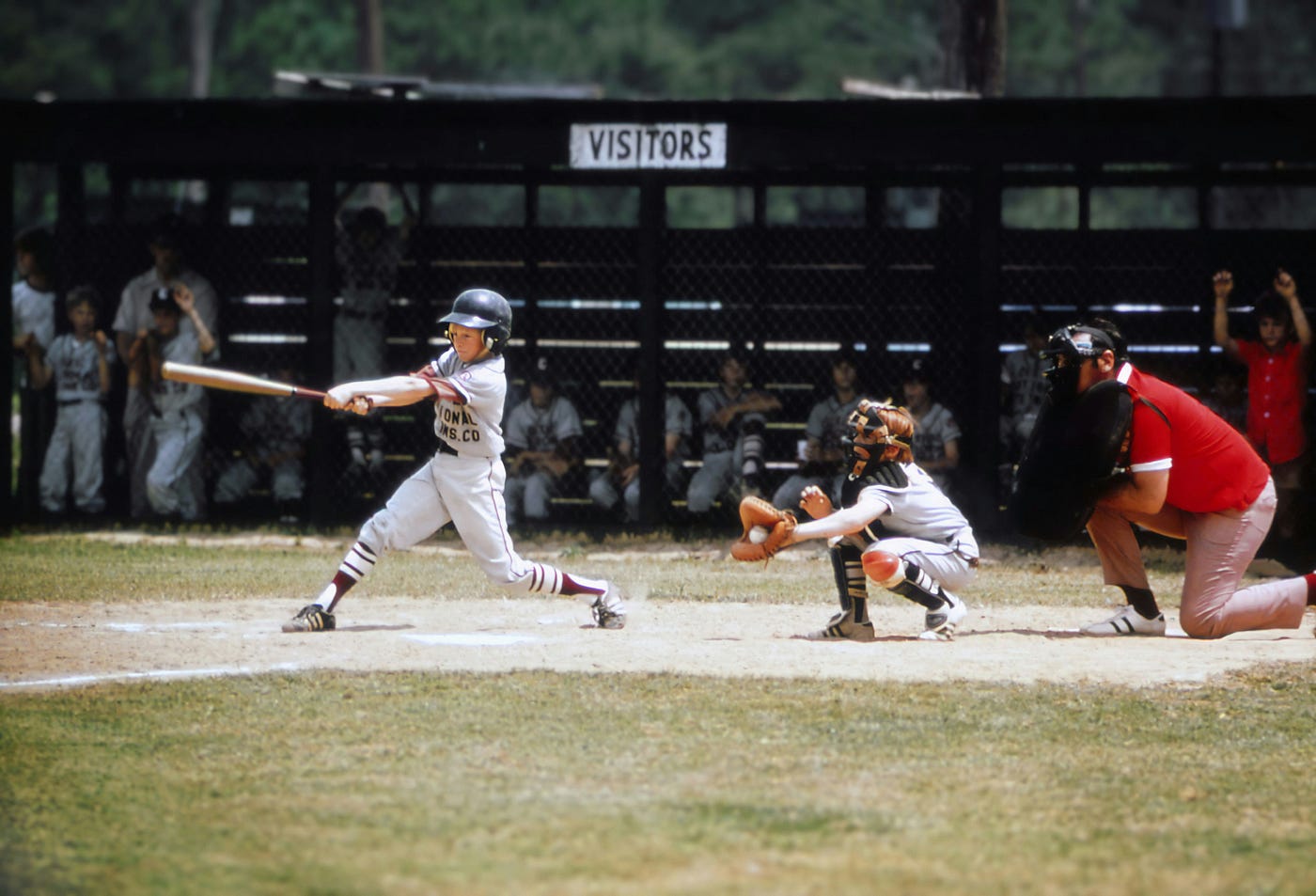
Photo by Documerica of Unsplash.
Somehow, my 11-year-old self had managed to work the count full against the husky 12-year-old pitcher, who looked more like a refrigerator in cleats, a grizzly bear at a petting zoo. Fridge McGrizzly had two types of pitches: fast and super fast.
My Little League Yankee team was trailing the Pirates 3–2 in the fourth inning with two outs.
I had to get a hit. Just had to.
But I was scared to death. Terrified. My heart was pounding like a basketball being dribbled on a court.
This was my chance. My big chance to be the hero.
McGrizzly nodded slowly at the catcher, agreeing with his pitch selection— like he would even consider throwing in anything but a fiery fastball right down the middle with extra mustard.
He went into his wind-up, kicking his left leg up high, almost to his chin, raising both his glove and the ball above his head, while finally uncorking the white rock out from his right hand like a slingshot.
I pulled my head badly, swung my bat aimlessly like a spaghetti noodle, praying that by some miracle of God, I would make contact with the white blur. The ball was smack dab down the middle and made a POP! like the sound of a firecracker as it met the catcher’s leather glove, the sound echoing throughout the diamond.
As if it wasn’t embarrassing enough what had just occurred at the Murray, Kentucky’s Central Park, the umpire punched the air and barked out, “Strike three! Yer out!”
Then it was time for the dejected walk of shame journey back to the dugout. The coach offered me encouraging words, “Good try, kid”, while one teammate said, “Next time, Mike,” and another patted me on the shoulder.
No one else said a word. They didn’t need to. I already knew I had let the whole team down. Again.
It was May of 1978, the defending world champion New York Yankees and Reggie Jackson were trying to catch the hot-starting Boston Red Sox. Pete Rose had just collected his 3,000th hit, and Nolan Ryan was striking out batters at a historic rate.
Meanwhile, my family has just moved from Fredonia, New York, to Murray. I was not happy. I loved Fredonia, just 50 miles southwest of Buffalo. The cobblestone roads rattling under our car, routine bike rides to GC Murphy’s for Clark bars, Atomic Fireballs, and Bottle Caps. And baseball. Sandlot baseball all day long until the dinner bell rang.
Now, I had to start over in a new town, make new friends in a new, confusing part of the country where everyone says “ya’ll” ate biscuits and gravy, and drink sweet tea like water.
Culture shock?
I reckon so, ya’ll.
It was like I was in a whole different country. In Kentucky in 1978, nobody just said things. Instead, they stretched them out like the summer heat. Coaches would remark, “That kid can flat out hit.” Umpires would shout, “I call ’em like I see ‘em.” Parents warned their kids, “Ya’ll be careful, you hear.”
But adapting to the language and accent was the least of my worries. My dad had contacted the local Little League, signed my brother Scot and me up, even though it was midway through the season. Scot adapted well to the Farm League Twins, taking over as the starting third baseman.
It was an entirely different tale for yours truly.
I was joining the 11- and 12-year-old Little League Yankees. A team that was a combination of talent like the real Yankees and the Bad News Bears. Sure, their record was a shiny 7–0, but after the first practice, I saw all the tarnish.
“Fuck you!” I heard a mouthy freckled player tell another. One sensitive kid started crying when he struck out. A red-headed kid with a limp was walking in circles mumbling to himself because he dropped a ball. Meanwhile, the shortstop and centerfield were cracking jokes and making fun of some of the younger players.
How the hell was I going to fit in with this group of untamed animals?
And, to top it all off, the coach was actually a local pastor. He had lots of patience. Delivered a handful of sermons, er, talks, and even some fire and brimstone ones as he’d on occasion turn red-faced and be forced to raise his voice.
For all his passion, little of it seemed to trickle into our heads.
After my first three games and three strikeouts, my role on the team was obvious. Minimal. I wasn’t a problem. I just wasn’t a solution. I’d be stuck in right field and bat once as my teammates hoped I’d either walk or get hit with a pitch… and not strike out.
I loved baseball. Collected baseball cards, buying them every chance I got. Raced out to the driveway every morning to grab the Louisville Courier-Journal sports section and burned through the stat page to see the batting averages of my favorite players: Pete Rose, Johnny Bench, Thurman Munson, and John Mayberry.
But this Bad News Yankees experience was squelching my joy of baseball.
I told my dad I wanted to get better at hitting, but I don’t think he realized how important it was to me. He was cutting articles out of the New York Times, stopped, looked over, and commented, “Just keep practicing. It’ll come. How about we go to the batting cages this weekend?”
“Sure,” I said, but I didn’t feel he had truly heard me.
So, I tried talking to my English-teaching mom.
“I want to get better at hitting,” I said.
“Oh, you need to talk to your dad.”
“I did. He was busy, but did say he would take me to the batting cages. Do you think you could take me to the bookstore to see if there are any books on hitting?”
It was practically hollering my name as I sauntered over to the sports section in the local bookstore.
Pete Rose’s Winning Baseball
I couldn’t buy it or read it fast enough. I devoured it in one night.
The key takeaways that stuck with me were:
- “See the ball, hit the ball.”
- “Every time I step in the box, I expect to hit.”
- “You’d be surprised how much hustle makes up for talent.”
Exactly, zero of these things I was currently doing. And that was about to change. Now. I grabbed a Sharpie and scribbled “PR” for Pete Rose on the bill of my Little League hat, my glove, and my cleats.
I even asked the coach for extra tips. He didn’t hold back.
“Well, I think you are scared of the ball. You pull your head, and your front foot always steps out toward third base. Keep your head down and step toward the mound.”
Easier said than done.
If he even plunked me with a pitch. He said, “Sorry about that,” but I could tell he was teaching me that being hit wouldn’t hurt.
I practiced hard as if I were part of the Cincinnati Reds’ Big Red Machine. “Hustle on every play” became my new mantra. Before every inning, I’d race out to right field like I was running in an Olympic track meet.
Progress was, well, slow.
I’m going to get a hit. I’m going to get a hit. I kept hammering home every time I stepped to the plate.
Two more games. Two more strikeouts. Then a breakthrough. Contact. A foul ball.
Sadly caught by the first baseman.
It was playoff time, and we were facing the familiar Pirates with Fridge McGrizzly on the bump. With three players absent, I had to start in right field. For the whole game.
I came up to bat in the second inning in a 0–0 game. talking the same confident words, but meaning it. Luckily, McGrizzly was off. His first two pitches were both high and outside. I took a chance he’d miss again, and he did. Another bad pitch and I had walked — but it felt like a hit.
I came around to score a few batters later as we leaped to a 3–0 lead.
In the fourth inning, I came up again. The score was again tied at 3–3. McGrizzly looked tired and frustrated.
I looked over at our coach.
He can’t be serious!
He was giving me the bunt sign. A sign of true confidence, I thought. McGrizzly went into his wind-up, and I squared up, heard the ping off my aluminum bat, and busted out of the box, helmet bouncing as if the rest of my life depended on it.
“Safe!” is all I heard as the umpire gave his verdict.
I looked down at the tiny “PR” on my cleats, high-fived the first-base coach, and let out a long breath of relief, smiling the most All-Star, season-satisfying smile of all time. Later, I came around to score, and every teammate greeted me with congratulations on “a helluva great bunt.”
But the joy didn’t last for long. And up I came for the third time. This time, it was the very last inning and we were trailing 5–4. Runners on second and third.
I’m going to get a hit, I told myself
McGrizzly was still out there, but wasn’t throwing his normal gas. He was exhausted and nowhere near his regular All-Star self.
This was my chance.
He wound up. See the ball, I told myself. I made sure my head was looking right at the mound, and refused to step outward but forward. The pitch came. It wasn’t fast. I could see it as it appeared the size of a softball. I swung with every fiber in my body and bashed it right down the right-field line. The first baseman dove, but missed. I raced to first. “Go, go, go… to second!” yelled the first-base coach. I flew like only Pete Rose could to second base, even sliding — alas not head first — despite not needing to.
The crowd roared. I pumped my right first towards the heavens. I had done it. It was my Rocky moment, and I was flying high now.
Our team has won!
I had the walk-off game-winning hit.
More high fives, more bops on my batting helmets, more pats on the shoulder. I was mobbed at second base and doused with a half dozen water bottles.
“Damn, kid,” our All-Star shortstop said, as he slapped me on the back with gusto. “I guess you ate your Wheaties. Way to come in the clutch! A true Reggie Jackson-like hit.”
“No, Pete Rose!” I corrected him.
“What a big hit, son,” the Bible-thumping coach said. “I had a good feeling about you today. I really noticed your all-around hustle, great attitude, and brimming confidence.”
Unfortunately, the win was short-lived. Two nights later, we lost to the underdog A’s in the championship 7–2. Our team completely fell apart. The Bad News Bears reared their ugly presence, arguing, pouting, crying, and exhibiting horrible sportsmanship.
Despite hustling on every play and between innings, I struck out swinging, but did ground out back to the pitcher.
It was frustrating, but seeing my teammates show their Bad News Bears’ colors made me strongly believe that our team did not deserve to win. Pete Rose would never have played the game or acted like that.
Years later, I found myself as a Little League coach with plenty of players notorious for pulling their heads and stepping out of the box. Scared of being hit by the ball. I gave all sorts of advice and tried tricks to correct these mistakes. One of our assistant coaches even lay on his stomach by the batter, held his ankles, and manually moved his feet in the right direction.
It worked as much as to be expected. Not much.
No, what helped the most was something I discovered years after my Little League days: the importance of loading the bat before swinging. The simple concept of pulling your bat back and lifting your front foot as the pitcher winds up to get an important head start on the pitch.
Simple, but never taught to me. Not even by Pete Rose.
To me, it’s the secret sauce of hitting.
Maybe if I had known to load back in 1978, I would have had a highlight reel of great hits.
Blasts off the outfield wall.
Even home runs.
Oh well, the beautiful bunt and barely fair double felt like more than a home run.
They were my grand slam Hall-of-Fame moments during a mostly forgettable, awful season with Murray’s version of the almost-champion Bad News Bears.
Thanks for reading my story.
메타데이터
- post_id
- 0adbe30199f9
- slug
- the-struggle-to-not-strike-out-0adbe30199f9
- url
- https://medium.com/beyond-the-scoreboard/the-struggle-to-not-strike-out-0adbe30199f9
- canonical_url
- https://medium.com/beyond-the-scoreboard/the-struggle-to-not-strike-out-0adbe30199f9
- author_url
- https://medium.com/@mlbutler_38162
- status
- ok
- fetched_at
- 2026-07-08 20:12:56