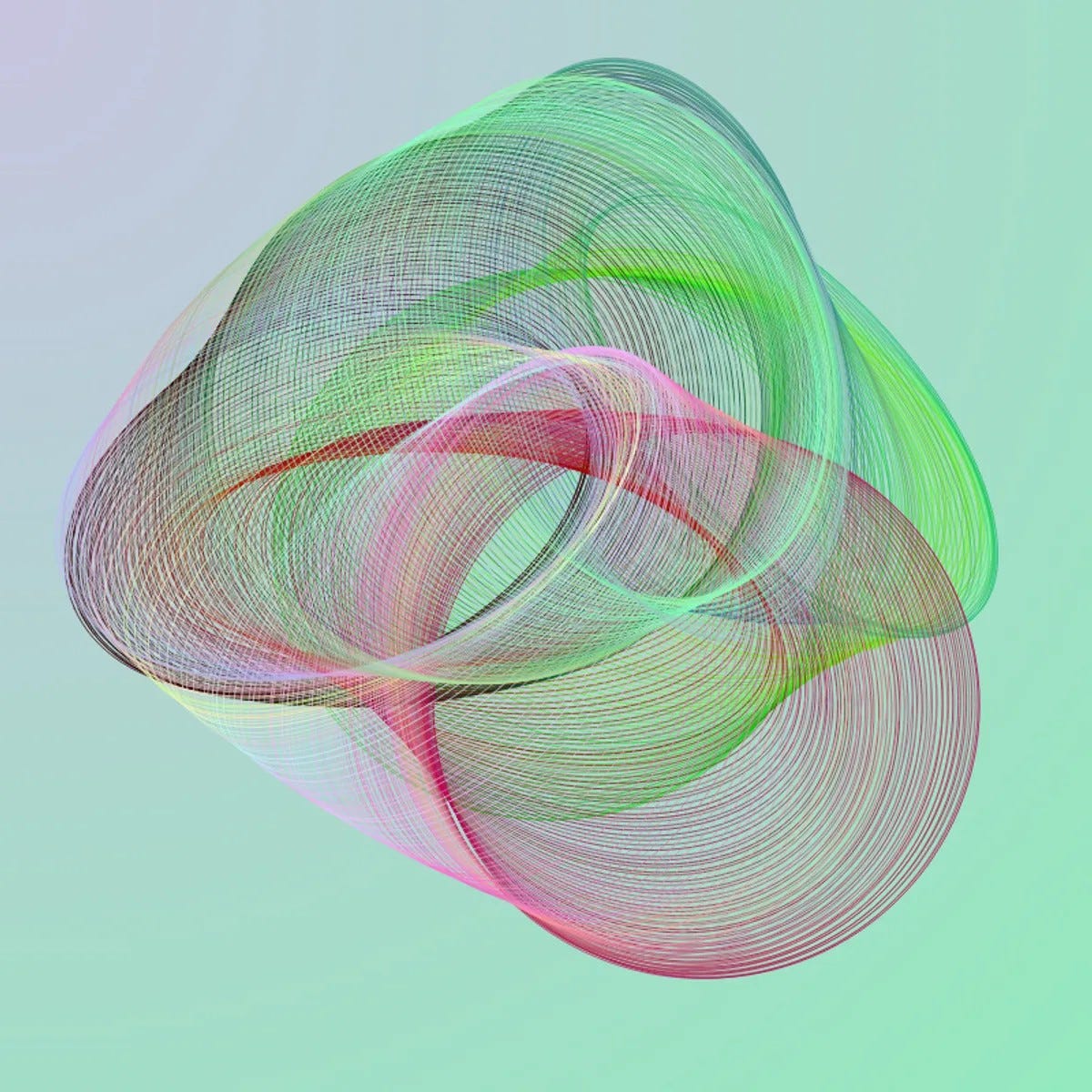
ChaotiColor: Cellular Automata as Chromatic Field and Computational Composition
Source code: https://github.com/reyrove/Generative-Art-on-fxhash/tree/master/chaotiColor
ChaotiColor: Cellular Automata as Chromatic Field and Computational Composition

ChaotiColor (2026). Two-dimensional visualization of evolving binary automata translated into parametric color systems, exploring emergent pattern formation under deterministic pseudo-random constraints.
Source code: https://github.com/reyrove/Generative-Art-on-fxhash/tree/master/chaotiColor
Project link: https://www.fxhash.xyz/project/chaoticolor
Introduction
ChaotiColor is a generative system that translates cellular automata dynamics into chromatic spatial fields. Rather than treating cellular automata as purely mathematical simulations, this project frames them as compositional engines for visual structure, transforming binary state evolution into large-scale pictorial surfaces.
Each output is deterministically generated from a cryptographic hash seed, producing a unique instantiation of rule-based emergence within a constrained algorithmic system. The work situates itself within the lineage of computational art, generative abstraction, and algorithmic formalism.
Conceptual Framework: Chaos as Aesthetic Structure
Cellular automata have historically functioned as models for emergent complexity, from John von Neumann’s self-replicating systems to Stephen Wolfram’s classification of computational universality. In ChaotiColor, the automaton is repurposed as a painterly mechanism: binary states become chromatic events, and iterative evolution becomes compositional rhythm.
Chaos here is not randomness but structured unpredictability — a deterministic system producing visually irreducible complexity. The grid functions as a field, while evolving states act as algorithmic brushstrokes.
Algorithmic Architecture
1. Binary Cellular Automaton Core
The system initializes a one-dimensional binary vector and evolves it through a rule set defined by local neighborhood states:
- Each cell’s next state depends on its left neighbor, itself, and its right neighbor.
- A randomly generated ruleset of length eight defines the automaton’s behavior.
This places the work within the tradition of elementary cellular automata, but extends it spatially by stacking iterations vertically, producing a two-dimensional matrix of evolving states.
2. Spatial Discretization
The canvas is subdivided into a dense grid defined by two parameters:
widthdivisionheightdivision
These parameters are randomly sampled per hash, resulting in variable resolutions ranging from coarse mosaics to microcellular textures. The number of rectangles becomes a recorded feature, emphasizing the computational ontology of the work.
3. Chromatic Systems
Color functions as the primary aesthetic vector. Three modes are stochastically selected:
- Binary Black vs. Curated Palette
- Inverse Palette Logic (Color for 1, Black for 0)
- Fully Random RGB Spectra
Curated palettes reference synthetic neon, cyberpunk chroma, and post-digital gradients, while random RGB introduces computational noise as chromatic entropy. This oscillation between curated and chaotic color systems reflects a tension between control and emergence.
Generative Composition as Computational Painting
Unlike traditional generative patterns that mimic natural forms, ChaotiColor embraces abstraction and machinic structure. The grid is explicit; the algorithm is visible. The visual field is not an illusionistic space but a computational surface, recalling modernist abstraction, Op Art, and post-internet aesthetics.
The automaton becomes a compositional agent, producing:
- Striations
- Fractal-like motifs
- Symmetry breaks
- Emergent banding structures
These phenomena arise without explicit design, highlighting the autonomy of algorithmic systems as co-authors.
Determinism, Hash, and Uniqueness
Each output is deterministically derived from the fxhash seed. This situates ChaotiColor within blockchain-based generative art, where uniqueness is not curated but cryptographically enforced.
The hash becomes a latent score, and the algorithm becomes an interpreter, aligning the work with procedural music, algorithmic architecture, and computational choreography.
Theoretical Positioning
ChaotiColor intersects multiple discourses:
- Generative Art: Algorithmic autonomy and emergent form
- Computational Aesthetics: Formal systems producing aesthetic phenomena
- Post-Digital Abstraction: Visible computation as aesthetic content
- Complex Systems Art: Chaos and self-organization as artistic media
By mapping cellular automata to color fields, the work proposes computation not merely as a tool, but as an ontological substrate for contemporary visual culture.
Conclusion
ChaotiColor transforms a classical computational model into a generative painterly system. It treats chaos as composition, grids as fields, and binary states as chromatic matter. The project demonstrates how deterministic algorithms can produce visually irreducible complexity, positioning computational processes as legitimate aesthetic agents.
In doing so, it contributes to the ongoing discourse on machine-generated abstraction and the aesthetics of algorithmic systems in the post-digital era.
메타데이터
- post_id
- 0aec6cb37364
- slug
- chaoticolor-cellular-automata-as-chromatic-field-and-computational-composition-0aec6cb37364
- url
- https://medium.com/@reyhanehdaneshdoost/chaoticolor-cellular-automata-as-chromatic-field-and-computational-composition-0aec6cb37364
- canonical_url
- https://medium.com/@reyhanehdaneshdoost/chaoticolor-cellular-automata-as-chromatic-field-and-computational-composition-0aec6cb37364
- author_url
- https://medium.com/@reyhanehdaneshdoost
- status
- ok
- fetched_at
- 2026-06-09 15:37:30