How AI Exacerbates Inequalities
The further we go, the more I feel it coming: AI exacerbates inequalities.
How AI Exacerbates Inequalities
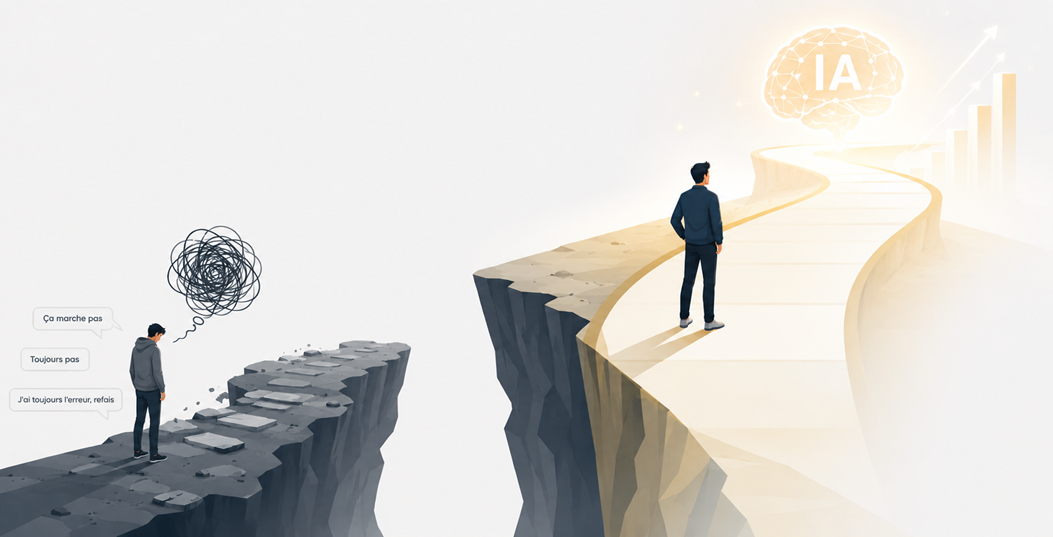
The further we go, the more I feel it coming: AI exacerbates inequalities.
Without claiming to deliver an exhaustive scientific study, I want to articulate a reasoning and put words to a trend that seems inevitable to me: AI will act as a multiplier for structured profiles, professionals equipped with good organization, technical rigor, and a solid working method. Meanwhile, for profiles that are more passive, less organized, and less inclined to use technology, an enormous gap is going to widen.
I felt this while “vibecoding” nutrisnap. To work with AI, you must have an overview. I had the idea, the roadmap, and the guidelines; all I lacked was time.
As a result, I completed an AI-boosted calorie counter in 5 hours, whereas it would have taken me dozens to implement the application alone. AI acted as a skill multiplier, which mechanically increased productivity: initial advantages compound.
And this is what is super interesting (or terrible?): AI compresses time. We can do much more in a short time, which allows us to absorb massive volumes of work. On the other hand, this will require making many micro-decisions in a very short time frame, whereas before, we reasoned at length and gave ourselves time to do things.
Beyond this temporal aspect, to be effective with AI, genuine problem-decomposition and orchestration skills will be necessary. You must be able to break down a complex project into subtasks to conduct recurring reviews of what the AI produces.
Better yet, with a pre-existing foundation of skills, we instantly audit and validate the answers, spot blind spots, etc.
In reality, the nature of our professions is changing. We are shifting from an executor stance to that of an art director or editor-in-chief of our own production. It is this shift that leaves behind those who never learned to have a critical mind about their work. When you outsource thinking before even knowing how to think for yourself, that is when the loss of control occurs.
If AI allows a novice to create an illusion at the start by generating an initial result, the trap closes very quickly for non-methodical profiles: the lack of digital hygiene or method rapidly turns AI into a generator of technical/intellectual debt.
I have experienced this myself and found a very telling term, visible anecdotally in some online searches: doom-prompting. Faced with an erroneous result, the user locks themselves into a loop of identical queries leading to the same problem every time, without the ability to modify the prompt or tackle the subject from another angle.
“It doesn’t work”
“Still not working”
“I still have the error, do it again”
Even more unhealthily, AI will provide an illusion of competence and create dependency on generated results. The user will have the impression of building something robust and reliable while building a tool outside of standard best practices.
And this is where AI works exactly like financial capital: it generates compound interest for those who already have the right foundations, while violently widening the gap with others. It is a terrible machine for exacerbating inequalities…
Tomorrow, the real divide will no longer be digital: it will be cognitive.
메타데이터
- post_id
- 0b3fc497554c
- slug
- comment-lia-exacerbe-les-inégalités-0b3fc497554c
- url
- https://medium.com/@dorian.naaji/comment-lia-exacerbe-les-in%C3%A9galit%C3%A9s-0b3fc497554c
- canonical_url
- https://medium.com/@dorian.naaji/comment-lia-exacerbe-les-in%C3%A9galit%C3%A9s-0b3fc497554c
- author_url
- https://medium.com/@dorian.naaji
- status
- ok
- fetched_at
- 2026-06-22 19:40:15