EU Machinery Regulation 2027: What Manufacturers Still Underestimate
The EU Machinery Regulation, Regulation (EU) 2023/1230, becomes applicable on 20 January 2027. That date is already widely quoted. What is…
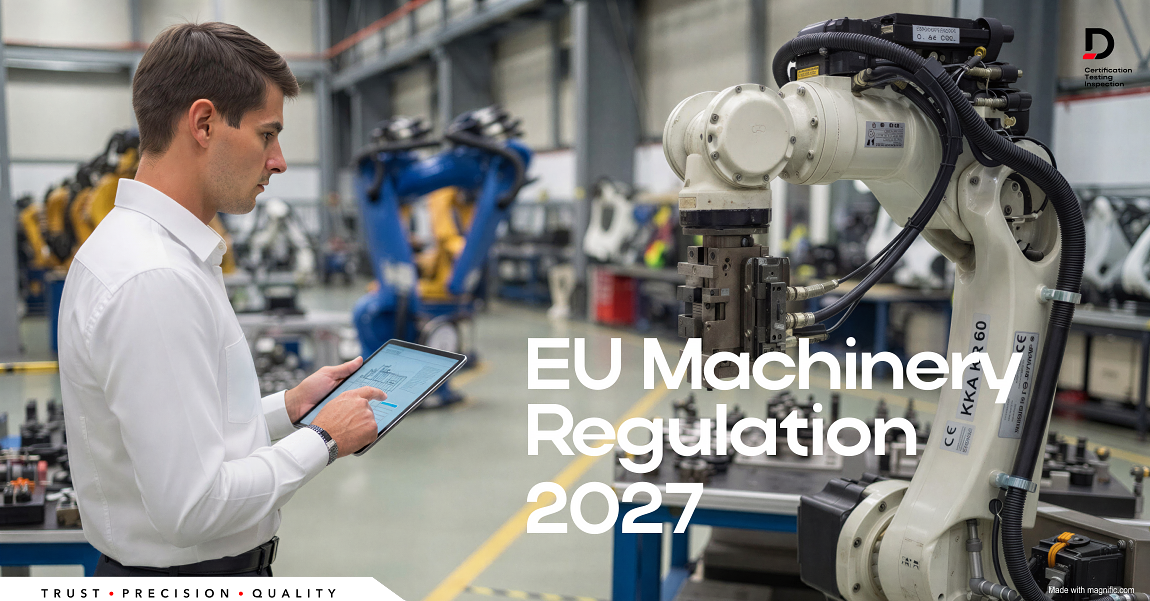
Machinery Regulation 2027: what to expect
EU Machinery Regulation 2027: What Manufacturers Still Underestimate
The EU Machinery Regulation, Regulation (EU) 2023/1230, becomes applicable on 20 January 2027. That date is already widely quoted. What is less widely understood is where the real workload sits.
For many manufacturers, the challenge is not the headline change from Directive to Regulation. The challenge is that the new framework reaches further into software, connectivity, safety logic, technical documentation and post-market modification decisions than many teams expect.
That is why the companies that prepare early usually avoid the most expensive surprises later.
The deadline is clear, but the transition is often oversimplified
The Machinery Regulation was published in June 2023 and becomes generally applicable on 20 January 2027. Until 19 January 2027, machinery placed on the EU market must still comply with Machinery Directive 2006/42/EC.
However, this is not a reason to postpone preparation. Some provisions have already applied earlier, including those related to notified bodies. In practice, the market has already started adjusting.
This matters because many internal projects still treat 2027 as a documentation deadline. It is not. It is a design, process and decision-making deadline.
The real shift is digital safety, not just legal wording
A large part of the new Regulation remains familiar. But the important changes are concentrated in areas that many machinery businesses still manage separately: software, connectivity, industrial cybersecurity and AI-related safety functions.
The Regulation addresses machinery safety in a more digital environment. That includes protection of safety-relevant software and data, the impact of connected devices, and safety functions influenced by machine learning approaches.
In other words, compliance is no longer only about guarding, mechanics and the traditional technical file. It increasingly depends on whether the machine’s safety logic remains safe when software, interfaces or connected components change.
“Substantial modification” is one of the biggest hidden risks
This is one of the most commercially important changes.
If a machine is modified after being placed on the market or put into service, and that modification creates a new hazard or increases an existing risk, the party making that substantial modification may take on manufacturer obligations.
That is highly relevant for: retrofit projects, automation upgrades, control system modernisation, remote access additions, software updates that affect safety functions, line integrations and machine rebuilds.
Many companies still speak about upgrades as if they were maintenance. Under the new Machinery Regulation, that assumption can become dangerous.
Digital documents help, but they also create process obligations
The Regulation allows instructions and certain declarations to be provided in digital form. That sounds simple and efficient, and in many cases it will be.
But from an operational standpoint, digital documentation creates new questions:
- How is the latest version controlled?
- How does the user access it? Is it printable?
- Can a paper version be supplied when requested?
- Who owns the update process across engineering, technical writing and after-sales?
So digital documentation is not just a formatting choice. It is a controlled compliance process.
Conformity strategy may need to be revisited earlier than expected
Manufacturers should not assume that their current conformity path will remain frictionless under the new Regulation.
For some machinery and related products, especially those in Annex I, the conformity assessment route becomes more strategic. The availability and scope of harmonised standards will matter. For certain higher-risk categories, notified body involvement remains central.
This is why late-stage compliance reviews are risky. If design assumptions, software architecture or supplier documentation are weak, the problem often appears too late, when redesign is already expensive.
What manufacturers should do now
The best starting point is not a generic awareness session. It is a structured gap review.
That review should cover: product scope and classification, Annex I implications, safety-related software and control logic, cybersecurity interfaces relevant to safety, documentation format and control, modification scenarios for installed machinery, and the intended conformity route.
The companies that move early are usually not doing more bureaucracy. They are reducing rework.
By 2027, the Machinery Regulation will not only test whether a product can be CE marked. It will test whether the manufacturer has treated machinery safety as a system issue across engineering, software, documentation and lifecycle change.
That is where the real preparation work begins.
메타데이터
- post_id
- 0b44cd3237bf
- slug
- eu-machinery-regulation-2027-what-manufacturers-still-underestimate-0b44cd3237bf
- url
- https://medium.com/@danet_test_certificate/eu-machinery-regulation-2027-what-manufacturers-still-underestimate-0b44cd3237bf
- canonical_url
- https://medium.com/@danet_test_certificate/eu-machinery-regulation-2027-what-manufacturers-still-underestimate-0b44cd3237bf
- author_url
- https://medium.com/@danet_test_certificate
- status
- ok
- fetched_at
- 2026-07-09 06:53:08