This Part of Voxtral TTS is Important than Anything | Must For Builders
Hoping nobody asks about vendor lock-in? Open Voice Agent has meant stitching Whisper to a closed TTS — Absolutely NOT
This Part of Voxtral TTS is Important than Anything | Must For Builders
Hoping nobody asks about vendor lock-in? Open Voice Agent has meant stitching Whisper to a closed TTS — Absolutely NOT

Mistral just dropped the piece the open-weight voice world had been missing a frontier-quality TTS with the weights sitting on Hugging Face, next to a codec that’s arguably the more interesting artifact. In a technical session on April 2, the team wired Voxtral Mini Transcribe Realtime, Mistral Large, and Voxtral TTS into a single real-time translation pipeline. Microphone in, translated speech out, not a single audio frame leaving the box.
If you’ve been building voice agents against vendor APIs for the last eighteen months, this is the moment where your architecture discussion changes. Not because the benchmark numbers are shocking they’re good, not unbelievable but because for the first time the whole pipeline, including the tokenizer, is open. That’s the actual unlock. Even, some people on the platform X talks like this is replacing whisper.
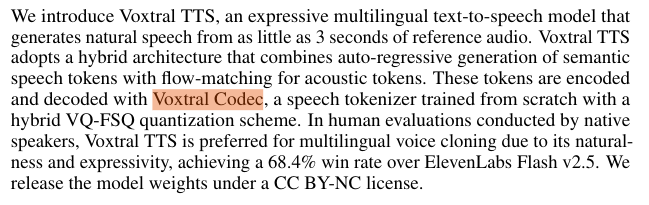
Fig 2. A Snap of Highligh from Voxtral Paper
I will walk through the stack. We’ll go deeper than it beats ElevenLabs into the Whisper-descended encoder, the Voxtral Codec tokenizer, the VQ/FSQ split that makes 3-second voice cloning work, and the hybrid autoregressive + flow-matching decode. Then we’ll wire it together in about ten lines of Python and have an honest conversation about latency.
The Voxtral Family, One Schematic
Voxtral is three models that share a spine. It’s worth pinning the shape of it before we go deeper into any single piece.
- Voxtral STT (Voxtral-Mini-3B-2507 and the 4B realtime variant): a Whisper-large-v3-based audio encoder, an MLP adapter, and a Ministral 3B or Mistral Small 3.1 24B decoder. Takes audio in, produces text (or instruction-following responses) out.
- Mistral Large (or Ministral, or any Mistral family LLM): the reasoning/translation/planning piece. Purely text-to-text.
- Voxtral TTS (Voxtral-4B-TTS-2603): a Ministral 3B decoder backbone that autoregresses speech tokens, plus a lightweight flow-matching head that predicts acoustic tokens, all running through the new Voxtral Codec at 12.5 Hz.

That 12.5 Hz frame rate shows up on both the STT and TTS sides. It’s not an accident. It’s the shared latency-versus-quality contract that makes the family consistent a frame every 80 milliseconds, however you’re using it.
Inside Voxtral STT: A Whisper Encoder with a Smarter Adapter
The STT encoder is Whisper large-v3. Raw audio gets mapped to a log-Mel spectrogram with 128 mel bins and a hop length of 160 samples, then shoved through a convolutional stem that halves the temporal resolution before the bidirectional self-attention layers take over. Output: 50 Hz audio embeddings.
Two details separate this from a naïve “just use Whisper” integration.
First, anything longer than Whisper’s 30-second window is handled by chunking. The encoder resets its absolute positional encodings for each chunk, which is functionally equivalent to chunk-wise attention. You get long-form behavior without bolting on a second model.
Second, this is where most teams skim past an MLP adapter sits at the encoder output and downsamples the embeddings by 4×. That takes the 50 Hz stream to an effective 12.5 Hz. With a 32k context window, that’s roughly 40 minutes of audio you can pass to the decoder in a single forward pass.
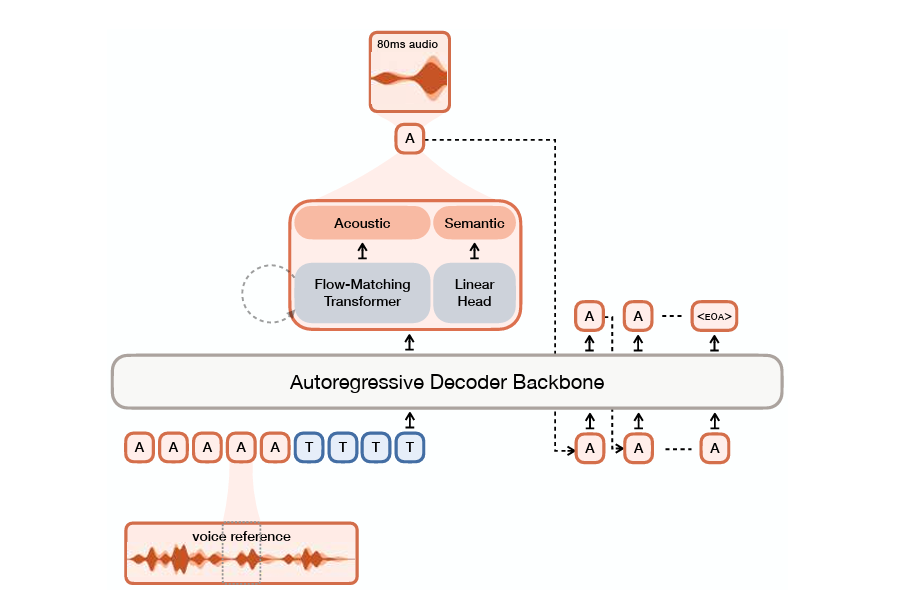
Fig 3. Architecture Overview of Voxtral TTS
The takeaway: if your pipeline today is “Whisper → text → LLM,” you’re paying a cost in both latency (a full decode before the LLM sees anything) and long-form behavior. Voxtral’s encoder-adapter-decoder fusion treats audio as a first-class input modality, not a transcription to pipe around.
Voxtral Codec: The Part People Under-Read
Here’s the part that’s been oddly under-discussed. The Voxtral TTS release is actually two artifacts: the TTS model itself, and the Voxtral Codec the tokenizer the model uses to represent speech.
The codec is a convolutional-transformer autoencoder. It takes 24 kHz mono waveforms and compresses them into frames at 12.5 Hz, where each frame carries 37 discrete tokens: one semantic token plus thirty-six acoustic tokens. Total bitrate: 2.14 kbps. That’s speech as a stream of tokens at roughly the bandwidth of a bad AM radio.
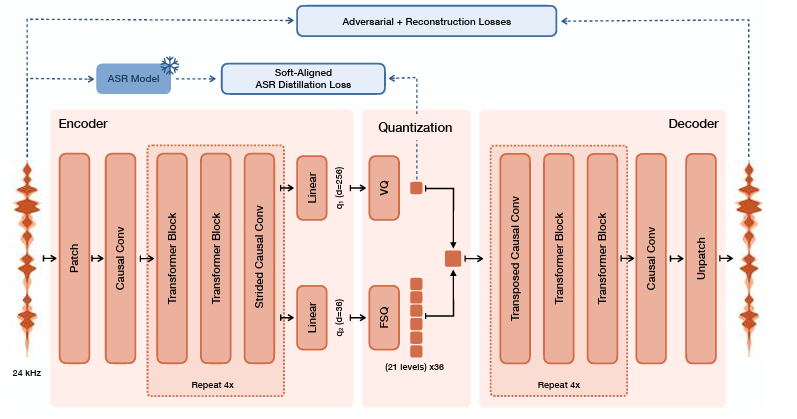
Fig 4. Architecture Overview of Voxtral Codec
The encode path is worth tracing:
- Input waveform at 24 kHz gets chunked into non-overlapping patches of 240 samples each, giving a 100 Hz input rate.
- A causal convolution with kernel size 7 projects each patch to a 1024-dimensional embedding.
- The transformer stack downsamples to 12.5 Hz and emits the 37-token-per-frame representation.
The reason 2.14 kbps is the interesting number: at that bitrate, a language model can actually afford to autoregress over speech. You’re not trying to reason over a 24 kHz waveform directly; you’re reasoning over a token stream roughly comparable in density to subword text. Which is why the decoder can be a Ministral 3B a regular LLM, not a bespoke audio model.
If you’re wondering whether this codec can be used independently, the short answer is yes, and the TDS “surgery” piece linked at the bottom walks through ripping it out and using it without the full TTS model. That alone is enough reason to pay attention to this release.
The VQ-FSQ Split: Semantic vs. Acoustic
The 37 tokens per frame aren’t symmetric. They come from two different quantization schemes doing very different jobs.
The semantic token (one per frame) is a classic vector-quantized code with an 8192-entry codebook. During training, this codebook gets an extra supervised distillation loss from an ASR model which forces the code to carry linguistic content. Phonemes, words, the stuff a transcription system would care about.
The acoustic tokens (thirty-six per frame) use finite scalar quantization FSQ with 21 entries per codebook. No semantic supervision. These end up capturing everything that isn’t “what was said”: timbre, prosody, speaker identity, room tone, subtle accent, disfluencies.
Each codebook has its own embedding table, and the frame’s per-token embeddings are summed into a single 1024-dim vector before being fed to the decoder. One frame, two jobs, cleanly factored.
This split is the architectural reason 3-second voice cloning works as well as it does and why it works the way it works.
Two-Stage Generation: AR Semantics, Flow-Matched Acoustics
Given that factored representation, how does generation actually work?
Stage one is pure LLM territory. The Ministral 3B decoder autoregressively predicts the sequence of semantic tokens. Text prompt goes in, semantic codes come out, one frame at a time. Because the semantic codebook is small (8192) and conditioned on text, this is behavior your existing LLM infrastructure already knows how to serve.
Stage two is a lightweight flow-matching model. Conditioned on the decoder’s hidden states, it predicts the acoustic tokens for each frame. Flow matching is non-autoregressive instead of generating one acoustic token at a time, it learns a velocity field that transforms noise into the target acoustic codes in a handful of steps. That’s the whole trick: you parallelize the expensive, wide part of the generation.
So when you call Voxtral TTS, first-audio latency comes down to three things: how fast the semantic AR loop emits its first few frames, how many flow-matching steps you run, and how fast the codec decoder can turn tokens back into waveforms. The codec decode is cheap. The flow-matching head is cheap. The AR loop is the gating factor.
That’s a very different profile from fully-AR codec TTS systems, where acoustic tokens dominate generation cost. It’s the reason Voxtral TTS can plausibly live in a realtime pipeline rather than a batch one.
Why 3-Second Voice Cloning Actually Works
Put those pieces together and the cloning story becomes mechanical rather than magical.
Your 3-second reference clip goes through the Voxtral Codec. Out comes a short sequence of semantic + acoustic tokens. For cloning, the model conditions on the acoustic distribution of that clip the FSQ tokens that encode timbre, accent, prosody, and the various quirks of the reference speaker.
Because the semantic channel is separate and driven by the text prompt you’re passing in, the model copies how the reference speaker sounds without leaking what they said. That’s the clean factoring you want. It’s also why the model preserves things that traditional TTS fine-tunes lose: subtle accent, inflection patterns, even small disfluencies that make voices sound human.
A few failure modes worth noting, because the marketing won’t mention them:
- Out-of-distribution accents or languages underrepresented in pretraining drift back toward the mean.
- References with clipping, loud background noise, or codec artifacts smuggle those artifacts straight into the acoustic codes your clone will sound compressed if the reference is compressed.
- Cross-lingual identity drift is real. A voice cloned on English can speak Spanish, but speaker identity is weaker than it is on the source language.
None of these are deal-breakers. They’re just the shape of the system.
Building the Stack: 10 Lines and Honest Latency Math
Here’s a minimal sketch of the full S2S translation pipeline the one Mistral demoed on April 2 glossing over production concerns like audio I/O buffering and backpressure.
from transformers import VoxtralForConditionalGeneration, VoxtralProcessor
from mistral_common import Mistral

stt = VoxtralForConditionalGeneration.from_pretrained("mistralai/Voxtral-Mini-4B-Realtime-2602")
llm = Mistral("mistral-large-latest")
tts = VoxtralForConditionalGeneration.from_pretrained("mistralai/Voxtral-4B-TTS-2603")
proc = VoxtralProcessor.from_pretrained("mistralai/Voxtral-4B-TTS-2603")
for audio_chunk in mic_stream(sample_rate=16_000):
    src_text = stt.transcribe(audio_chunk)                       # en
    tgt_text = llm.chat(f"Translate to French: {src_text}")       # fr
    audio    = tts.synthesize(proc(tgt_text, voice_ref=ref_clip)) # fr audio
    speaker.play(audio)
Real implementations are streaming all the way through you emit semantic tokens as fast as the AR loop runs them, flow-match acoustic tokens as chunks arrive, and hand the codec decoder a rolling window to synthesize.
Where does the latency actually live? Rough budget on a single H100, ballparked from published numbers and similar architectures:
- STT first-token: 120–180 ms on a warm model, dominated by the encoder forward pass.
- LLM TTFT: 150–300 ms for Mistral Large with a short prompt; less with Ministral or KV caching.
- TTS first-audio: 200–350 ms, mostly the AR semantic loop warming up before flow-matching can produce the first chunk.
- Jitter buffer + audio I/O: 40–80 ms, and this is where self-hosting actually earns its keep you control it.
That’s a 600ms–900ms end-to-end first-word latency for a full S2S turn. Not best-in-class against a tightly-integrated vendor stack like gpt-realtime, but very much usable and crucially, every millisecond of it is on your hardware.
What This Unlocks (And What’s Still Missing)
The headline “open weights, beats ElevenLabs” is the boring version of this story. The interesting version is that the codec is open too.
Once the codec is open, other teams can train their own autoregressive heads without touching the audio stack. You want a lower-latency realtime TTS? Train a smaller decoder on top of Voxtral Codec tokens. You want a specialized medical-narration TTS? Same move, different data. You want to run voice generation as a side output of your existing LLM? The codec gives you the tokens; bolt on a flow-matching head and you’re in business. This is the “Llama moment” for speech generation not because Voxtral is the best possible model, but because it normalizes the shape that future open models will take. Someone on internet have traced the codec based on the described architecture using pytorch — Github. This could be a start.
What’s still missing, honestly:
- The encoder side of the TTS model is the murkiest part of the release. The TDS “Voice Cloning with a Missing Encoder” piece walks through the surgery required to use reference conditioning standalone it works, but it’s clearly not the main supported path yet.
- Cross-lingual voice consistency needs another round of training.
- The flow-matching head is lightweight but still a moving part that complicates deployment versus a pure AR pipeline.
If I were building on this today, I’d start with the STT model in production (the gains over standalone Whisper are real), prototype the TTS behind a feature flag while the API stabilizes, and keep an eye on the codec as a platform that’s where third-party contributions are going to show up first.
Hope you learnt something new from this article. If you like it, consider sharing with your friends and do not forget to follow me for more Voice Content every day.
References:
메타데이터
- post_id
- 0b4cf0804cf4
- slug
- this-part-of-voxtral-tts-is-important-than-anything-must-for-builders-0b4cf0804cf4
- url
- https://levelup.gitconnected.com/this-part-of-voxtral-tts-is-important-than-anything-must-for-builders-0b4cf0804cf4
- canonical_url
- https://levelup.gitconnected.com/this-part-of-voxtral-tts-is-important-than-anything-must-for-builders-0b4cf0804cf4
- author_url
- https://medium.com/@mahimairaja
- status
- ok
- fetched_at
- 2026-06-09 15:37:30