Wang Chuqin in Paris 2024: The Broken Racket, A Fated Fall, and the Hardest Mountain to Climb
In the history of sports, great souls must always endure a baptism that verges on utter destruction.
Wang Chuqin in Paris 2024: The Broken Racket, A Fated Fall, and the Hardest Mountain to Climb
In the history of sports, great souls must always endure a baptism that verges on utter destruction.
Some athletes are remembered for their championships, while others are truly understood through their tribulations. Wang Chuqin clearly belongs to the latter — a young man repeatedly battered by fate, yet constantly fighting to stand back up amidst the ruins.
Chapter I — Paris 2024 | Destiny’s Cruel Joke
July 30, Paris. South Paris Arena.
As the final ball touched the floor, the scoreboard froze at 4–2:11–6, 7–11, 11–8, 11–5, 7–11, 11–9.
Wang Chuqin and Sun Yingsha embraced tightly as the arena erupted around them.
China had finally won its first-ever Olympic Mixed Doubles gold medal.
But that victory did not feel light. It felt earned through exhaustion, sacrifice, and years of pressure invisible to the outside world.
For more than a thousand days, they had rebuilt themselves over and over again — physically, mentally, emotionally. Every rally carried hidden pain. Every point was paid for in sweat, doubt, and sleepless nights.
Moments later, a team staff member rushed onto the court and handed them the Chinese flag.
Holding it high, smiling beneath the lights, Wang Chuqin looked untouchable — youthful, emotional, alive in the greatest moment of his career.
He turned from camera to camera, wanting to share that happiness with the world.
And then everything changed.
As he faced one final wave of photographers, the noise of the arena suddenly seemed to disappear.
Standing nearby was his coach, Xiao Zhan.
In his hands was a broken racket.
Not just any racket.
It was his racket — the one that had accompanied him through years of training, pressure, and ascension to World №1. The racket that had become an extension of his body.
Now it hung in two pieces.
Later, reporters on site recalled that the blade and handle were nearly separated completely, connected only by a few splinters of wood — like a bone violently snapped in half.
Wang Chuqin froze.
Just seconds earlier, his eyes had been filled with tears and joy. Now they have lost focus completely.
Something inside him seemed to collapse in real time.
He did not fully understand what had happened. He simply stared at the racket in silence, looking lost — almost childlike in his confusion.
One moment, he was standing at the summit of Olympic glory.
The next, fate shoved him from that height without warning.
The emotional drop was so violent that he barely even had the strength to feel anger.
Around him, tens of thousands were still cheering. He still held the national flag in his hands.
But his eyes never left the broken handle.
At the exact moment of triumph, the weapon that had carried him there disappeared in the most absurd way imaginable.
And in the center of that roaring arena, Wang Chuqin’s inner world suddenly became silent.
The Crueler Reality | No Time to Grieve
The cruelest part was this:
He was not given time to process any of it.
Only hours later, he had to return to the court for the Men’s Singles event — using a backup racket.
To ordinary viewers, that might sound insignificant.
To elite table tennis players, it changes everything.
The spare racket had been assembled in haste shortly before the tournament. The rubber response, sponge elasticity, grip balance, and touch sensitivity were all different from his primary setup.
For a world-class athlete, this is like asking a concert pianist to suddenly perform on an unfamiliar piano with completely different key spacing.
But fate was not finished with him yet.
After his shocking second-round loss to Truls Möregårdh, public opinion turned almost instantly.
The cheers disappeared overnight.
What replaced them was criticism.
Mockery.
Judgment.
The internet moves quickly — and forgets even faster.
People stopped talking about the Olympic gold medal. They stopped talking about the years of sacrifice behind it. Instead, they dissected his defeat with brutal certainty:
“How can a World №1 lose because of a backup racket?” “His mentality is too weak.” “The racket is just an excuse.”
Many people watching from behind screens failed to understand how deeply elite athletes depend on feel, rhythm, and psychological stability — especially under Olympic pressure.
What they also did not see was that Wang Chuqin had reportedly been dealing with physical discomfort and enormous mental strain at the same time.
For days, his name became attached to sarcasm and ridicule across social media.
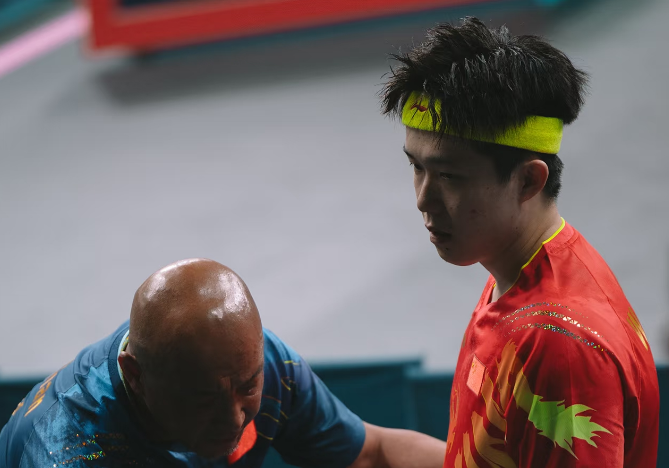
The broken racket had already hurt him.
But the public reaction became a second injury — one far more painful.
In the mixed zone afterward, he lowered his head and said quietly:
“Changing the racket is not an excuse for losing. The problem was still my own performance
He accepted the blame himself, even when many believed the situation was deeply unfair.
He never lashed out publicly. He never tried to weaponize sympathy.
Instead, he endured the storm in silence.
And that silence made the entire moment even sadder.
Because suddenly, it felt as if he had lost not only his racket — but also his right to explain himself to the world.
The irony was impossible to ignore.
He was still an Olympic champion. He had still delivered a crucial gold medal for China. He would eventually leave Paris with two Olympic gold medals.
And yet, none of it seemed enough.
That summer in Paris became cold in an instant.
Maybe, deep down, he kept asking himself the same question
Why today? Why me?
Carrying the wound fate had carved into him, Wang Chuqin walked alone into a darkness that would last for months.
The world waited for him to collapse completely.
They waited for him to break apart like the racket itself.
But what many people failed to realize was this:
Sometimes, the strongest things are born beneath ruins.
Next Stop: Fukuoka, Japan.
메타데이터
- post_id
- 0b4dfdcd69e1
- slug
- paris-broken-racket-broken-heart-a-fated-fall-and-the-hardest-mountain-to-climb-0b4dfdcd69e1
- url
- https://medium.com/@queenie201616/paris-broken-racket-broken-heart-a-fated-fall-and-the-hardest-mountain-to-climb-0b4dfdcd69e1
- canonical_url
- https://medium.com/@queenie201616/paris-broken-racket-broken-heart-a-fated-fall-and-the-hardest-mountain-to-climb-0b4dfdcd69e1
- author_url
- https://medium.com/@queenie201616
- status
- ok
- fetched_at
- 2026-06-27 18:20:27