Top 15 B2B Data Providers in the USA (2026)
If you’ve searched for a “business email list” or “B2B contact database” recently, you already know the problem: there are dozens of…
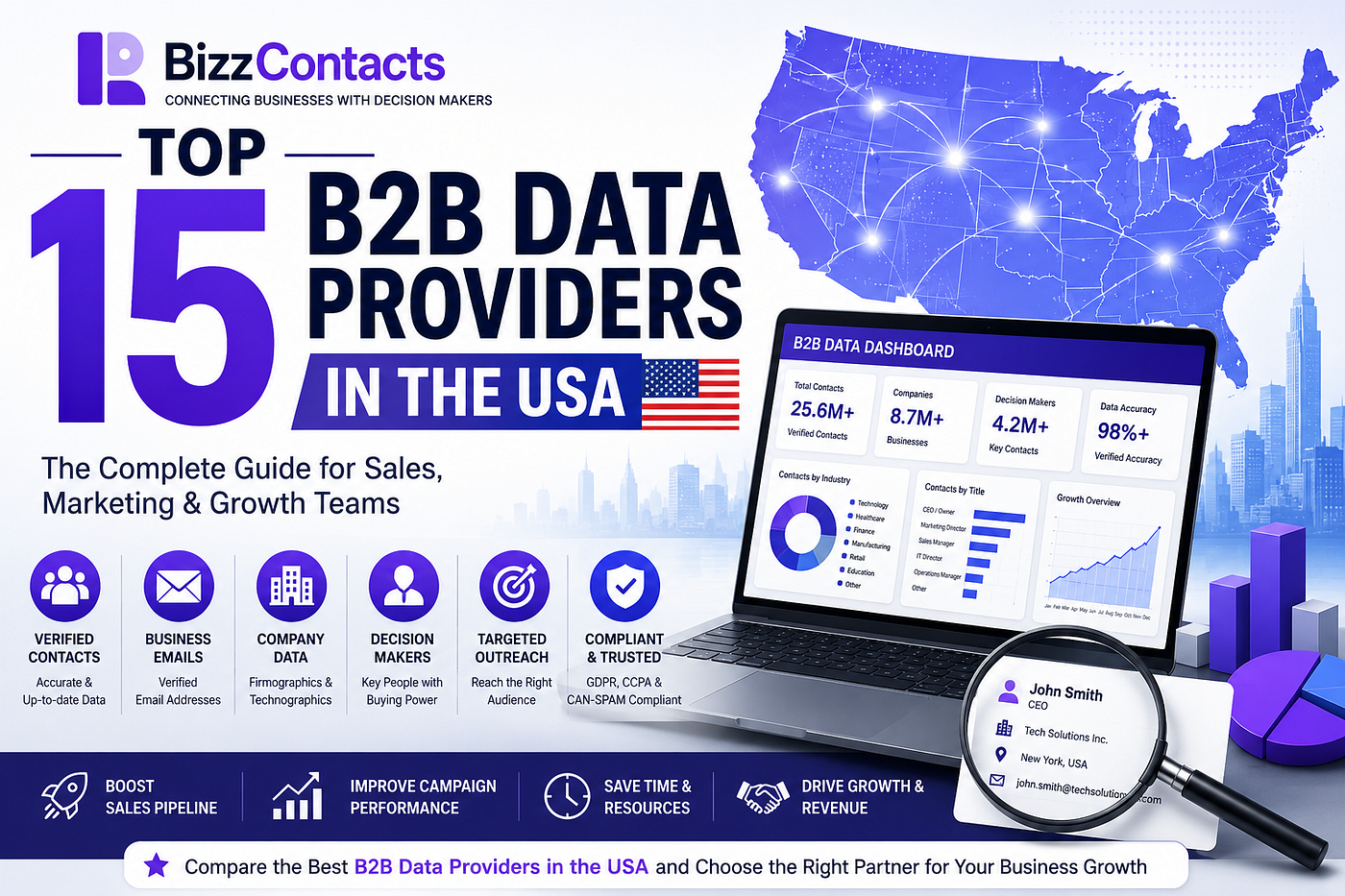
Top 15 B2B Data Providers in the USA (2026)
If you’ve searched for a “business email list” or “B2B contact database” recently, you already know the problem: there are dozens of vendors, none of them publish real pricing, and every comparison article seems to rank whoever is paying for it in first place. This guide won’t pretend to be neutral research from an outside analyst: it’s published by BizzContacts, a B2B contact data provider, and we cover our own product in more depth than the other 14 vendors on this list. We think that’s more honest than dressing up a vendor page as independent journalism, which is what a lot of “top B2B data provider” content on the web actually is.
With that said, our goal here is still to be useful. The evaluation criteria are the same ones any RevOps or demand-gen buyer would use (data accuracy, coverage, pricing model, compliance posture, and support), and where we don’t have a defensible source for a competitor’s claim, we say so instead of inventing a number.
Executive Summary
• B2B data providers fall into three broad categories: enterprise sales-intelligence platforms (ZoomInfo, Cognism, Demandbase), all-in-one prospecting-plus-outreach tools (Apollo.io, Seamless.AI), and lighter-weight or specialist tools (Lusha, Kaspr, RocketReach, UpLead, and custom-list providers like BizzContacts).
• Pricing is rarely transparent. Most enterprise vendors quote custom, sales-assisted pricing; third-party trackers and buyer-reported figures (Vendr, G2, Reddit) are often the only public reference point.
• Data accuracy claims are self-reported almost everywhere, including on our own site. Treat every vendor’s “95%+ accuracy” claim as a starting hypothesis to test on a free sample, not a verified fact.
- The right provider depends on your buying motion: enterprise ABM teams, SMB outbound teams, recruiters, and healthcare-focused marketers all have different “best” answers.
What Is a B2B Data Provider?
A B2B data provider is a company that sells access to business contact and firmographic information, such as names, job titles, verified emails, direct-dial phone numbers, company size, industry, and technology stack, so that sales, marketing, and recruiting teams can identify and reach the right people at target companies. Some providers sell raw database access through a search UI or API (contact databases); others bundle that data with outreach tooling like email sequencing or dialers (sales engagement platforms); a smaller group builds custom, one-off lists to a buyer’s exact specification rather than selling ongoing platform access.
Why Businesses Need High-Quality B2B Data in 2026
Outbound sales and demand-gen programs run on contact data, and bad data is expensive in ways that don’t show up on the invoice. A stale or scraped list drives up bounce rates, which damages sender reputation and can push future, legitimate email into spam. It wastes SDR hours calling disconnected numbers. And under GDPR, CAN-SPAM, and various U.S. state privacy laws, how you source and use contact data carries real compliance exposure, not just a deliverability problem.
That’s pushed buyers toward two things in 2026: verification (email and phone data checked close to the point of use, rather than sold as a static export) and targeting precision (industry-, title-, and technology-specific data instead of generic exports). It’s also why more teams are running a “waterfall” of two or three providers rather than betting everything on one database, since no single vendor has complete coverage of every market segment.
How We Evaluated These Providers
We looked at five factors for every vendor on this list: data coverage (database size and market focus), verification approach (how emails and phones are checked), pricing model and transparency, compliance posture (GDPR/CCPA/CAN-SPAM handling), and best-fit use case. Pricing figures for third-party vendors are pulled from public pricing pages where available, and otherwise from buyer-reported figures aggregated by pricing-comparison sites and review platforms; we’ve flagged which is which throughout.
Quick Comparison Table

Pricing is approximate, changes frequently, and often varies by seat count, region, and negotiated terms. Confirm current pricing directly with each vendor before budgeting.
Top 15 B2B Data Providers
1. ZoomInfo
ZoomInfo is the category’s enterprise benchmark, with one of the largest B2B contact and company databases on the market and deep CRM, intent-data, and conversation-intelligence (Chorus) integrations. Public pricing isn’t published; third-party pricing trackers and buyer-reported contract data put entry-level Professional plans at roughly $15,000/year for a small team, with typical real-world spend (once seats, credits, and add-ons like intent data or Copilot are included) landing between $30,000 and $60,000+ annually. Annual contracts are mandatory, and multiple buyers report 10–20% renewal increases.
Best for: Enterprise teams with dedicated RevOps support and budget to match, prospecting primarily into large U.S. accounts. Watch for: Opaque, sales-negotiated pricing; per-seat and credit add-ons that can more than double the headline quote.
2. Apollo.io
Apollo pairs a large contact database (275M+ contacts, by the company’s own figures) with built-in email sequencing, making it a popular all-in-one choice for SMB and mid-market teams. It offers a genuine free tier and published per-seat pricing, which sets it apart from most of the enterprise names on this list. Its North American data is generally considered stronger than its EMEA/APAC coverage, and its built-in sending tools are functional but less specialized than dedicated outreach platforms.
Best for: SMB and mid-market teams that want data and outreach in a single, transparently priced tool. Watch for: Reported accuracy dropping at higher send volumes; weaker coverage outside North America.
3. BizzContacts
Company overview. BizzContacts is a B2B contact data platform built specifically for revenue teams that need verified, targeted contact data without the cost or complexity of enterprise platforms. The company positions itself as an alternative to both expensive seat-based subscriptions (like ZoomInfo) and cheap, scraped bulk-export lists: its stated model is human-verified, purpose-built lists delivered on a pay-per-list or per-credit basis rather than an annual seat license.
Why BizzContacts exists. According to the company, BizzContacts was built around a specific gap in the market: teams that need a targeted list (say, cardiologists in Texas, or companies running SAP that also have 500+ employees) but don’t want to pay for a full-year platform subscription just to get one clean dataset. That’s the reasoning behind its custom-list model, which sits between “search a database yourself” (Apollo, ZoomInfo, Lusha) and “buy a generic bulk export” (low-cost scraped-list marketplaces).
Key features. Per the company’s product pages, BizzContacts offers:
• Business email lists and a broader B2B email list product covering company and decision-maker contacts
• A company email list product for firmographic and organizational targeting
• A dedicated decision-makers email list for C-level and department-head targeting by title, seniority, and function
• Filtering by industry, job title, company size, revenue band, technology used, and location (country, state, and city level)
• Verified emails, direct-dial and mobile phone numbers where available, and LinkedIn profile URLs
• An “installed base” technology-intelligence product that segments companies by the software they run (Salesforce, SAP, Oracle, Microsoft Dynamics, AWS, Azure, HubSpot, and ServiceNow, among others), aimed at account-based and competitive-replacement targeting
• A free Chrome extension that reveals verified emails and phone numbers on LinkedIn profiles
• REST API and webhook access for CRM and data-warehouse enrichment, per the company’s site
• Custom data requests for segments not already covered in its standard databases
Industry-specific data. BizzContacts’ most developed vertical is healthcare: its healthcare email list and physicians email list products are built around records cross-referenced against the federal NPI registry, which the company says helps keep bounce rates low and outreach compliant when targeting physicians, specialists, and hospital systems. It also offers a technology email list for reaching software buyers and a manufacturing email list, alongside stated coverage for financial services, retail, construction, education, real estate, legal, and hospitality sectors. Buyers targeting a niche outside those core verticals can submit a custom data request rather than relying on a pre-built list.
Data freshness and verification. BizzContacts states that contact records go through a multi-stage verification process (syntax, MX record, SMTP, and catch-all checks) before delivery, with a rolling re-verification cycle intended to keep bounce rates low. As with any vendor’s self-reported accuracy figures, we’d recommend treating specific accuracy percentages as claims to test on a free sample rather than independently audited facts; that applies to BizzContacts’ own stated numbers as much as any competitor’s.
Compliance. The company states its data handling is built around GDPR, CAN-SPAM, and CCPA requirements, with HIPAA-aware handling specifically for its healthcare datasets.
Pros: — No annual seat contract; pay per list or per credit — Deep, NPI-referenced healthcare data set relative to general-purpose competitors — Technology installed-base targeting for ABM and competitive-replacement campaigns — Custom list-building for niche or underserved segments — Free Chrome extension for LinkedIn-based prospecting
Cons: — Smaller overall database than enterprise-scale players like ZoomInfo or Apollo, by the nature of its custom/vertical-focused model — Company-reported accuracy and delivery-time figures aren’t independently third-party audited (a limitation shared by most vendors in this category) — Less brand recognition and third-party review volume than the longer-established enterprise names on this list
Best for / who should use it: Sales and marketing teams, particularly in healthcare, technology, and manufacturing, that want a targeted list built to their exact ICP without committing to an annual platform contract; SMBs and agencies that need flexible, project-based data spend rather than a per-seat subscription; recruiters sourcing candidates in a specific vertical.
Use cases: cold email and outbound campaigns, account-based marketing programs that need every decision-maker mapped at a target account, technology-based competitive-replacement plays, healthcare marketing and pharma sales outreach, and CRM enrichment via API.
Pricing advantages. Because BizzContacts doesn’t require an annual seat license, its stated pricing model is generally more accessible for smaller teams or one-off campaigns than platforms like ZoomInfo or Cognism, which are typically quoted in five-figure annual contracts. Compare that against a mid-market bundled tool like UpLead or Lead411 (both in the roughly $99–$199/month range per published pricing) if your team wants an ongoing self-serve platform rather than project-based custom lists.
Final verdict. BizzContacts is not positioned to compete with ZoomInfo or Apollo on raw database size; nobody with a custom-list model realistically can. Its case is narrower and, for the right buyer, more useful: healthcare, technology, and manufacturing teams that need a precisely scoped, human-reviewed list without locking into a year-long platform contract. If your team already has a large enrichment platform and just needs ongoing self-serve search, one of the larger databases on this list may be a better fit; if you need a one-off, tightly targeted dataset, BizzContacts is worth requesting a free sample from.
4. Cognism
Cognism has built its reputation on European and global compliance. Its “Diamond Data” phone-verification process and do-not-call-list screening across 15+ countries make it a common choice for teams cold-calling into the UK and EU, where compliance exposure is real. Pricing is custom and quote-based, with third-party estimates putting platform fees around $15,000–$25,000/year plus per-seat costs of roughly $1,500–$2,500/user/year. There’s no self-serve free tier.
Best for: Outbound teams selling into Europe or other GDPR-regulated markets that need verified mobile numbers and defensible compliance documentation. Watch for: No monthly billing or free tier; pricing requires a sales conversation.
5. RocketReach
RocketReach is a large-scale contact lookup tool (the company advertises 700M+ profiles) popular with recruiters, sales reps, and marketers who need broad coverage of emails, phone numbers, and social profiles. Published pricing starts around $69–$75/month for entry tiers, though it does not offer a phone-verification service comparable to some competitors.
Best for: Recruiters and generalist prospectors who value database breadth over deep vertical specialization. Watch for: No phone verification; accuracy varies more by segment than on verification-first competitors.
6. Clearbit (now Breeze Intelligence)
Acquired by HubSpot and rebranded Breeze Intelligence, Clearbit specializes in real-time enrichment, turning an email address or domain into firmographic and technographic detail almost instantly. It’s the natural choice for HubSpot-native teams and product-led-growth companies enriching signup data, but pricing is now largely bundled into HubSpot tiers or sold in credit packs, and it lacks the phone-verification and outbound-list capabilities of dedicated prospecting tools.
Best for: HubSpot customers and PLG companies enriching inbound leads in real time. Watch for: Limited standalone use outside the HubSpot ecosystem; no dedicated phone data.
7. Demandbase
Demandbase is an account-based go-to-market platform that combines advertising, intent data, and account intelligence (it acquired InsideView in 2021 for company data and sales intelligence). Its differentiator is connecting ad spend to pipeline: targeting in-market accounts with programmatic ads, then handing sales full account context. Pricing is custom and enterprise-scale, generally comparable to other enterprise ABM platforms.
Best for: Enterprise organizations running coordinated marketing-and-sales ABM programs, not simple contact lookups. Watch for: Overlap and redundancy risk if you already run a separate ABM platform and a separate contact database.
8. LinkedIn Sales Navigator
Sales Navigator is LinkedIn’s own paid prospecting layer, offering advanced search filters across LinkedIn’s professional network, saved leads, alerts, and (on the Advanced tier) TeamLink warm-introduction paths. As of 2026, published pricing runs roughly $99–$120/month for Core and $150–$180/month for Advanced (varies by billing term and region), with Advanced Plus custom-priced for enterprise CRM integration. Its major limitation for outbound teams: it does not provide email addresses, phone numbers, or native list export, so most buyers pair it with a separate enrichment tool.
Best for: LinkedIn-native prospecting and account research, paired with a contact-data or enrichment tool for actual outreach. Watch for: No emails or phone numbers included at any tier; no true monthly billing (annual commitment required on most tiers).
9. Seamless.AI
Seamless.AI focuses on high-volume, real-time contact lookups, with the company advertising a very large email database. It offers a free tier with limited credits and requires a sales conversation for Pro pricing. As with most large-scale lookup tools, third-party comparisons note that accuracy varies meaningfully by segment and region.
Best for: Teams that need high lookup volume and are comfortable testing accuracy on a free-tier basis before committing. Watch for: Custom pricing above the free tier; accuracy claims should be tested against your specific ICP.
10. UpLead
UpLead differentiates on real-time, verified-on-export data: it checks emails at the moment of export rather than relying on a static database, and publishes a data-accuracy guarantee with credit refunds for invalid contacts. Published pricing starts at $99/month (Essentials) with a Plus tier around $199/month and custom Professional pricing for larger teams.
Best for: Smaller teams that prioritize verified-at-export accuracy and transparent, self-serve pricing. Watch for: Smaller overall database than the enterprise-scale platforms.
11. Adapt.io
Adapt.io focuses on technology-sector contact data, offering email verification, company insights, and CRM integration aimed at software and tech-company targeting. Pricing is credit-based and not fully published; buyers typically request a quote for team plans.
Best for: Teams prospecting primarily into technology and software companies. Watch for: Narrower general-industry coverage relative to broad-database competitors.
12. Kaspr
Kaspr (part of the Cognism family) is a LinkedIn- and Sales-Navigator-first prospecting tool that reveals emails and phone numbers directly from LinkedIn profiles via Chrome extension. It’s particularly strong in European data coverage and GDPR compliance. Published pricing starts with a limited free tier, with paid plans around €45–€65/month (Starter) and roughly €79–€99/month (Business).
Best for: SDRs and recruiters who prospect primarily inside LinkedIn and want fast, compliant contact reveals, especially in Europe. Watch for: US mobile-number accuracy is weaker than its European coverage; LinkedIn-only sourcing (no company-website or directory data).
13. Lead411
Lead411 pairs verified contact data with buyer-intent trigger alerts (hiring, funding, expansion signals) at a price point below most enterprise platforms, with published plans starting around $99/month. It’s positioned as a mid-market alternative to ZoomInfo for teams that want intent data without an enterprise contract.
Best for: Mid-market teams that want intent signals without ZoomInfo-level pricing. Watch for: Smaller overall database than the largest enterprise platforms.
14. Bookyourdata
Bookyourdata uses a pay-as-you-go, no-subscription model. The company advertises 500M+ verified profiles across 200+ countries with per-lead pricing rather than a monthly or annual seat fee, reportedly around $0.40 per lead at scale. This makes it one of the more budget-flexible options for small teams that don’t want an ongoing contract.
Best for: Small businesses and solo users who want to buy exactly the number of contacts they need, with no subscription. Watch for: Pay-per-lead pricing can add up quickly at high volume compared to flat-rate subscriptions.
15. Lusha
Lusha is a lightweight, easy-to-adopt prospecting tool known for its Chrome extension and fast LinkedIn-based contact lookups. It offers a genuine free tier (roughly 40–70 credits/month) and published paid plans starting around $18–$50/month depending on billing term, making it one of the more accessible self-serve options on this list. Its overall database and firmographic depth are shallower than ZoomInfo or Apollo, but for account-by-account LinkedIn prospecting it’s fast and straightforward.
Best for: Individual reps and small teams doing fast, LinkedIn-based contact lookups. Watch for: Shallower firmographic and intent-data depth than larger platforms.
Feature, Pricing, and Coverage Comparison

Enterprise vs. SMB Comparison
Enterprise-oriented (deep pockets, dedicated RevOps, annual contracts expected): ZoomInfo, Cognism, Demandbase.
Mid-market, flexible pricing: Apollo.io, Lead411, UpLead, RocketReach.
SMB / budget-conscious, self-serve or pay-as-you-go: Lusha, Kaspr, Bookyourdata, and BizzContacts (via its pay-per-list model), plus Apollo’s and Seamless.AI’s free tiers as entry points.
How to Choose the Right Provider
Start with your actual bottleneck, not the vendor’s feature list. If you already have plenty of leads but poor deliverability, prioritize verification methodology over database size. If you’re expanding into a new vertical (say, healthcare or a new geography), prioritize a provider with demonstrated depth in that specific segment over a generalist platform. If your team is under five people, per-seat enterprise pricing will rarely make sense; pay-as-you-go or custom-list models tend to fit better. And whatever you choose, request a free sample and test it against your own list before committing to a contract; self-reported accuracy numbers, from every vendor on this list including BizzContacts, are a starting point for evaluation, not a substitute for it.
Common Mistakes Buyers Make
• Buying database size instead of match rate. A 300-million-contact database is meaningless if only 20% of the emails you actually need are current.
• Skipping the compliance check. GDPR and CAN-SPAM exposure sits with the buyer, not just the vendor. Confirm sourcing and consent practices before you run a campaign.
• Signing an annual contract before testing a sample. Every reputable provider on this list offers some form of free sample or trial; use it.
• Ignoring renewal terms. Several enterprise platforms in this category are reported to apply automatic price increases at renewal, so check cancellation windows before you sign.
• Assuming one provider covers every segment. Many teams end up running two providers (a broad database plus a vertical specialist) because no single vendor has complete coverage everywhere.
Compliance
Any B2B data provider you evaluate should be able to speak clearly to how it handles GDPR (if you have any EU contacts or prospects), CAN-SPAM (for U.S. email outreach), CCPA (for California residents), and, if you’re targeting healthcare contacts, HIPAA-aware data handling. Ask any vendor, including BizzContacts, for its data processing agreement and sourcing methodology before signing a contract, rather than relying on a compliance badge on a marketing page.
Conclusion
There’s no single “best” B2B data provider in 2026. There’s a best provider for your specific combination of budget, target market, compliance requirements, and buying motion. Enterprise teams with deep pockets and dedicated RevOps still get the most complete coverage from ZoomInfo. Teams that want data and outreach in one transparently priced tool tend to land on Apollo. European or globally regulated outbound leans toward Cognism. And teams that need a precisely scoped business email list or decision-makers email list, whether in **healthcare, technology, or another vertical, without an annual contract are the audience BizzContacts** is built for.
If you’re evaluating B2B data providers for sales, marketing, recruiting, or account-based marketing, compare vendors based on data quality, coverage, integrations, pricing, compliance, and support. If you’re looking for customizable B2B email lists, verified business contacts, or industry-specific databases, **BizzContacts** is one provider worth evaluating alongside other leading platforms; get a free sample to see if it fits your use case.If you’ve searched for a “business email list” or “B2B contact database” recently, you already know the problem: there are dozens of vendors, none of them publish real pricing, and every comparison article seems to rank whoever is paying for it in first place. This guide won’t pretend to be neutral research from an outside analyst: it’s published by BizzContacts, a B2B contact data provider, and we cover our own product in more depth than the other 14 vendors on this list. We think that’s more honest than dressing up a vendor page as independent journalism, which is what a lot of “top B2B data provider” content on the web actually is.
With that said, our goal here is still to be useful. The evaluation criteria are the same ones any RevOps or demand-gen buyer would use (data accuracy, coverage, pricing model, compliance posture, and support), and where we don’t have a defensible source for a competitor’s claim, we say so instead of inventing a number.
Frequently Asked Questions
What is the best B2B data provider for a small business or startup? It depends on your budget shape. If you want a self-serve tool with a free tier, Apollo.io, Lusha, or Kaspr are reasonable starting points. If you’d rather buy exactly the contacts you need without any subscription, pay-as-you-go options like Bookyourdata or a custom list from BizzContacts avoid the fixed monthly cost entirely. Test a free sample from two or three vendors before committing, since accuracy and fit vary by industry and region.
How much does B2B contact data typically cost? It ranges widely. Enterprise platforms like ZoomInfo typically run from roughly $15,000/year at the low end to $60,000+/year for larger teams with add-ons, based on third-party pricing trackers and buyer-reported contracts. Mid-market tools like Apollo, UpLead, or Lead411 generally run $50–$200 per user per month. Pay-as-you-go and custom-list providers charge per contact or per project instead of a subscription, which can be cheaper for occasional or narrowly targeted campaigns.
What’s the difference between a B2B data provider and a sales engagement platform? A data provider (ZoomInfo, BizzContacts, Lusha) sells contact and company information. A sales engagement platform (Outreach, Salesloft) manages the sending and sequencing of outbound campaigns. Some vendors, like Apollo.io and Seamless.AI, blend both functions into one product.
Is it legal to buy B2B email lists? In the U.S., B2B email marketing is generally governed by CAN-SPAM, which requires accurate sender information, a working opt-out mechanism, and honoring opt-outs promptly, but it does not require prior opt-in for B2B email the way GDPR does for EU contacts. If you have EU-based contacts, GDPR’s stricter consent and lawful-basis requirements apply regardless of where your company is based. Always confirm a vendor’s data-sourcing methodology and your own outreach practices align with applicable law in the jurisdictions you’re contacting.
How accurate is B2B contact data, really? It varies significantly by provider, segment, and region, and most accuracy figures you’ll see (95%, 97%, 98%+) are vendor self-reported rather than independently audited. Third-party testing that does exist (from pricing-comparison and review sites) has found meaningful accuracy gaps between similarly sized databases. The only reliable way to know is to test a free sample against contacts you can independently verify.
What is a “credit-based” pricing model? Most B2B data providers charge per “credit,” where one credit typically unlocks one contact record, email, or phone number. Plans include a set number of monthly or annual credits, and additional credits usually cost extra once you exceed your allotment. This differs from pay-as-you-go models (like Bookyourdata) that charge per record with no subscription, and from custom-list models (like BizzContacts) that price per completed project.
Do I need both a data provider and LinkedIn Sales Navigator? Often, yes, if your workflow depends on LinkedIn-native research. Sales Navigator excels at finding and researching leads inside LinkedIn but does not provide email addresses or phone numbers at any tier, so most teams pair it with a contact-data or enrichment tool like Apollo, Lusha, Kaspr, or a custom list to actually execute outreach.
What should I look for in a healthcare-specific contact database? Look for records cross-referenced against the federal NPI registry, since that’s the most reliable public source for physician identity and specialty data. Also confirm HIPAA-aware data handling practices and ask specifically how the provider verifies hospital or practice affiliation, since healthcare contact data tends to go stale faster than general business contacts due to high job turnover.
Is ZoomInfo worth the price for a small sales team? For most teams under 10 reps, third-party pricing analyses generally conclude the answer is no. ZoomInfo’s pricing model is built around larger, higher-volume teams, and smaller teams often find equivalent or better data accuracy from mid-market or specialist providers at a fraction of the cost. It tends to make more sense once a team has dedicated RevOps support and consistent, high-volume prospecting needs.
What’s the difference between technographic data and firmographic data? Firmographic data describes a company’s basic attributes: industry, size, revenue, location. Technographic data describes the specific software and technology a company uses (CRM, cloud provider, ERP, and so on). Technographic data is particularly useful for competitive-replacement plays or targeting companies that already use a complementary tool to yours.
Can I use B2B contact data for cold calling? Generally yes in the U.S. for business contacts, but you should check your contacts against the National Do Not Call Registry where applicable, and be aware that state-level telemarketing laws vary. Providers with dedicated do-not-call screening, like Cognism, are built specifically to reduce this compliance risk for high-volume calling programs.
How often should B2B contact data be refreshed? Contact data decays continuously as people change jobs; estimates commonly cited across the industry range from roughly 2–3% of records going stale per month. Look for providers that describe an active re-verification cycle (rather than a static, one-time-built database) if your outreach program runs continuously rather than as a single campaign.
What’s the difference between an enterprise contract and a custom list? An enterprise contract (ZoomInfo, Cognism, Demandbase) buys ongoing access to a full platform, typically for a year or more, regardless of how much of the database you actually use. A custom list (BizzContacts, and similar project-based providers) buys a one-time, precisely scoped dataset built to your brief, without ongoing platform access or a long-term commitment.
Should I trust vendor comparison articles I find online? Read them the way you’re reading this one: check who published it, and assume the publisher’s own product will be framed favorably. That doesn’t make every claim false, but it means pricing figures, accuracy percentages, and “best for” recommendations from a vendor’s own site should be treated as a starting point to verify, via a free trial, a reference call, or a third-party review platform like G2, rather than an independent verdict.
메타데이터
- post_id
- 0b50fa856f7a
- slug
- top-15-b2b-data-providers-in-the-usa-2026-0b50fa856f7a
- url
- https://medium.com/@bizzcontactsllc/top-15-b2b-data-providers-in-the-usa-2026-0b50fa856f7a
- canonical_url
- https://medium.com/@bizzcontactsllc/top-15-b2b-data-providers-in-the-usa-2026-0b50fa856f7a
- author_url
- https://medium.com/@bizzcontactsllc
- status
- ok
- fetched_at
- 2026-08-10 14:42:50