ADL Is Broken: Why Winning Traders Keep Getting Punished
The October 2025 crash liquidated $19 billion and exposed a fundamental flaw in how crypto derivatives exchanges handle risk. It’s time to…
ADL Is Broken: Why Winning Traders Keep Getting Punished
The October 2025 crash liquidated $19 billion and exposed a fundamental flaw in how crypto derivatives exchanges handle risk. It’s time to rethink the system.
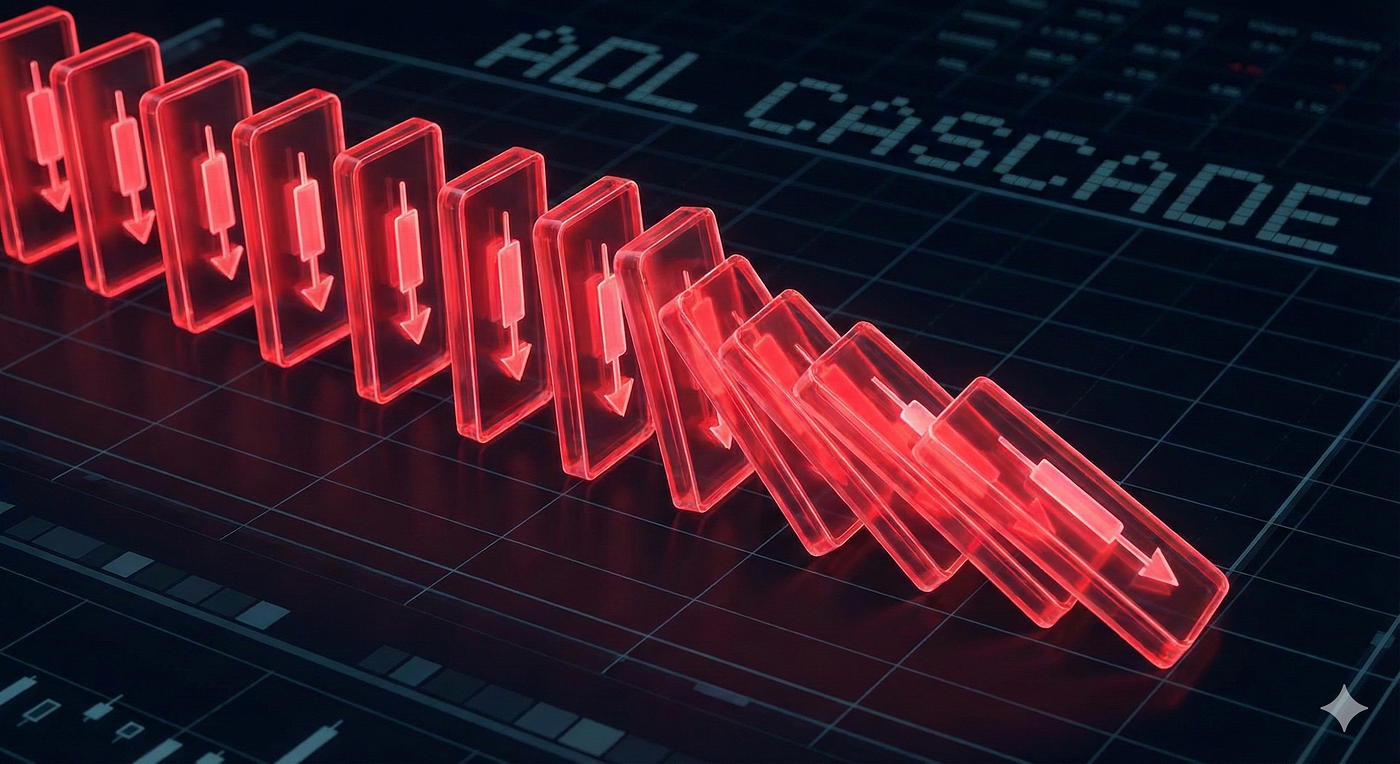
Liquidation cascade visualization
On the evening of October 10, 2025, Donald Trump posted about 100% tariffs on China. Within minutes, the crypto market entered freefall. Bitcoin dropped from $122,000 to $104,000. Ethereum cratered. Altcoins lost 50–80% of their value.
But the real chaos wasn’t the price drop, it was what happened next.
Across every major exchange, a mechanism most traders had never heard of kicked in: Auto-Deleveraging (ADL). Suddenly, traders who had correctly predicted the crash, the ones sitting on profitable short positions, watched in disbelief as their winning trades were forcibly closed. Not because they were wrong. Because the system couldn’t pay them.
In a single 24-hour period, $19 billion was liquidated. 1.62 million accounts were affected. And thousands of traders learned the hard way that in crypto derivatives, being right doesn’t mean you get to keep your profits.
What Is ADL, and Why Does It Exist?
To understand why ADL is broken, you first need to understand why it exists.
Perpetual futures are a zero-sum game. Every dollar a long position makes comes from a short position’s pocket, and vice versa. The exchange doesn’t hold some magical reserve of Bitcoin, it’s just moving money between traders based on who called the market correctly.
This works fine in normal conditions. But when markets crash hard and fast, a problem emerges: liquidated traders can’t pay what they owe.
Here’s the sequence:
- Price crashes → Leveraged long positions get liquidated
- Liquidations flood the market → Not enough buyers to absorb the selling
- Insurance fund depletes → The exchange’s backup reserve runs dry
- No one left to pay the winners → Short sellers are owed money that doesn’t exist
Enter ADL, Auto-Deleveraging. When there’s no money left to pay winning traders, the exchange forcibly closes their profitable positions. The logic is simple: if someone has to lose, better to trim the winners than let the whole system collapse.
Think of it like an overbooked flight. When there are no volunteers to give up seats, the airline starts bumping passengers, starting with whoever they deem most expendable.
The problem is, in crypto, “most expendable” means “most profitable and most leveraged.” The better you traded, the higher you rank in the ADL queue.
October 10: A Wake-Up Call
The October 2025 crash wasn’t just another volatile day. It was nine times larger than any previous liquidation event. And it exposed just how broken ADL really is.
Hyperliquid, one of the leading decentralized perpetual exchanges, triggered cross-margin ADL for the first time in over two years of operation. In a five-minute window, 35,000 positions were forcibly closed across 20,000 traders.
Binance used approximately $188 million from its insurance fund to cover bad debt, and still had to activate ADL. An oracle malfunction caused USDe to briefly crash to $0.65, while wrapped tokens like wBETH and BNSOL lost over 80% of their value in minutes.
Bybit saw $4.65 billion in liquidations, with $4.44 billion in ETH ADL alone. Over 50,000 short positions were forcibly closed.
The stories from affected traders were brutal. Wintermute’s founder, Evgeny Gaevoy, described ADL prices that were “completely illogical”, market price at $1, but positions forcibly closed at $5. “There’s no way to hedge that,” he said. “You just have to swallow the loss instantly.”
Market makers running hedged strategies, supposedly the safest way to trade, found one leg of their trades forcibly closed while the other remained open. Suddenly, their “market-neutral” positions were naked directional bets at the worst possible moment.
The Five Fatal Flaws of ADL
1. Portfolio Blindness
ADL operates at the single-market level. It doesn’t care about your overall account exposure, only whether your individual position is profitable.
Consider Alice, a sophisticated trader running a BTC-ETH spread:
- Long 40 BTC perps,
- Short 1,000 ETH perps.
This is a hedged position designed to be roughly market-neutral.
Now imagine both BTC and ETH rally 5%. Alice’s positions should offset, leaving her flat. But if the insurance fund’s BTC side runs dry, ADL triggers on her profitable BTC long, closing it at a worse price. Meanwhile, her ETH short keeps bleeding.
The hedge is destroyed. Alice, who was carefully risk-managed, suddenly realizes a massive loss, not because she was wrong, but because ADL can’t see beyond a single market.
2. Cross-Platform Hedge Destruction
It gets worse for traders hedging across exchanges. If you’re long spot on Coinbase and short perps on Binance, you think you’re protected. But when ADL closes your short, you’re suddenly naked long at the exact moment you least want to be.
This is what happened to countless “delta-neutral” yield farmers during the October crash. Their short positions vanished via ADL, and their spot collateral on lending protocols got liquidated as values tanked. A strategy designed to be immune to price moves became catastrophically long at the worst possible time.
3. The Ethena Problem
Here’s where it gets really unfair: not everyone plays by the same rules.
Ethena Labs, the protocol behind the USDe synthetic dollar, reportedly negotiated ADL exemption clauses with certain centralized exchanges (CEX). This makes sense for Ethena, their entire business model depends on holding short perp positions as hedges. If those shorts get Auto-Deleveraged (ADL’d), USDe could depeg.
But think about what this means for everyone else. If Ethena is exempt from ADL, the risk doesn’t disappear, it gets redistributed to other users. When the music stops, someone has to lose. If it’s not Ethena, it’s you.
Wintermute’s Gaevoy acknowledged this creates an unfair market structure: “If such protection exists, of course we’d want it, but should exchanges offer such clauses widely? Not necessarily.”
The transparency issue is glaring. No exchange discloses who has ADL exemptions. You’re playing a game where some participants have cheat codes you don’t even know exist.
4. Instantaneous and Irreversible
When ADL triggers, your profits crystallize instantly, at the worst possible price, at the worst possible moment.
There’s no appeal. No waiting for markets to recover. No chance that the insurance fund gets replenished before affecting you. Your position is closed at the bankruptcy price of the liquidated counterparty, which can be drastically different from market price.
One trader on Bybit reported his position being ADL’d 30 minutes after the price that supposedly triggered it. The market had already moved significantly, but he was still executed at the stale, unfavorable price. There’s no transparency into why decisions are made when they are.
5. Computational Chaos
ADL is computationally expensive. It requires scanning all accounts on the platform, calculating rankings, and executing forced closures, all while the system is already under extreme stress.
This creates a perverse feedback loop. ADL adds congestion to an exchange precisely when it’s most congested. Traders can’t exit positions, can’t adjust hedges, can’t react to their positions being closed. The mechanism designed to restore stability often amplifies the chaos.
CEX vs DEX: Same Problem, Different Packaging
Here’s what’s crucial to understand: ADL isn’t just a centralized exchange problem. Hyperliquid, one of the most celebrated decentralized exchanges, uses ADL too. So does Aster DEX. So do most perp DEXs.
The October crash proved that on-chain transparency doesn’t fix ADL’s fundamental flaws. Yes, you can verify that ADL happened on Hyperliquid. Yes, the code is more visible than Binance’s black box. But if your profitable position still gets forcibly closed at the worst possible moment, does transparency really matter?
The real divide isn’t CEX vs DEX. It’s ADL vs the alternative.
The Alternative: Socialized Loss
There’s a better way. It’s called socialized loss, and it’s been quietly working for years.
**Deribit, one of the largest crypto options and futures exchanges (now owned by Coinbase**), has operated with socialized loss instead of ADL since 2016. The result? Zero instances of socialized loss actually being applied. The mechanism exists as a backstop, but the combination of robust insurance funds and intelligent risk management has made it unnecessary.
**Paradex**, a newer decentralized exchange, deliberately chose not to implement ADL. Their reasoning is worth quoting directly:
“ADL is a relic of isolated margin systems. It breaks cross-platform hedges, adds unpredictability to risk management, and fails for complex assets and portfolio-margin setups.”
So how does socialized loss work?
Instead of targeting specific traders, socialized loss spreads any deficit across all profitable traders proportionally. More importantly, it’s conditional and deferred:
- Losses are applied only upon withdrawal
- Only if the platform is still experiencing a solvency deficit at that time
- If the market rebounds or the insurance fund recovers, the shortfall is erased
This introduces something ADL completely lacks: time and recovery potential.
If you’re a long-term trader who doesn’t need to withdraw during a crisis, you might never be affected at all. If the insurance fund rebuilds through normal trading fees, the deficit disappears. You have a choice about when to realize any haircut.
Compare this to ADL, which crystallizes losses instantly, irreversibly, and without any input from the affected trader.
Why Socialized Loss Is Fairer
The differences are stark when you line them up.
Targeting: ADL hunts specific traders, prioritizing the most profitable and most leveraged. Socialized loss spreads the burden proportionally across all winners.
Timing: ADL strikes instantly, in the heat of the crisis. Socialized loss is deferred, applied only when you withdraw.
Reversibility: ADL is permanent the moment it executes. Socialized loss is conditional. If the insurance fund recovers, your haircut disappears.
Transparency: ADL relies on complex queue calculations that most traders can’t anticipate. Socialized loss is a simple percentage of the deficit divided by total profits.
Portfolio awareness: ADL operates market by market, blind to your overall exposure. Socialized loss applies at the account level.
Computational load: ADL requires scanning every account on the platform during peak stress. Socialized loss is a lightweight ratio calculation.
User choice: ADL gives you none. Socialized loss lets you decide when to withdraw and whether to wait for recovery.
The fairness argument writes itself. ADL punishes traders for being good at their job, targeting the most profitable positions first, essentially taxing success. Socialized loss spreads risk evenly among winners. You pay a proportional share, not a targeted penalty.
November’s Aftermath: Fear as the Only Protection
You might think October’s chaos would prompt immediate reforms. It didn’t.
What happened instead was grimly instructive. In November 2025, the market crashed again, multiple times. Bitcoin dropped from $95,000 to $81,050. Another $2 billion was liquidated on Black Friday alone. The Fear & Greed Index hit 11, its lowest reading since the FTX collapse in 2022.
But here’s the telling part: ADL barely triggered.
Why? Because traders had already deleveraged themselves. After October’s bloodbath, open interest across the market dropped by over 40%. Funding rates normalized. Speculative positions evaporated. The fear lingered for months.
In other words, the only thing that “fixed” the ADL problem was traders learning to fear it so much that they reduced their exposure preemptively. Leverage depth was simply lower in November, less fuel for the cascade.
This isn’t a solution. It’s an indictment.
When your risk management mechanism is so broken that the market’s only defense is collective trauma, you don’t have a risk management system, you have a threat. Traders aren’t protected by ADL; they’re protected from ADL by staying small and scared.
The November crashes also revealed what didn’t change:
- Same liquidation mechanics: Cascades still happened, just smaller ones
- Same structural fragility: One analyst warned that Binance “remains the single point of failure for stablecoin flows”
- No circuit breakers implemented: Despite widespread calls for reform
- ETF outflows amplified the pain: $3.79 billion fled Bitcoin ETFs in November, a new record
The infrastructure that failed in October was still in place. The only difference was that traders had learned, through $19 billion in losses, not to trust it.
That’s not progress. That’s Stockholm syndrome.
What Traders Should Demand
The October 2025 crash was a $19 billion wake-up call. The industry can either learn from it or wait for the next disaster.
Here’s what sophisticated traders should be asking their exchanges:
- What happens when your insurance fund runs out? If the answer is ADL, understand what that means for your hedged strategies.
- Are there ADL exemptions? If some users are protected, you should know. Your risk profile depends on it.
- How is the ADL queue calculated? Vague answers like “profit and leverage” aren’t enough. Demand specifics.
- Have you considered socialized loss? Exchanges that dismiss it as “old technology” may not have your interests at heart.
- What’s your track record? Deribit has operated since 2016 with zero socialized losses applied. What’s your exchange’s history with ADL?
The Path Forward
ADL made sense in 2016 when BitMEX adapted it from Huobi’s system. Crypto markets were smaller, less sophisticated, and dominated by isolated-margin degen trades. The idea of closing profitable positions to balance the books was crude but functional.
But the market has evolved. We now have portfolio margining, cross-exchange arbitrage, institutional market makers, and synthetic dollar protocols that depend on perpetual positions for stability. ADL was never designed for this complexity, and October 2025 proved it can’t handle it.
Socialized loss isn’t perfect. The idea of taking a haircut on your profits is never pleasant. But it’s transparent, predictable, and fair. It doesn’t destroy hedges, doesn’t target successful traders, and doesn’t make irreversible decisions during moments of maximum chaos.
Paradex got it right: “If your exchange can’t guarantee portfolio integrity under stress, it’s the architecture that’s broken.”
The question isn’t whether ADL will fail again, it’s whether exchanges will fix the problem before it does.
The crypto derivatives market processes trillions in volume annually. It’s time the infrastructure matched the stakes. Demand better.
Sources
- Paradex, “ADL Is Broken. Socialized Loss Is the Future” (Oct 16, 2025)
- *The Block Podcast with Evgeny Gaevoy, Wintermute CEO (October 15, 2025)*
- Arthur Hayes, “Adapt or Die”, Crypto Trader Digest
- Deribit Insights, “The Deribit Insurance Fund and Socialised Loss System”
- Yahoo Finance, “Crypto Market Wipeout: $2B in 24-Hour Liquidations” (Nov 21, 2025)
- Ethena Labs Documentation, “Liquidation Risk”
About the author: ZkMarc is a blockchain engineer based in Taipei with 7+ years exploring DeFi protocols and infrastructure. He’s currently diving into emerging primitives across the stack, including ZK technologies, vault mechanisms on cheaper L2s post-Pectra, perpetual trading platforms, and cross-chain analytics. Always building, always learning.
메타데이터
- post_id
- 0b60da2d9eed
- slug
- adl-is-broken-why-winning-traders-keep-getting-punished-0b60da2d9eed
- url
- https://medium.com/@zkMarc/adl-is-broken-why-winning-traders-keep-getting-punished-0b60da2d9eed
- canonical_url
- https://medium.com/@zkMarc/adl-is-broken-why-winning-traders-keep-getting-punished-0b60da2d9eed
- author_url
- https://medium.com/@zkMarc
- status
- ok
- fetched_at
- 2026-08-12 14:20:29