Five Days in an Origami Kayak
This summer I went on a five-day, four-night paddling trip in an Oru Bay origami kayak. I’d like to share my experience with those thinking…
Five Days in an Origami Kayak
This summer I went on a five-day, four-night paddling trip in an Oru Bay origami kayak. I’d like to share my experience with those thinking about buying a portable kayak — or simply curious about what an origami kayak can do.
I’ve been using the Oru Bay for about a year on short evening paddles along Lake Ontario’s shoreline, as well as for single-day or overnight fishing trips. But this was my first true multi-day tour with extended paddling time in this kayak.
The Trip
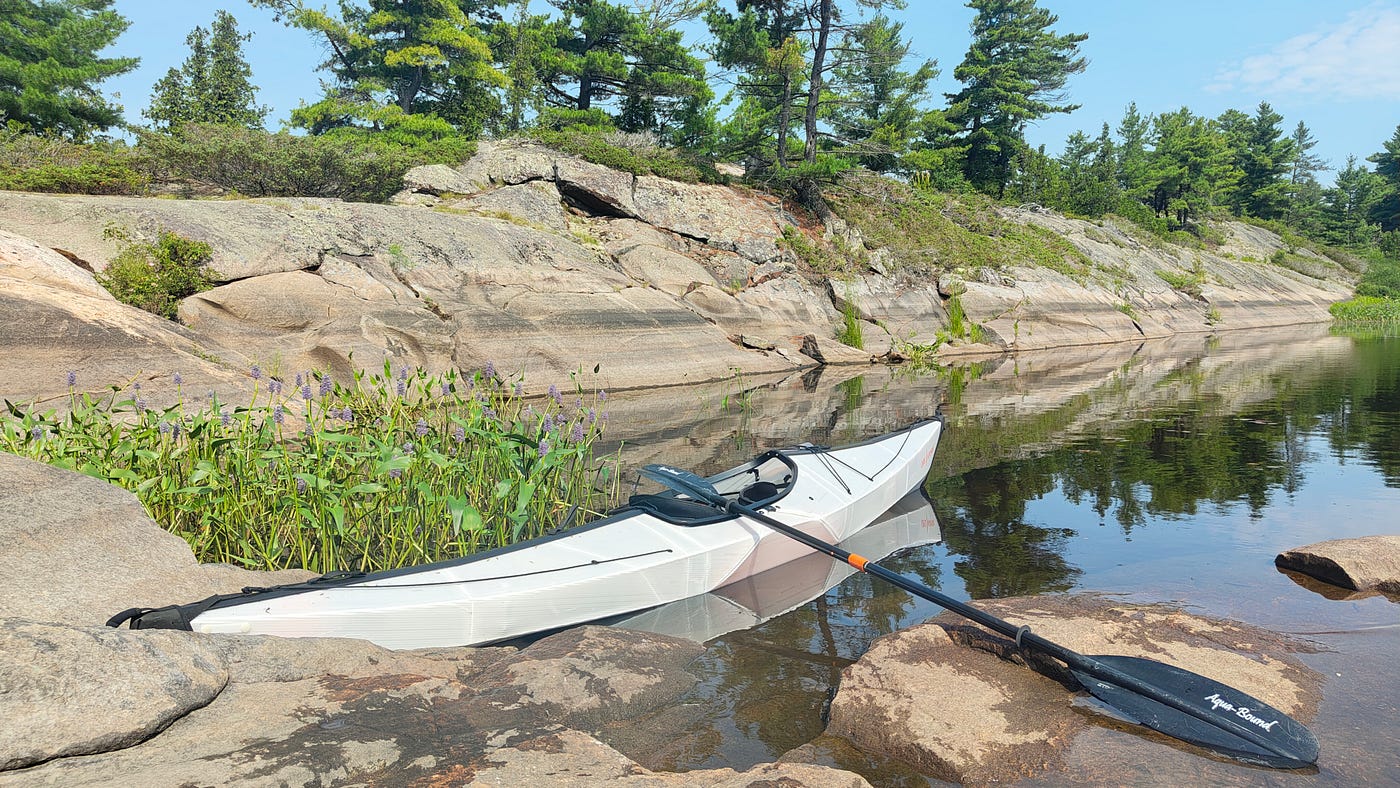
Our destination was French River Provincial Park in Ontario — a system of interconnected rivers and lakes that flows from Lake Nipissing into Georgian Bay (Lake Huron), meandering through rocky formations. Apart from some rapids, the current is minimal, so paddling upstream is nearly as easy as downstream, allowing for flexible loop routes.
Our final route involved ninety kilometers of paddling on flatwater, a few portages of varying difficulty, several rapids, and a few kilometers of choppy water in Georgian Bay. We camped at four different sites and stopped at several others for lunch. Our group included three people: two in a canoe, and myself in the kayak.

My Setup
Having a canoe in the group let me offload some gear to my friends. I packed a 3-person tent in the bow, a 30-liter dry bag with sleeping gear, clothes, and other items behind the seat, along with fishing gear and a dry bag with spare footwear. Since the Oru Bay doesn’t have bulkheads, I filled the stern and other empty areas with air-filled dry bags for flotation. My water bottle stayed under the front bungee cord.


Food, cookware, camping chairs, an axe, and some miscellaneous gear went in the canoe.
For paddling, I used an NRS Ninja life jacket, an AquaBound Eagle Ray Carbon paddle, a spray skirt, and sandals.
Experience
The Oru Bay isn’t the fastest kayak, and its tracking doesn’t compare to longer touring models. But in exchange, it’s highly nimble — great for navigating the narrow, rocky areas common in the French River, especially in the Five Fingers delta system. That agility proved useful more than once.
My kayak kept up with the canoe with ease, and could outpace it when I pushed harder. It also handled headwinds better. While the canoe struggled, I was able to keep moving forward with less effort. That said, tailwinds tend to benefit the canoe more. Thanks to its speed and manoeuvrability, we often used my kayak to scout when unsure of the route.

The spray skirt came in handy in windy conditions and while paddling on Georgian Bay. The kayak handles waves decently, but when waves spill over the deck, the skirt is essential. Water still gradually seeps in, though, so I wouldn’t recommend extended rough-water paddling without proper boat flotation gear.
Portaging the Oru Bay is relatively easy due to its light weight. Most of the time, I just carried it by the cockpit rim. For longer portages, a buddy would help using the built-in handles. Even so, I tried not to overuse those handles — they’re attached to soft neoprene sections at the bow and stern and, while they seem sturdy, I didn’t want to risk tearing them. In general, overloading the kayak isn’t a good idea. Neither the handles nor the cockpit rim are meant for very heavy loads.

Oru claims their kayaks are resistant to punctures and abrasions and can handle sliding over rocks. The French River — with its underwater rocks and rugged portage paths — was a great test of that claim. I did a fair bit of bumping and dragging. The kayak held up well: no punctures, no leaks, and I never had to use the repair kit I brought.

There was some visible wear on the edges — nothing critical, but for my next trip I’ll likely reinforce those areas with tape. I also found a few dents, likely from hitting something sharp. They didn’t puncture the hull; the material seems flexible and tends to deform rather than tear.


At times, I heard strange squeaky noises from behind me. At first, I thought it was a bird chirping, but I realized it coincided with my paddle strokes. I couldn’t pinpoint the source — maybe a strap or the seat — but I found no damage afterwards and it didn’t persist, so I don’t think it’s a real concern.
The biggest issue was the footrest. The adjustment belt buckles kept slipping, so I had to readjust constantly. This had happened before, but on a longer trip it became a serious nuisance. I’m still figuring out a fix — maybe replacing the buckles will help.
Overall, the Oru Bay exceeded my expectations. It was faster, more comfortable, and gave me more confidence on the water than I had anticipated.
Recommendations
Trip Duration
Oru Bay is marketed as a kayak for day trips or light overnight adventures. I admittedly cheated by sharing gear with a canoe. But remember — we also carried extra items like chairs, an axe, and canned food. I had a rugged 3-person tent in the kayak. If you pack light, stick to dry food, filter your water, and leave unnecessary items at home, the Bay has enough room for solo multi-day trips.
Technique
Learn proper paddling technique — use your whole body, not just your arms. This will make you more efficient and reduce fatigue. An introductory paddling course or a few good YouTube tutorials can go a long way. Going on a long tour relying on arm strokes is a mistake.
Seat Configuration
Try lowering the backrest as much as possible so it wraps around your hips rather than your waist. This allows for more efficient body movement and better long-term comfort. It might be different for others, but for me, it was a game-changer.

One small caveat: you may feel the hard cockpit rim against your back. It might seem like a big problem, but you rarely lean back while paddling. If it still bothers you, cover it with something soft.
I also recommend getting the seat wedge from Oru, it’s more ergonomic than just the default flat seat.
Life Jacket
You don’t necessarily need a high-back life jacket like the Oru PFD or NRS Chinook. A standard one worked fine for me. The back of my NRS Ninja stayed above the cockpit rim and never caused discomfort. Still, if you can, try before you buy.

There are also flat-back options like the NRS Odyssey. These sit lower and may add cushioning — possibly solving the cockpit rim issue — but I suspect they might restrict torso rotation during paddling.
Boat Flotation
Be sure to use flotation gear. I used air-filled dry bags instead of Oru’s official float bags. I borrowed the idea from other folding kayak brands, where flotation bags double as storage. Dry bags don’t fill the kayak’s empty space perfectly, so use your best judgment in choosing a setup that works for you.
Conclusion
The Oru Bay can be a versatile companion — from casual day paddles to multi-day expeditions — with a few considerations. Its main limitations are lower durability compared to rigid kayaks, and the lack of bulkheads, which affects flotation. But the trade-off is its light weight and portability — advantages that, in my experience, are well worth it.
You can extend the kayak’s life by treating it gently: rinse sand out of the folds, avoid dragging it, and steer clear of submerged hazards. Flotation bags, either official or improvised, solve the missing bulkhead problem.
With reasonable care and a mindful approach to packing and paddling, the Oru Bay can bring you years of enjoyment.
Good luck on the water, and stay safe!

메타데이터
- post_id
- 0b84d5e4aaa7
- slug
- five-days-in-an-origami-kayak-0b84d5e4aaa7
- url
- https://medium.com/@soljarka/five-days-in-an-origami-kayak-0b84d5e4aaa7
- canonical_url
- https://medium.com/@soljarka/five-days-in-an-origami-kayak-0b84d5e4aaa7
- author_url
- https://medium.com/@soljarka
- status
- ok
- fetched_at
- 2026-06-11 15:16:29