Your Digital ID is coming! Is the Infrastructure Coming With It?
On digital inclusion, structural exclusion, and what South Africa’s proposed Digital Identity system must be accompanied by
Your Digital ID is coming! Is the Infrastructure Coming With It?
On digital inclusion, structural exclusion, and what South Africa’s proposed Digital Identity system must be accompanied by
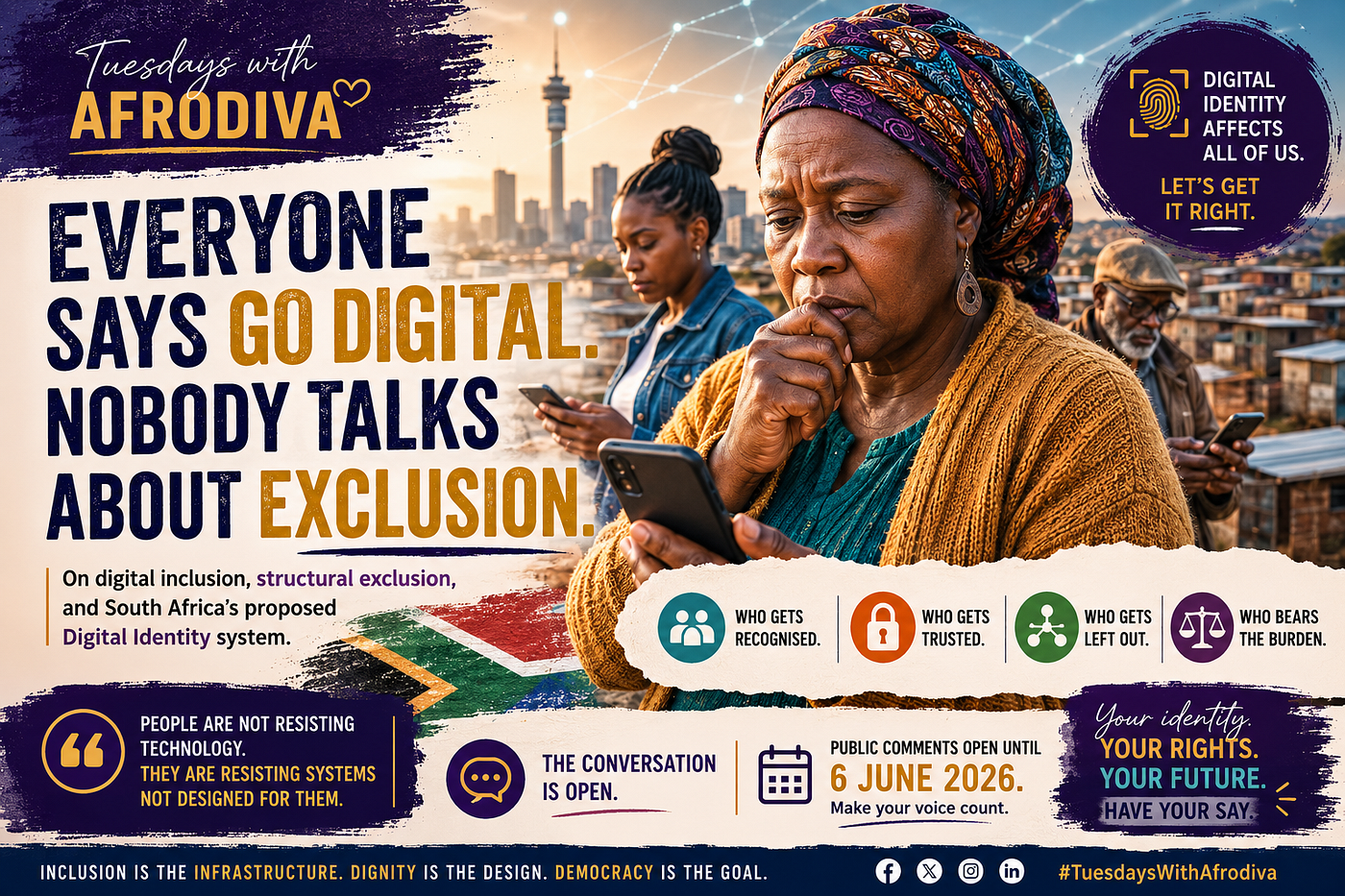
Image generated with the assistance of AI for illustrative purposes and curated by the author.
There was a time when I thought digital inclusion simply meant getting people online:
- A smartphone.
- Data.
- An email address.
- A password.
Problem solved. Or so I thought.
But somewhere between helping women navigate broken systems, watching elders quietly struggle with platforms they never asked for (remember those COVID vaccine registration apps), and listening to young people fluent in apps yet locked out of economic opportunity, I began to understand that digital exclusion is not a personal failing. It is a structural one—and it can be disguised as progress.
You are “connected,” but no one explained the rules. You are “verified,” but still not trusted. You are “visible,” but still unseen. You are told the future is digital, while the infrastructure that would actually make that future accessible—affordable data, reliable networks, affordable devices, practical skills—has not arrived at your door.
We all encounter the friction of digital systems. Forgotten passwords. Customer service bots that cannot resolve real problems. Accounts locked when you need them most. Platforms designed for people with fast connections, recent devices, and hours to spend navigating bureaucracy. These are not individual inconveniences—they are design failures, and they fall hardest on the people with the least margin for error. It is that experience of systems being built without you in mind that determines whether you can work, travel, access services—or simply belong. That is an exclusion.
Digital exclusion does not always look like poverty, but its effects compound it. It is the parent who cannot register her children for school online because the portal requires a device she does not own. The elder who cannot access a government grant because the verification system does not accommodate her. The worker who is navigating a digital process they were never trained for in a language that is not their own. The small trader who is shut out of e-commerce platforms that were designed for people who already have reliable data, banking access, and digital fluency. A citizen quietly concluding that the future was built for someone else, not them.
These are not edge cases. They are the lived reality of millions of South Africans — and they are almost entirely absent from the way we talk about digital transformation. Which brings me to something South Africa is deciding right now—and that most people have not heard about.
The Department of Home Affairs has published draft regulations for a proposed digital identity system. On paper, it sounds efficient and straightforward: secure digital identity credentials that would exist alongside physical IDs, enabling people to verify themselves digitally and access official documents through their smartphones. The department is explicit that it would complement, not replace, physical identity documents.
Public comments are open until 6 June 2026.
Most people will never know that. And that gap — between a policy process happening in public and the public it is supposed to serve — is exactly the problem this story is about.
Digital identity sounds technical. Bureaucratic. Abstract. The kind of thing you leave to experts and technocrats while getting on with your life.
But digital identity is never just about technology.
It is about power. About who gets recognized and who gets questioned. About who the system trusts by default and who carries the burden of proving themselves repeatedly when things go wrong. About who was in the room when these systems were designed and who was expected to simply adapt afterward.
The questions worth asking are not technical ones.
Will ordinary people be able to access and trust these systems — or will they simply be expected to comply? When mistakes happen — and they will — will they be easy to fix, or will people spend months navigating bureaucracy to reclaim their own identity? Will communities currently excluded from digital services be included in the design process or discovered as an afterthought at implementation? Will there be meaningful, accessible offline alternatives when systems fail, phones break, or data runs out? And critically: will this proposal be accompanied by comparable investment in the connectivity infrastructure, affordable devices, and digital skills training that would actually make it usable for everyone?
A digital identity system cannot function in isolation. In South Africa, where nearly 40% of households lack internet access, data costs consume a disproportionate share of low-income budgets, and millions of people have never received structured digital skills training, the infrastructure question is not a footnote. It is the central question. Here is what I have learned from years of working on digital inclusion across the global majority.
People are not resisting technology.
People are resisting systems that were not designed for them—and that have not been accompanied by the investment needed to make them work.
The grandmother, who cannot use a smartphone, was not given the opportunity to learn. The worker navigating a confusing digital process was never trained for it. The small-business owner, overwhelmed by platform requirements, was never included in the design process. These are not individual failures. They are the predictable consequence of rolling out digital systems without investing equally in the conditions that make those systems accessible: affordable devices, reliable connectivity, and practical digital skills at scale.
When we build systems that require digital fluency, people are never given the opportunity to develop—and deploy them without the infrastructure investments that would make them genuinely usable—we are not building the future. We are building a more efficient version of exclusion.
South Africa is at a genuine decision point. A digital identity system, done well, could meaningfully improve how people access services, protect against fraud, and reduce the indignities of a Home Affairs system that has caused real suffering for decades.
Done poorly—or done without the accompanying investments in connectivity, devices, and digital skills—it could deepen the very exclusions it promises to solve. It could create a two-tier society: one where people with reliable internet, smartphones, and digital confidence move smoothly through the system, and one where everyone else accumulates a new category of administrative vulnerability—locked out not by intention, but by the gap between what the system assumes and what people actually have.
The public comment window closes on 6 June 2026.
Whether you are excited, skeptical, hopeful, or worried—this is not a conversation to leave to technocrats alone. The people most affected by how identity systems work are rarely the people designing them. That is precisely why public participation matters and precisely why so few people know it is happening.
The future cannot belong only to those who already have fast internet, affordable devices, and years of digital experience. It must also belong to those still building access, still developing skills, still waiting for the infrastructure investment that makes any of this possible.
What would it take for this digital identity system to work for everyone — not just those already connected? What investments in infrastructure, affordability, and skills would need to accompany it? The comment box is open. Use it.
Public comments on the Draft Regulations for Digital Identity can be submitted to the Department of Home Affairs until 6 June 2026.
메타데이터
- post_id
- 0b99cd58ea5f
- slug
- your-digital-id-is-coming-is-the-infrastructure-coming-with-it-0b99cd58ea5f
- url
- https://medium.com/@theafrodivaspeaks/your-digital-id-is-coming-is-the-infrastructure-coming-with-it-0b99cd58ea5f
- canonical_url
- https://medium.com/@theafrodivaspeaks/your-digital-id-is-coming-is-the-infrastructure-coming-with-it-0b99cd58ea5f
- author_url
- https://medium.com/@theafrodivaspeaks
- status
- ok
- fetched_at
- 2026-07-26 20:20:34




