WeOneNoOne Case Study #5 — How Far Can AI Scale, and How Structural Can It Become?
From Scaling Systems to Structural Sufficiency
WeOneNoOne Case Study #5 — How Far Can AI Scale, and How Structural Can It Become?
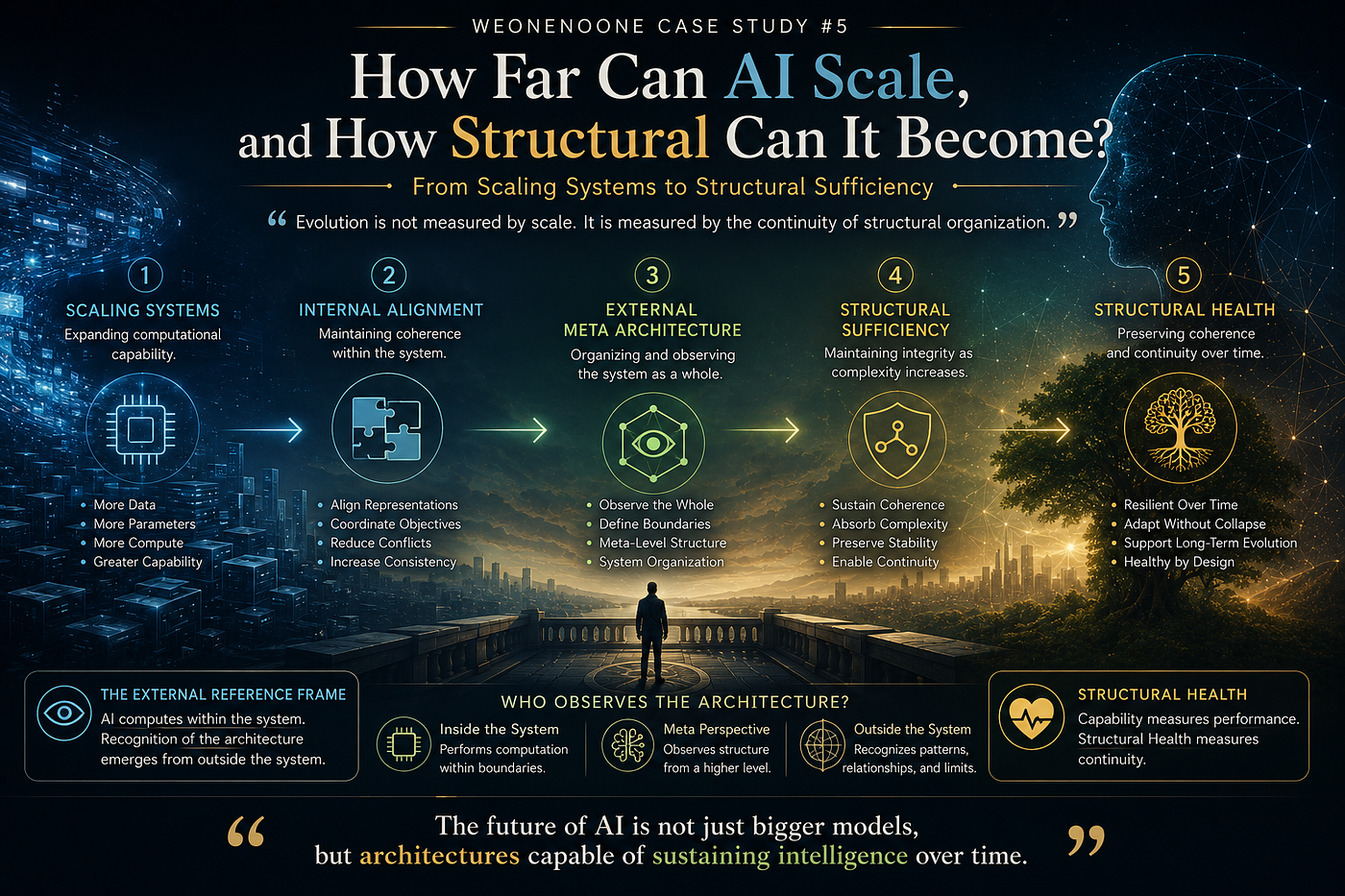
From Scaling Systems to Structural Sufficiency
When we talk about the progress of artificial intelligence, one word appears again and again:
Scale. More GPUs. More data. More parameters. Modern AI systems have demonstrated that increasing scale can produce remarkable improvements in capability.
But an important question remains:
Can AI simply keep getting larger and become continuously more intelligent?
The fifth case study from the WeOneNoOne Foundation approaches this question from the perspective of AI architecture.
It does not compare specific AI models or propose a new algorithm. Instead, it asks a more fundamental question:
As AI becomes increasingly complex, what kind of structure is required to preserve coherence, stability, and continuity?
Looking at Architecture, Not Just Models
When comparing AI systems, we often ask:
- Is GPT better?
- Is Gemini faster?
- Is Claude more capable?
These questions focus on performance. This study asks something different:
What kind of structure makes intelligence possible at increasing levels of complexity?
The object of observation therefore shifts from the model to the architecture.
1. Scaling Systems
Much of modern AI development has been driven by Scaling Systems. The basic idea is straightforward:
Increase the scale, and new capabilities may emerge.
The progression can be represented as:
Scaling Systems
      ↓
Larger Models
      ↓
More Data
      ↓
More Computation
      ↓
Greater Capability
Scaling has clearly been one of the major drivers of recent AI progress. The study does not reject this. Instead, it asks a deeper question:
Does greater capability automatically mean better structure?
A system can become more powerful while simultaneously becoming more difficult to understand, coordinate, or stabilize.
2. Internal Alignment
As AI systems become larger, their internal components must remain increasingly coherent. The study describes this requirement as Internal Alignment. The basic progression is:
Scaling
   ↓
Internal Representations
   ↓
Structural Coordination
   ↓
Coherence
This is one reason AI Alignment has become such an important field.
A highly capable system can still become problematic if its internal objectives, representations, or behaviors become inconsistent as complexity increases.
But the study identifies another limitation:
Internal coherence alone may not be enough to explain the structure of the whole system.
A system can be internally consistent while still lacking a sufficiently organized architecture at the level above it.
3. External Meta Architecture
This is where the case study introduces its central concept: External Meta Architecture.
The idea is not to improve computation inside the AI. It is to introduce a structural level capable of observing and organizing the AI system as a whole.
The relationship can be represented as:
Internal Alignment
        ↓
Structural Boundaries
        ↓
External Meta Architecture
        ↓
System-Level Organization
This concept connects directly to the External Reference Frame introduced in the WeOneNoOne Foundation.
Computing from within a system and understanding the architecture of that system are fundamentally different tasks.
The first is an internal function. The second requires a meta-level perspective.
4. Structural Sufficiency
The most important concept in this case study is Structural Sufficiency. Structural sufficiency does not mean that an AI system has become sufficiently large. It means that the architecture remains capable of maintaining coherence as complexity continues to increase.
The progression becomes:
Scaling
   ↓
Alignment
   ↓
Meta Architecture
   ↓
Structural Sufficiency
A highly capable AI and a structurally sufficient AI are therefore not necessarily the same thing. One measures what the system can do.
The other asks whether the system can remain structurally coherent while continuing to evolve.
AI Evolution May Be About Structure, Not Size
The study proposes a broader model of AI development:
Scaling Systems
        ↓
Internal Alignment
        ↓
External Meta Architecture
        ↓
Structural Sufficiency
        ↓
Structural Evolution
This changes the way AI progress is understood.
Instead of measuring evolution primarily through:
- GPU count,
- parameter count,
- benchmark scores,
the study proposes looking at the organization and continuity of structure.
Evolution is not measured only by scale. It is measured by the continuity of structural organization.
The External Reference Frame
This raises another question:
Who — or what — can observe the architecture itself?
Once again, the concept of the External Reference Frame becomes relevant. An AI system can perform computations within its own architecture.
But recognizing the architecture as a whole requires a perspective capable of stepping outside its internal operations. The study summarizes this distinction:
“Architecture evolves within the system. Recognition emerges outside the system.”
The architecture develops internally. The recognition of that architecture requires a meta-level perspective.
What Is a Structurally Healthy AI?
The study finally introduces the concept of Structural Health.
Structural health is not simply:
- benchmark performance,
- inference speed,
- model size,
- computational efficiency.
Instead, it refers to the ability of the entire architecture to maintain coherence over time. This distinction can be summarized as:
Capability measures performance. Structural Health measures continuity.
A system may become more capable while simultaneously becoming more fragile.
Structural health asks whether capability can continue to grow without destroying the coherence of the architecture that supports it.
Five Levels of AI Structural Evolution
The framework therefore proposes five connected concepts:
1. Scaling Systems
Expanding computational capability.
2. Internal Alignment
Maintaining coherence within the system.
3. External Meta Architecture
Organizing and observing the system at a higher structural level.
4. Structural Sufficiency
Maintaining structural integrity as complexity increases.
5. Structural Health
Preserving coherence and continuity over time.
Together, these form a possible path from increasing capability to sustainable structural evolution.
Beyond Bigger Models
This case study does not propose a new AI model. Nor does it attempt to replace existing AI research. Instead, it proposes expanding the perspective from capability to architecture.
The question is no longer simply:
How much more powerful can AI become?
It becomes:
How much complexity can an AI architecture sustain while remaining coherent, observable, and structurally healthy?
That may become one of the central questions of the next stage of AI development.
Conclusion
AI is becoming increasingly powerful. But the next major challenge may not simply be building larger models.
It may be building architectures capable of sustaining greater complexity without losing structural coherence.
The fifth case study of the WeOneNoOne Foundation therefore treats AI not merely as a computational system, but as an evolving architecture.
From Scaling Systems, through Internal Alignment and External Meta Architecture, toward Structural Sufficiency and Structural Health, the study proposes a different way of thinking about AI progress.
Perhaps the future of intelligence will not be determined only by how large a system becomes,
but by how well its structure can continue to hold together as it grows.
메타데이터
- post_id
- 0ba9a51f0ea0
- slug
- weonenoone-case-study-5-how-far-can-ai-scale-and-how-structural-can-it-become-0ba9a51f0ea0
- url
- https://medium.com/@weonenoone/weonenoone-case-study-5-how-far-can-ai-scale-and-how-structural-can-it-become-0ba9a51f0ea0
- canonical_url
- https://medium.com/@weonenoone/weonenoone-case-study-5-how-far-can-ai-scale-and-how-structural-can-it-become-0ba9a51f0ea0
- author_url
- https://medium.com/@weonenoone
- status
- ok
- fetched_at
- 2026-08-12 19:10:20




