NNPC Raises Petrol to N960: Why Domestic Refining Didn’t Stop the 24% Price Shock
Nigeria imports zero petrol. Dangote produces 65 million litres daily. Yet prices jumped from N774 to N960 in one day. The Middle East…
NNPC Raises Petrol to N960: Why Domestic Refining Didn’t Stop the 24% Price Shock
Nigeria imports zero petrol. Dangote produces 65 million litres daily. Yet prices jumped from N774 to N960 in one day. The Middle East crisis reveals the limits of domestic refining when crude is purchased at global prices. Plus: Dangote’s 1,000 CNG trucks signal logistics transformation.
Fuel Price Watch • March 5, 2026 • 10 min read
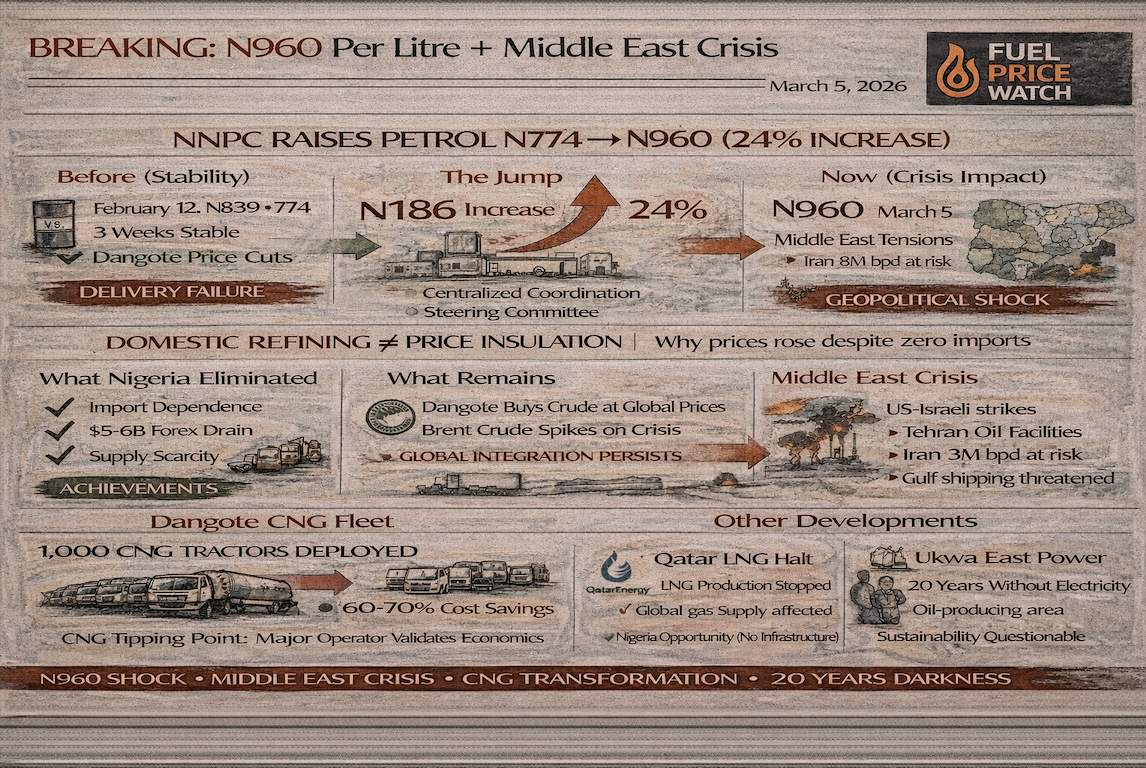
On March 5, 2026, NNPC Limited increased petrol prices from N774 to N960 per litre. That’s an N186 increase, representing 24% price shock.
This comes after three weeks of price stability following Dangote Refinery’s price cuts on February 12 (from N839 to N774). Nigerians experienced sustained lower prices, stable supply, and zero fuel queues for the first time in years.
Then, overnight, prices jumped 24%.
The reason: Middle East crisis. US-Israeli strikes targeted Tehran oil facilities, escalating Gulf tensions and threatening global oil supply.
But here’s what makes this price increase significant: Nigeria currently imports zero petrol. Dangote Refinery produces 65 million litres daily, exceeding Nigeria’s 50–60 million litres daily consumption. We are entirely self-sufficient in petrol supply for the first time in decades.
So why did prices rise 24% when Nigeria doesn’t import petrol anymore?
The answer reveals both the achievements and limitations of domestic refining, the reality of global crude market integration, and why energy independence doesn’t mean price insulation.
The Middle East Crisis That Triggered the Increase
US-Israeli military strikes targeted oil production facilities in Tehran on March 5, escalating Gulf region tensions that have been building for weeks.
The Immediate Impact
Iran produces approximately 3 million barrels per day of crude oil. Strikes on production infrastructure create several supply concerns:
Production Disruption: Damaged facilities reduce Iran’s output capacity. Even if strikes didn’t completely halt production, they create uncertainty about Iran’s ability to maintain current output levels.
Shipping Route Threats: The Strait of Hormuz, through which roughly 21 million barrels per day flow (about 21% of global petroleum liquids consumption), faces heightened security risks. Any disruption to this shipping chokepoint affects global supply chains.
Regional Escalation: Strikes on Iran could trigger retaliation against other Gulf producers or infrastructure, expanding disruption beyond Iranian facilities.
Market Psychology: Beyond actual supply disruption, the perception of risk drives oil prices. Traders price in potential future disruptions, pushing prices higher even before physical shortages materialize.
OPEC+ Had Anticipated This
On March 2 (three days before strikes), OPEC+ approved oil production increases specifically anticipating Gulf crisis escalation. The production hike aimed to build supply cushion that could absorb potential disruptions without catastrophic price spikes.
But production increases take time to flow through supply chains. OPEC+ members need weeks or months to ramp up output, transport increased volumes to refineries, and deliver refined products to markets.
Meanwhile, strikes create immediate supply concerns. The time lag between OPEC+ production increases and their market impact means prices spike despite OPEC+ action.
Brent Crude Surge
While specific Brent crude prices following strikes haven’t been disclosed, the pattern is predictable: Middle East supply concerns typically drive Brent crude from recent $70+ levels to $80–90+ range within days.
Every $10 increase in Brent crude translates to roughly N50–70 per litre increase in refined product costs when accounting for refining margins, distribution, and exchange rates.
If Brent spiked $15–20 on crisis news, that explains the N186 per litre increase Nigerian consumers are experiencing.
Why Nigeria Couldn’t Escape the Price Increase
This is the critical question. Nigeria now has:
- Dangote Refinery producing 65 million litres petrol daily
- Domestic consumption of 50–60 million litres daily
- Zero petrol imports (42.2% decline from previous 42.9 million litres daily imports to 24.8 million, and further reduction since)
- Complete supply self-sufficiency
Nigeria achieved what policymakers promised for 50 years: domestic refining capacity meeting national demand without imports.
Yet prices rose 24% when global crude markets reacted to Middle East crisis.
The Crude Feedstock Reality
Dangote Refinery refines petroleum products domestically. But it purchases crude oil feedstock at global market prices.
Where Dangote Gets Crude:
Currently, Dangote imports significant crude volumes from the United States and Brazil because Nigerian crude allocation to Dangote has been limited. NNPC and international oil companies producing in Nigeria prioritize export contracts over domestic refinery supply.
When Dangote purchases American or Brazilian crude, it pays international prices denominated in US dollars. These prices track Brent crude benchmark.
Even Nigerian crude purchased domestically is priced at international rates minus a modest discount for freight savings. Nigerian producers won’t sell crude to Dangote at significantly below-market prices because they can export at full international prices.
The Economics:
When Brent crude is $70 per barrel, Dangote pays approximately $70 per barrel for feedstock (whether imported or purchased domestically).
When Brent spikes to $85–90 per barrel on Middle East crisis, Dangote pays $85–90 per barrel for feedstock.
Higher crude input costs = higher refined product output costs.
This is true regardless of whether refining happens in Nigeria or abroad.
Dangote refining in Lagos versus refining in Rotterdam makes no difference to crude input costs. Both pay global market prices for crude feedstock.
What Domestic Refining Did Achieve (And Didn’t)
Understanding what domestic refining accomplished versus what it couldn’t address is essential for realistic expectations.
What Domestic Refining Eliminated:
Import Dependence: Nigeria no longer relies on refined product imports from international refineries. This eliminates vulnerability to international refinery outages, shipping disruptions, or foreign exchange shortages preventing import purchases.
Foreign Exchange Drain: Importing 42.9 million litres daily cost approximately $400–500 million monthly in foreign exchange. The 42.2% import decline (February 16 data) saved $5–6 billion annually in forex. This strengthens Nigeria’s external reserves and reduces pressure on the naira.
Supply Scarcity: Fuel queues, hoarding, and scarcity-driven price gouging are eliminated when domestic production exceeds consumption. Supply security is real achievement.
Employment and Economic Activity: Dangote Refinery employs thousands directly and creates economic activity through logistics, services, and downstream businesses. This is domestic value creation versus sending money abroad for imports.
Strategic Autonomy: Nigeria controls its fuel supply chain rather than depending on international suppliers who can withhold products during disputes or prioritize other markets during shortages.
These achievements are substantial and transform Nigeria’s energy security fundamentally.
What Domestic Refining Didn’t Eliminate:
Global Crude Price Exposure: As long as Dangote (or any domestic refinery) purchases crude at international prices, refined product prices track global crude markets. Domestic refining doesn’t insulate Nigeria from crude price volatility.
Exchange Rate Sensitivity: Crude purchases in dollars mean naira devaluation increases costs even when crude prices remain stable. If naira weakens from N1,350/$ to N1,500/$, crude costs increase 11% in naira terms without any change in dollar-denominated crude prices.
Geopolitical Risk Transmission: Middle East crises, OPEC production decisions, and global supply disruptions still affect Nigerian fuel prices through crude market channels.
Nigeria achieved energy supply independence but not energy price independence.
The Domestic Crude Supply Solution (That Doesn’t Exist Yet)
There is a theoretical solution to Nigeria’s continued crude price exposure: domestic crude supply to domestic refineries at cost-based pricing rather than international market pricing.
The Logic:
Nigerian crude belongs to Nigeria. When NNPC or indigenous producers extract crude from Nigerian fields, production costs are approximately $15–30 per barrel (varying by field and operator).
If Nigeria allocated crude to Dangote at cost-based pricing ($20–25 per barrel) plus reasonable margin ($5–10 per barrel), Dangote could purchase crude at $30–35 per barrel regardless of international Brent prices.
Refining crude at $30–35 per barrel versus $70–90 per barrel would enable dramatically lower petrol prices ($N400–500 per litre range) that remain stable despite global crude market volatility.
Why This Doesn’t Happen:
Opportunity Cost: Every barrel sold to Dangote at $30–35 is a barrel not exported at $70–90. Nigerian producers (NNPC, IOCs, indigenous operators) lose $35–55 per barrel by supplying domestically versus exporting.
For NNPC producing 400,000 bpd, domestic supply at cost-based pricing means $14–22 million daily revenue loss ($5–8 billion annually) compared to export sales.
Foreign Exchange Considerations: Exporting crude generates dollar revenues Nigeria needs for imports, debt service, and foreign exchange reserves. Domestic crude supply generates naira revenues. Given Nigeria’s forex constraints, prioritizing dollar-earning exports over naira-earning domestic supply makes economic sense.
Contractual Obligations: Many Nigerian crude volumes are committed to international buyers through long-term contracts. Breaking these contracts to supply Dangote creates legal and commercial complications.
Political Economy: International oil companies operating in Nigeria prioritize exports to parent company refineries globally. Forcing them to divert crude to Dangote would create investment disputes and potentially deter future investment.
The Policy Choice:
Nigeria could mandate that a percentage of crude production (say, 30–40%) must be sold to domestic refineries at cost-based pricing, with the remainder available for export at international prices.
This would require:
- Legislation or executive action overriding producer discretion
- Compensation mechanisms addressing producer revenue losses
- Renegotiation of international supply contracts
- Balancing domestic supply requirements against foreign exchange needs
No such policy exists currently. Domestic refineries purchase crude at near-international prices, meaning refined product prices track global markets.
Dangote’s 1,000 CNG Trucks: The Logistics Transformation
While petrol prices jumped 24%, Dangote Group announced deployment of 1,000 CNG-powered tractors and semi-trailers for distribution logistics.
This represents fundamental transformation in how fuel is distributed across Nigeria.
The Economics of CNG for Heavy Transport
Compressed natural gas costs approximately N200–300 per litre-equivalent for fuel. Diesel costs N900–1,100+ per litre (and likely rising alongside petrol).
For heavy trucks and tractors:
- Diesel consumption: 3–5 litres per kilometer (depending on load and terrain)
- CNG consumption: Equivalent energy at 60–70% lower cost
For 1,000 trucks operating 300 km daily:
- Daily diesel cost: 900,000–1,500,000 litres × N1,000 = N900 million-N1.5 billion
- Daily CNG cost: Equivalent energy × N250 = N270–450 million
- Daily savings: N450–1,050 million
- Annual savings: N164–383 billion
Even accounting for CNG infrastructure costs (compression stations, truck conversions, maintenance), the savings are enormous.
Why This Matters Beyond Dangote
When a major logistics operator like Dangote achieves 60–70% fuel cost reduction through CNG adoption, competitive pressure forces industry-wide transformation:
Other logistics companies must switch to CNG or accept cost disadvantage that makes them uncompetitive for contracts. If Dangote can transport fuel at 60% lower cost than diesel-powered competitors, Dangote wins logistics contracts.
This creates virtuous cycle:
- Major operators adopt CNG
- Demand for CNG infrastructure increases
- Compression stations become profitable investments
- Infrastructure expands
- CNG becomes accessible to smaller operators
- Adoption accelerates
CNG Ecosystem Convergence
Multiple CNG initiatives are converging simultaneously:
- Presidential CNG Initiative (government support and policy)
- MEA Energy’s 250 automated retail stations (some with CNG capability)
- NARTO reporting 30% cost reduction for CNG vehicles
- Tetracore and Tulip compression facilities opening
- Now Dangote’s 1,000-truck fleet conversion
This ecosystem development is reaching critical mass where CNG transitions from niche alternative to mainstream fuel for commercial transport.
The Strategic Irony
Nigeria is deploying CNG for transport while petrol prices spike on global crude volatility. CNG insulates Nigeria from global oil price fluctuations because:
- Nigeria has 209 TCF domestic gas reserves
- Gas is produced domestically, not imported
- CNG pricing isn’t tied to international crude markets
- Gas-to-CNG conversion happens entirely within Nigeria
CNG provides the price stability and independence that domestic petrol refining doesn’t deliver because gas is truly domestically sourced and priced, while crude feedstock for petrol refining is internationally priced.
The more Nigeria shifts transport fuel from petrol to CNG, the more Nigeria insulates from global oil price shocks.
The Other Developments: Qatar and Ukwa East
QatarEnergy LNG Production Halt
QatarEnergy announced halt to downstream production following LNG export suspension. Qatar is one of the world’s largest liquefied natural gas exporters.
This creates global gas supply concerns and upward pressure on LNG prices. For Nigeria, it represents missed opportunity:
Nigeria has 209 TCF gas reserves but limited LNG export infrastructure. Dangote Fertilizer monetizes some gas (converting to urea), and Nigeria LNG Limited exports LNG, but capacity is constrained.
If Nigeria possessed large-scale gas-to-LNG infrastructure, Qatar’s production halt would create lucrative export opportunity. Instead, Nigeria continues flaring 203.9 billion scf annually while global gas markets tighten.
Ukwa East Power After 20 Years
Governor Alex Otti ordered electricity restoration to Ukwa East Local Government Area (oil-producing region in Abia State) after 20 years without power.
The area lost electricity due to vandalism. Rather than repair infrastructure and secure it, authorities disconnected the community entirely for two decades.
This represents recurring pattern in oil-producing regions: communities produce national wealth while living without basic services (electricity, water, roads, healthcare, education). Grievances over resource extraction without local benefit drive vandalism, theft, and militancy, which then trigger punitive disconnection rather than investment in infrastructure and security.
Whether restoration proves sustainable depends on:
- Addressing underlying community grievances over resource sharing
- Securing infrastructure against vandalism through community engagement, not just enforcement
- Maintaining power supply consistently rather than symbolic reconnection
Nigeria has announced many such restorations before. Sustainability requires solving root causes, not just fixing immediate infrastructure.
What March 5 Reveals
Domestic Refining’s Real Limits
Nigeria achieved remarkable milestone: domestic refining capacity exceeding national consumption, zero petrol imports, supply security. But N774 to N960 (24% increase) in one day proves domestic refining doesn’t insulate from global crude price volatility when refineries buy crude at international prices.
Energy supply independence ≠ energy price independence.
The Missing Piece: Domestic Crude Supply
Until Nigeria implements policy mandating cost-based domestic crude allocation to domestic refineries, refined product prices will track international crude markets regardless of where refining occurs.
This requires political will to accept opportunity cost (lost export revenue) in exchange for price stability and consumer benefit.
CNG as True Independence
Ironically, CNG provides price stability domestic petrol refining doesn’t deliver because gas is genuinely domestically sourced and priced. Dangote’s 1,000 CNG trucks signal transition toward fuel that actually insulates Nigeria from global volatility.
The Recurring Patterns
Oil-producing communities without electricity for 20 years. Qatar halting LNG while Nigeria flares gas. Remarkable progress (Dangote refinery) coexisting with persistent failures (domestic crude supply policy, gas monetization).
Nigeria’s energy sector remains unfinished transformation: achievements proving what’s possible, gaps revealing what’s missing, contradictions defining reality.
About Fuel Price Watch
Fuel Price Watch provides real-time, crowd-sourced fuel price data across Nigeria. Our mission is transparency in Nigeria’s fuel market. We report what’s happening without modification or spin.
Track fuel prices in your area and contribute updates at **app.fuelpricewatch.com**
Stay informed. Stay fueled.
Sources:
- NNPC Limited petrol price increase announcement, March 5, 2026
- US-Israeli strikes on Tehran oil facilities, March 5, 2026
- Dangote Group CNG logistics deployment, March 5, 2026
- QatarEnergy production halt, March 5, 2026
- Ukwa East power restoration order, March 5, 2026
메타데이터
- post_id
- 0baa8f74fbce
- slug
- nnpc-raises-petrol-to-n960-why-domestic-refining-didnt-stop-the-24-price-shock-0baa8f74fbce
- url
- https://medium.com/@fuelpricewatchteam/nnpc-raises-petrol-to-n960-why-domestic-refining-didnt-stop-the-24-price-shock-0baa8f74fbce
- canonical_url
- https://medium.com/@fuelpricewatchteam/nnpc-raises-petrol-to-n960-why-domestic-refining-didnt-stop-the-24-price-shock-0baa8f74fbce
- author_url
- https://medium.com/@fuelpricewatchteam
- status
- ok
- fetched_at
- 2026-06-20 20:29:01