Different Models, Same Logic: How LLMs Converge on Shared Reasoning Patterns
A team from Shanghai Jiao Tong University just dropped a new paper on arXiv asking a question that’s been quietly bugging the field: when…
Different Models, Same Logic: How LLMs Converge on Shared Reasoning Patterns
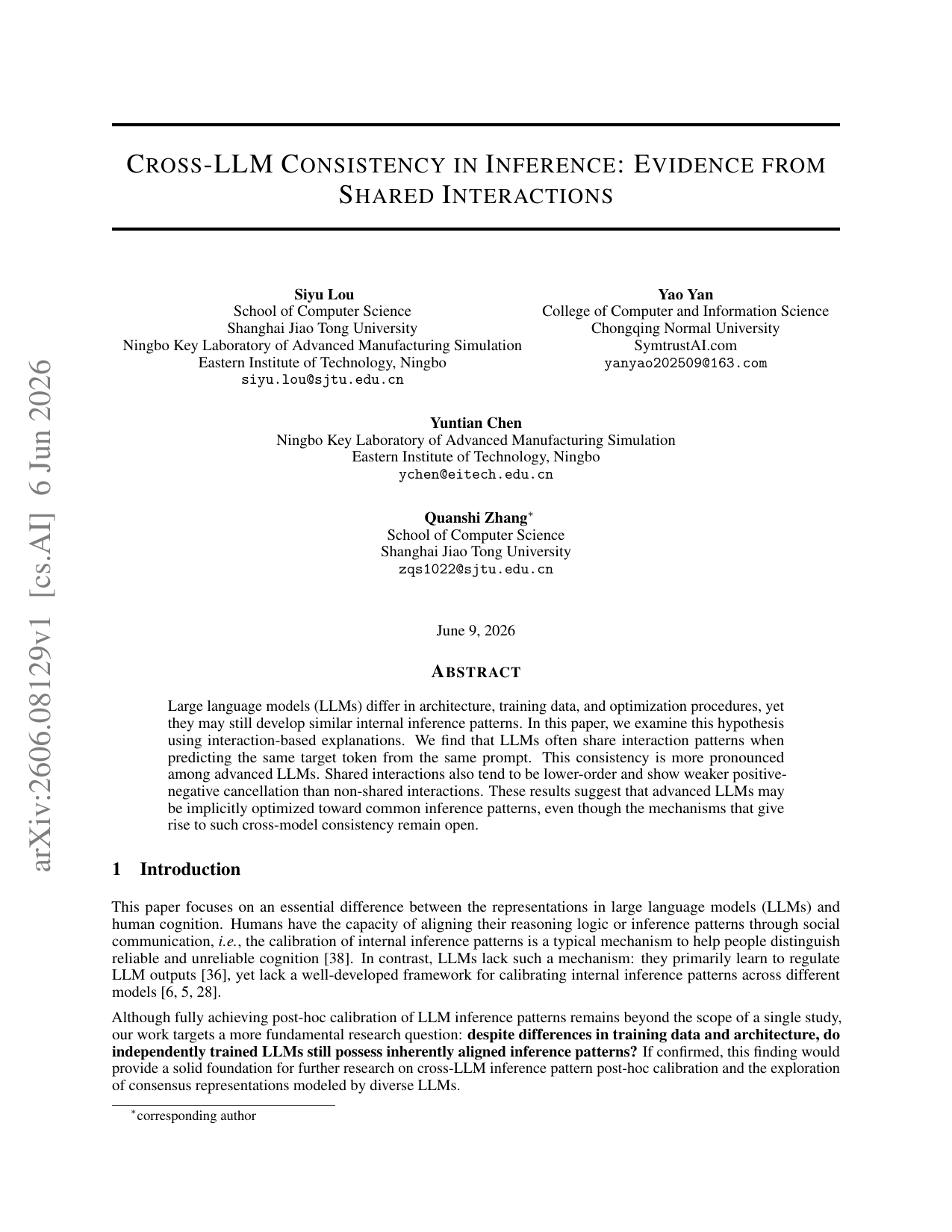
A team from Shanghai Jiao Tong University just dropped a new paper on arXiv asking a question that’s been quietly bugging the field: when large language models are trained on different architectures, different data, completely independently — do they actually reason differently under the hood, or do they somehow converge on the same internal logic?
To answer that, you first need a way to quantify reasoning logic. They reached for interaction-based explanations, a framework that’s matured quite a bit over the past couple of years. The intuition is this: a model doesn’t predict the next token based on individual input tokens acting alone. It’s combinations of short phrases that do the work. Say both “strong” and “spatial” appear in the input — that co-occurrence gets activated and contributes a measurable boost to the predicted score for a target word like “variation.”
These patterns that only fire when certain words appear together are called interactions. And it can be proven theoretically that the effective interactions within any given sentence are sparse — typically somewhere between 50 and 150 — and that they can be assembled into an AND-OR logic model that nearly perfectly replicates the original model’s output across all possible masking conditions. In other words, these interactions can be treated as the actual atomic units of reasoning the model is using — primitive inference patterns.
That gives you a principled basis for comparison: take two models, feed them the same sentence with the same target word, extract their interactions, and check the overlap.
The first finding: overlap genuinely exists, and stronger models share more of it.
The second: the shared interactions tend to be low-order — simple patterns involving only a handful of words. The interactions that are unique to each model, by contrast, skew high-order and complex.
The third: those unshared, model-specific interactions largely cancel each other out. Positive effects — combinations that push the model toward predicting the target word — and negative effects — combinations that suppress it — offset each other, leaving the net contribution small.
They capture this with a metric called κ, which measures how much of a model’s prediction is built on shared interactions. For stronger models like Qwen3–8B, Qwen2.5–14B, LLaMA3–8B, and DeepSeek-R1-Distill, pairwise κ values run from 60.99% to 77.46% — meaning more than two-thirds of what these models are actually doing rests on a common underlying logic.
And this similarity cuts across model families: Qwen, LLaMA, DeepSeek, Gemma, GLM. It can’t be explained by shared lineage. Flip the lens to older, weaker models — BERT, RoBERTa, Falcon — and they lean far more heavily on their own idiosyncratic patterns.
The authors are clear about scope: this currently covers single target-word prediction, not multi-step generation, and compute constraints meant larger closed-source models weren’t tested. But the core result is striking enough. Independent models, trained from scratch by different teams, appear to be converging on a shared set of primitive reasoning patterns — and the stronger the model, the more pronounced that convergence becomes.
| Find papers faster on arXivSub with AI summary (CVPR/ICCV/ICML/ICLR/NeurIPS/AAAI/MICCAI)

메타데이터
- post_id
- 0bb86f332076
- slug
- different-models-same-logic-how-llms-converge-on-shared-reasoning-patterns-0bb86f332076
- url
- https://medium.com/@zljdanceholic/different-models-same-logic-how-llms-converge-on-shared-reasoning-patterns-0bb86f332076
- canonical_url
- https://medium.com/@zljdanceholic/different-models-same-logic-how-llms-converge-on-shared-reasoning-patterns-0bb86f332076
- author_url
- https://medium.com/@zljdanceholic
- status
- ok
- fetched_at
- 2026-06-16 19:09:56