On Analogies Between the Human Brain and AI: Memory
What does it mean to “store” information in the brain, and why can two people who shared the same experience later describe it in…
On Analogies Between the Human Brain and AI: Memory
What does it mean to “store” information in the brain, and why can two people who shared the same experience later describe it in surprisingly different ways?

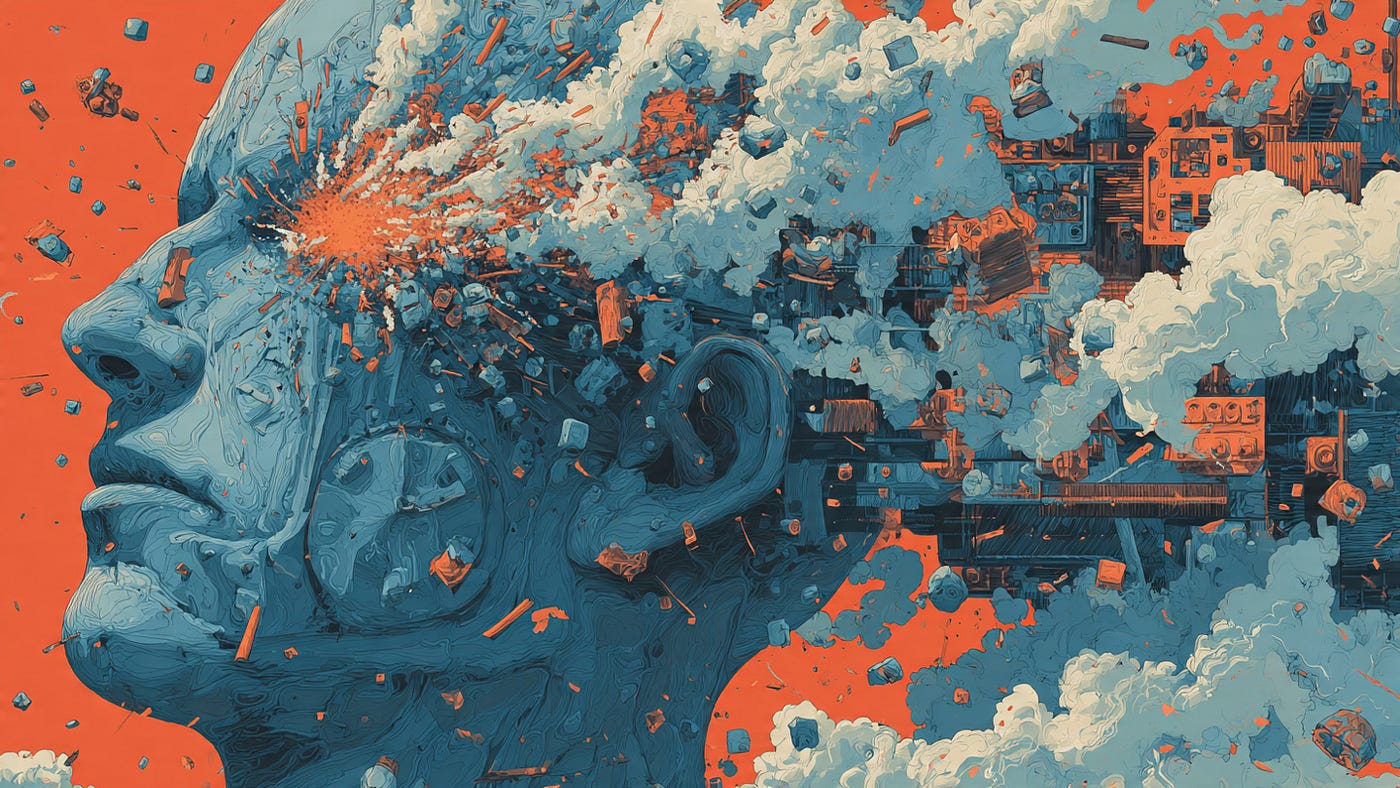
Photo taken and edited by author
Your memories of that wonderful island vacation last year may still be vivid and detailed, yet you might struggle to remember the name of a colleague you met only yesterday. How can the same capacity for storing information produce such different results? And why can two people who shared the same experience later describe it in surprisingly different ways?
At least computers store information reliably. A file saved long ago can be retrieved unchanged, provided you know where to find it. Yet modern artificial intelligence systems, despite being trained on enormous amounts of data, can sometimes generate facts that never existed. So what exactly does it mean to “store” information, and are biological and artificial neural networks really as different in this respect?
The ability to remember is one of the most widely recognised functions of the human brain. It plays a central role in learning, and individuals are often distinguished by their capacity to store and recall information. In everyday language we commonly say that someone has a “good memory,” in much the same way we might describe a person as having strong muscles or exceptional eyesight.
Unlike organs involved in these traits, memory is not localised to a single place in the brain where information is simply stored. Instead, several interconnected brain regions contribute to different aspects of memory. In the scientific literature, these systems are typically classified according to duration — such as sensory, short-term, and long-term memory — and according to accessibility, distinguishing between explicit and implicit memory.
This broad classification is relatively intuitive. Short-term (or working) memory, for example, allows us to temporarily keep recently heard words during a conversation, yet the information fades quickly if it is not reinforced. Implicit memory, in contrast, operates largely outside conscious awareness. A person may learn how to swing a tennis racket and successfully hit a ball, yet still be unable to verbally describe the precise sequence of muscle activations involved in that movement.
Despite the functional diversity of these memory systems, their underlying biological foundation is largely similar: networks of interconnected neurons. The identification of brain structures involved in memory is relatively recent. Early insights came from studying patients with localised brain damage, while more recent advances have been driven by brain imaging techniques that allow researchers to observe which regions become active during specific cognitive tasks.
Nevertheless, the idea that experiences are stored within networks of interconnected elements and later retrieved through appropriate cues dates back more than a hundred years to the work of Richard Semon. He also introduced the term *engram* to describe this, now empirically observable, neural trace of memory. Despite its relevance, this concept has only rarely found its way into standard school textbooks.
For some time, computers appeared to provide a more useful metaphor for understanding memory. In the von Neumann architecture, information is stored in memory encoded as binary digits, ones and zeros. This memory is clearly separated from the processor, and program instructions can always be distinguished from the data on which they operate. At first glance, human thinking may seem to follow a similar pattern: we recall stored facts and perform various operations on them. However, as discussed earlier, the brain does not contain separate executive and memory units. Instead, it operates differently.
Machine learning systems, particularly Large Language Models, do not fit into the classical instruction-based paradigm too. In these models, information is distributed across the entire network, and it is not possible to localise where specific facts are stored. As a result, we cannot meaningfully speak of a distinct memory component within the model itself. To be more precise, temporary information such as chat history can be stored and used during interaction, but this mechanism exists outside the model itself and must be created and maintained separately.
This also means that individual pieces of information embedded in the artificial neural network cannot be directly modified or removed — operations that are trivial in conventional software systems. Instead, knowledge is encoded across the model’s parameters as a whole. To determine whether a language model contains a particular piece of information, we must query it appropriately.
Moreover, because both training and inference are highly context-dependent, accurate retrieval depends strongly on how the question is formulated. In practice, the model is more likely to produce correct information when the query resembles patterns encountered during training.
This behaviour more closely resembles explicit memory in humans, which is also acquired and retrieved in a context-dependent manner. Although working memory allows us to temporarily hold diverse pieces of information that are readily accessible, recalling long-term memories typically requires conscious processing that links these elements to appropriate cues. In other words, when answering a question, the brain reconstructs relevant information based on a combination of linguistic input and contextual signals.
If information is encoded within network structures and depends on specific input patterns for its storage and retrieval, it cannot be deliberately “cleared” in a straightforward way. To forget something, the underlying network would need to be reorganised. More precisely, it would need to stop responding to the cues originally associated with that information. In other words, there is no central executive mechanism in the brain that can simply delete a stored memory.
Moreover, memories are rarely erased entirely. Instead, they are gradually modified or, more often, become inaccessible, as suggested by recent research. Yet even such buried traces of the past may resurface when we are exposed to the right cues. This helps explain why certain memories — particularly those associated with traumatic experiences — can be so persistent and difficult to forget permanently.
There are further implications of this perspective. Our memories are not inherently “time-stamped.” While some can be linked to specific events that we can place in time and space, in many cases it is difficult to determine when and where a particular memory was formed. Similarly, attributing information to a specific source is not automatic; it requires the formation of an additional association. As a result, we often struggle to recall where we learned certain facts or who originally conveyed them.
This also helps explain why people sometimes unintentionally adopt or reproduce others’ ideas as their own. Such occurrences are less a matter of deliberate intent and more a consequence of how our memory is structured and retrieved.
Finally, our memories are not stored in isolation but are continuously integrated into an existing network that is constantly being updated. This resembles the training process of language models, where the ability to reproduce facts emerges gradually through parameter updates, and excessive training can overwrite previously learned information.
Similarly, new information in the brain is incorporated into existing structures and linked to prior knowledge. This helps explain why memories of shared experiences can differ so significantly between individuals. The same sensory input may trigger different internal processes, as each person has learned to respond to patterns in their own way. Moreover, the context provided by prior experience is highly individual, sometimes leading to markedly different interpretations of the same event.
Over time, the act of recalling and retelling an experience further reshapes it. Each retrieval involves reconstructing the memory using connections to other stored information, rather than reproducing it exactly as it originally occurred. Despite this, such memories can feel vivid and certain. This discrepancy between confidence and accuracy provides fertile ground for persistent disagreements about past events, our common history.
메타데이터
- post_id
- 0bc25efa41bb
- slug
- on-analogies-between-the-human-brain-and-ai-memory-0bc25efa41bb
- url
- https://medium.com/brain-labs/on-analogies-between-the-human-brain-and-ai-memory-0bc25efa41bb
- canonical_url
- https://medium.com/brain-labs/on-analogies-between-the-human-brain-and-ai-memory-0bc25efa41bb
- author_url
- https://medium.com/@bohus.ziskal
- status
- ok
- fetched_at
- 2026-06-11 05:11:55