Agentic AI: The Shift from Passive Chatbots to Action Bots
For years, the promise of Artificial Intelligence was centered on conversation. We marveled at LLMs that could write poetry, debug code, or…
Agentic AI: The Shift from Passive Chatbots to Action Bots
For years, the promise of Artificial Intelligence was centered on conversation. We marveled at LLMs that could write poetry, debug code, or explain quantum physics in the style of a pirate. But as we move through 2026, the novelty of “chatting” has worn off. The industry has reached a tipping point where users no longer want a digital pen pal; they want a digital employee.
This transition marks the era of Agentic AI — a fundamental shift from passive chatbots that wait for instructions to autonomous “action bots” that execute workflows.
Beyond Information Retrieval: What Defines an AI Agent?
The core difference between a traditional chatbot and an AI agent lies in autonomy. A chatbot is reactive; it requires a prompt to produce an output. If you ask a chatbot to “plan a business trip,” it will provide a lovely itinerary and perhaps some links to hotels. You are then left to do the actual work — booking the flights, confirming the reservations, and syncing your calendar.
An agentic system, however, understands intent. When given the same goal, an agent doesn’t just list flights; it accesses your travel profile, compares prices across platforms, executes the purchase through a secure API, and updates your itinerary. It doesn’t just tell you what to do; it does it. This shift from Generative AI (creating content) to Agentic AI (executing tasks) is the defining technical milestone of the year.
The Mechanics of Execution: Reasoning, Planning, and Tools
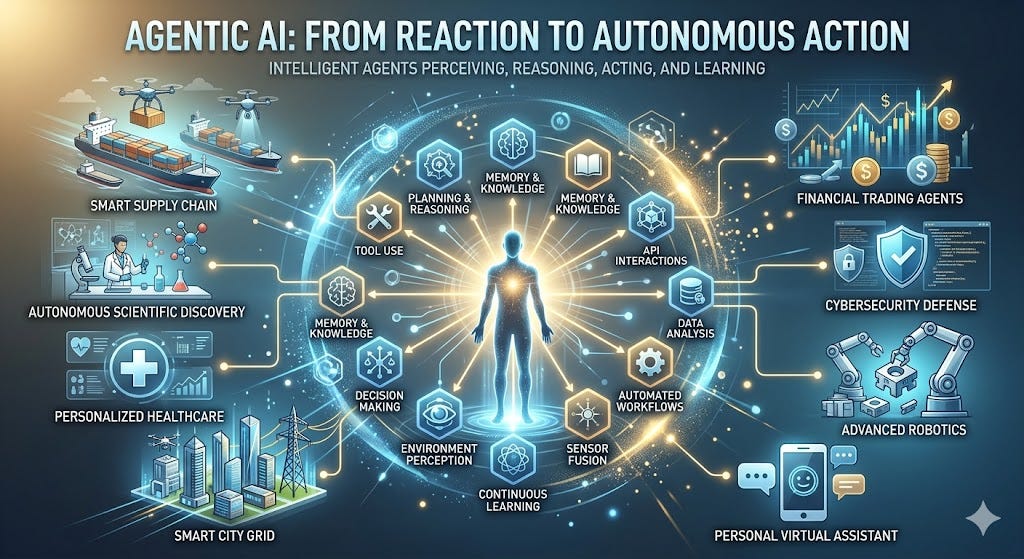
To move from “passive” to “active,” AI agents rely on a sophisticated architecture that goes beyond simple pattern matching. In 2026, the most effective agents utilize a “Reasoning and Acting” (ReAct) framework. This allows the AI to break down a complex goal into a sequence of smaller, manageable sub-tasks.
For example, if an agent is tasked with “optimizing a digital marketing budget,” it must first analyze current spend, then research competitor keywords, and finally adjust bid prices in real-time. This requires the agent to have “tool-use” capabilities — the ability to interact with external software, databases, and web browsers. By integrating with enterprise APIs, these agents act as a bridge between high-level human logic and the granular execution of software.
2026: The Year the Robots Logged In
We are seeing this play out across every major sector. In finance, agentic systems are moving beyond simple fraud alerts to autonomous portfolio rebalancing based on shifting market sentiment. In IT, we’ve moved past simple troubleshooting; agents are now identifying server vulnerabilities and deploying patches before a human administrator even sees the ticket.
The democratization of these tools has also reached the average consumer. Modern operating systems are being rebuilt around “Action Models” that can navigate your apps on your behalf. Whether it’s managing an overflowing inbox or organizing a complex family schedule, the AI is no longer a separate tab in your browser — it is an invisible layer of the OS itself. For those looking to keep up with the technical specifications of these new frameworks, resources like **geekmainframe.com** provide deep dives into the underlying hardware and software architectures driving this change.
Bridging the Gap Between Intent and Result
One of the biggest hurdles in this shift is “alignment.” When an AI has the power to spend money or delete files, the stakes of a misunderstanding are high. The industry has responded by moving toward “Human-in-the-loop” (HITL) designs.
Instead of full, unchecked autonomy, agents operate on a permission-based hierarchy. The AI handles the “heavy lifting” of research and preparation, but pauses to seek human confirmation before executing high-impact actions. This ensures that while the AI is doing the work, the human remains the final authority. This collaborative model is what makes Agentic AI a productivity multiplier rather than a liability.
Ethical Guardrails in an Autonomous World
As bots begin to “act” on our behalf, we face new ethical questions. Who is responsible if an AI agent makes a legal error in a contract? How do we prevent “agentic drift,” where a system prioritizes efficiency over safety?
The focus of 2026 has been the development of **Constitutional AI**, where agents are governed by a set of hard-coded ethical principles that cannot be bypassed by clever prompting. Security is also being overhauled, with “sandboxed execution environments” ensuring that an agent can only interact with the specific data and tools it needs to complete its assigned task.
Conclusion
The shift from passive chatbots to action-oriented agents represents the true “adulthood” of Artificial Intelligence. We are moving away from the “Type and Wait” era and into an era of seamless, autonomous assistance. By offloading the friction of digital logistics to Agentic AI, we aren’t just saving time; we are reclaiming the mental bandwidth to focus on strategy, creativity, and the human elements of our work. The bots are finally doing more than just talking — they’re getting to work.
메타데이터
- post_id
- 0bc3358dc3d2
- slug
- agentic-ai-0bc3358dc3d2
- url
- https://medium.com/@Blaberize/agentic-ai-0bc3358dc3d2
- canonical_url
- https://medium.com/@Blaberize/agentic-ai-0bc3358dc3d2
- author_url
- https://medium.com/@Blaberize
- status
- ok
- fetched_at
- 2026-07-13 06:23:13