A Boy Turns Into a Girl. Somehow That’s Not the Weirdest Thing Happening Here.
The curse is normal. The people are the problem.
A Boy Turns Into a Girl. Somehow That’s Not the Weirdest Thing Happening Here.
The curse is normal. The people are the problem.
A boy falls into a magic spring in China and now turns into a girl whenever cold water touches him. Hot water reverses it. His father, who caused this, turns into a panda. They move into a house with a martial arts family whose patriarch — upon learning about the curse — immediately decides the correct response is to accelerate the existing engagement agreement between his daughter and this child.
Nobody calls a doctor. Nobody contacts authorities. Nobody suggests that perhaps the living situation could be reconsidered.
This is the setup. This is treated as normal. The series runs for hundreds of episodes and remake by Mappa.
The house
The Tendo household is not a home.
It’s a containment facility.
Current residents: one cursed martial artist, one martial artist who is deeply tired of everything, one sister who has correctly identified every human relationship in her vicinity as a financial opportunity, one sister who keeps the entire structure from collapsing through sheer competence and cheerful denial, one father whose primary combat technique is crying, and one panda who used to be a person and has opinions about this.
Kasumi deserves a medal. Kasumi is the reason this building still has walls. While everyone around her is fighting, transforming, chasing fiancés, or making incomprehensible life decisions, Kasumi is cooking dinner and saying “oh my” with the energy of someone who has long since processed that this is simply what her life is now.
Ranma
The funniest thing about Ranma Saotome is that he’s somehow the straight man in a show where he turns into a girl.
Think about that for a second. In any other anime, the curse would be the weirdest thing happening. In Ranma ½, it barely makes the top ten. Ranma wakes up every day and has to process: a rival who cannot navigate to the next street, a man who cannot identify him despite having met him hundreds of times, multiple fiancées operating on independent and incompatible logic systems, a father who has restructured his entire existence around not being accountable for anything, and a rotating schedule of martial arts disciplines that should be regulated by international law.
His reaction to most of this is: this is the dumbest thing I’ve ever heard.
And then he participates anyway. Because the alternative is letting someone get hurt, and despite the performance of not caring, Ranma consistently shows up when things go wrong. He’s not crazy. He’s trapped inside crazy. There’s a difference, and that difference is why the show needs him — someone has to react to all of this with appropriate disbelief, and Ranma has been volunteered.
The morning routine
Normal anime school morning: wake up, eat breakfast, go to school.
Akane Tendo’s morning: wake up, defeat approximately twenty boys who have assembled outside to challenge her for the right to date her, eat breakfast, go to school.
This has been happening every day. The boys are aware they will lose. They show up anyway. The school’s attendance records presumably read: Akane — present; challenger number forty-seven — hospital.
Nobody asks Akane if she wants any of this. Nobody asks the boys to stop. The neighborhood has collectively decided this is fine. It is not fine. It is a public health crisis that everyone has agreed to normalize.
Then Ranma arrives, watches this happen, and thinks: what kind of school is this?
The answer, Ranma, is Furinkan. You’ll get used to it. You won’t like it but you’ll get used to it.
Ryoga
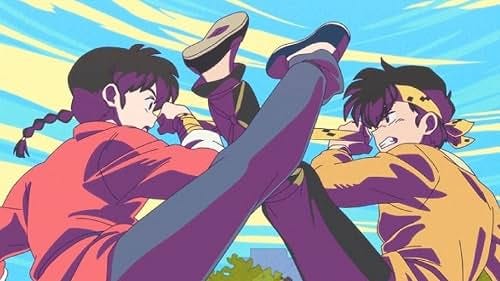
Ryoga Hibiki is one of the most powerful fighters in the series.
He can destroy concrete with his bare hands. His bandanas are lethal weapons. His Battle Aura is strong enough to affect the physical environment around him. He has trained with genuine commitment and arrived at genuine mastery.
He cannot find his own house.
Ryoga once tried to meet Ranma at a specific location and arrived three weeks late because he had accidentally navigated to a different country. This is presented as a character trait rather than a medical emergency.
Then he falls into a spring and turns into a small black pig named P-chan, who Akane adopts and loves unconditionally, who sleeps in her room, who she carries around and pets and calls adorable. Ryoga is technically sleeping in Akane’s room every time this happens. Ranma is aware of this. Ranma watches this happen regularly with an expression that could charitably be described as resigned.
Ryoga’s situation is: strong enough to reshape geography, cannot find next-door neighbor, accidentally became cherished pet of the girl he has feelings for, still gets lost.
Kuno
Tatewaki Kuno occupies a unique space in the Ranma ½ ecosystem: he is the one character who seems to be experiencing a completely different show.
Kuno sees girl Ranma. He falls in love. He names her the Pigtailed Girl and pursues her with the confidence of a man who has never once questioned his own perception of reality.
Kuno sees boy Ranma. He declares him a rival and attempts to defeat him approximately forever.
Kuno never connects these two people. Not once. Across the entire series. The information is available to him. He has access to both of them. He simply refuses to allow it to form a coherent picture.
This is not played as a conspiracy. It’s not a deliberate choice. Kuno’s brain has a room where this realization lives and the door is simply sealed from the inside.
His speeches are extraordinary. He delivers them at full volume to people who are actively trying to escape. He uses the vocabulary of romance novels. He is completely sincere. Every single time.
Shampoo
Shampoo operates on a set of cultural rules that are internally consistent and externally catastrophic for everyone in the general vicinity.
She likes Ranma. Her solution: marry him. Her approach to obstacles: eliminate them. Her reaction to the concept of “no”: what is that.
Every time Shampoo appears, the local property damage estimates increase. This is not hyperbole — she arrives, usually on bicycle, with the energy of a natural disaster that has developed feelings. The chaos radius on a standard Shampoo entrance is approximately one city block.
She also turns into a cat. Ranma has a severe fear of cats. The universe arranged this specifically.
Nabiki
The actual villain of Ranma ½ is not any of the recurring antagonists.
It’s Nabiki Tendo, who has correctly identified that she is living inside a situation of infinite financial opportunity and has been systematically extracting value from it since approximately episode two.
Ranma in trouble? Information sold. Akane angry? Information sold. Shampoo arrives? Information sold. Kuno wants photos of girl Ranma? Information sold at premium pricing.
Nabiki is the smartest person in the Tendo household by a significant margin, understands everyone’s weaknesses with clinical precision, and has made peace with the fact that her family is feral. She has simply decided to monetize it.
The funniest thing about Nabiki is that she never actually causes the main problems. She just profits from them. She is a passive disaster investor and she is thriving.
Genma and Soun
Two men who present themselves as martial arts masters and father figures.
Two men who are directly responsible for approximately ninety percent of the problems in this series.
Genma sold his son’s future multiple times before the boy was old enough to object. He created the engagement. He created the training conditions that led to the curse. He possesses a unique martial arts technique: the moment responsibility appears on the horizon, he becomes a panda. Not metaphorically. Literally. Cold water, panda, problem avoided. The accountability transformation is his most-used skill and arguably his most effective.
Soun, meanwhile, has a special technique: whenever an actual problem appears, he cries. Not strategically. Just immediately and completely. Something goes wrong — Soun crying. Something goes right in a way he didn’t expect — Soun crying. The dojo is threatened — Soun crying in the corner while his teenage daughters manage the situation.
These men will sit together and discuss family honor, martial arts legacy, and the responsibility they bear to the next generation. Then something will happen and Soun will be crying and Genma will be a panda and the next generation will be handling it themselves.
They have been preparing their children for leadership primarily by being unavailable when leadership is required. It is, in its way, effective.
The romance
Ranma and Akane have been in love since approximately episode three.
Neither of them will say this. Neither of them will allow this to be said near them. If you get close to saying it in their presence, someone will be thrown through a wall before you finish the sentence.
Their actual feelings are visible to: everyone who has ever met them, the audience, probably Nabiki who has been charging Kuno extra for this information, and nobody in the cast who is positioned to do anything about it.
Their system for emotional communication is: argue, fight, almost say something real, get interrupted by a fiancée or a curse or Ryoga appearing from a direction that makes no geographical sense, deny everything, repeat.
The universe has a vested interest in preventing resolution. Every time progress occurs, a new character arrives, a new martial arts discipline is introduced, or Genma makes a historical decision that creates three new engagements. The series would end in twenty episodes if either of them said one honest sentence. Rumiko Takahashi has therefore ensured that honest sentences are the rarest thing in Nerima.
The best moments between them aren’t romantic. They’re the quiet ones — Ranma worrying without admitting it, Akane protecting without being asked, someone choosing the other over the situation without making it a speech. Those moments happen and then immediately get buried under: idiot. Tomboy. Pervert. Jerk.
And then they’re back.
Why it works
Ask someone who watched Ranma ½ what the main plot was.
They will struggle.
Ask them if they remember Ryoga getting lost trying to walk to the school next door. Ask them about Kuno’s speeches. Ask them about Genma turning into a panda whenever accountability appeared on the horizon. Ask them about P-chan. Ask them about the first time Akane destroyed twenty boys before breakfast and the show acted like this was just Tuesday.
Immediate memories. All of them.
Ranma ½ has almost no overarching plot. It has a cast of absolute disasters who keep finding each other, keep ruining each other’s lives, keep coming back anyway. Ryoga returns. Shampoo returns. Ukyo returns. The Tendo household remains standing through Kasumi’s heroic refusal to acknowledge how insane everything is.
Nobody ever solves anything. Nobody ever confesses anything. The curse is never cured. The engagements are never resolved. The boys outside the gate never stop showing up.
Just another Tuesday.
The containment facility is still standing.
Kasumi made dinner.
Genma is somewhere being a panda.
Soun is crying about something.
Ranma and Akane are arguing, which means they’re fine.
Kuno has not figured it out.
He never will.
Honestly, at this point I’m not convinced he could figure out rain.
메타데이터
- post_id
- 0bc4ffd8ea52
- slug
- a-boy-turns-into-a-girl-somehow-thats-not-the-weirdest-thing-happening-here-0bc4ffd8ea52
- url
- https://medium.com/@sureshkumarnadar1701/a-boy-turns-into-a-girl-somehow-thats-not-the-weirdest-thing-happening-here-0bc4ffd8ea52
- canonical_url
- https://medium.com/@sureshkumarnadar1701/a-boy-turns-into-a-girl-somehow-thats-not-the-weirdest-thing-happening-here-0bc4ffd8ea52
- author_url
- https://medium.com/@sureshkumarnadar1701
- status
- ok
- fetched_at
- 2026-06-25 16:53:31