Guidewire DevOps CI CD and Release Management in Cloud Projects
A single misaligned config file once pushed an entire policy rating engine offline for six hours. That’s the kind of story that makes…
Guidewire DevOps CI CD and Release Management in Cloud Projects
Guidewire DevOps CI CD and Release Management in Cloud Projects
A single misaligned config file once pushed an entire policy rating engine offline for six hours. That’s the kind of story that makes insurance IT teams take Guidewire DevOps seriously instead of treating it as an afterthought.
As more carriers move InsuranceSuite to the cloud, the old habit of manual deployments and quarterly release windows simply doesn’t hold up. Speed, stability, and traceability now matter just as much as the code itself.
Why Manual Releases Quietly Wreck Cloud Projects

Why Manual Releases Quietly Wreck Cloud Projects
Guidewire implementations are notoriously complex, with PolicyCenter, BillingCenter, and ClaimCenter often evolving on separate but interdependent timelines. When teams rely on manual builds and hand-off deployments, small errors compound fast — a missed configuration change in one module can break integrations in another.
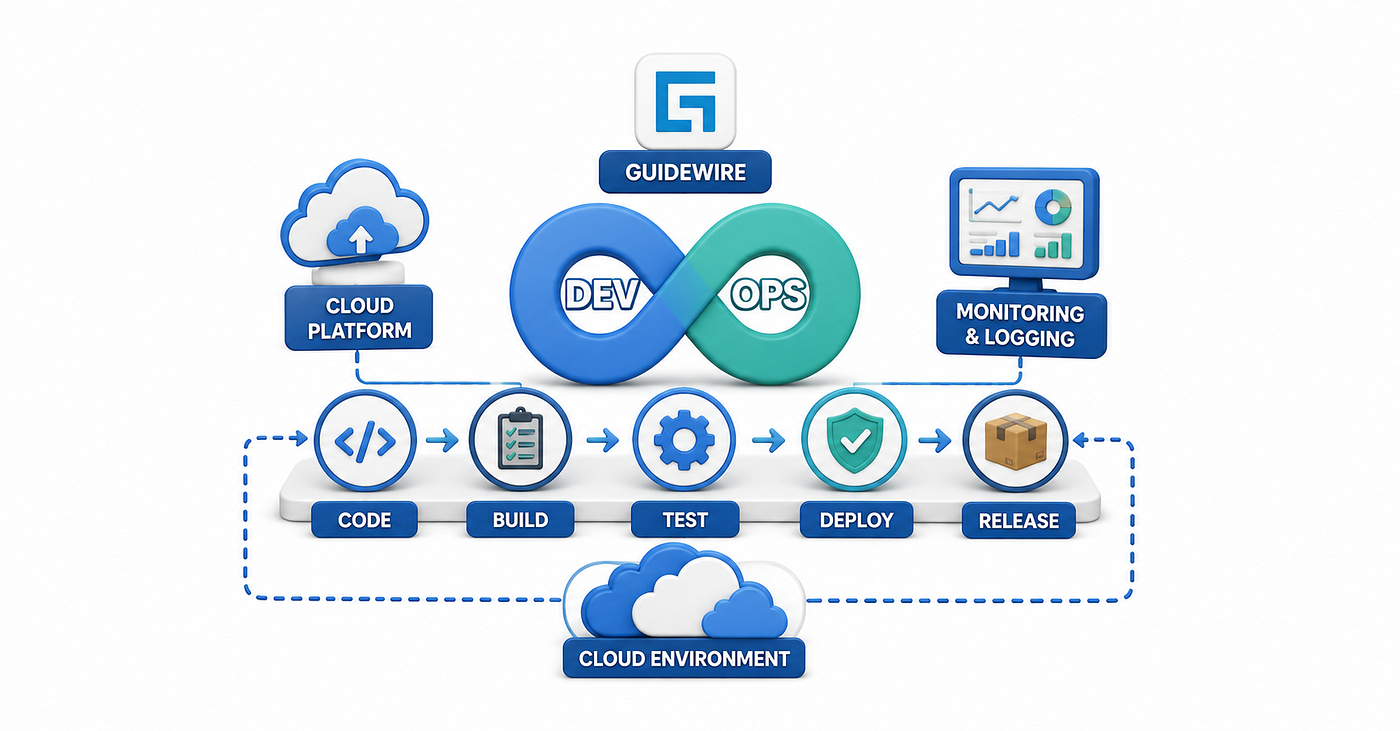
This is where CI/CD earns its keep. Automated pipelines catch these issues early, during the build and test phase, rather than after a costly production rollout. A well-structured pipeline runs unit tests, validates Gosu code, and checks integration points every time a developer commits changes.
Teams that skip this step usually pay for it later. Rollbacks eat into sprint time, QA teams burn hours chasing regression bugs, and business stakeholders lose confidence in release schedules. None of that is dramatic on its own, but it adds up quietly until a release cycle that should take two weeks stretches into six.
Automating the pipeline doesn’t just save time — it creates a paper trail. Every build, test result, and deployment gets logged, which matters enormously when auditors or compliance teams come asking questions about a cloud-hosted insurance platform.
Building a CI/CD Pipeline That Actually Fits Guidewire

Building a CI/CD Pipeline That Actually Fits Guidewire
Generic DevOps tooling doesn’t always map cleanly onto Guidewire’s architecture. Successful pipelines typically combine Jenkins or Azure DevOps for orchestration with Guidewire’s own Cloud API and gwcc (Guidewire Cloud Console) for environment-specific deployment tasks.
A practical setup looks like this:
- Source control with branching strategies tied to Guidewire’s configuration and integration layers
- Automated builds that compile Gosu and validate metadata changes before merge
- Environment promotion through dev, test, and staging with consistent configuration
- Automated regression suites targeting policy, billing, and claims workflows specifically
The tricky part is sequencing. Guidewire cloud environments have their own deployment windows and dependency chains, so pipelines need built-in checks that respect those constraints rather than fighting them. Teams that adapt their CI/CD tooling to Guidewire’s rhythm, instead of forcing a one-size-fits-all DevOps template, tend to see far fewer failed deployments.
Release Management: The Part Everyone Underestimates

Release Management: The Part Everyone Underestimates
CI/CD gets the pipeline moving, but release management decides whether that speed is actually useful. Cloud projects often introduce faster release cadences, and without a clear governance model, that speed turns into chaos — competing changes, unclear ownership, and confusion about what’s actually live in production.
Strong release management for Guidewire cloud projects usually includes versioned release notes, defined approval gates before production deployment, and rollback plans tested ahead of time, not improvised during an incident. Cross-team communication matters just as much as tooling here, since PolicyCenter changes frequently ripple into BillingCenter and ClaimCenter.
The carriers getting this right treat release management as an ongoing discipline, not a one-time setup task. They review deployment metrics regularly, adjust cadence based on team capacity, and keep documentation current so new engineers can onboard without guesswork.
Conclusion
Guidewire DevOps isn’t about chasing the fastest pipeline possible — it’s about building CI/CD and release management practices that match the platform’s complexity. Get that balance right, and cloud projects ship faster with far fewer surprises.
메타데이터
- post_id
- 0bcad18e966e
- slug
- guidewire-devops-ci-cd-and-release-management-in-cloud-projects-0bcad18e966e
- url
- https://medium.com/@worksanmitra450/guidewire-devops-ci-cd-and-release-management-in-cloud-projects-0bcad18e966e
- canonical_url
- https://medium.com/@worksanmitra450/guidewire-devops-ci-cd-and-release-management-in-cloud-projects-0bcad18e966e
- author_url
- https://medium.com/@worksanmitra450
- status
- ok
- fetched_at
- 2026-08-21 17:13:44