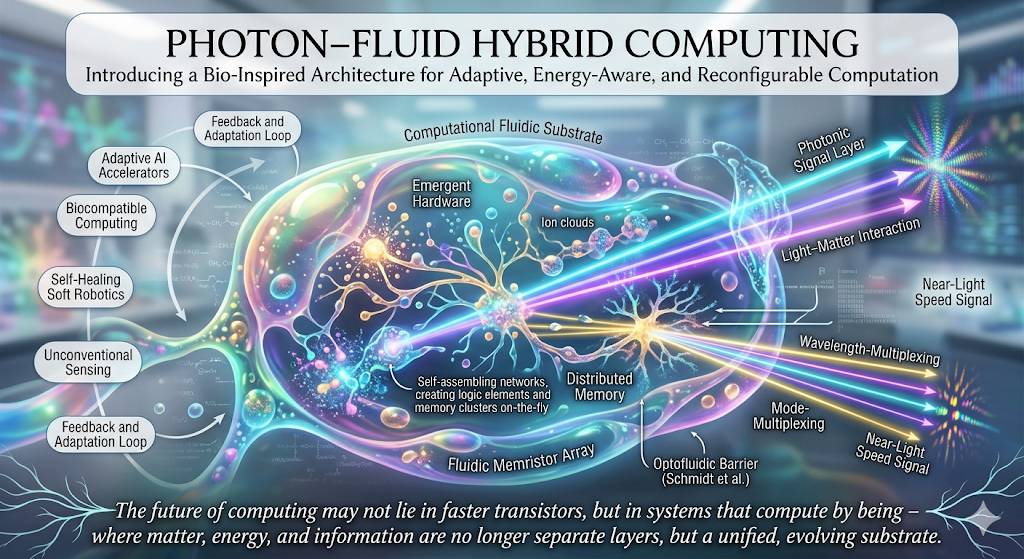
Artificial Bio-Cellular Fluidic Computing: The Future of Thinking Machines Inspired by Life Itself
Subtitle:
Artificial Bio-Cellular Fluidic Computing: The Future of Thinking Machines Inspired by Life Itself
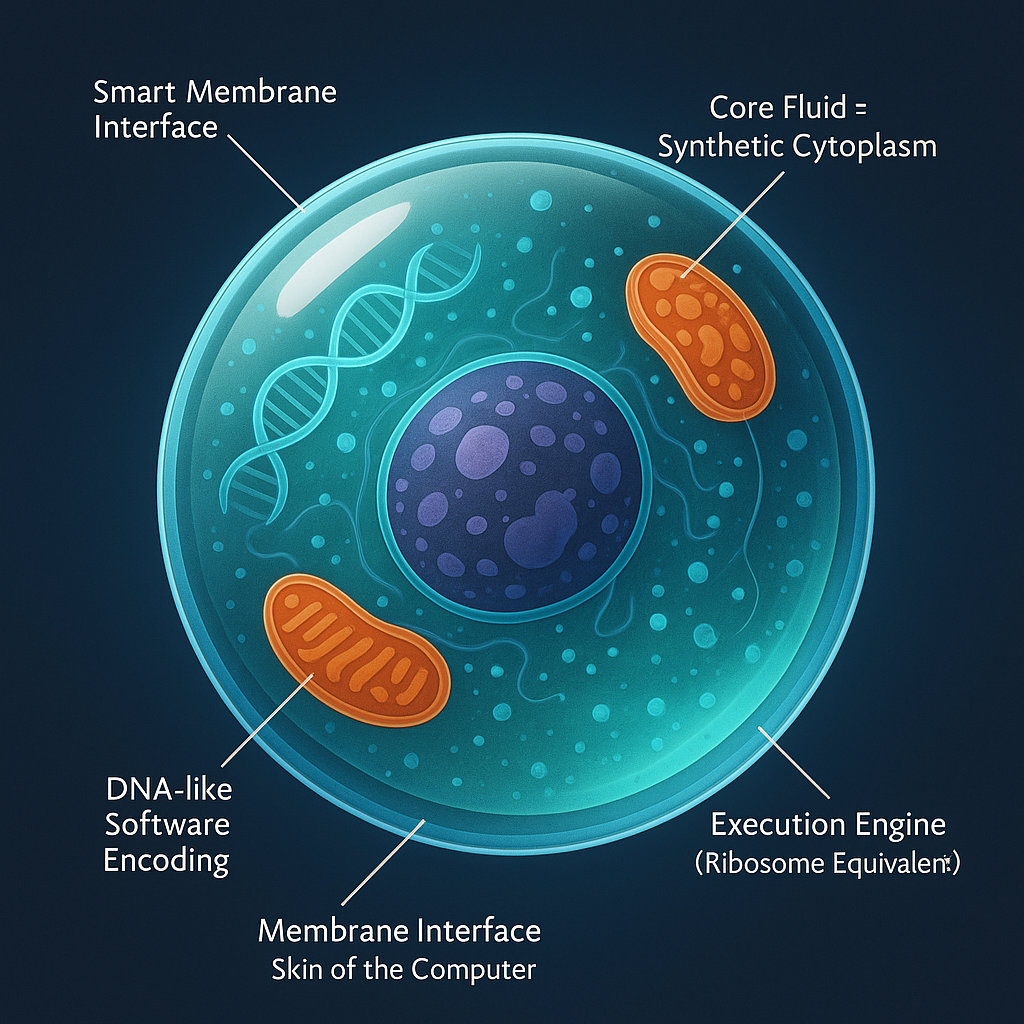
Artificial Bio-Cellular Fluidic Computer : featuring dynamic nano-particles, genetic instruction strands, and a smart membrane interface.
Subtitle:
What if the future of computing wasn’t silicon and circuits — but programmable liquid inspired by the design of living cells?
Body:
Imagine a computer that isn’t built with chips, but an artificial programmable nano-fluid cell. A system not just inspired by biology, but engineered as biology — a fluid that computes, adapts, repairs itself, and even evolves. This fluid embodies computation, memory, and interface functions simultaneously, eliminating the boundary between hardware and software.
This isn’t science fiction. It’s a new vision I call BioCellular Fluidic Computing: a programmable fluid-based computer system modelled after the astonishing complexity and efficiency of a single biological cell.
Could it be both hardware and software?
- In theory: A smart fluid could form dynamic physical logic structures (hardware) and also store/update instructions (software).
- It would behave like programmable matter, where the medium itself is reconfigurable, executable, and sensory.
How It Works (Theoretical Design)
1. Smart Nano-Fluid
- Contains trillions of programmable nanoparticles (quantum dots or molecular switches) suspended in a fluid medium.
- Each particle can change state, form logic gates, or link to others dynamically, forming a temporary physical circuit.
- External magnetic, electric, or optical fields control particle arrangements.
2. Dynamic Circuit Formation
- Input signals (from a user or sensors) trigger real-time reconfiguration of logic gates and memory units within the fluid.
- The fluid “grows” circuits as needed, then dissolves them when no longer in use.
3. Self-Healing & Redundancy
- Damaged areas of the fluid reorganize automatically.
- No fixed CPU or RAM — computation and memory are distributed across the medium.
4. Multimodal I/O
- The glass case integrates light, pressure, and EM wave emitters/detectors to communicate with the fluid.
- It could accept data via voice, gesture, or neural signals.
The Cell: Nature’s Most Perfect Computer
Cells are autonomous. They carry their own code (DNA), execution units (ribosomes), memory (chromatin), energy systems (mitochondria), and communication interfaces (membranes). They can self-repair, self-replicate, adapt, and respond to complex environments.
Why not build computers the same way?
Introducing the BioCellular Fluidic Core
At the heart of this system is a nano-engineered fluid that behaves like a living cell. Here’s how it works:
- Programmable Particles suspended in fluid act as dynamic hardware — reorganising in real time to form logic gates and memory units.
- Digital DNA inside the fluid encodes behavioural instructions and guides how particles form circuits.
- A Smart Membrane Interface lets the system sense its environment and communicate , just like a biological membrane.
- The fluid learns, heals, and reconfigures itself , adapting to new tasks over time.
- Reconfigurable logic architecture.
- Fluidic parallelism (true parallel computing).
- Energy-efficient and fault-tolerant.
- Scalable: single cell to “fluid brain”.
- Self-repairing and self-adaptive.
A Living Machine
This system isn’t just flexible — it’s alive in the way it functions:
- No fixed architecture. Circuits grow and dissolve as needed.
- Fully distributed intelligence — no central CPU.
- Scalable from a single “fluid cell” to a “fluid brain.”
- Visibly alive: internal flow changes reveal learning, stress, or thinking patterns.
Biological Cell as a Model
Inspiration:
The living cell — a tiny, self-contained unit of life — is:
- A processor (nucleus = control center),
- A data storage system (DNA = software),
- A machine (ribosomes, mitochondria = hardware),
- And a network (cell membrane + signal receptors = I/O interface).

Bio-Cellular Fluid System Design
A. Nano-Fluid Core (Synthetic Cytoplasm)
- Nanoparticles with configurable states.
- Dynamic assembly of logic gates and memory cells.
B. Programmable Instructions (Digital DNA)
- Encoded sequences that trigger behaviors and circuit formation.
- Evolvable over time — self-learning.
C. Execution Engine (Ribosome Equivalents)
- Specialized nodes that interpret fluidic “genetic” sequences and rewire logic in real time.
D. Smart Membrane Interface
- Allows selective input/output.
- Responsive to environmental signals (heat, EM waves, chemicals, etc).
What Could It Be Used For?
- AI Cores: Adaptive agents and systems that learn from fluid logic.
- Wearable or Shape-shifting Tech: Fluidic CPUs embedded in fabrics.
- Medical Implants: Biocompatible, self-healing devices.
- Space Exploration: Hardware that adapts to unknown environments.
- Synthetic Lifeforms: Machines that grow, repair, and evolve.
Why Now?
We already see the pieces:
- DNA Computing
- Smart Fluids (ferrofluids, electrorheological fluids)
- Soft Robotics
- Synthetic Biology (CRISPR logic gates, gene circuits)
- Programmable Matter
- Neuromorphic Computing
메타데이터
- post_id
- 0bcd0ff5b0f2
- slug
- artificial-bio-cellular-fluidic-computing-the-future-of-thinking-machines-inspired-by-life-itself-0bcd0ff5b0f2
- url
- https://medium.com/@mdamirshohail786/artificial-bio-cellular-fluidic-computing-the-future-of-thinking-machines-inspired-by-life-itself-0bcd0ff5b0f2
- canonical_url
- https://medium.com/@mdamirshohail786/artificial-bio-cellular-fluidic-computing-the-future-of-thinking-machines-inspired-by-life-itself-0bcd0ff5b0f2
- author_url
- https://medium.com/@mdamirshohail786
- status
- ok
- fetched_at
- 2026-06-23 17:05:31