When Should You Stop Reading A Book?
Here’s how I made the call on Percival Everett’s ‘James,’ a National Book Award winner and Pulitzer frontrunner
TRY THE ‘PAGE 69’ TEST
When Should You Stop Reading A Book?
Here’s how I made the call on Percival Everett’s ‘James,’ a National Book Award winner and Pulitzer frontrunner
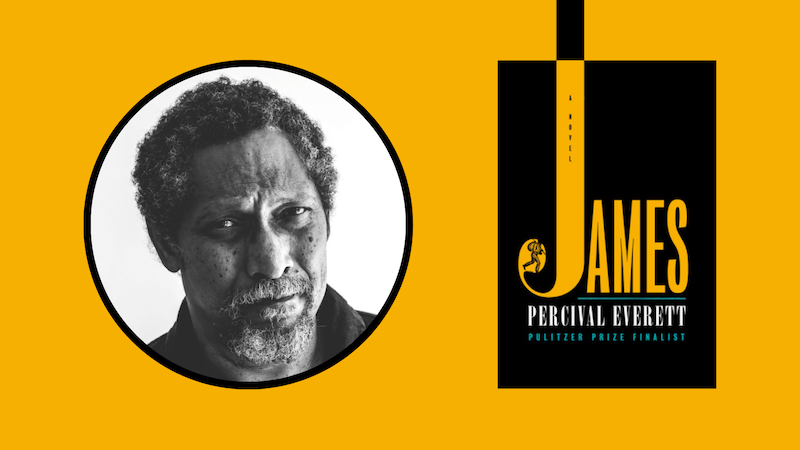
Percival Everett and the cover of “James” / Penguin Random House
As a critic, I get a lot of books for free. It’s a great perk of the job.
I get books from publishers who want me to review them. I get them from NetGalley, a site that lets working critics download advance reader’s copies of forthcoming titles at no cost. When I was a judge of the National Book Critics Circle Awards, one of the three major American book prizes, I got them as part of the submission process.
That doesn’t count all the books I get from my unusually kind public library, which doesn’t save all of its discards for an annual sale but puts them out daily on a rolling cart, where they’re free to all takers.
What all of it means is that I seldom pay the average $25 or so for a new hardcover or $15 for a paperback. I buy books mainly to support author friends or my local indie bookstore or because there’s a classic I know I’ll want to keep. And I look for deals on Kindle or used copies when I do.
The last book I bought was a digital edition of Philip Roth’s 1960 National Book Award winner, Goodbye, Columbus, which I wanted to reread and was going for 99 cents during a Black Friday sale on Amazon.
Yet giving up on a book can be surprisingly hard even when it doesn’t involve a financial loss. I’ve been a critic for years— first for Glamour and then a large newspaper — and it never gets easier.
That has a lot to do with a vital lesson of book reviewing: Some authors take a while to find their footing or, in critics’ shorthand, to “get on top of a story.” You’d ideally give those writers a few chapters, though it isn’t always possible when you’re getting 400 copies a week from publishers, as I did when I edited the book section of a newspaper. But there’s no “right” number of pages to read: Every book is different.
How the ‘Page 69 Test’ can help
Some critics try to avoid quitting too soon by taking what’s known as the “Page 69 Test,” which readers can also use as a guide: Dip into a book around page 69. The Penguin copywriter Louise Willder explained the logic in her Blurb Your Enthusiasm, an insider’s view of book publicity:
“Forget covers, blurbs, reviews or introductions. Forget the book’s first line. If you want to know if you’re going to enjoy a book, open it at page 69. If you like what you read, buy the book. By then the author has settled into their story and has stopped showing off.”
But that test has its own problems. You may belong to a book club that expects members to finish every selection and know you’ll feel guilty if you don’t. Or you may have received a book as a holiday gift from someone who loves it and wants to talk about it with you.
Then there are books that are so popular or have won so much acclaim, they set you up for the “it must be me” syndrome: So many people seem to like a book that you wonder if you’re just clueless.
A case in point is Percival Everett’s bestselling novel James, a recasting of Mark Twain’s Adventures of Huckleberry Finn centered on Jim rather than Huck. Since its publication earlier this year, it’s become a National Book Award winner and Booker Prize finalist and had the kind of soaring reviews that make it a frontrunner for the Pulitzer for fiction.
Even in my small town in the Deep South, you can hardly find a book club that isn’t reading James or considering it for its 2025 list.
I admire Huckleberry Finn and have defended it, online and elsewhere, from book banners trying to kick it out of libraries. But I have a journalist’s natural skepticism of bandwagons like the one that’s turned James into an international hit. I’ve seen too many novels overpraised, and to protect my reading time, before investing a novel, I download free excerpts from Amazon or a publisher’s site.
An editor’s view of the dilemma
In reading those samples, I think often of an old neighbor, a former editor-in-chief of a high-prestige Random House imprint who had a tactful way of turning down books submitted to him by literary agents. He’d say:
“It didn’t capture my heart.”
Those words come closer to the truth about how a lot of us read — and certainly how I do — than many longer-winded explanations involving phrases like “too little conflict” and “underdeveloped characters.” We respond to books with our hearts as well as our minds.
For James the free sample was generous: the first two chapters and part of the third, or about three dozen pages. But nothing in it ran off with my heart, and some of it had little appeal.
In one scene, James teaches enslaved black children how to speak “correct incorrect grammar,” such as “dat be” instead of “that is.” He explains:
“White folks expect us to sound a certain way and it can only help if we don’t disappoint them.”
To illustrate that principle, James gives pages of examples of the “correct incorrect grammar” he wants young people or others to use to ingratiate themselves with their white enslavers.
James’ point was clear and historically accurate: Black people of the era needed to pander to their white owners in order to survive.
But the early pages gave me pause for two reasons. One was that I tend to dislike reading long stretches of dialect of any kind. Another was that the pages were too didactic for my taste.
Everett at times seemed to be pandering coyly to his own readers, alternately lecturing and winking with a subtext bordering on a cuteness that implied: “I know you’ll get this.”
Chapters as short as James Patterson’s
To get a sense of whether all of this was typical of what followed, I read a half dozen major reviews. I wasn’t reassured by the words of one of America’s most thoughtful fiction critics, Sam Sacks of the Wall Street Journal. Sacks said tactfully that the pedagogical tone is “always somewhat present in the novel.”
I was ready to put the novel aside until, by happenstance, I saw James sitting on an end table when I arrived at two friends’ home for Christmas dinner and I began flipping through it. A host said she’d dipped into the book and decided not to finish it — she’d been put off by all the “correct incorrect” speech, too—and offered to lend me the novel.
I had time to read a few more chapters. So on Christmas night — happily sated by slices of an excellent cheese ball and an Ina Garten-inspired roast — I read the last 32 pages of James.
They were marginally better than the early chapters, chiefly in that the story was rolling by then, and they were less didactic.
But the later pages, like the early ones, gave off a whiff of pandering, especially in their faddishly short, large-font chapters, a James Patterson-influenced trend that’s inspired its own pushback. Everett aims to show that enslaved people had more intelligence than their white owners imagined, which nobody would dispute. But the brevity of the chapters at times clashed with that aim: It could make his hero look unwilling or unable to develop longer thoughts.
Other critics have faulted a fact revealed later: James is aware of Kierkegaard, who wasn’t available in English in his day.
Anachronisms like that may represent an intentional blurring of the line between past and present, a valid literary device.
But the more I read of James, the harder it became to ignore an additional reservation about it. A book inspired by another needs to nod to the original while also transcending it and establishing its own identity. Mark Twain sat distractingly on my shoulder as I read the excerpts from James.
By the time I gave up on the book, I’d read more than 60 pages. I’d also read a half dozen major reviews and other commentary on it. And I’d talked about it with people whose tastes resembled mine: not just the friend who’d lent it to me but people who were reading it with local book clubs.
Sometimes you have to say, as my editor friend did: This book just didn’t capture my heart.
I read for many reasons: for truth or beauty, for insight or facts, for escape or distraction, or because a publication is paying me to do it. But above all, I read for pleasure. James, finally, yielded too little of it to keep reading.
I had other novels I wanted to read and higher literary priorities than Everett’s perspective on a racism I’d seen too much I’d seen here in the Deep South, including when the KKK threw flyers into my neighbors’ driveways. To paraphrase Huck in Twain’s masterpiece, it was time to light out for the territory of other books.
Jan Harayda is an award-winning critic and journalist who has been the book columnist for Glamour and the book editor of a large U.S. newspaper. She has also been a judge of the National Book Critics Circle Award, which more recently gave Percival Everett a lifetime achievement award.
If you’d like to read more stories like this, please visit my free Substack newsletter* Jansplaining*.
메타데이터
- post_id
- 0bcd9c5d6809
- slug
- when-should-you-stop-reading-a-book-0bcd9c5d6809
- url
- https://medium.com/thought-thinkers/when-should-you-stop-reading-a-book-0bcd9c5d6809
- canonical_url
- https://medium.com/thought-thinkers/when-should-you-stop-reading-a-book-0bcd9c5d6809
- author_url
- https://medium.com/@janiceharayda
- status
- ok
- fetched_at
- 2026-07-15 20:14:52