Orthography and Identity: The Struggle for Standardization and Officialization of the Aragonese…
Nestled in the Pyrenean valleys of northeastern Spain, the Aragonese language stands as a living testament to the medieval Kingdom of…
Orthography and Identity: The Struggle for Standardization and Officialization of the Aragonese Language
Nestled in the Pyrenean valleys of northeastern Spain, the Aragonese language stands as a living testament to the medieval Kingdom of Aragon’s linguistic heritage. Classified as “definitely endangered” by UNESCO, with an estimated 8,000 to 12,000 active speakers primarily in the provinces of Huesca and northern Zaragoza, Aragonese represents not merely a regional dialect but a distinct Romance language with roots in Navarro-Aragonese, the medieval vernacular of the kingdom. For centuries, this language has persisted in the face of political suppression, sociolinguistic marginalization, and the overwhelming dominance of Castilian Spanish. Today, the revival and preservation of Aragonese hinge critically on two interconnected challenges: establishing a unified orthographic standard that honors its historical depth while serving modern communicative needs, and achieving the legal officialization that would grant it institutional support and recognition. The orthographic debate in particular encapsulates fundamental questions about linguistic identity, with proposals ranging from more phonetic systems that prioritize ease of learning to historically-grounded systems that emphasize etymological continuity with the language’s medieval past. This essay argues that a historical orthography not only pays homage to Aragonese’s long evolution but also provides the most accurate foundation for its standardization. Furthermore, it contends that without official recognition, even the most carefully crafted orthographic system will struggle to reverse the language’s decline.
Historical Context and Linguistic Position of Aragonese
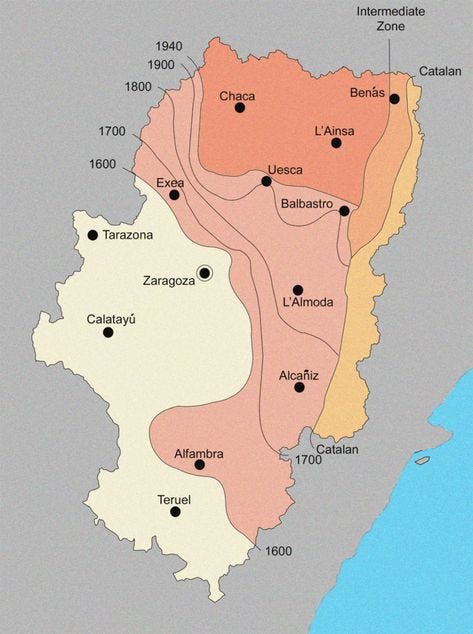
The historical trajectory of Aragonese is one of remarkable resilience amid political upheaval. Evolving from Vulgar Latin with a distinctive Basque substratum influence, Aragonese began to differentiate as a distinct language by the 8th or 9th centuries. Its earliest written attestations appear in the 10th-century Glosas Emilianenses, and it flourished during the High Middle Ages as the vernacular of the expanding Kingdom of Aragon, used in legal documents like the Fuero de Jaca (c. 1077) and administrative records . The language’s position was significantly altered by the dynastic union of the Crowns of Castile and Aragon in 1479, which elevated Castilian as the prestige language of administration and culture . This marginalization was institutionalized through the Nueva Planta Decrees of 1707, which, following Aragon’s defeat in the War of Spanish Succession, abolished the kingdom’s traditional institutions and prohibited the use of Aragonese in official documents, courts, and public administration. Consequently, the language retreated from public life, surviving primarily as an oral medium in isolated rural communities.
Linguistically, Aragonese occupies a fascinating position within the Romance continuum, sharing conservative features with Catalan, such as the preservation of Latin initial F- (e.g., fillo for “son”) and specific outcomes for consonant groups like -CT- and -LT- (e.g., feito for “done”). It also displays traits shared with Spanish, including the devoicing of medieval sibilants, and possesses unique conservative features not found in either neighbor, such as the preservation of Latin -B- in certain verb endings (e.g., teneba for “he had”) . This unique blend underscores Aragonese’s independent development from a common Latin source, not as a mere dialect of Spanish. The language is internally diverse, traditionally divided into four main dialect groups — Western, Central, Eastern, and Southern (Somontano) — reflecting centuries of geographical fragmentation in the Pyrenean valleys. This dialectal richness, while a testament to the language’s vitality, has historically complicated efforts to establish a unified standard for education and official use.
The Landscape of Proposed Orthographies
The modern standardization of Aragonese orthography has been characterized by competing philosophies, each representing different visions for the language’s future. Prior to 2023, three main systems coexisted, creating a fragmented written landscape.
The Grafía de Uesca (Huesca Orthography), codified in 1987 by the Consello d’a Fabla Aragonesa, was the most widely used system for decades. It adopted a predominantly phonetic approach, prioritizing consistency and ease of learning. This system made deliberate choices to regularize spelling, such as using ⟨b⟩ exclusively for the /b/ sound (merging the etymological ⟨b⟩ and ⟨v⟩), and employing ⟨ch⟩ for the voiceless palatal affricate /tʃ/, regardless of a word’s origin. It also incorporated letters strongly associated with Spanish orthography, like ⟨ñ⟩. Proponents argued that this approach made the language more accessible to new learners and speakers accustomed to Spanish spelling conventions, thus aiding revitalization.
In contrast, the grafía SLA (Sociedat de Lingüistica Aragonesa Orthography), devised in 2004, championed a historically-rooted model. This system consciously aligned Aragonese spelling with its medieval conventions and with neighboring Romance languages like Catalan and Occitan. It maintained etymological distinctions, such as between ⟨v⟩ and ⟨b⟩, and used digraphs like ⟨tx⟩ for /tʃ/ and ⟨ix⟩ for /ʃ/, which reflect historical spellings and differentiate Aragonese more visibly from Spanish. Advocates viewed this system as a means to reclaim the language’s historical identity and assert its independence from Castilian linguistic influence.
The establishment of the Academia Aragonesa de la Lengua in 2021 as the official regulatory institution marked a pivotal shift. On April 3, 2023, the Academy approved and published a unified Orthography of Aragonese in Aragon’s official gazette . This new standard, while drawing from previous proposals, represents an effort to synthesize different perspectives with scholarly rigor. For instance, in its foundational documents, the Academy’s preparatory committee engaged with extensive community feedback, deliberating on points like the representation of the palatal nasal /ɲ/. While some advocated for ⟨ñ⟩ due to familiarity or ⟨gn⟩/⟨nn⟩ for etymology, the committee retained the digraph ⟨ny⟩, noting its historical presence in Aragonese and rejecting arguments based on “anti-Catalan” sentiment as extralinguistic. This new orthography aims to provide a single, authoritative reference point to end the “war of orthographies” that had previously splintered the language community.
The Case for a Historical Orthography: Accuracy, Heritage, and Unity
The argument for a historically-grounded orthography for Aragonese extends beyond traditionalism; it is fundamentally about linguistic accuracy and the preservation of a unique cultural heritage. A spelling system that reflects etymology captures the deep historical layers of the language, connecting modern usage to its medieval roots. For example, maintaining a distinction that reflects the Latin origins of words, even when the sounds have merged in some dialects, preserves morphological relationships within the language and with other Romance languages. This depth is erased in a purely phonetic system, which by design records only the contemporary surface pronunciation of a particular dialect.
Furthermore, a historical orthography serves as a powerful tool for identity reclamation. For a language systematically marginalized and long dismissed as a “dialect” of Spanish, adopting a writing system that visibly aligns with its own medieval tradition and with Pyrenean Romance neighbors (Catalan, Occitan) is a declarative act of linguistic independence. It helps break the psychological subordination to Castilian by demonstrating that Aragonese follows its own internal logic and history, not Spanish rules. This can foster a stronger sense of pride and ownership among speakers and learners. The historical argument finds a compelling parallel in the development of Spanish itself, whose orthography is described by the Royal Spanish Academy as inherently historical — a system born from the “slow process of evolution without rupture from Latin to Romance,” not one created artificially.
Critics of historical orthographies often raise concerns about learnability, arguing that complex or irregular spellings pose a barrier to new speakers and children. However, this challenge can be effectively managed through consistent, high-quality education — a necessity for any minority language revival. The real threat to learnability is not a coherent historical system, but the absence of a single, universally accepted standard. The decades of competition between the Grafía de Uesca and the grafía SLA created confusion, hindered the production of unified educational materials, and fragmented the language community. The 2023 orthography approved by the Academia Aragonesa de la Lengua, by seeking a consensus that respects historical principles while considering modern usage, represents the most promising path forward. Its success, however, is contingent on widespread adoption and institutional support.
The Imperative for Officialization: Legal Status as a Cornerstone for Survival
An orthographic standard, no matter how well-designed, cannot secure the future of Aragonese on its own. It requires the force of law and institutional backing to move from paper into daily life. Officialization — granting Aragonese co-official status alongside Spanish within its historical territory — is the indispensable next step. The current legal framework is inadequate. While the 2009 Language Act recognized Aragonese as Aragon’s “native, original and historic” language, and the 2013 law (despite controversial changes in terminology) continued to afford it certain protections, neither granted true co-official status. This means citizens do not have an enforceable right to use Aragonese in dealings with public administration, courts, or to receive education in the language as a primary medium of instruction.
The benefits of officialization are manifold. First, it would mandate and fund the integration of Aragonese into the education system at all levels. Currently, the teaching of Aragonese is patchy and marginalized; it is often offered only as an optional, non-evaluable subject outside regular school hours, with a severe lack of standardized textbooks and trained teachers. Official status would require the development of a proper curriculum, teacher training programs, and the option for immersion or bilingual schooling, which is crucial for intergenerational transmission. Second, officialization would normalize the language’s use in public spheres: government services, signage, media, and cultural institutions. This visibility is vital to countering stigma and transforming the language from a private, rural artifact into a living public good.
The political path to officialization is complex, as it requires an amendment to Aragon’s Statute of Autonomy. Resistance often stems from misconceptions that such a move is separatist or impractical. However, the example of other regions in Spain, such as Galicia, the Basque Country, or Catalonia, demonstrates that co-officiality can function successfully, fostering cultural vitality without compromising social unity. For Aragonese, a language with far fewer speakers and in a more critical state, official recognition is not a luxury but an emergency measure for survival. It would provide the stable, long-term policy framework needed to implement the new orthography, support revitalization programs, and ultimately, change the linguistic habits of a community.
Conclusion
The orthographic journey of the Aragonese language, from fragmented proposals to a unified standard in 2023, mirrors its broader struggle for dignity and continuity. The choice of a spelling system is never merely technical; it is a profound statement about a language’s identity and future. A historical orthography, as embodied in the new standard, offers the most accurate and respectful means of capturing the language’s essence, connecting its speakers to a grand literary and historical tradition that predates the dominance of Castilian. It asserts Aragonese’s rightful place as an independent member of the Romance family.
Yet, this orthographic consensus will remain a scholarly ideal without the robust support that only official legal status can provide. Orthography provides the script, but officialization builds the stage upon which the language can perform in the modern world. The two are inextricably linked: a standard enables education and publishing, while officialization creates the demand and infrastructure for their implementation. The Aragonese people and their institutions now stand at a critical juncture. Embracing the new orthography and relentlessly advocating for co-officiality are complementary and urgent tasks. The survival of Aragonese — a language that carries the unique voice of the Pyrenees and a key to understanding Spain’s rich medieval past — depends on turning these linguistic tools into instruments of daily life. The words must not only be spelled correctly; they must be spoken in the halls of government, taught in the classrooms, and heard in the media, ensuring that the fabla of the mountains continues to echo for generations to come.
메타데이터
- post_id
- 0bee1d0ef414
- slug
- orthography-and-identity-the-struggle-for-standardization-and-officialization-of-the-aragonese-0bee1d0ef414
- url
- https://medium.com/@gabcosta/orthography-and-identity-the-struggle-for-standardization-and-officialization-of-the-aragonese-0bee1d0ef414
- canonical_url
- https://medium.com/@gabcosta/orthography-and-identity-the-struggle-for-standardization-and-officialization-of-the-aragonese-0bee1d0ef414
- author_url
- https://medium.com/@gabcosta
- status
- ok
- fetched_at
- 2026-08-17 16:37:36