Brave New Cattle
Eric had been ill for years. Tuberculosis was eating away at his lungs. He decided to isolate himself on a remote island in Scotland. A…
Brave New Cattle
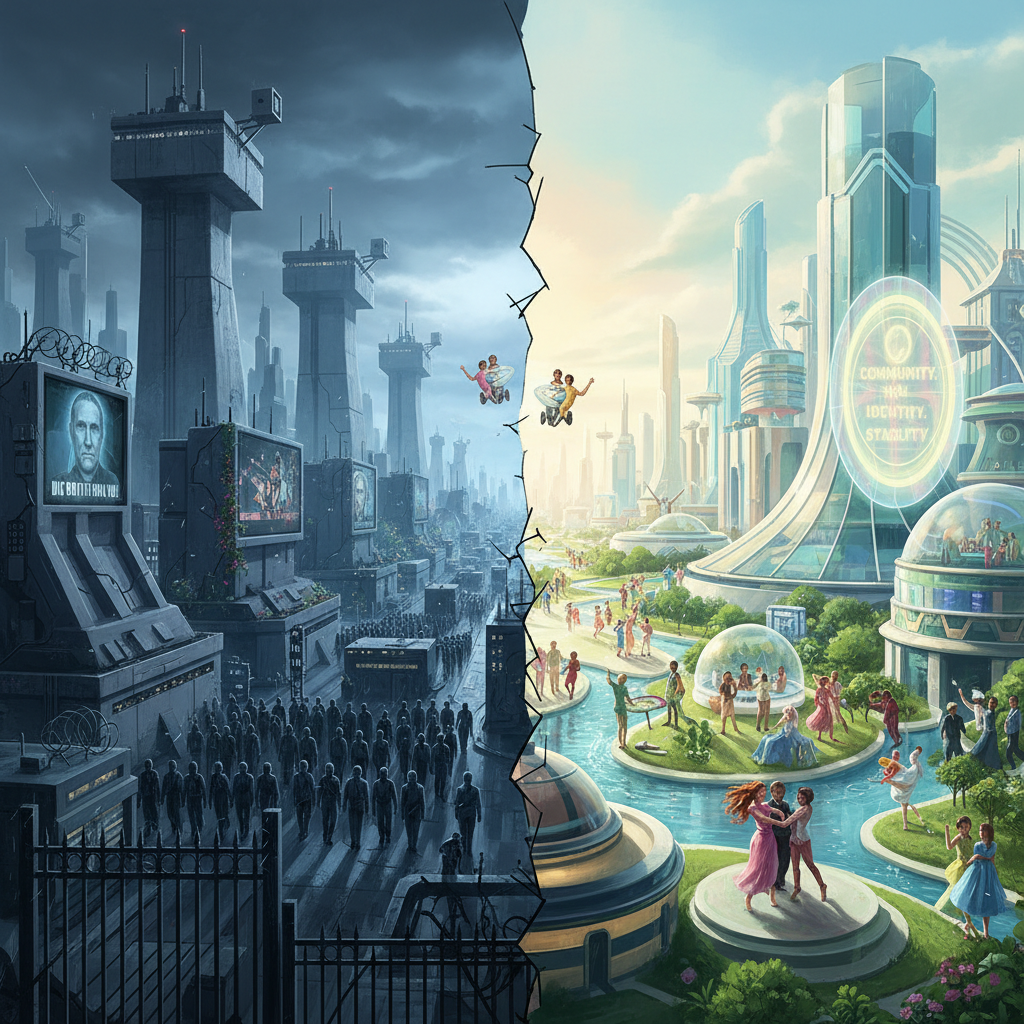
AI-generated image by the author.
Eric had been ill for years. Tuberculosis was eating away at his lungs. He decided to isolate himself on a remote island in Scotland. A small, cold island, with the wind howling through the cracks in the windows. No electricity, no doctor nearby, no distraction. He took with him a typewriter and an idea. He was in a hurry; he knew he was dying; he had a frequent fever; he coughed up blood. But he continued to write, lying on a narrow bed, with a machine resting on his chest. Some pages cost a whole day of work. He wanted to write a novel about the future, a dystopian future, in which the totalitarian state would watch over all citizens at all times. In which the rulers would rewrite the truth. In which thinking independently would be considered a crime.
The book was published in June 1949. It was an immediate and resounding success! Eric used a pseudonym as a writer: George Orwell[1]. And the title of the book was 1984. It was the year in which the future, according to him, would reach the darkest predictions. Critics praised his courage; readers were shocked by the content; neologisms have entered the popular vocabulary: Big Brother, doublethink, Newspeak, telescreen.
Orwell was admitted to a sanatorium a few months after he delivered the manuscript to the publisher in London. Seven months after the book’s publication, he died in January 1950, at the age of 46, in a London hospital, as a result of a pulmonary hemorrhage. He never saw the book’s real impact. He never knew that it would become one of the most read in history. He never saw his predictions begin to come true.
Orwell’s book described a surveilled society, in which the state controlled citizens through fear: telescreens in every home; surveillance cameras everywhere; hidden microphones; informant neighbors; thought police hunting down dissidents. Privacy did not exist; intimacy was abolished. Every gesture, every word, could be used against you. History was rewritten daily to sell the narrative of those in power. The Ministry of Truth fabricated lies. One member of the Inner Party, O’Brien, describes the result bluntly: “a boot stepping on a human face forever”.
At the time the book was written, all of this seemed like exaggerated fiction. The technology of the time did not allow anything close to this. Cameras were heavy and expensive; microphones were limited; computers occupied entire rooms. No one could have imagined that, a few decades later, each person would voluntarily carry a surveillance device in their pocket.
The surveillance that Orwell envisioned exists today, but in a different form: it is private and not state-owned. In the book, Big Brother was a distant, omnipresent figure. Today’s Big Brothers are big tech companies that have our permission to watch us, know our location in real time, know our tastes and desires, and read our messages. The telescreen fits in your pocket. And we voluntarily feed your database with information that we provide all the time, with every click, like, share, and open link. We are the ones who choose to be watched, in exchange for convenience, entertainment, belonging, and small digital pleasures.
Orwell also predicted the worsening of something that already existed at the time (in fact, it has always existed), but which today gains alarming proportions: the manipulation of truth. In the universe of 1984, the Ministry of Truth rewrote history every day, erased old records, invented new ones, and created convenient alternative realities. Today, with fake news, deepfakes, artificial intelligence, and flawed algorithms, the truth is increasingly difficult to discern.
Orwell predicted something even more profound: the degradation of language. In the book, Newspeak reduced the vocabulary every year. The fewer words there were, the fewer thoughts were possible. The fewer people who thought, the easier it would be to manipulate them. Today, research shows that the public and everyday use of language is getting shorter, faster, and more standardized, reduced to emojis, abbreviations, and ready-made phrases.
Orwell died without seeing any of this happen. But the book he wrote on an icy Scottish island, dying, with tuberculosis, remains a lucid warning about the paths our civilization has decided to choose. Seventy-seven years later, 1984 is no longer fiction; it is a reading manual for the present.
In 1917, when Orwell was still a teenager and went by the name Eric Blair, he took French lessons at Eton with none other than Aldous Huxley. Four months after Orwell published 1984, his former teacher sent him a letter saying he had described the dystopia incorrectly. The letter was not an abstract debate between strangers; it was a professor saying to his former student: “I have observed the same forces as you, but we have come to different conclusions, and I think mine will be correct”.
Huxley told Orwell: the “boot-on-the-face” model is unstable. Violence creates friction, fiction creates martyrs, martyrs create resistance. It is too expensive to maintain this forever. The oppressed see the cage that binds them. It is not invisible. The smartest way would be to make the cage comfortable enough that no one looks for the door. His prediction, written 77 years ago: oppression can be exercised more effectively by suggesting people to love their servitude than by kicking and whipping them into obedience.
Huxley thought that pleasure would win over pain as a control mechanism because pain is tangible. A population that knows it is being oppressed can name its oppressor, organize against him, and react. The pleasure is different. A comfortable population has no reason to organize. The cage does not need guards if the prisoner has stopped looking for the door. Rational rulers would eventually discover that a happy slave is more productive than a frightened slave.
Orwell described a nightmare that is easily recognizable. The oppressed would feel the “boot-on-the-face”. He would know that he is in the cage. This concrete sensation is what would make resistance possible. Huxley suggested an alternative dystopia: a cage that you would decorate yourself and call home. The most insidious tyranny does not need imposition, because the population itself imposes it voluntarily.
In Huxley’s Brave New World, there are no boots. Citizens are genetically conditioned before birth, separated into castes by design. A drug called “soma” eliminates discomfort whenever necessary. The entertainment is infinite and superficial. Every desire is immediately satisfied. No one burns books; no one needs to burn. The desire to read them has already been eliminated by engineering. Freedom is given willingly, cheerfully, in exchange for comfort. Look around you. What dystopia are you living in?
In the so-called “authoritarian states”, Orwellian dystopia apparently prevails. In North Korea, for example, the state controls every transmission and every movement of citizens. Going out without the government’s permission is illegal. Citizens are executed for watching foreign films. China operates 600 million surveillance cameras, a social credit system that can ban you from trains and flights, and a firewall that erases inconvenient stories in real time. Russia arrests journalists. Iran uses the morality police. The cage is visible. People know they are inside it.
However, look at the so-called “democratic world”: no secret police, no travel bans, superficial, endless, on-demand sensory entertainment designed to occupy every free moment. Notwithstanding, the United States of America consumes 30% of the world’s supply of opioids and 68% of prescription opioid analgesics. Antidepressant use increased by nearly 400% between 1988–1994 and 2005–2008 among people aged 12 years and older. An average American spends 7 hours on screens daily. Doesn’t that sound like Brave New World? Here’s the uncomfortable question Huxley asks: Which cage is harder to escape from, the one you hate or the one you love?
Two of the greatest dystopian thinkers of the twentieth century disagreed about how we would lose our freedom, but they agreed that we would lose it anyway. And you, what do you think? What dystopia are we living in?
[1] “George” was a very common, typically English name, which gave it a simple, easy-to-remember literary identity. “Orwell” came from the Orwell River in Suffolk, a place he enjoyed. The pseudonym helped separate Eric Blair’s personal life from his writing career. It also gave him a name with a stronger, more striking sound for publishing his texts. The choice of name was a combination of style, literary identity, and privacy.
메타데이터
- post_id
- 0bf46b615381
- slug
- brave-new-cattle-0bf46b615381
- url
- https://medium.com/illumination/brave-new-cattle-0bf46b615381
- canonical_url
- https://medium.com/illumination/brave-new-cattle-0bf46b615381
- author_url
- https://medium.com/@ricardo-bastos
- status
- ok
- fetched_at
- 2026-07-19 20:05:34