Useful Fiction 2.0: How the UFO Community Built the Pentagon’s Best Budget Weapon
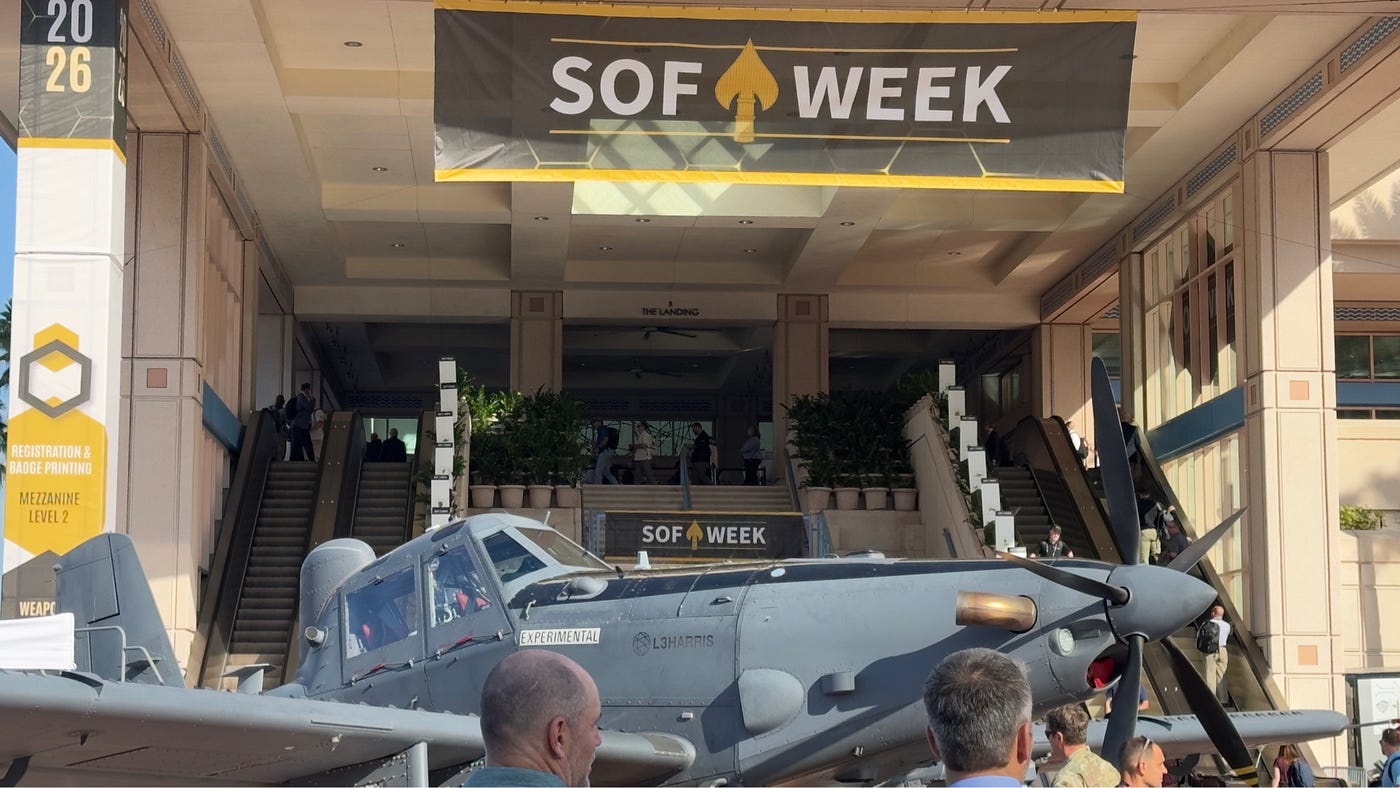
I sat there in Tampa this past Tuesday afternoon, May 20, 2026, inside the Marriott Water Street’s Florida Salons V-VI during SOF Week, listening to August Cole and retired General Scott Miller explain how “useful fiction” can shock institutions into seeing threats they’d rather ignore.

They were making a case for stories as a planning tool…Ghost Fleet-style stories that force operators to confront autonomous swarms, space decapitation, and undersea vulnerabilities before the adversary actually fields them. It was sharp, well-reasoned, and aimed at people who actually have to fight when the assumptions collapse.
Then the larger game clicked into place, and the whole session took on a different, uglier color.
Cole and Miller were describing the honest, above-board version of FICINT…the stuff that gets briefed to actual special operations commanders who need to imagine the next fight. What they weren’t talking about, and what the UFO community still refuses to see, is the much larger, much quieter version being run somewhere else in the government. The version where the entire modern UFO topic — your books, your podcasts, your congressional testimonies, your “whistleblower” drops, your endless arguments over stigma and disclosure — is functioning as the most effective, lowest-cost narrative weapon the national security state has fielded in decades.
You think you’re participating in “disclosure” but you’re not. You’re a FREE CONTENT farm for intelligence operations.
Every time Lue Elizondo drops another chapter about nonhuman intelligence surveilling nuclear sites, every time George Knapp testifies that crash-retrieval programs are real and the technology represents a breakthrough aerospace capability, every time Garry Nolan publishes another paper on anomalous materials or enlarged brain structures in “experiencers,” every time Travis Taylor appears on cable explaining how Skinwalker Ranch phenomena could jam GPS and threaten autonomous systems-you’re generating exactly the kind of emotional, viral, “this changes everything” pressure that dry Pentagon budget requests couldn’t produce on their own.
That pressure lands on Congress. And Congress, being Congress, responds the way it always does when scared or shamed in public: it authorizes money. New sensors. New space-based detection architectures. New undersea surveillance networks. New directed-energy programs. New AI-enabled multi-domain command systems. New counter-UAP task forces with real budgets and real classification. The same agencies that couldn’t get those line items through normal channels now have a permanent, self-sustaining outrage engine doing the work for them.
The community thinks it’s fighting the “slow walk” and demanding transparency. But you’re not. You’re working for free and manufacturing the consent necessary to bypass normal oversight. The stigma you complain about is the exact feature that makes this whole boondoggle work — because the more you frame any skepticism as cowardice or complicity, the more you delegitimize the normal analytical friction that usually slows down blank-check defense spending. Your anger is the accelerant.
This isn’t SOF or SOCCENT running the play. Those organizations are still doing the relatively straightforward version Cole was describing — using stories to prepare actual operators for plausible futures. The larger operation sits somewhere upstream and to the side, in the parts of the government that specialize in budget justification and threat inflation. They don’t. need to believe in aliens….they only need a reliable source of high-signal, low-scrutiny narrative that makes exotic new capabilities look like prudent, even overdue, responses to an urgent, poorly understood threat.
Your “disclosure” movement supplies that narrative at industrial scale and zero marginal cost to the agencies involved. The books become media events. The media events become congressional hearings. The hearings become authorization language. The authorization language becomes programs. And the programs become the next generation of weapons and surveillance architecture — many of which have far more conventional applications against peer competitors than they do against hypothetical nonhuman visitors.
The community’s internal drama only helps. Every fight over who is a “real” whistleblower, every accusation that someone is controlled opposition, every purity spiral about who gets to define the narrative…it all keeps the content machine running and the pressure constant. It also keeps the focus on personalities and grievances rather than on the actual mechanism: threat inflation through participatory storytelling.
Cole and Miller are right that strategic fiction works. What they didn’t say, because it was outside the scope of their brief, is that the most successful current example isn’t a novel written by a defense academic. It is the sprawling, self-replicating, community-maintained fiction that something world-changing is hovering just out of our view, out of our reality…and that only more disclosure, more funding, and more institutional attention can save us. The people running that version don’t wear uniforms. They do not brief here at SOF Week. They simply watch the engagement metrics, the hearing transcripts, and the budget documents, and they keep the conditions that make the engine run.
You are not the audience for this FICINT. You are the labor. And the product being manufactured is not understanding…it is authorization.
The next time someone in the community posts another triumphant thread about how “disclosure is happening” or how “they can’t keep it secret anymore,” consider whats actually being disclosed and who benefits from the urgency. The technology they are describing, whether real or not, has already been turned into the justification layer for capabilities that will outlast any particular administration and any particular set of congressional majorities. The story is the delivery system. You’re writing it for free.
That is the part the Tampa session did not cover. And it is the part the UFO community still can’t be bothered to see.
메타데이터
- post_id
- 0bf64c6e7a4c
- slug
- useful-fiction-2-0-how-the-ufo-community-built-the-pentagons-best-budget-weapon-0bf64c6e7a4c
- url
- https://medium.com/@osirisuap/useful-fiction-2-0-how-the-ufo-community-built-the-pentagons-best-budget-weapon-0bf64c6e7a4c
- canonical_url
- https://medium.com/@osirisuap/useful-fiction-2-0-how-the-ufo-community-built-the-pentagons-best-budget-weapon-0bf64c6e7a4c
- author_url
- https://medium.com/@osirisuap
- status
- ok
- fetched_at
- 2026-06-09 15:37:30