Alternative Data Vs Traditional Research: Which Delivers Better Timing Signals For Singapore…
Singapore investors have access to more market information than ever before. Company filings, earnings calls, analyst forecasts and…
Alternative Data Vs Traditional Research: Which Delivers Better Timing Signals For Singapore Investors?
Singapore investors have access to more market information than ever before. Company filings, earnings calls, analyst forecasts and economic reports remain central to investment research.
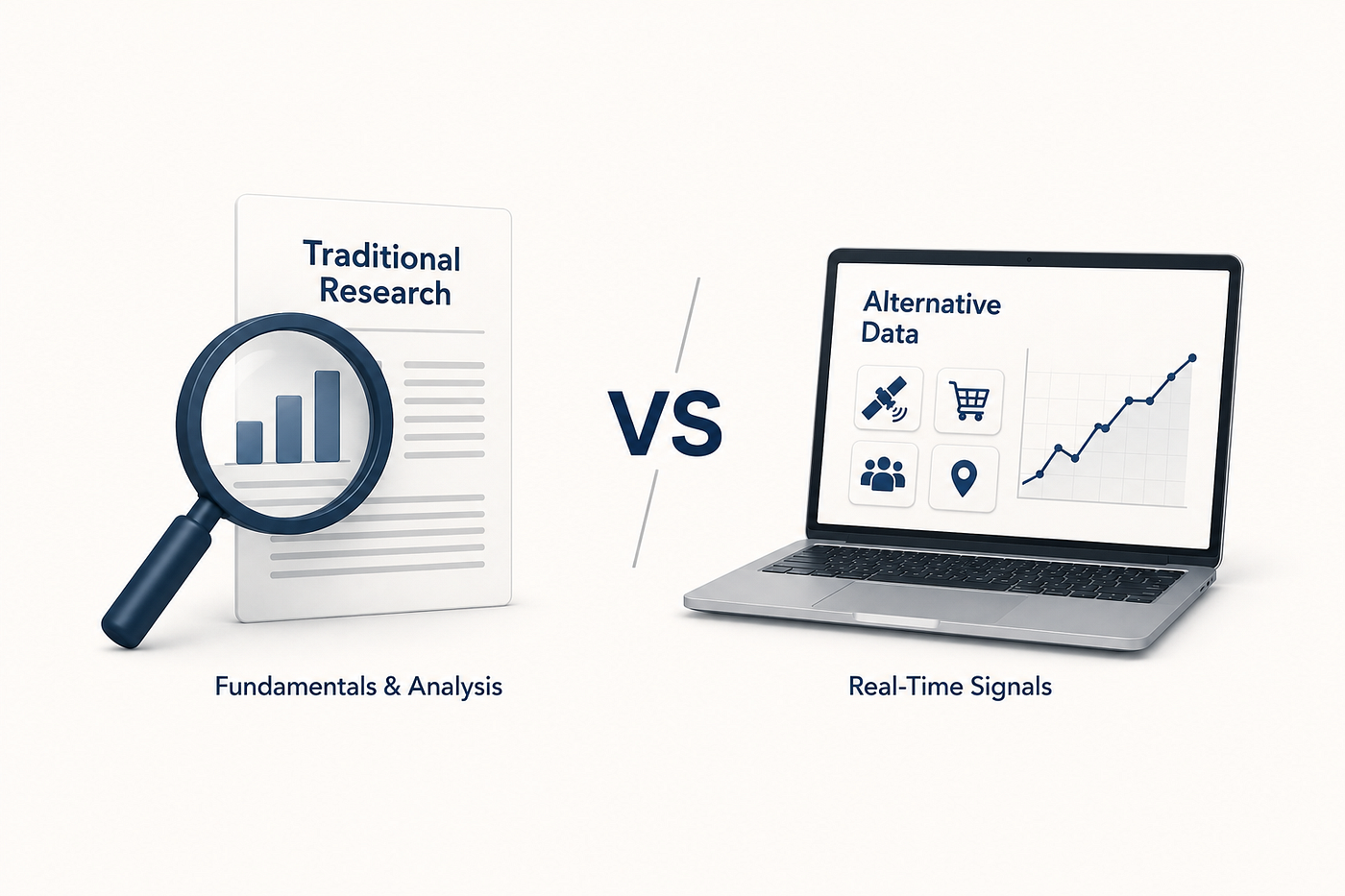
At the same time, satellite imagery, transaction data, website activity, shipping movements, online pricing and artificial-intelligence models are creating new ways to assess economic activity.
This raises an important question: alternative data vs traditional research — which delivers better timing signals for Singapore investors?
The answer is not as simple as choosing one method.
Traditional research is generally stronger for understanding business quality, valuation, financial resilience and long-term investment potential. Alternative data can provide faster evidence of changing demand, sentiment, operational activity and market liquidity.
Traditional research explains what an investment may be worth. Alternative data may reveal when the conditions surrounding that investment are beginning to change.
The strongest timing process combines both.
Singapore investors can use traditional research to identify fundamentally attractive assets and alternative data to improve the timing of entries, additions, hedges and risk reductions.
However, alternative data introduces challenges involving quality, privacy, licensing, model risk and regulatory compliance. It must be tested and governed carefully before it influences capital.
What Is Traditional Investment Research?
Traditional investment research uses established financial and economic information to evaluate an asset.
For equities, this can include revenue, earnings, cash flow, debt, profit margins, management quality and valuation.
For bonds, investors may analyse credit quality, interest coverage, duration, inflation and monetary policy.
For real estate investment trusts, traditional research may focus on occupancy, rental income, leverage, debt maturity and distribution sustainability.
Economic research can include inflation, employment, trade, manufacturing, consumer demand and central-bank policy.
These sources are usually structured and widely understood.
An analyst can explain how a change in earnings, interest rates or valuation affects the investment thesis.
This transparency makes traditional research particularly useful for investment committees, family offices and institutions that must document why capital was allocated.
Its greatest limitation is timing.
Many traditional datasets are published after the period they describe. Earnings reports are retrospective, while official economic statistics may be delayed or revised.
Traditional research can therefore provide a strong explanation of what has happened without always identifying the change early enough to improve market entry.
What Is Alternative Data?
Alternative data refers to information obtained from sources outside traditional market prices, company filings, analyst reports and official economic releases.
The US Securities and Exchange Commission has identified examples including satellite imagery, aggregated credit-card transactions, social-media activity, internet searches, mobile-device geolocation and information generated by consumer applications.
Other examples can include website traffic, app downloads, online product prices, job advertisements, vessel movements, freight activity and weather information.
These datasets can provide a more immediate view of economic behaviour.
A company may report quarterly sales weeks after the period ends. Aggregated transaction data may suggest whether demand strengthened while the quarter was still underway.
A government may release trade statistics after a delay. Shipping activity may indicate changes in regional demand earlier.
This speed creates the potential for better timing signals.
However, alternative data is not automatically accurate. Coverage may be incomplete, collection methods can change and a statistical relationship may disappear when market behaviour shifts.
Why Timing Signals Matter
A fundamentally attractive investment can still deliver disappointing returns when capital is deployed during an unfavourable market phase.
A high-quality company may decline because liquidity is weakening, interest rates are rising or investor sentiment has deteriorated.
An undervalued market may remain undervalued for a long period when there is no catalyst to change investor behaviour.
Timing signals help investors decide whether the market is beginning to support the fundamental thesis.
Traditional research may identify the opportunity.
Alternative data may indicate whether the opportunity is becoming actionable.
For example, an analyst may conclude that a consumer company is undervalued based on cash flow and long-term market share.
Improving payment activity, web traffic and product-pricing data could then provide earlier evidence that demand is recovering.
The investor can use this confirmation to begin deploying capital rather than relying only on the previous quarter’s financial statements.
Traditional Research Provides Economic Context
Traditional research is usually stronger when investors need to understand why an investment should generate value.
Financial statements show how a company earns money, how much debt it carries and whether profits are supported by cash flow.
Management commentary can explain capital expenditure, competition and strategic priorities.
Valuation analysis can estimate whether the current market price offers an acceptable return.
This economic context is essential.
Alternative data may show that store visits are increasing, but it may not reveal whether customers are buying profitable products.
Website traffic may rise while the company spends heavily on promotions.
Shipping activity may increase even as transportation costs reduce margins.
Traditional research helps investors convert an observed change into a financial interpretation.
Without that context, alternative data can produce signals that appear exciting but have little connection to shareholder value.
Alternative Data Can Offer Greater Speed
The main advantage of alternative data is timeliness.
Traditional reports often confirm developments after they have occurred. Alternative sources may provide information closer to real time.
Researchers studying big data in finance have documented the increasing use of information such as satellite images, credit-card activity, online data and machine-learning techniques in asset pricing and corporate finance research.
For Singapore investors managing Asian and global portfolios, this faster information can be valuable.
Regional trade, tourism, manufacturing and consumer activity can change before the effects become visible in company filings.
Flight bookings may provide information about tourism demand.
Port activity can help investors monitor trade and logistics.
Online prices may reveal inflation or discounting trends.
Job advertisements may indicate that a company or industry is expanding.
These signals can help investors prepare for changing earnings or sector rotation.
Alternative Data Is Most Useful At Turning Points
Alternative data may be particularly valuable when the investment environment is changing.
During a stable economic period, traditional reports and analyst forecasts may describe conditions reasonably well.
At a turning point, historical information becomes less useful because the relationship between the past and future is changing.
Alternative data can help identify this transition.
A decline in job postings may appear before a company announces weaker hiring.
Falling website engagement may precede slower digital demand.
Improving freight activity may indicate that inventories and industrial production are beginning to recover.
The investor should not act on one signal alone.
A stronger timing decision emerges when several independent datasets confirm the same change and market prices begin responding.
Traditional Research Is Easier To Explain
Investment decisions must often be communicated to clients, boards, trustees and risk committees.
Traditional research offers familiar evidence.
An investment manager can explain that a company has improving earnings, declining leverage and an attractive valuation.
Alternative data may be harder to interpret.
A model could produce a positive score from thousands of observations without making the underlying economic logic clear.
This creates governance risk.
An institution should be able to explain what the dataset measures, why it should affect the asset and how the signal influenced the decision.
A timing process that cannot be explained may be difficult to validate or audit, even when its historical results appear strong.
For this reason, Singapore institutions should treat explainability as part of investment quality rather than as a separate technical issue.
Alternative Data Can Challenge Management Narratives
Traditional research frequently depends on information provided by companies.
Management teams decide how they describe performance, strategy and market conditions.
Alternative data can provide an independent check.
A retailer may describe consumer demand as resilient, while transaction or traffic data show weakening activity.
A logistics company may report a positive outlook, while shipping volumes suggest slower regional trade.
A technology platform may highlight user growth, while engagement data indicate that customers are becoming less active.
The alternative signal does not automatically prove management wrong.
It gives the analyst a reason to investigate further.
This ability to challenge consensus is one of the strongest advantages of alternative data.
Traditional Data Is Usually More Standardised
Traditional financial information generally follows established definitions and reporting frameworks.
Investors can compare revenue, debt, earnings and cash flow across reporting periods.
Alternative datasets may not offer the same consistency.
A vendor may change its methodology.
A website may redesign its pages and interrupt data collection.
A payment dataset may represent only one provider rather than the entire market.
A location dataset may become less representative after privacy settings change.
This creates a risk that the apparent investment signal reflects a change in the dataset rather than a change in economic activity.
Singapore institutions need clear ownership and monitoring of data quality.
MAS’s information paper on data governance and management practices emphasises governance, ownership, data-quality controls and oversight across the data lifecycle. These principles are directly relevant when alternative information is used in financial decision-making.
The Cost Difference Can Be Significant
Traditional information is often available through established market-data terminals, company websites and official statistical sources.
Alternative data can require specialised vendors, cloud infrastructure, engineers, data scientists and legal review.
The headline vendor fee represents only part of the total cost.
The manager may also need to clean the information, maintain data pipelines, monitor methodology changes and test the signal continuously.
A dataset can improve forecast accuracy without improving portfolio returns if implementation expenses exceed its value.
Singapore investors should therefore measure incremental benefit.
Did the alternative signal improve the entry price?
Did it identify a risk earlier?
Did it reduce drawdowns?
Did it improve sector selection?
The dataset should be evaluated according to the decision it improves rather than the quantity of information it provides.
Backtesting Can Overstate Alternative-Data Performance
Alternative datasets often look impressive during historical testing.
However, backtests can contain several biases.
The historical information may have been cleaned using knowledge unavailable at the time.
Publication delays may be ignored.
The test may include companies that survived while excluding those that disappeared.
The model may be adjusted repeatedly until it fits the past.
Research on high-dimensional financial data shows that traditional interpretations of market efficiency and apparent anomalies become more complicated when investors examine large numbers of potential signals.
A realistic test should preserve point-in-time data and include transaction costs, data delays and execution limits.
The manager should also test whether the signal works across different interest-rate, volatility and liquidity environments.
A model that succeeds during one market regime may fail when conditions change.
Privacy And Licensing Risks Matter
Some alternative data can involve personal or commercially sensitive information.
Singapore’s Personal Data Protection Commission has published guidelines explaining how the Personal Data Protection Act applies when organisations use personal information in artificial-intelligence recommendation and decision systems.
Asset managers should understand how information was collected, whether individuals can be identified and whether the intended use is permitted.
Data that has been aggregated or anonymised may still require careful review.
Licensing is another important issue.
Information visible online is not automatically available for unrestricted commercial use.
Website terms, intellectual-property rights and contractual limitations may affect whether a dataset can be collected or incorporated into an investment model.
The compliance and legal review should begin before a dataset influences live capital.
Material Non-Public Information Is A Serious Risk
Alternative data can also create concerns about material non-public information.
The SEC has highlighted investment-adviser compliance issues involving the use of non-traditional data sources and insufficient policies designed to address the risk of receiving or using material non-public information.
Singapore managers should apply their own regulatory and legal requirements, but the underlying lesson is broadly relevant.
The firm should understand where the information came from, whether it was collected lawfully and whether the provider had the right to distribute it.
Employees should have a process for escalating questionable datasets or unexpected information.
A timing advantage is not valuable when it creates legal or reputational exposure.
Artificial Intelligence Expands Both Opportunity And Risk
Artificial intelligence can make alternative data more useful.
Models can analyse satellite images, classify documents, interpret online sentiment and connect thousands of observations with portfolio holdings.
This can improve speed and coverage.
However, AI can also create unstable, biased or difficult-to-explain outputs.
MAS published an information paper on artificial-intelligence model risk management in December 2024, highlighting the importance of governance, development, validation and deployment controls.
The level of control should reflect how the model is used.
A system that helps analysts prioritise research may require lighter controls than one that automatically changes portfolio exposure.
Human review remains important when alternative data is converted into an investment decision.
Which Method Is Better For Fundamental Selection?
Traditional research generally delivers stronger signals for long-term asset selection.
It helps investors evaluate business quality, management, competitive position, valuation and balance-sheet strength.
Alternative data can add useful evidence, but it rarely provides a complete investment thesis by itself.
Store traffic cannot replace analysis of profit margins.
App downloads cannot replace an understanding of customer economics.
Shipping activity cannot replace an assessment of debt and cash flow.
For strategic portfolio construction, traditional research should therefore remain the foundation.
Alternative data should test, refine or update the thesis.
Which Method Is Better For Market Timing?
Alternative data can deliver better timing signals when it provides a faster view of changing behaviour.
It may identify demand shifts, liquidity stress or sentiment changes before traditional reports.
However, speed is useful only when the signal is reliable.
Alternative data may produce more false signals because it is noisy, incomplete or sensitive to temporary events.
Traditional research may react more slowly but offer stronger confirmation.
The best timing framework uses alternative data as an early-warning system and traditional research as a validation layer.
The investor prepares when alternative signals begin changing.
The investor confirms the opportunity when prices and market liquidity respond.
The investor validates the decision when traditional fundamentals support the same conclusion.
A Practical Comparison For Singapore Investors
Traditional research performs best when the objective is understanding value, financial resilience and long-term return potential.
Alternative data performs best when the objective is identifying changes before conventional reports.
Traditional information is usually easier to explain and compare.
Alternative information may provide more detailed and timely insight.
Traditional data often costs less to govern because standards and definitions are well established.
Alternative data can require specialised technology, vendor oversight and privacy controls.
Traditional research may be slow near turning points.
Alternative data may be fast but noisy.
Neither approach consistently dominates across every investment decision.
The correct method depends on the question.
Build A Combined Timing Framework
Singapore investors can combine the two approaches through a Prepare–Confirm–Validate–Protect framework.
During the Prepare stage, traditional research identifies attractive assets, valuation ranges and long-term portfolio roles.
Alternative data helps monitor the conditions that could make the opportunity actionable.
During the Confirm stage, the investor looks for changes in price, volume, liquidity and market breadth.
During the Validate stage, alternative signals are compared with financial statements, earnings expectations, economic data and cross-asset behaviour.
During the Protect stage, the investor defines what would invalidate the view.
The warning may come from declining alternative indicators, deteriorating fundamentals or weakening market structure.
This process avoids treating alternative data as a standalone prediction system.
Use Confidence-Based Position Sizing
A combined signal should influence position size rather than produce a simple buy-or-sell instruction.
An attractive valuation with early alternative-data improvement may justify a small initial allocation.
Stronger price confirmation and improving reported results may support additional deployment.
When alternative data conflicts with fundamentals, the investor can reduce confidence and wait.
The amount of capital should also reflect volatility, liquidity and portfolio concentration.
A strong signal in an illiquid asset may still require a modest position.
This probability-based approach is more practical than assuming that any dataset can provide certainty.
Keep Every Signal Audit-Friendly
An institutional timing process should preserve the source, version and timestamp of every material dataset.
The decision record should explain what the signal indicated, how it was validated and who approved the portfolio response.
Changes in vendor methodology or model logic should be documented.
Overrides should also leave a visible record.
This creates an institutional memory.
The manager can later determine whether value came from traditional research, alternative data, portfolio implementation or discretionary judgment.
Without this separation, successful outcomes can be incorrectly attributed and failed models may remain in use.
Financial Astrology As An Alternative Timing Layer
Financial astrology can be considered an additional alternative timing framework.
It studies whether planetary configurations appear to align with changes in market sentiment, volatility or turning points.
Financial astrology is not scientifically established as a reliable method of predicting investment returns.
It should never replace fundamental research, market data, economic analysis or risk controls.
However, it may be used as a secondary calendar layer when the methodology is transparent and conventional signals provide confirmation.
If a cycle model identifies a potential volatility period, the investment team can increase its monitoring of alternative data, liquidity and price behaviour.
Confidence should rise only when several independent indicators align.
How Rajeev Prakash Finance Supports Integrated Timing Research
Rajeev Prakash Finance provides timing intelligence across global equities, indices, commodities, currencies and broader financial cycles.
Singapore investors can use this intelligence as an overlay on traditional and alternative-data research.
Traditional analysis determines what assets deserve consideration.
Alternative data can identify early changes in demand, activity or sentiment.
The timing layer helps assess when capital should be prepared, deployed gradually, increased or protected.
Rajeev Prakash Finance combines conventional market analysis with broader cycle research and financial astrology.
The objective is not to replace professional judgment.
It is to provide an additional perspective that can be compared with fundamentals, price behaviour, liquidity and alternative indicators.
Final Thoughts
Alternative data vs traditional research is not a competition in which one method must completely replace the other.
Traditional research provides economic logic, valuation context and a clearer understanding of long-term investment quality.
Alternative data can provide speed, detail and earlier evidence of changing behaviour.
For Singapore investors, the strongest timing signals often emerge when both methods agree.
Traditional analysis may identify a fundamentally attractive company or market.
Alternative data may show that demand, activity or sentiment is beginning to improve.
Price behaviour and liquidity can then confirm that other investors are recognising the same change.
This combination supports a more disciplined capital-deployment process.
Alternative data should be tested for quality, stability and economic relevance. Privacy, licensing and material non-public information risks must be addressed before implementation.
Traditional research should also remain open to evidence that challenges the established thesis.
Neither source guarantees accurate forecasts.
Together, they can help investors move from delayed confirmation toward earlier, better-governed timing decisions.
Explore integrated market timing, alternative-data confirmation and multi-asset cycle research at:
메타데이터
- post_id
- 0bfc81cf741c
- slug
- alternative-data-vs-traditional-research-which-delivers-better-timing-signals-for-singapore-0bfc81cf741c
- url
- https://medium.com/@financeastrodunia/alternative-data-vs-traditional-research-which-delivers-better-timing-signals-for-singapore-0bfc81cf741c
- canonical_url
- https://medium.com/@financeastrodunia/alternative-data-vs-traditional-research-which-delivers-better-timing-signals-for-singapore-0bfc81cf741c
- author_url
- https://medium.com/@financeastrodunia
- status
- ok
- fetched_at
- 2026-08-03 02:51:34