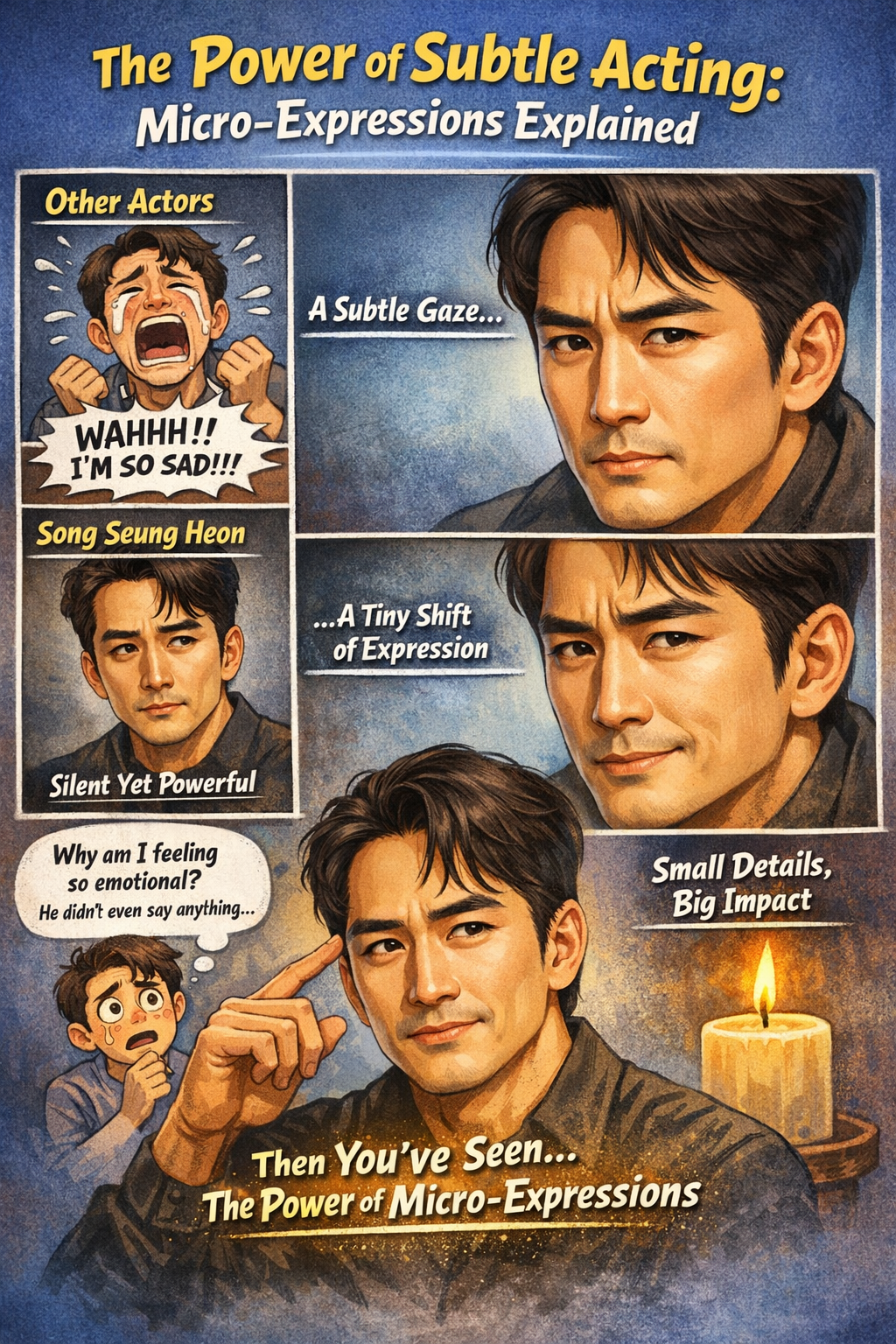
When You’ve Watched Him Cry Once, You’re Never the Same
Let’s face it, I’m one of those fans that cries so easily. It hits more when the men are brave enough to cry those tears.
When You’ve Watched Him Cry Once, You’re Never the Same

Let’s face it, I’m one of those fans that cries so easily. It hits more when the men are brave enough to cry those tears.
Okay, first thing’s first: I have been known to stop my drama at precisely the frame where his chin quivers, hit screenshot, share to the group chat without comment, and just wait for the inevitable explosion of emotion. If you’re here, I’m going to guess you’ve probably done it too. Come in. Have a seat. Bring us some tissues, please and thank you.
There’s a very specific kind of devastation that comes from watching a man who has spent an entire drama being composed, controlled, maybe even a little emotionally unavailable, finally lose it. Not yelling. Not smashing something dramatically against a wall. Just quietly, unglamorously, falling apart. Eyes glassy. Breathtaking. One tear is having a slow unbothered slide down one cheek because it really has to go somewhere terribly important. And once you’ve seen that? You’re done. Cooked. There is no going back to who you were before.
Why We’re Like This
Let’s be honest about something first: crying men on screen didn’t used to get this kind of reverence. For decades, mainstream media taught us that masculinity and tears were basically oil and water and that a “strong” male lead grits his teeth, clenches his jaw, and maybe allows himself one single manly tear that he immediately wipes away like it was an inconvenience, like his own emotions were a smudge on his sleeve.
So when an actor gives us the opposite. The ugly crying, shoulders shaking, nose running, and the whole unfiltered mess of real grief and it doesn’t just move us. It shocks us a little. Like, very good. Like you’ve been carried secretly somewhere you weren’t even meant to be able to go. Or like you’re allowed to watch him strip away years of carefully assembled armour and piece by piece put it at your feet. Because he can trust you just with this little piece of him for just this long.
That’s not just good acting. That’s vulnerability as a gift. And fans notice. We notice immediately.
The Anatomy of a Legendary Crying Scene
Here’s the thing about a truly great crying scene, the kind that ends up gifed into oblivion, the kind that gets its own compilation video with 4 million views and a comment section that is 90% broken hearts and 10% people typing “I WASN’T READY” in all caps. It’s never just about the tears themselves. It’s about everything leading up to them.
It’s the almost imperceptible tremor in the voice before the first tear even falls. It’s the way his hands find something to do and clench a fist, grip a table edge, cover his own mouth like he’s trying to physically hold the sound in. It’s the fact that he tries not to cry and fails, and that failure is the most honest thing you’ve ever seen. A man who lets himself cry easily is one thing. A man who has spent the whole story trying not to and finally can’t hold the dam anymore? But that's what legends are made of. You will be staring at your ceiling two minutes later, asking why you chose THIS life and sending your best friend nothing but "I NEED TO DISCUSS EPISODE 14. Lmao, this made us lose sleep."
Great actors know this instinctively. They don’t just cry; they perform the entire fight against crying and let us watch them lose.
It’s Funny, Actually, How Predictable We Are
Can we talk about how absolutely, comedically predictable fandom behaviour is around this stuff? The second, and I mean the second, a beloved character’s eyes start welling up, timelines everywhere ignite like a wildfire. And suddenly we are all amateur cinematographers, pausing on the split second when a teardrop refracts in perfectly even lighting.
Fan videos that hit hours later. Featuring sweeping piano versions of music not present in the footage can be seen. Somewhere a very serious individual has printed this shot as their phone wallpaper. Someone is likely typing a five to eleven page (very) academic essay about the deep, unmistakable symbolism of rain in an otherwise clear sky because they felt that would be aesthetically richer.
We are unwell. We are, collectively, a group of people who have decided that our emotional stability is optional and that a fictional (or semi-fictional, or “he was just really in character that day”) man’s tears are worth rearranging our whole week around. And honestly? I wouldn’t have it any other way. There’s something delightfully unserious about how seriously we take this. We joke about needing therapy after certain episodes, but underneath the joking is something real: we felt something. In a world that constantly asks us to be numb, to scroll past, to feel less. Getting genuinely wrecked by a stranger’s performance on a screen is, weirdly, a small act of staying alive inside.
The Warmth Underneath the Ache
Here’s what I think we don’t say enough, though, amid all the screenshots and the group chat spirals: watching a man cry on screen doesn’t just wreck us. It heals something too.
Somewhere along the way, so many of us. Women and men, both, grew up around men who didn’t cry. Fathers who “handled it". Brothers who were told to “man up". Partners who apologised for crying, like it was a weakness they needed to manage rather than a language they were allowed to speak. So when a character on screen lets it all go. Grief, love, guilt, longing, whatever it is and the story doesn’t punish him for it, doesn’t make him “weak” for it, and actually treats it as the most powerful moment in the whole episode? That does something to us. It rewires a little bit of what we were taught. It says, 'This is allowed.' This was always allowed. Somebody should have told you sooner.
That’s why a Medium article, the kind explaining why men crying on screen is “one of the most powerful things an actor can do", hits different than your average think piece. It’s not really about acting technique. It’s about permission. Cultural, collective permission for men to feel things all the way through, without flinching and without apologising for it afterward.
And when the man doing that crying is someone you’ve followed for years, someone whose smile you know as well as your own front door, and someone you’ve watched grow from role to role, getting better and braver with every performance. It hits somewhere even deeper. It’s not just “acting is powerful". It’s him. It’s every project. Every time that he’s interviewed on his roles, he discusses his craft, ‘devoting himself to it’. Every single instance of growth you’ve witnessed as a bystander who roots for him. When he cried in this film, it wasn’t seeing a well-performed stage crying.
It's watching someone you admire hand you a piece of his craft, wrapped in real feeling, and trust you to hold it gently.
That’s not a small thing. That’s not something you just scroll past.
So Here’s to the Criers
So, here’s to the actors that realised, at least one day in their career, that the opposite of soft is not strong; it’s just … It’s a different kind of strong. And it's even harder to express through body and screen and, for the actors, to find strength in allowing the film to show the messy middle grief instead of neat before and after moments. Here’s to every quivering lip and caught breath and every single time an actor valued fully human over cool composure.
And here’s to us, the fans, unhinged as we may be about it. Staying up too late to relive the same three minute scene, writing essays nobody asked for (hi, this one, this exact moment), and building little corners of the internet dedicated to celebrating a stranger’s willingness to be soft in public. It’s a little ridiculous. It’s also, I think, kind of beautiful. We’re not just fans of a face or a filmography. We’re fans of the honesty. Of the moments where the performance stops looking like performance and starts looking like truth.
Once you’ve watched him cry, really cry, the kind that catches you off guard, the kind you weren’t ready for, something in you shifts. You start noticing softness differently. You start valuing it more, in him, in the men in your own life, and in yourself. That’s the quiet gift buried inside all our chaotic fan behaviour: we’re not just moved. We’re a little bit changed.
So yes. Once was more than enough. And also, somehow, always, never quite enough at all.
💛 If this made you feel something (be honest, it did), come cry with me some more. I write these little love letters to the moments that undo us. Follow along on Medium @oppaVibesSSH for more, and find me on Instagram @oppaVibesSSH for the daily edits, GIFs, and general emotional chaos.
We’re all in this together. Bring tissues.
메타데이터
- post_id
- 0c1086c0e1ea
- slug
- when-youve-watched-him-cry-once-you-re-never-the-same-0c1086c0e1ea
- url
- https://medium.com/@oppavibessh/when-youve-watched-him-cry-once-you-re-never-the-same-0c1086c0e1ea
- canonical_url
- https://medium.com/@oppavibessh/when-youve-watched-him-cry-once-you-re-never-the-same-0c1086c0e1ea
- author_url
- https://medium.com/@oppavibessh
- status
- ok
- fetched_at
- 2026-08-04 19:47:58